0:00 / 0:00

The Imperial System

The Imperial System (or British Imperial System) is a system of measurement that evolved from the thousands of Roman, Celtic, Anglo-Saxon, and customary local units employed in the Middle Ages. It has the following common units of measurements.

Measurements of Length (Distance)

UnitAbbreviationFun "helpful" ReferencesInch/ Inchesin. or "Thumb length /or/3 grains of barley placed end to endFoot/ Feetft. or Foot length /or/A door is just short of 7’Yard/ Yardsyd.Arm span /or/the length of a man’s beltMile/ Milesmi.The distance walked in 20 minutes /or/1000 paces\begin{array}{|c|c|c|} \hline \text{Unit}&\text{Abbreviation}&\text{Fun "helpful" References}\\ \hline \text{Inch/~Inches}&in.~\text{or}~"&\begin{array}{c}\text{Thumb length /or/}\\ \text{3 grains of barley placed end to end}\end{array}\\\\ \text{Foot/~Feet}&ft.~\text{or}~'&\begin{array}{c}\text{Foot length /or/}\\\text{A door is just short of 7'}\end{array}\\\\ \text{Yard/~Yards}&yd.&\begin{array}{c}\text{Arm span /or/}\\ \text{the length of a man's belt}\end{array}\\\\ \text{Mile/~Miles}&mi.&\begin{array}{c}\text{The distance walked in 20 minutes /or/}\\\text{1000 paces}\end{array}\\ \hline \end{array}

Measurements of Weight (Mass)

UnitAbbreviationOuncesozPoundlbStonestTont\begin{array}{|c|c|} \hline \text{Unit}&\text{Abbreviation}\\ \hline \text{Ounces}&oz\\ \text{Pound}&lb\\ \text{Stone} &st\\ \text{Ton}&t\\ \hline \end{array}

Measurements of Capacity (Volume)

UnitAbbreviationFluid ouncesfl ozPintptQuartqtGallongal\begin{array}{|c|c|} \hline \text{Unit}&\text{Abbreviation}\\ \hline \text{Fluid ounces}&fl~ oz\\ \text{Pint}&pt\\ \text{Quart} &qt\\ \text{Gallon}&gal\\ \hline \end{array}

Did you Know?

  • USA is one of the few countries that still officially uses the imperial system; however, in some countries such as the UK and Liberia, the imperial system is still commonly used.
  • The imperial system is commonly used in areas of construction.
PAGE BREAK

Converting Measurements of Length (Distance)
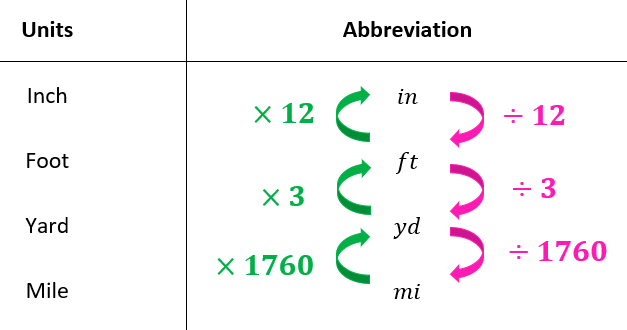
1ft=12in1yd=3ft=36in1mi=1760yd=5280ft=63360in\boxed{ \begin{array}{ccccc} 1ft&=&12in\\ 1yd&=&3ft&=&36in\\ 1mi&=&1760yd&=&5280ft&=63360in \end{array}}


PAGE BREAK

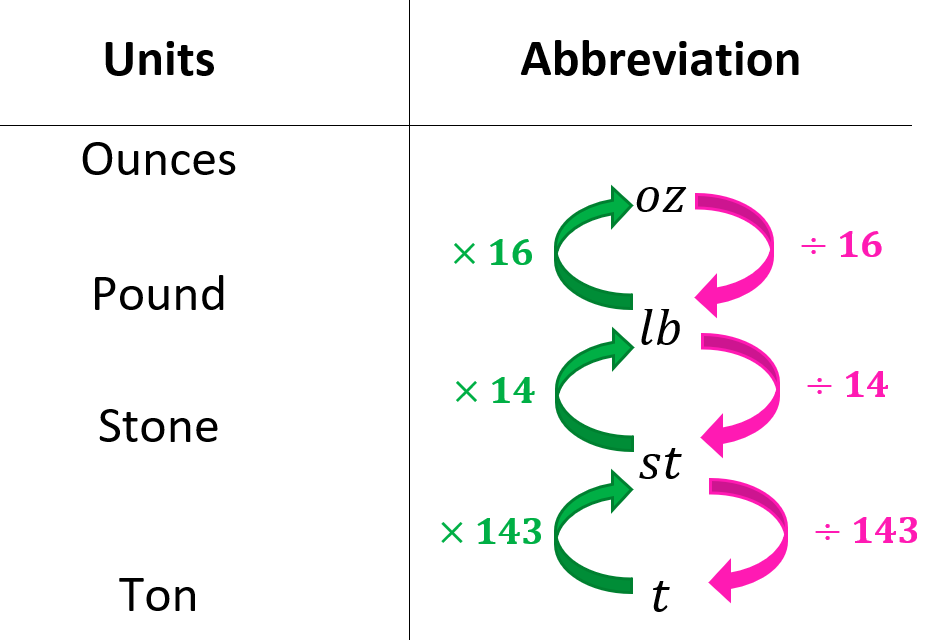
Converting Measurements of Mass (Weight)

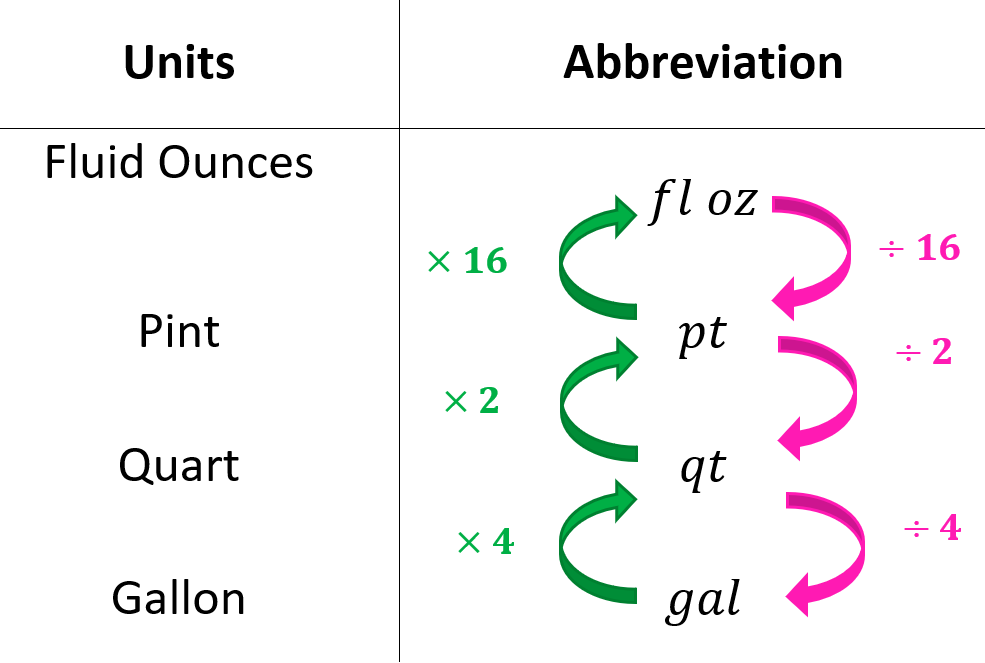
Converting Measurements of Capacity (Volume)

0:00 / 0:00

Example: Unit Conversion

Convert the following quantites to the unit indicated.

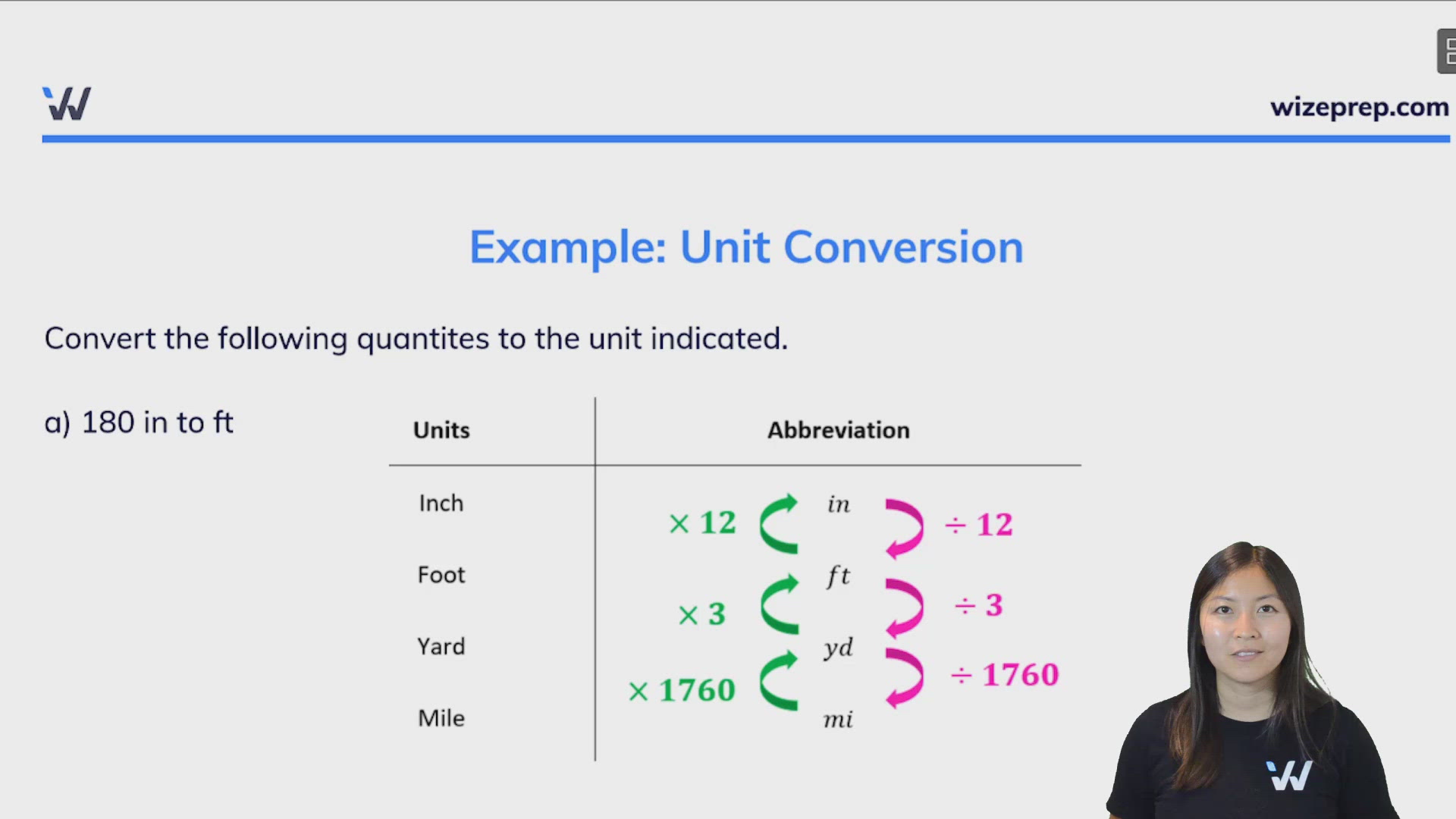
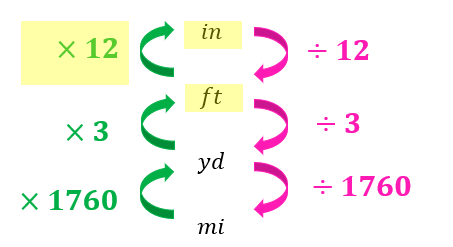
a) 180 in to ft

Method 1
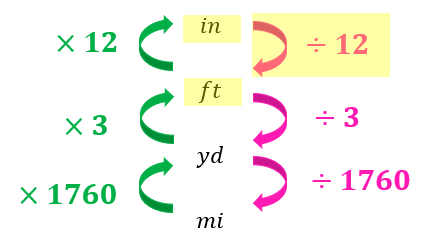
180÷12=15 ft\begin{array}{cl} &180\div 12\\ =&\boxed{15~ft} \end{array}

Method 2
180 in×1 ft12 in=180 in1×1 ft12 in=180×1 ft12=15 ft\begin{array}{cl} &180~in\times\dfrac{1~ft}{12~in}\\[1em] =&\dfrac{180~\cancel{in}}{1}\times\dfrac{1~ft}{12~\cancel{in}}\\[1em] =&\dfrac{180\times1~ft}{12}\\[1em] =&\boxed{15~ft} \end{array}

PAGE BREAK
b) 2.25 ft to in

Method 1

2.25×12=27 in\begin{array}{cl} &2.25\times 12\\ =&\boxed{27~in} \end{array}

Method 2
2.25 ft×12 in1 ft=2.25 ft1×12 in1 ft=2.25×12 in1=27 in\begin{array}{cl} &2.25~ft\times\dfrac{12~in}{1~ft}\\[1em] =&\dfrac{2.25~\cancel{ft}}{1}\times\dfrac{12~in}{1~\cancel{ft}}\\[1em] =&\dfrac{2.25\times12~in}{1}\\[1em] =&\boxed{27~in} \end{array}

PAGE BREAK

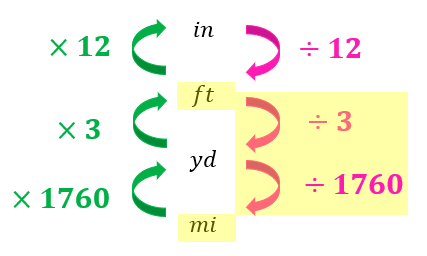
c) 17500 ft to mi
Method 1

17500÷3÷17603.314 mi\begin{array}{cl} &17500\div 3\div 1760\\ \approx&\boxed{3.314~mi} \end{array}

Method 2
17500 ft×1 mi5280 ft=17500 ft1×1 mi5280 ft=17500 mi52803.314 mi\begin{array}{cl} &17500~ft\times\dfrac{1~mi}{5280~ft}\\[1em] =&\dfrac{17500~\cancel{ft}}{1}\times\dfrac{1~mi}{5280~\cancel{ft}}\\[1em] =&\dfrac{17500~mi}{5280}\\[1em] \approx&\boxed{3.314~mi} \end{array}

PAGE BREAK

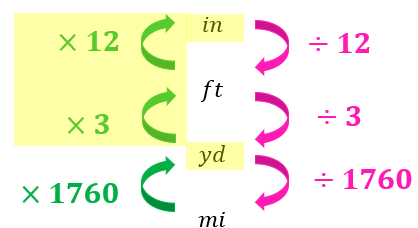
d) 0.081 yd to in
Method 1

0.081×3×12=2.916 in\begin{array}{cl} &0.081\times 3\times 12\\ =&\boxed{2.916~in} \end{array}

Method 2
0.081 yd×36 in1 yd=0.081 yd1×36 in1 yd=0.081×36 in1=2.916 in\begin{array}{cl} &0.081~yd\times\dfrac{36~in}{1~yd}\\[1em] =&\dfrac{0.081~\cancel{yd}}{1}\times\dfrac{36~in}{1~\cancel{yd}}\\[1em] =&\dfrac{0.081\times36~in}{1}\\[1em] =&\boxed{2.916~in} \end{array}

Practice: Unit Conversion

Select the best estimate for the distance between Los Angeles, US and Tokyo, Japan.

Practice: Unit Conversion

Select the best estimate for the average height of a 6th grader in North America.

Practice: Unit Conversion

Here are the most common mattress sizes available:
  • Twin 39" x 75"
  • Full 54" x 75"
  • Queen 60" x 80"
  • King 76" x 80"
[*The smaller number represents the width of the mattress, the larger number represents the length]

The height of an average NBA basketball player is 6' 6" (6 feet 6 inches). Which mattress(es) should an NBA player with an average height purchase? (Select all appropriate mattress sizes)


Discussion Time!

Can you think of scenarios in the real-world that uses imperial units for measurements of length/distance?

Share your thoughts in the Ask a Question box 😄