Wize High School Grade 11 Math Textbook > Absolute Value
Absolute Value Functions

0:00 / 0:00
Absolute Value Functions
The absolute value function is defined as follows:
Wize Tip
Functions defined in this way are called piecewise: they have different behaviours depending on the value of .
In this case, we see that positive numbers are unchanged, but negative numbers are negated to "undo" the negative.
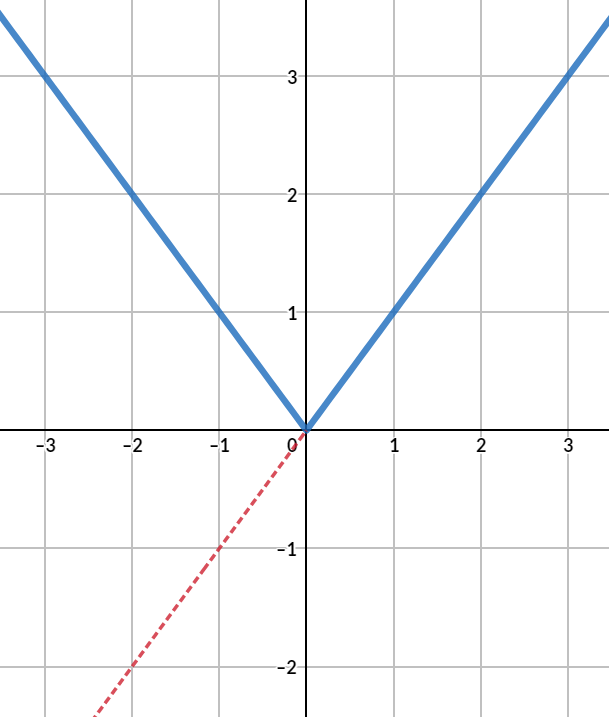
Graph of
The graph of is similar to the graph of .
The only difference is for numbers less than 0: the y-values must stay positive!
Domain: (all real numbers)
Range: (only non-negative numbers)
Graphing Absolute Value Functions
The absolute value of a function is the same as the original function, except that negative parts are reflected up across the x-axis to make them positive.
Steps
1. Graph the original function
2. Wherever the function is negative (below the x-axis), "flip" it up to make it positive.
Example
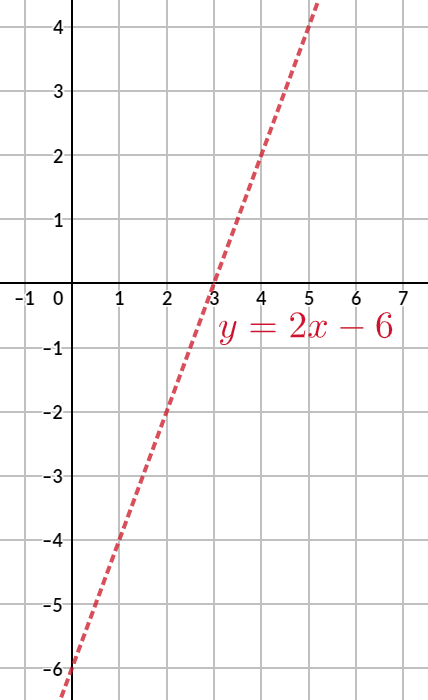
Graph .
Start by graphing . This has a y-intercept of -6 and a slope of 2.
Notice the x-intercept at x=3. Here, the function changes sign. We have to flip the negative part up to make it positive.

0:00 / 0:00
Example: Absolute Value Functions
a) Graph the function .
To begin, we consider the function without the absolute value: .
We can approach graphing this quadratic in a few ways, but here we'll complete the square to convert to vertex form.
Therefore, the vertex is , and the parabola opens up since the leading coefficient is positive.

Now we look for where the function is negative.
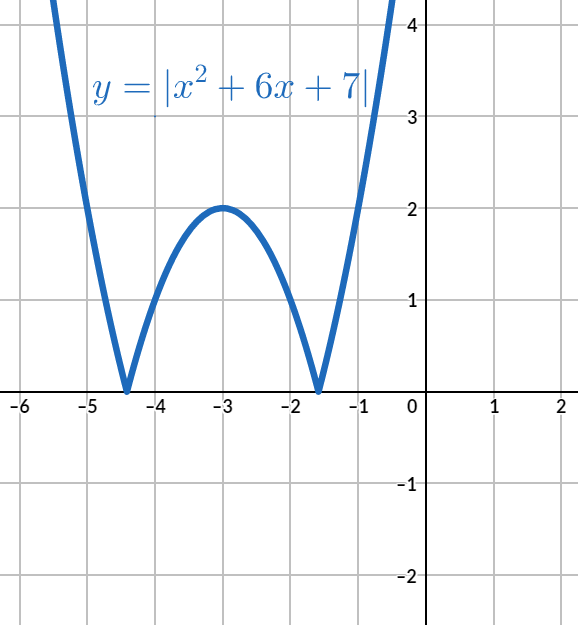
In this case, we see that the y-values are negative between the x-intercepts.
Take this section and reflect it up across the x-axis to obtain the graph of :
b) Write as a piecewise function.
We see that there are two "parts" to this graph.
To be precise about where they split, we must find the zeros using the quadratic formula.
- The first part is the original function without the absolute value: . This is the part of the graph that has not been reflected. It appears to the left of the leftmost x-intercept: and to the right of the rightmost x-intercept:
- The second part is the part that we reflected across the x-axis. This function is simply the negative of the original: It appears between the x-intercepts:
Putting these together, we can write the following piecewise function:
Practice: Absolute Value Functions
The following table of values shows values of and the corresponding values of .
Fill in the third column with the correct values of .
| x | f(x) | |f(x)| |
| -2 | -8 | |
| -1 | 5 | |
| 0 | -2 | |
| 1 | -1 | |
| 2 | 9 |
Practice: Absolute Value Functions
Answer the following questions about the function .
Select the correct graph of .
Practice: Absolute Value Functions
The following questions refer to the function .
What are the -intercepts of the quadratic inside the absolute value: ?