Wize High School Grade 11 Math Textbook > Absolute Value
Solving Absolute Value Equations
Popular Courses
Grade 11 Math
Canada High School
Algebra I
US High School
Math 20-1
Alberta High School
MATH 206
Concordia University
Pre-Calculus 11
British Columbia High School
MATH 157
Simon Fraser University
MATH 1314
Tarrant County College District
MATH 1302
University of Texas at Arlington
MATH 0098
Baton Rouge Community College
0:00 / 0:00
Solving Absolute Value Equations
We can solve equations involving absolute values either graphically or algebraically.
We'll look at solving equations of the form .
Wize Tip
- If the equation is not already in the form , rearrange it first!
- Sometimes, equations don't have any solutions at all.
Solving Graphically:
Just like solving any equation graphically, we can graph the functions on both sides of the equation and look for points of intersection.
Example
Solve using a graph.
We want to get the absolute value part alone on the left, so we should start by rearranging.
Let's add 5 to both sides to get:
Below we've graphed in blue, and in orange.
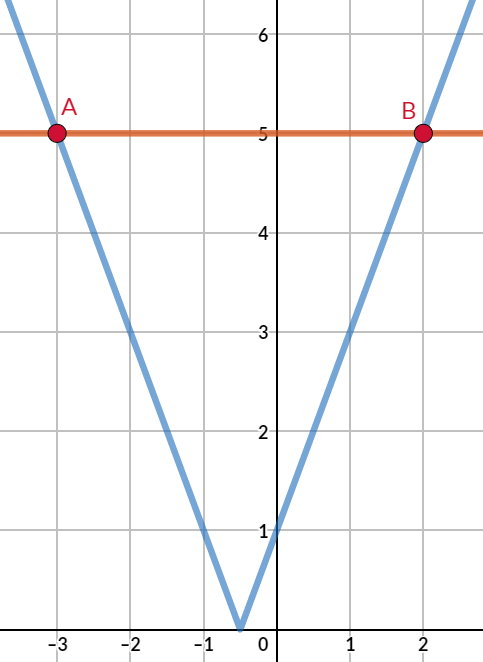
There are two points of intersection (POIs):
- When , both functions produce , so the POI is
- When , both functions produce , so the POI is
As long as you are able to graph both sides of the equation, you can get an idea of what the solutions are by looking for POIs!
Solving Algebraically:
To solve without graphing, we use the piecewise definition of the absolute value:
This way, we just have to check both cases:
- where (in the case that )
- where (in the case that )
Example
Solve the same problem as before algebraically:
Once again, we rewrite this as .
According to the piecewise definition:
Simplify each of the conditions by solving for :
and similarly:
So now we can work on each case separately by setting the parts of the piecewise function equal to the RHS, which is 5.
Case 1:
Solving for :
Watch Out!
Always make sure your solution satisfies the condition!
In this case, since the condition is , the solution is accepted.
Case 2:
Solving for :
Since the condition is , the solution is accepted.
Practice: Solving Absolute Value Equations
Select all solutions to the equation .

0:00 / 0:00
Example: Solving Absolute Value Equations
Solve .
Start by rearranging to get to the form :
Writing the piecewise definition:
Now let's determine the conditions more specifically:
and
Now we can rewrite the piecewise definition:
Case 1:
Since the condition includes , our solution is valid.
Case 2:
Since the condition is , these are both extraneous (invalid) solutions!
Therefore, the only solution is .
To solve graphically, graph and .
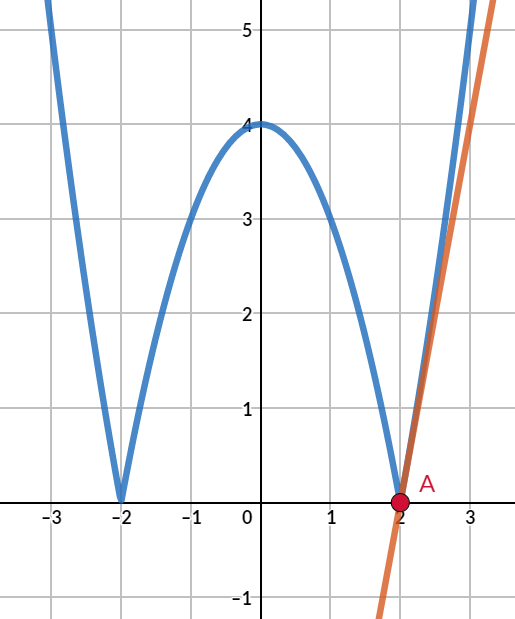
We can see that is indeed the only solution (the only point of intersection).
Practice: Solving Absolute Value Equations
Select all solutions to the equation .
Practice: Solving Absolute Value Equations
Select all solutions to the equation .