Popular Courses
Grade 10 Math
Canada High School
Geometry
US High School
Grade 9 Math
Canada High School
DAT
General Course
DAT
General Course
DAT
General Course
Grade 10 Principles of Mathematics
Ontario High School
Math 9
Alberta High School
Grade 10 Foundations of Mathematics
Ontario High School
Mathematics 9
British Columbia High School

0:00 / 0:00
Similar Triangles
Similar triangles are triangles that have the same shape but different sizes.
How can we tell if two triangles are similar?
- Using angles: The corresponding angles (angles in the same relative positions) are all the same Example: , , We say that .

- Using side lengths: The corresponding sides (sides in the same relative positions) have the same proportions Example: We say that .

0:00 / 0:00
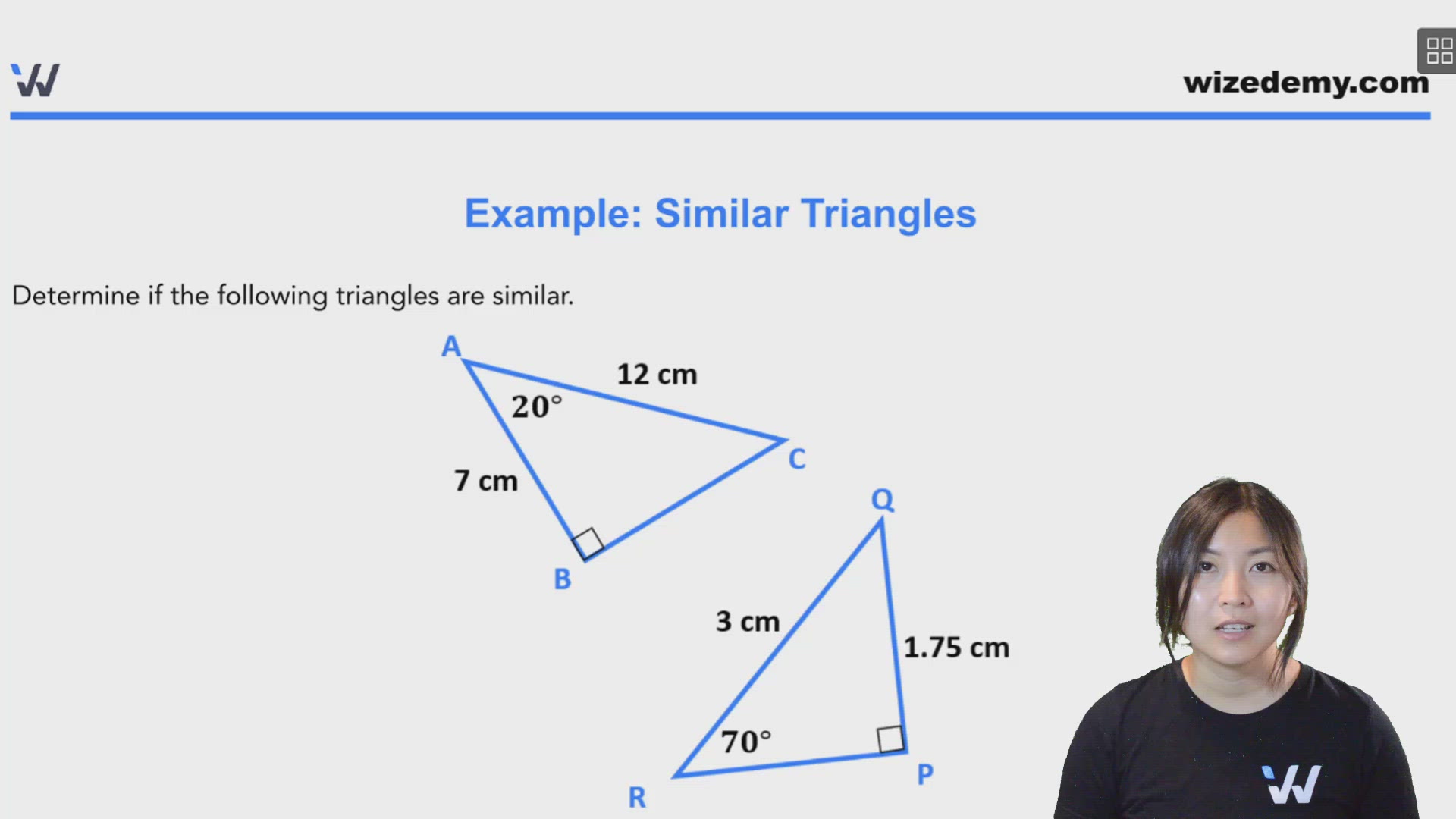
Example: Similar Triangles
Determine if the following triangles are similar.

Using Angles
- Triangle 1: The 2 given angles in the first triangle are and . Since the sum of the interior angles in a triangle is , we know that the missing angle is .
- Triangle 2: The 2 given angles in the second triangle are and . Similar to the first triangle, we know that the missing angle is .
Matching up the same angles, we see that .
Using Sides
- Triangle 1: Using Pythagorean's theorem, we see that
- Triangle 2: Using Pythagorean's theorem, we see that
Matching up the sides:
- longest sides:
- medium sides:
- shortest sides:
Since the corresponding side lengths have the same proportions, we see that .
Practice: Similar Triangles
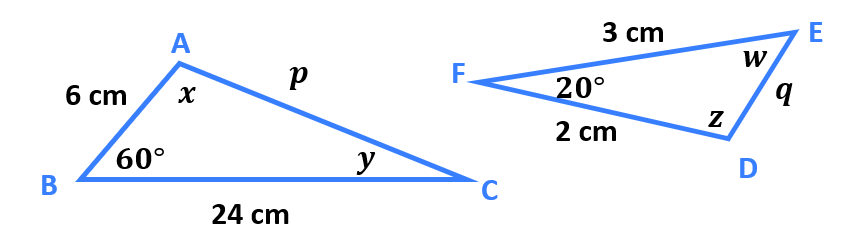
If is similar to , solve for the missing variables .
Practice: Similar Triangle
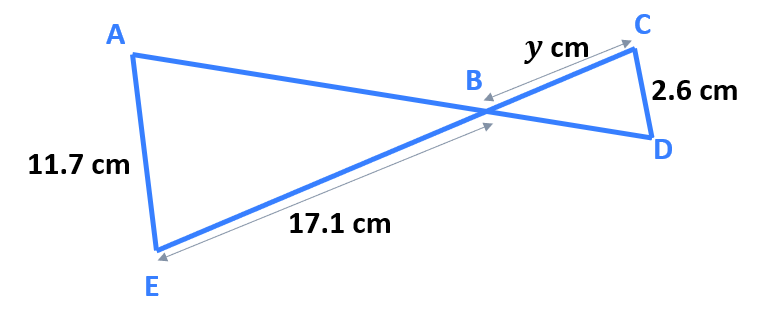
Identify the similar triangles in the following diagrams, then find the missing lengths.
Practice: Similar Triangles
A flashlight that is placed on the ground is pointed at a brick wall that is 20m away. A basketball player who is 1.9m tall stands 4m in front of the flashlight. Determine the height of the shadow of the basketball player that is cast on the brickwall.

0:00 / 0:00
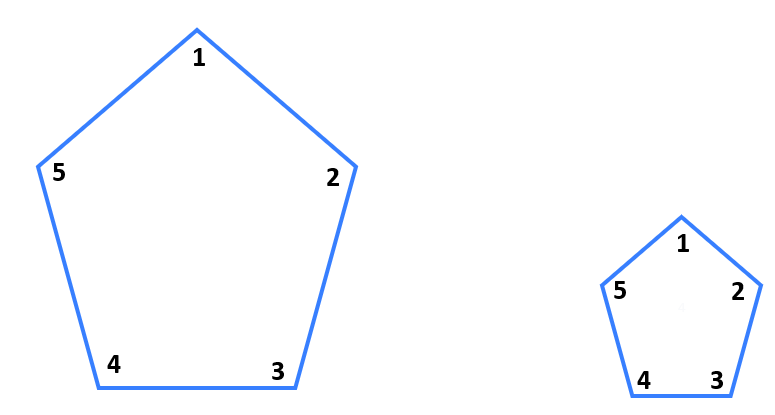
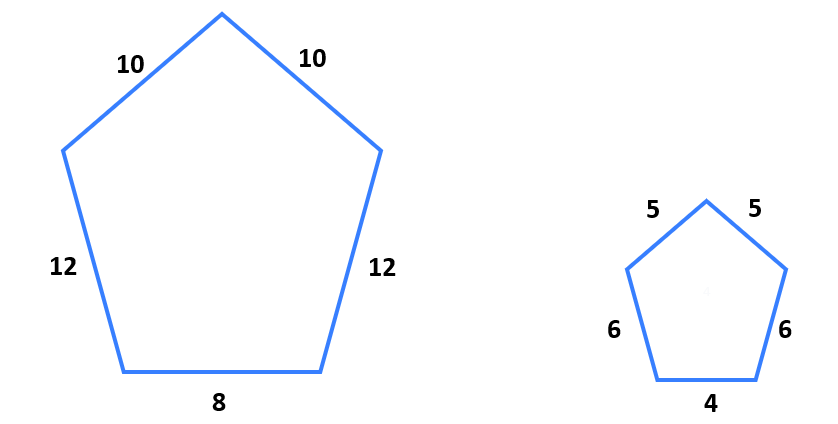
Similar Polygons
Similar polygons are figures that have the same shape but different sizes.
How can we tell if two polygons are similar?
- Using angles: The corresponding angles (angles in the same relative positions) are all the same Example:
- Using side lengths: The corresponding sides (sides in the same relative positions) have the same proportions Example:
Practice: Similar Polygons
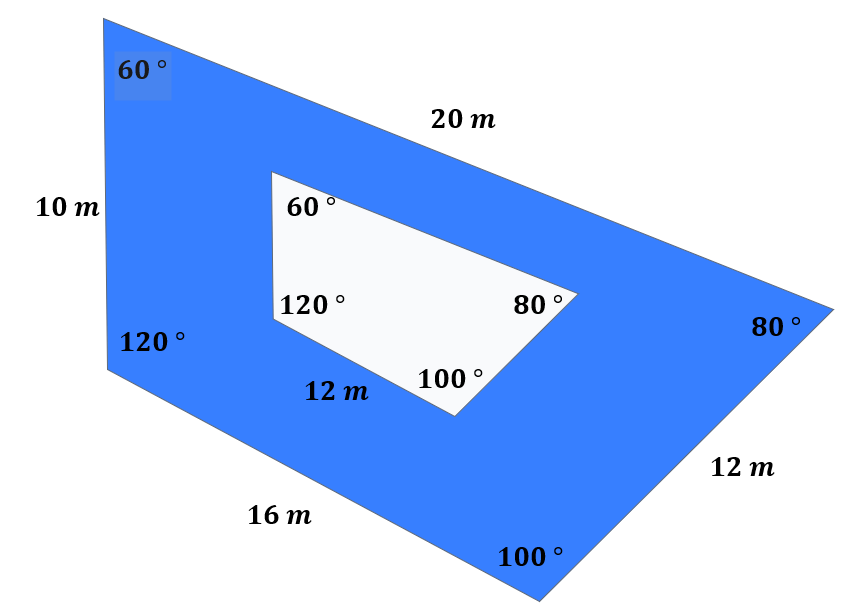
A swimming pool has a smaller quadrilateral in the center that does not hold water. Find the perimeter of the smaller center quadrilateral.