
0:00 / 0:00
Enlargements & Reductions
An enlargement is when the dimensions of a shape or object increases by a constant factor.
Example
This is an enlargement because ALL of the dimension increased by the same factor (we multiplied them by the same number 2)

A reduction is when the dimensions of a shape or object decreases by a constant factor.
Example
This is a reduction because ALL of the dimensions decreased by the same factor (we multiplied them by the same number 0.5)

A scale factor is the constant factor that we increase/decrease (multiply) all the dimensions by.
- Scale factor bigger than 1 → it is an enlargement
- Scale factor smaller than 1 → it is a reduction
Watch Out!
- If we don't increase or decrease all dimensions by the same factor, it is not an enlargement or reduction, it could just be a stretch or compression!
- It is not an enlargement or reduction when we increase or decrease all dimensions by the same amount (addition), we have to increase or decrease the dimensions by the same factor (multiplication)
Practice: Enlargements & Reductions
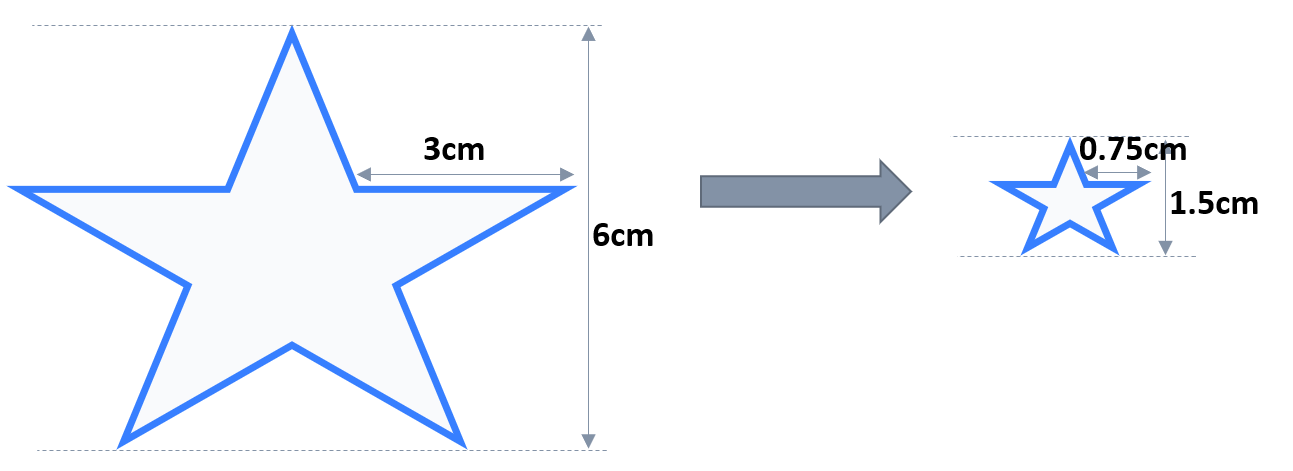
For each of the following figures and objects,
a) indicate whether it is a reduction, enlargement, or neither.
b) if it is a reduction or enlargement, determine the scale factor.
(If it is neither a reduction or enlargement, enter NA)

Mark Yourself Question
- Grab a piece of paper and try this problem yourself.
- When you're done, check the "I have answered this question" box below.
- View the solution and report whether you got it right or wrong.
Practice: Enlargement and Reduction

a) Draw the enlargement with a scale factor of 1.5 for the above figure.
b) Draw the enlargement with a scale factor of 25% for the above figure.
0:00 / 0:00
Scale Diagrams
A scale is a ratio used to compare the size of a drawing (or diagram or map) to the actual size of the object or image. You can represent a scale as:
- a ratio Example: means that every 1 unit on the diagram is 3 units in real life
- a fraction Example: means that every 1 unit on the diagram is 100 in real life *A scale represented as a fraction is also called the scale factor
- a diagram Example: This scale is from Google Maps

- in words Example: 1cm on the map is equivalent to 10km
Wize Tip
Practice: Proportions
Fill in the missing number in each proportion.
a)
b)
c)
0:00 / 0:00
Example: Scale Diagram
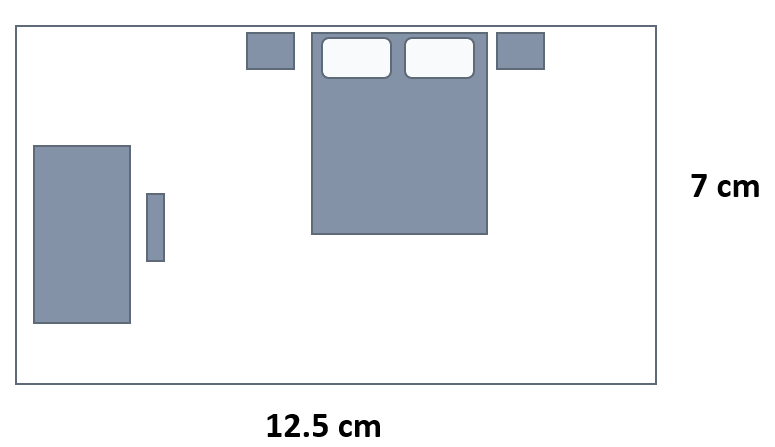
The scale diagram of a room uses a scale of 1 : 43.5
a) if the following is the diagram of the room, what are the actual dimensions of the room?
Method 1
- or
- or
So, the actual dimensions of the room are or
Method 2
- In the numerator, we multiplied the 1 in the first fraction by 7 to get to the 7 in the second fraction. So we need to multiply 43.5 by 7 to get to →
- In the numerator, we multiplied the 1 in the first fraction by 12.5 to get to the 12.5 in the second fraction. So we need to multiply 43.5 by 12.5 to get to →
So, the actual dimensions of the room are .
b) if the measurements of the actual room is , what should the dimensions of the diagram of the room be in inches?
(* 1 feet = 12 inches)
The scale factor is .
- So, this measurement in this diagram is approximately 0.2759 feet or .
- So, this measurement in this diagram is approximately 0.2529 feet or .
Therefore, the dimensions on the diagram in inches are .
Practice: Scale Diagram
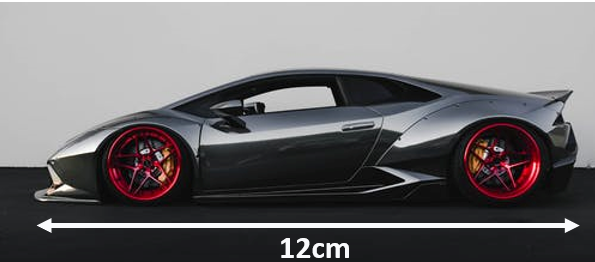
The following scale diagram uses a scale of 1 : 37.5. What is the actual length of this car?
Practice: Scale Diagram
Rony used Google maps to find that the driving distance between the CN Tower in Toronto, Canada and the Statue of Liberty in New York, United States is 762km.
a) If you had to draw a map with a scale of 1: 6,000,000 to represent this driving distance, what would the distance on the map be?
b) True or False? If you took a rule and drew a straight line on the map between the CN Tower and the Statue of Liberty and measured that straight distance, you will get the distance you calculated in part a).