Wize High School Geometry Textbook (Common Core) > Foundations of Geometry
Points, Lines, & Planes
Popular Courses
Find My Course
0:00 / 0:00
Points, Lines, and Planes
In geometry we'll often be working with points, lines, and planes. These have specific meanings or definitions associated with them.
Points and Lines
A point is an exact spot on a plane, or in space. We say it has no dimension, meaning that it doesn't have any thickness to it. We often use a dot to represent a point. To identify a point, we can use a capital letter.

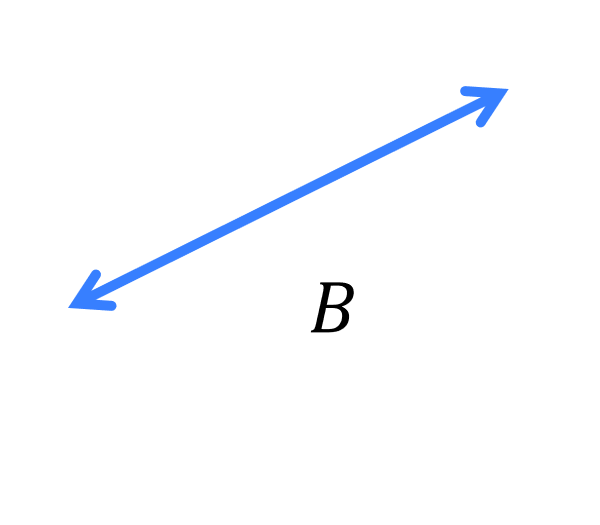
A line is strait object. It has one dimension and it extends without stopping in two directions.
We often use a line with two arrows on each end to represent it.
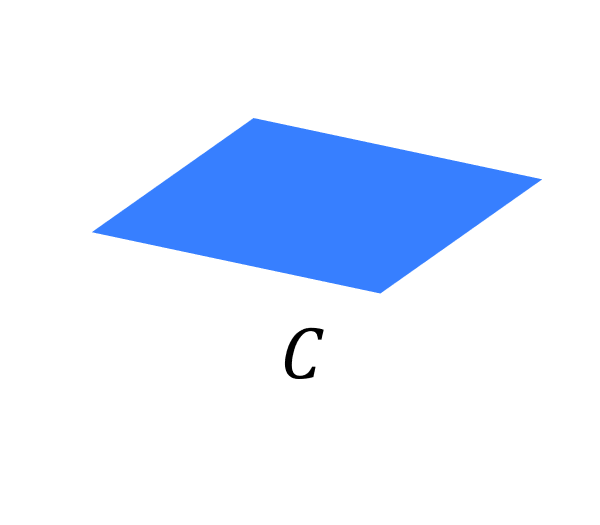
A plane is a flat surface. It has two dimensions, meaning that we can travel along the surface without stopping, but it has no thickness.
Watch Out!
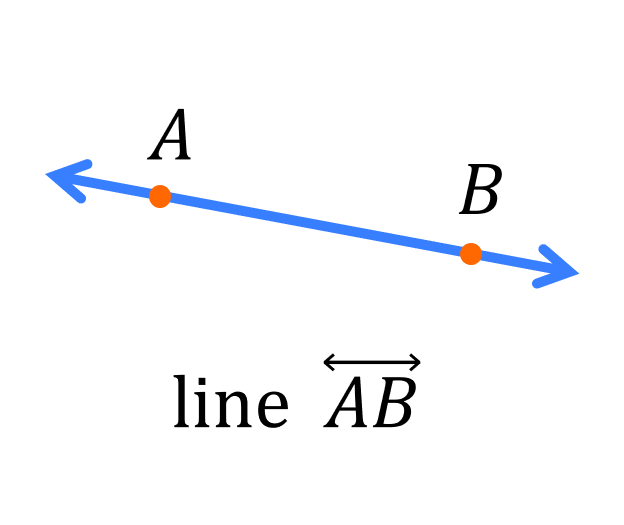
There other ways we commonly describe lines and planes. Some of these ways include using the points that are on the line or plane. Symbols may be used over the points to better identify the object.
Basic Properties
If we are given any two points, then there is always a line that will go through these two points.
If we are given any three points, that don't end up on the same line, then there is always a plane that will go through these three points.
We say that two objects cross, or intersect, if they share a common point.
Example
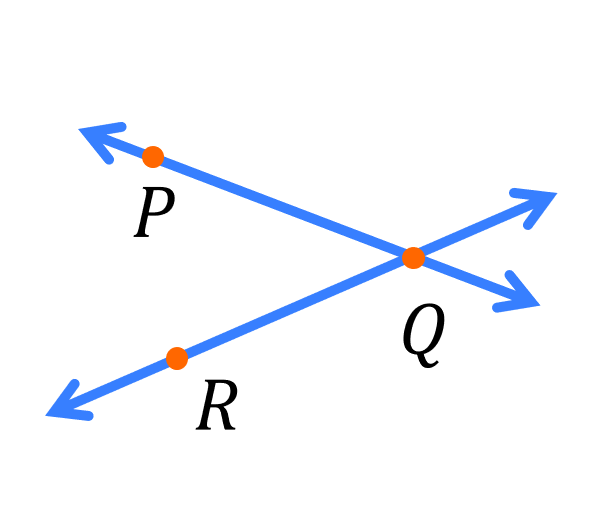
- Draw three points and label them with the letters , , and .
- Draw a line through and .
- Draw a line through and .
ANSWER:
0:00 / 0:00
Building construction
Jenny is working on adding a new room to her house. Part of the construction process will involve putting a new roof over the room. Use the diagram to answer some of the question below.

1. The ridge of the roof will go through points and . What object can we use to model this, and what notation can we use?
ANSWER: We can use a line, and the notation .
2. The gable end of the roof has corners at , , and . What object can we use to model this flat surface, and what notation can we use?
ANSWER: We can use a plane, and the notation plane
3. For the side of the roof we can use a single plane that goes through the points , , , and . In general when we have three points there will exist a plane that goes through them. Since we have more than three point, why is it we only have one plane for this surface?
ANSWER: We have to carefully watch the wording of the property. Let's take a look at what it says:
"If we are given any three points, that don't end up on the same line, then there is always a plane that will go through these three points."
We can see that point like and are on the same line. So even though we have a total of four point, only three of them can be grouped together such that they are not all on the same line. This give us only one plane.
Identify the objects
Using the given diagram identify the following

- What point is not in the plane XBC?
- The name of the line that contains point
- The name of the plane that contains points , and .
What point is not in the plane XBC?
Properties of Points, Lines and Planes
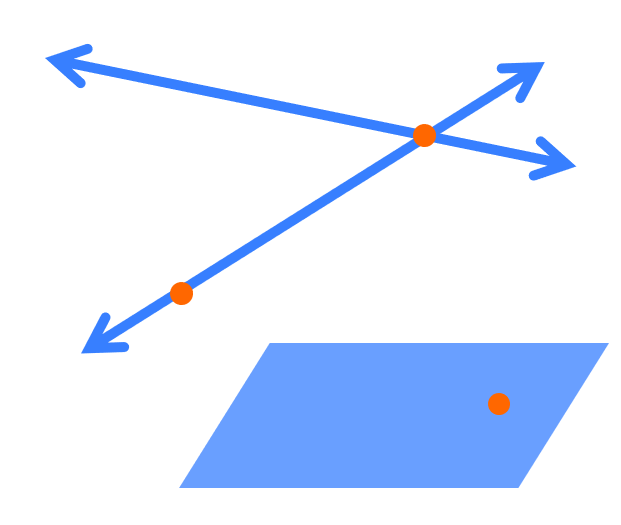
Think carefully about what we can do with points line and planes. Use what you've learned to determine if the following questions are True or False.
- If given two points, there will always be a line that passes through them.
- If given two planes, they will always intersect to form a line.
- If given three points, then there is a single plane that goes through them.
- If two lines are in the same plane, and they are not parallel, then they will intersect.
If given two points, there will always be a line that passes through them.
Bowling time

Katherine always throws her bowling ball so that it rolls in a strait line (even after it hits a pin). There are a total of 5 pins that all need to be knocked down, shown in the diagram below. (It is safe to assume that the pins are spaced far enough away from each other such that the ball can only hit one at a time, and that the pins will not hit each other after they've been hit.)
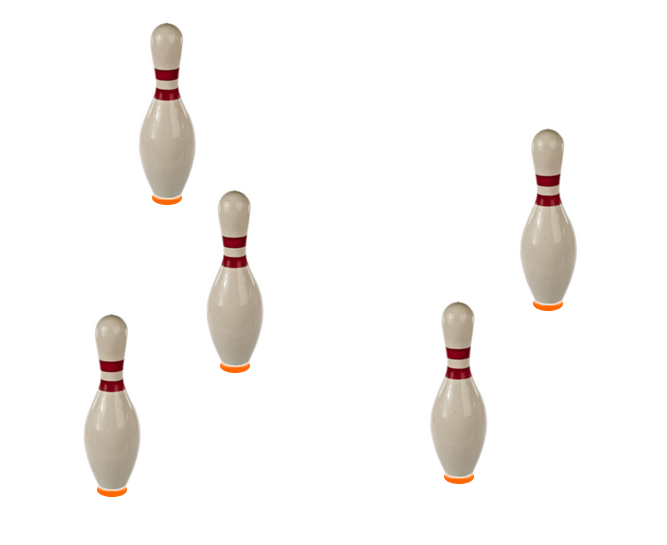
What is the smallest number of throws it will take to hit all of the pins? Explain.