Create a free account to get started

Unlock full course notes by signing up

  • Video lessons taught by top educators
  • Practice questions with guided solutions
  • Written review notes for reference
  • Expert answers anytime from course tutors

Line Segments and Rays

Image illustrating Line Segments and Rays


There are even more objects we can create when using geometry!

Segments and Rays

A line segment is similar to a line, but only includes two points, which we call endpoints, and all the points in between. To identify a line segment we can use two capital letters with a line segment over them.

Image illustrating Line Segments and Rays

A ray is similar to a line, but only continues on in one direction. This means it will contain two points, with one of them acting as an endpoint. To identify a ray we use two capital letters with a directed arrow over them.

Image illustrating Line Segments and Rays

Two rays are considered opposite if they have the same endpoint, but continue on in opposite directions.

Image illustrating Line Segments and Rays


Example

  1. Draw three points and label them PP, QQ, and RR.
  2. Draw a line segment between points PP and QQ.
  3. Draw the ray PR→\overrightarrow{PR}

ANSWER:

Image illustrating Line Segments and Rays

Create a free account to get started

Unlock full course notes by signing up

  • Video lessons taught by top educators
  • Practice questions with guided solutions
  • Written review notes for reference
  • Expert answers anytime from course tutors

Art and Geometry

When modeling the human body, artist might use a wooden puppet to help them.
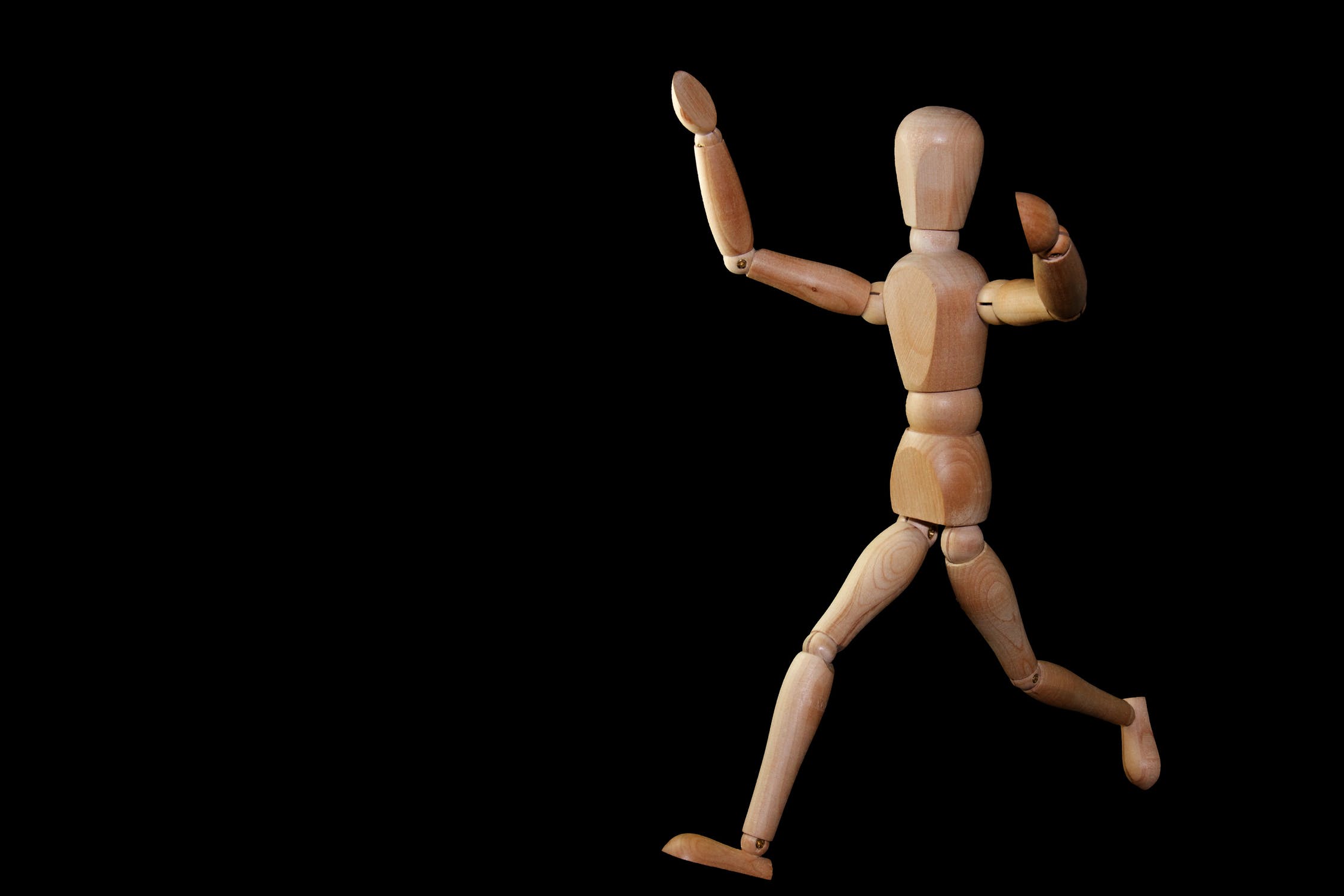

Image illustrating Example


Geometrically you can think of the puppet being made up of several line segments connected at vertices.

Use the diagram below, which represents the upper body of one of these puppets to answer the following questions.
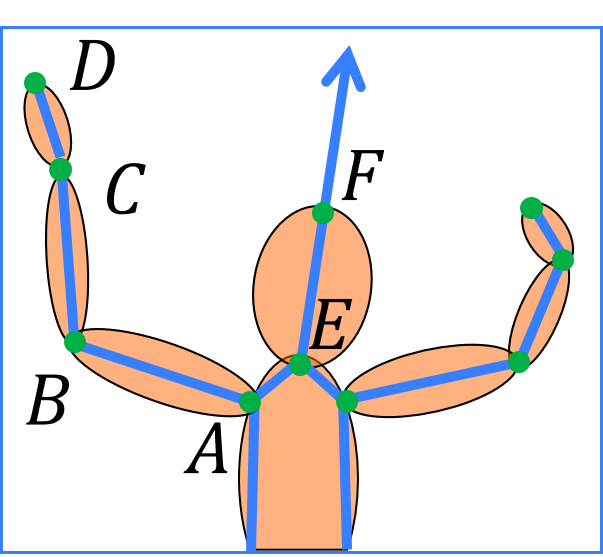

Image illustrating Example


1. How many segments are used to model the right arm and hand. What notation can we use to describe these segments?


ANSWER: There are a total of 3 segments in the right arm and hand. They are: DC‾,CB‾,\overline{DC}, \overline{CB}, and BA‾\overline{BA}. Note the order of the endpoints does not matter.


2. The head of a puppet is held up by a small string. What object is used to model this and what notation do we use?


ANSWER: To model the string a ray is used. We can use the notation EF→\overrightarrow{EF}. Note the order of the points matters for a ray.


3. In the arm of the puppet 4 points are identified as the end points of the segments, A,B,C,A, B, C, and DD . Are these the only point that model the arm?


ANSWER: No, there are several points. To see why, let's carefully check the wording of a line segment.


"A line segment is similar to a line, but only includes two points, which we call endpoints, and all the points in between. To identify a line segment we can use two capital letters with a line segment over them."


These means all of the points between the endpoints are also included, even though they are not marked or labeled in any way.


Identify the objects

Looking at the diagram below, how many line segments are there?

Illustration for practice question: Identify the objects

Create a free account to get started

Unlock full course notes by signing up

  • Video lessons taught by top educators
  • Practice questions with guided solutions
  • Written review notes for reference
  • Expert answers anytime from course tutors

Vocabulary Check

Illustration for practice question: Vocabulary Check


Match each term with its appropriate diagram.

Match each term
A.

Illustration for practice question: Vocabulary Check

B.

Illustration for practice question: Vocabulary Check

C.

Illustration for practice question: Vocabulary Check

D.

Illustration for practice question: Vocabulary Check

E.

Illustration for practice question: Vocabulary Check

Point WW

Ray WY→\overrightarrow{WY}

Plane WW

Segment XW‾\overline{XW}

Line XY↔\overleftrightarrow{XY}

Create a free account to get started

Unlock full course notes by signing up

  • Video lessons taught by top educators
  • Practice questions with guided solutions
  • Written review notes for reference
  • Expert answers anytime from course tutors

Reading Maps

Two cars began at an intersection and started driving away from each other in opposite directions, forming opposite rays.


Illustration for practice question: Reading Maps


1. What are the two possible streets the cars might be on?


2. If one car is driving south on Acorn Drive, then what is the direction and street the other car is driving?


1. What are two possible streets the cars might be on?

Choose an answer

Create a free account to get started

Unlock full course notes by signing up

  • Video lessons taught by top educators
  • Practice questions with guided solutions
  • Written review notes for reference
  • Expert answers anytime from course tutors