Wize High School Geometry Textbook (Common Core) > Lines
Angles from Intersecting Lines

0:00 / 0:00
Pairs of angles from lines

When we have a pair of lines, we can cross them with a third line. This creates many new angles which have important properties associated with them.
Wize Concept
Remember that we can call pairs of these angles by special names:
- Corresponding angles - These are located in corresponding, or similar positions. For example one angle inside the pair of lines, and one outside the pair of lines, but both on the same side of the transversal.
- Alternate interior angles - These are located between the pair of lines, and either side of the transversal.
- Alternate exterior angles - These are located outside the pair of lines, and either side of the transversal.
- Consecutive interior angles - These are located inside the pair of lines, and the same side of the transversal.
Important Theorems
- Corresponding Angles Theorem - If two parallel lines are cut by a transversal, then the pair of corresponding angles are congruent.
- Alternate Interior Angles Theorem- If two parallel lines are cut by a transversal, then the pairs of alternate interior angles are congruent.
- Alternate Exterior Angles Theorem - If two parallel lines are cut by a transversal, then the pairs of alternate exterior angles are congruent.
- Consecutive Interior Angles Theorem - If two parallel lines are cut by a transversal, then the pairs of consecutive interior angles are supplementary.
0:00 / 0:00
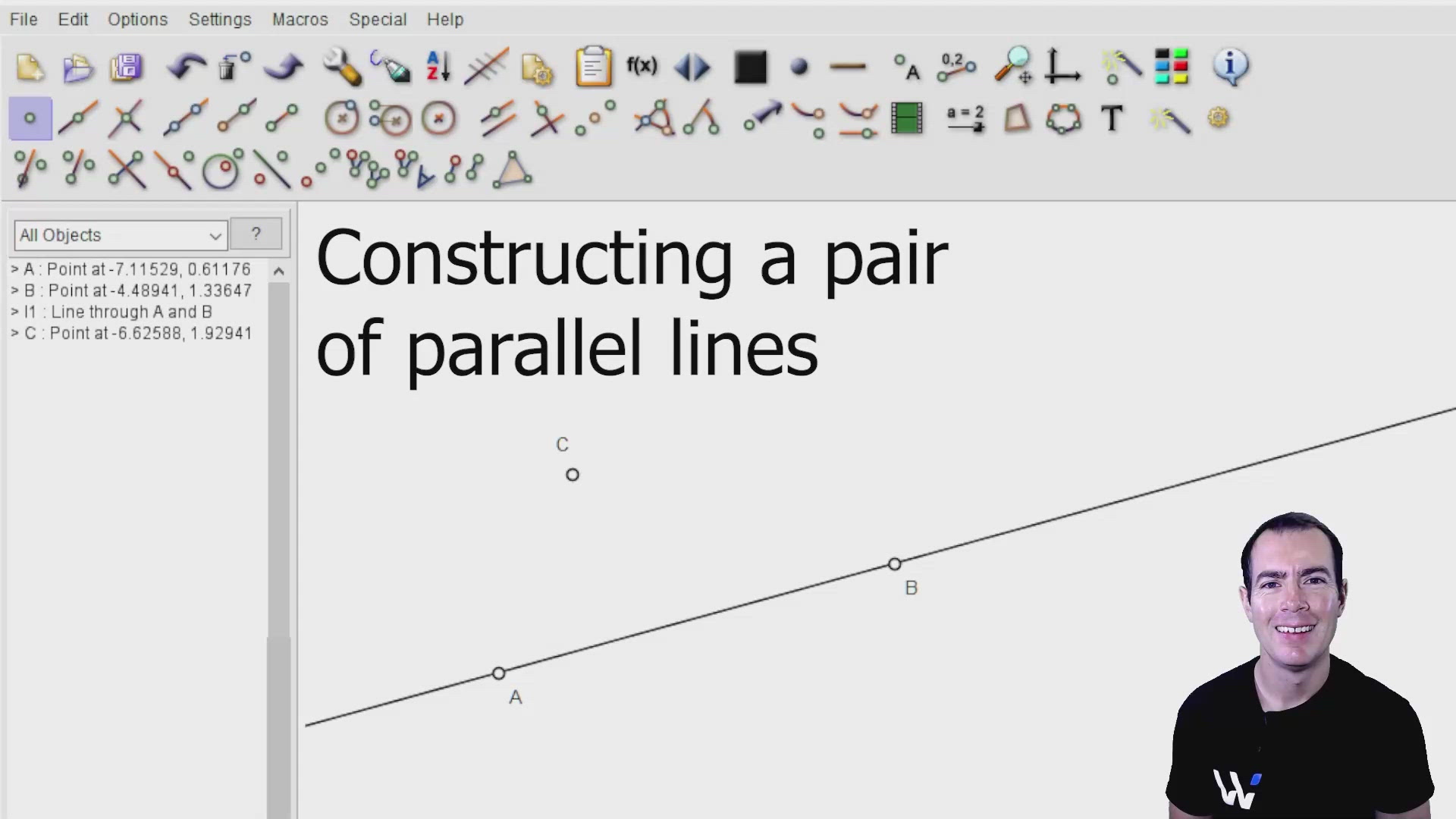
Constructing a pair of parallel lines
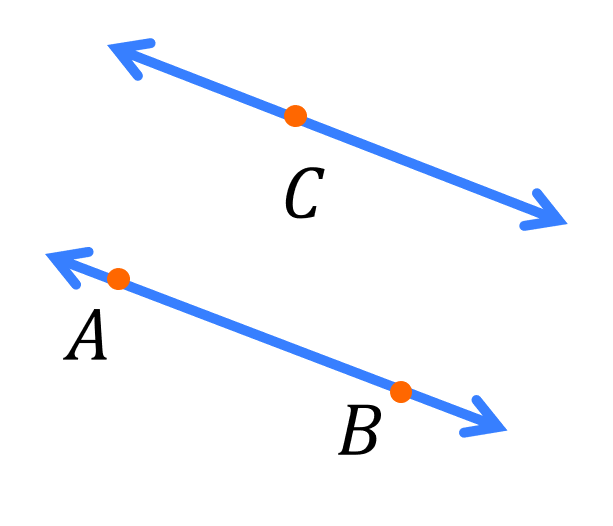
Our goal in this construction is to create a new line that is parallel to a given line, and goes through a given point.
Using Technology
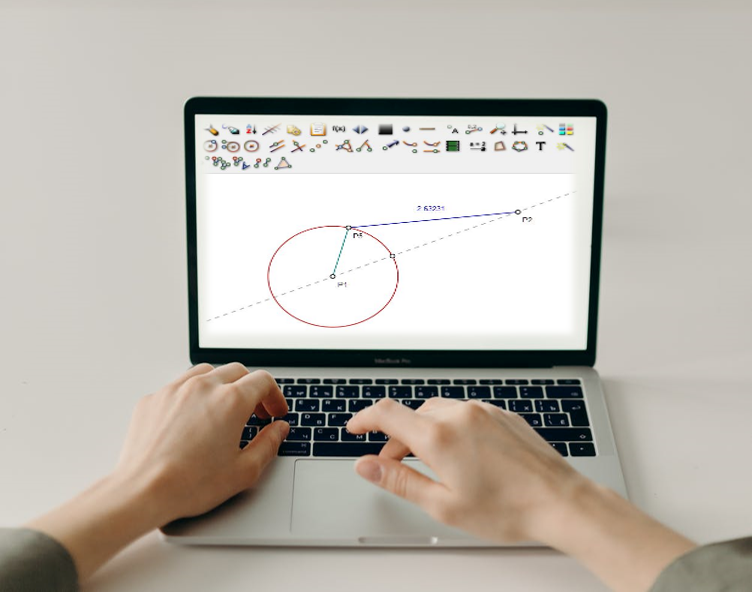
Begin with a line , and a point off the line labeled .
- Make a line through and .
- Place a point along line
- Create a circle with a radius the length of centered at . Label the intersection of the circle and the segment as point .
- Use the compass tool to make a circle with the radius of centered at . Label the intersection of the circle and the line as point .
- Use the compass tool to make a circle with the radius of centered at . Label the intersection of the two circles as point .
- Draw the line through and .
From this we now have that is parallel to .
0:00 / 0:00
Angles and Rails
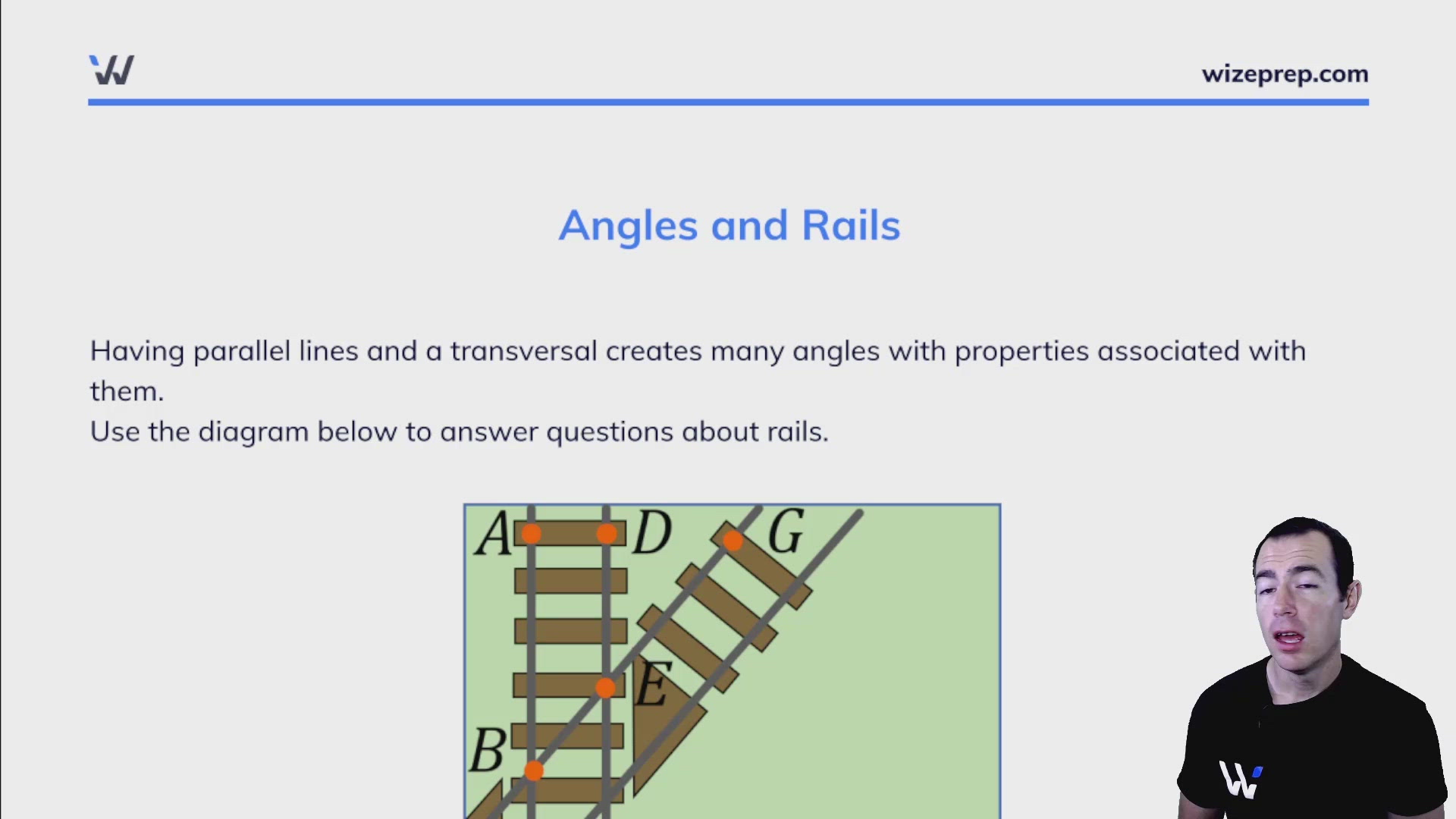
Having parallel lines and a transversal creates many angles with properties associated with them.
Use the diagram below to answer questions about rails.
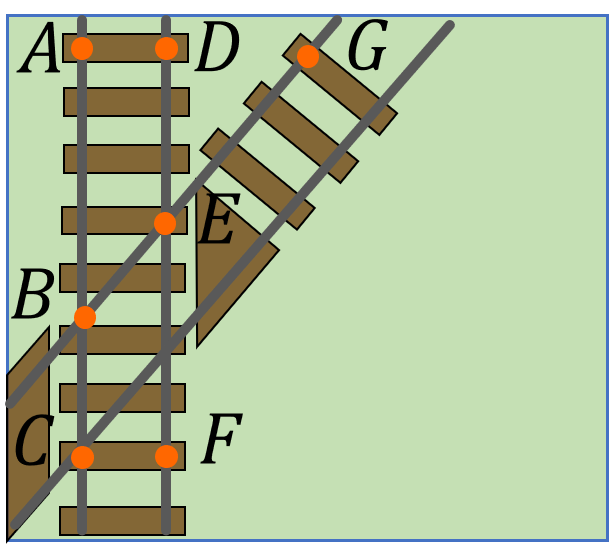
Given that line is parallel to line , and that
1. What is the measure of angle ?
ANSWER: Angle and are vertical angles, so we have
2. What is the measure of angle ?
ANSWER: Angle and are corresponding angle, so we have
3. What is the total measure of ?
ANSWER: These angles are consecutive interior angles. From the consecutive interior angles theorem we know that these will be supplementary. This means the total of their measures is .
Find the angles measure
Use the diagram, and the fact that ,to find the measure of the following angles or sum of angles.
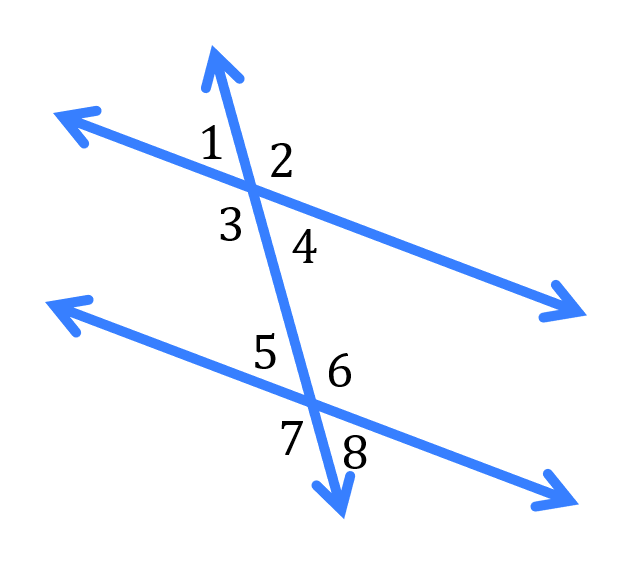
1. What is the measure of angle ?
2. What is the measure of angle ?
3. What is the sum of angles and ?
4. What is the sum of angles and ?
1. What is the measure of angle ?
Shapes and Geometry
A trapezoid is a polygon with four sides, and a pair of parallel sides.
Use the diagram below to answer the following questions. Note that the parallel sides have been marked with arrows.
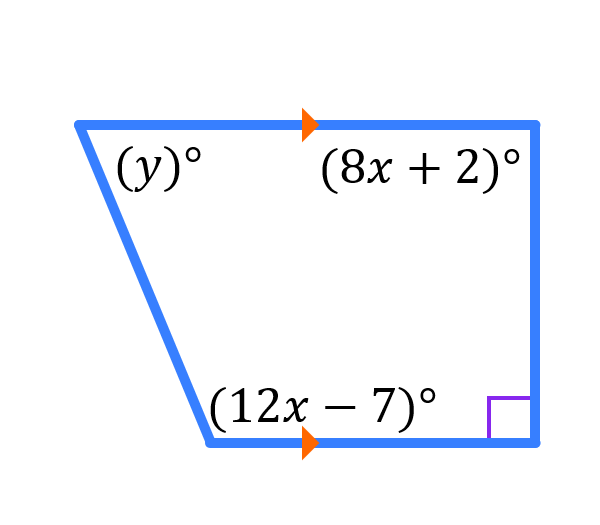
1. What is the value of ?
2. What is the value of the obtuse angle?
3. What is the value of ?
1. What is the value of ?
Power and Mathematics
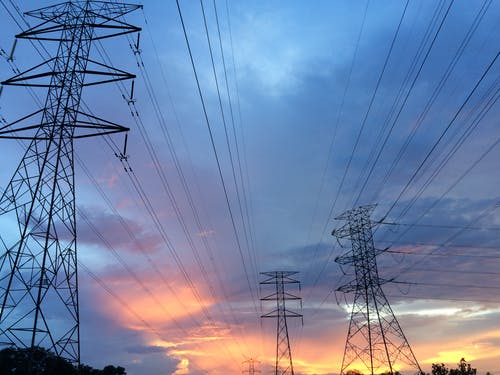
Some power lines can carry as much as 345,000 volts. Special poles are needed to keep these high off the ground safely supported when spanned over large distances.
Below is a diagram of two parallel poles that are supported together. Use it, and the given information to answer the following questions.
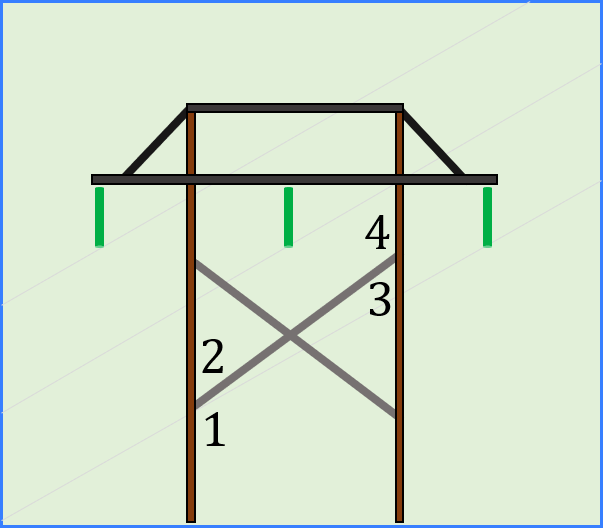
1. What type of angles have been marked in the diagram?
2. If is , then what is the measure of ?
3. Suppose that the span between the two poles was changed so that the measure of was no smaller. What effect would this have on the measure of ?
1. What type of angles have been marked in the diagram?