Wize High School Geometry Textbook (Common Core) > Lines
Pairs of Lines
0:00 / 0:00
Pairs of Lines

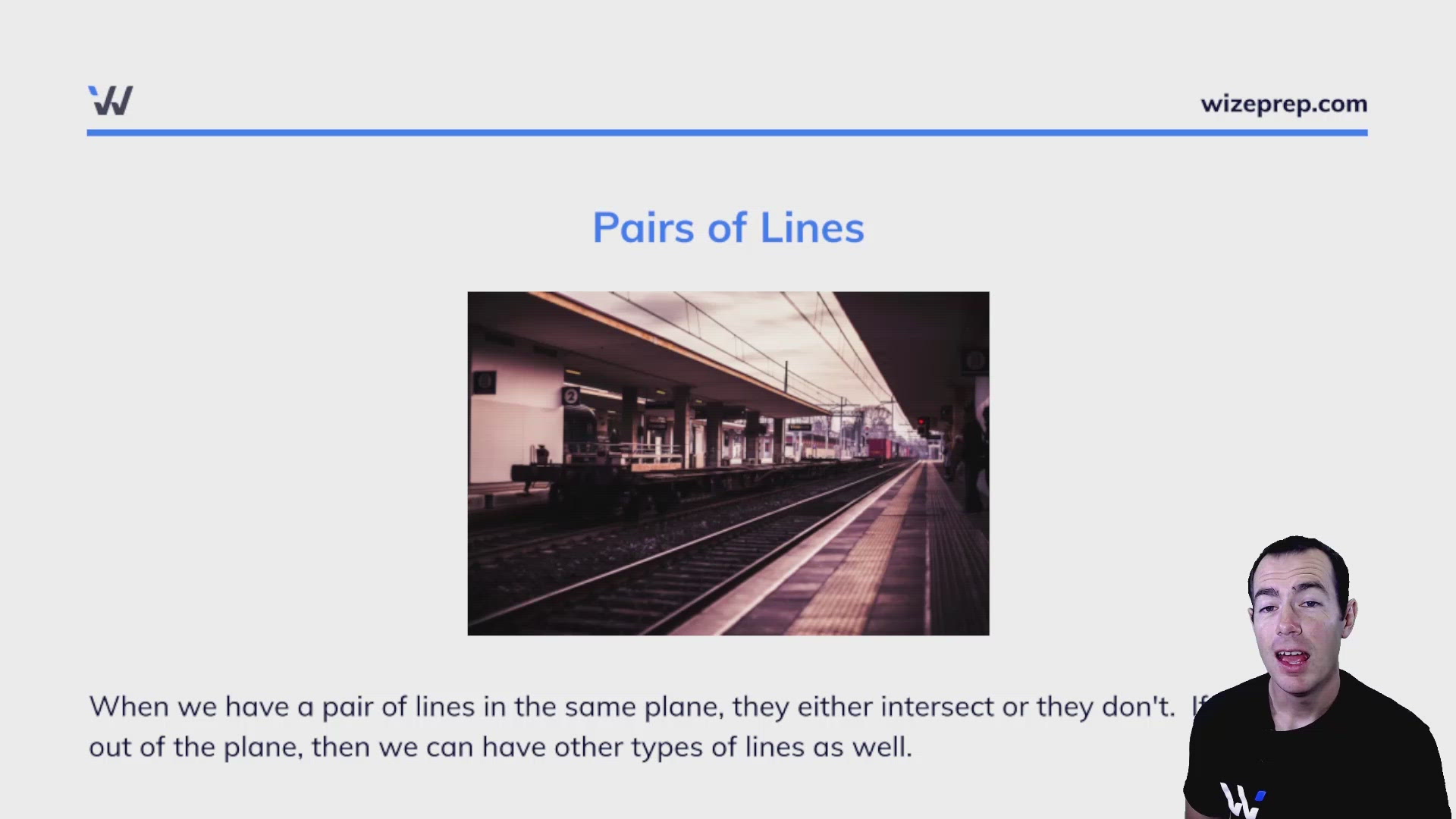
When we have a pair of lines in the same plane, they either intersect or they don't. If we step out of the plane, then we can have other types of lines as well.
Types of lines
A pair of lines are parallel if they are in the same plane, and do not intersect.
A pair of lines are skew if they are not in the same plane, and they do not intersect.
Pairs of angles from lines
A transversal is a line that cuts through two or more lines at different points in the same plane.

When we have a transversals it can create many different types of angles.
- Corresponding angles - These are located in corresponding, or similar positions. For example one angle inside the pair of lines, and one outside the pair of lines, but both on the same side of the transversal.
- Alternate interior angles - These are located between the pair of lines, and either side of the transversal.
- Alternate exterior angles - These are located outside the pair of lines, and either side of the transversal.
- Consecutive interior angles - These are located inside the pair of lines, and the same side of the transversal.
Important Postulates
- Parallel Lines Postulate - If given and line and a point, not on the line, then there is exactly one line through the point parallel to the given line.
- Perpendicular Lines Postulate - If given a line and a point not on the line, there there is exactly one line through the point perpendicular to the given line.

0:00 / 0:00
Constructing perpendicular lines
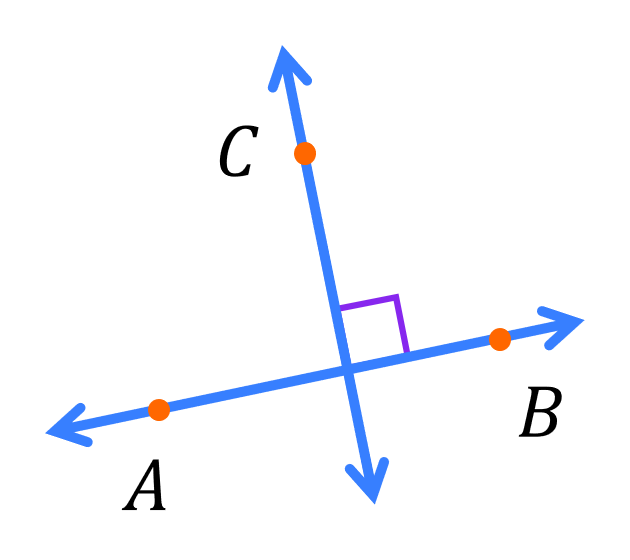
Our goal in this construction is to create a new line that is perpendicular to a given line and goes through a given point.
Using Technology
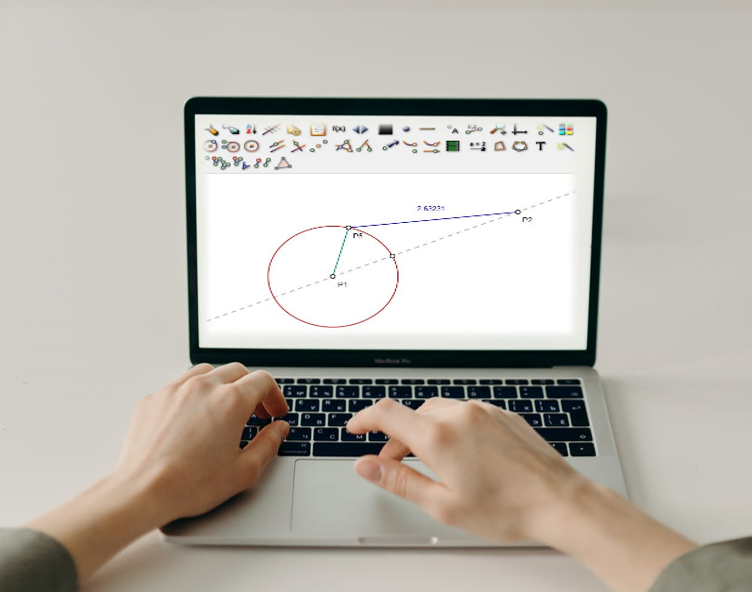
Begin with a line , and a point off the line.
- Draw a circle with the center at . Make sure it is large enough to intersect the given line at two points. Label these new points as and .
- Use the midpoint tool to place a point in the middle of segment . Label this as point .
- Draw a line through points and .
From this we now have that is perpendicular to .
0:00 / 0:00
Construct a perpendicular bisector
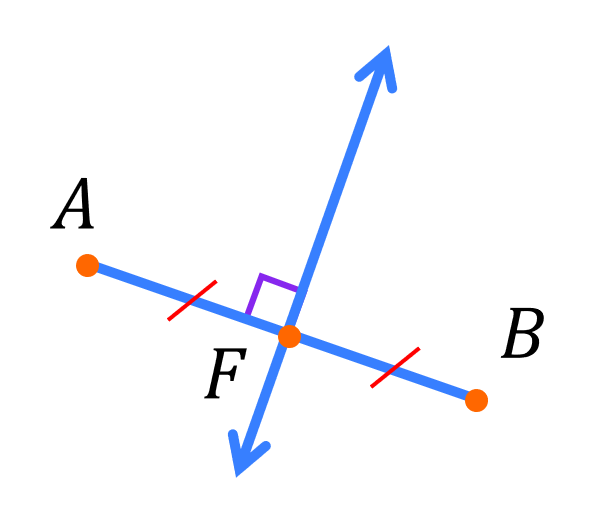
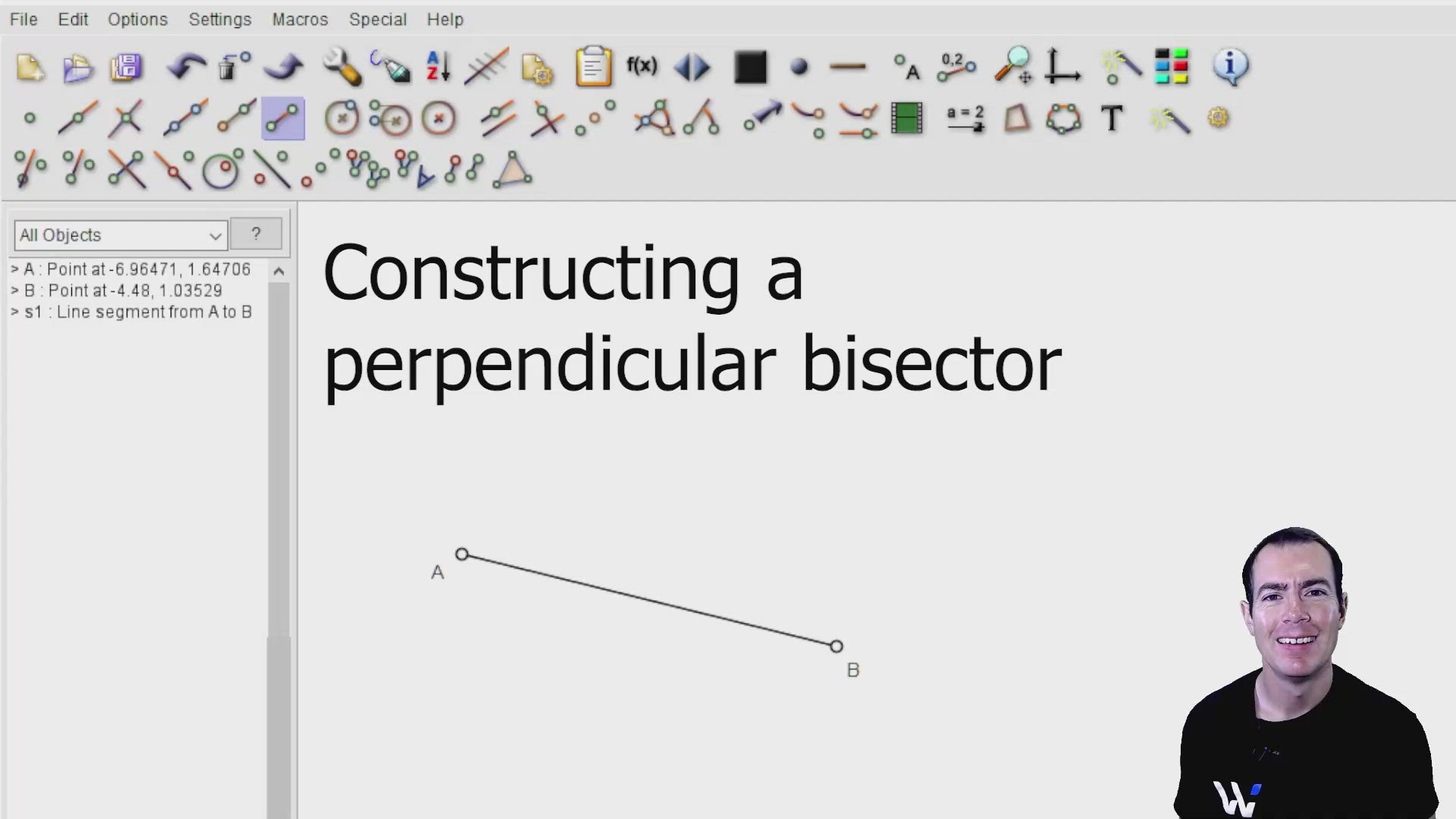
Our goal in this construction is to create a new line that bisects, and is perpendicular to a given line segment.
Using Technology
Begin with a segment
- Draw a circle whose radius is slightly larger than the midpoint of , centered at . Label the intersection of the segment and the circle as point .
- Use the compass tool to draw a circle whose radius is the length of , with the center at . Label the intersection of the circles as point and .
- Draw a line through points and . Label the intersection of the line and as point .
From this we now that point is the midpoint of , and that is perpendicular to
0:00 / 0:00
Lines and Rails

The Canadian National railway is the largest railroad in Canada. It has about 32,000 km of rails that cross the country and help people get where they need to go.
Use the diagram of two railroad tracks crossing to answer the questions below.
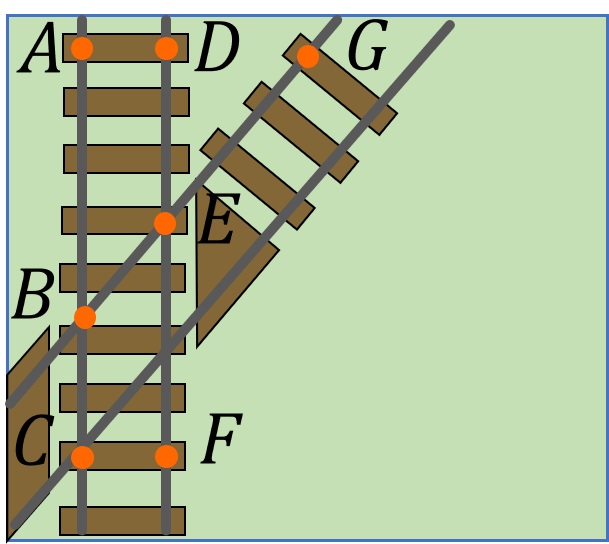
1. In the diagram it appears that lines and are parallel. What is a good argument that they are indeed parallel?
ANSWER: Railroad tracks should stay the same distance apart so that the train can ride over them smoothly. This means they will not intersect.
2. Line is incident to lines , and . What angles are considered alternate interior angles? What are these angles interior ?
ANSWER: Alternate Interior Angles:
These are interior the pair of lines and .
3. If given a line such as and a point off the line like, then there exist a unique line through . According to the diagram we have two lines that go through . Namely and . How can this be?
ANSWER: We have to be careful with the wording of the postulate. If given a line and a point off of the line, then there exist a unique line that is parallel to the original line. The diagram does not break this postulate since line would be the unique parallel line to that goes through point .
Identifying Angle Pairs
Use the diagram to math the pairs of angles with their best description.
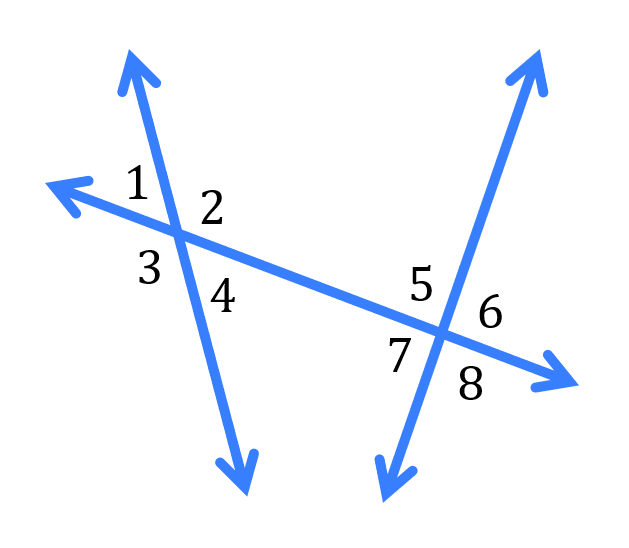
A.
Consecutive interior angles
B.
Corresponding angles
C.
Alternate exterior angles
D.
Alternate interior angles
Thinking about lines
Everyday objects can be modeled using geometry in a variety of ways. The following diagram shows a simple box that his ready for shipping. Assume that each segment is part of a line and that all angles are right angles.
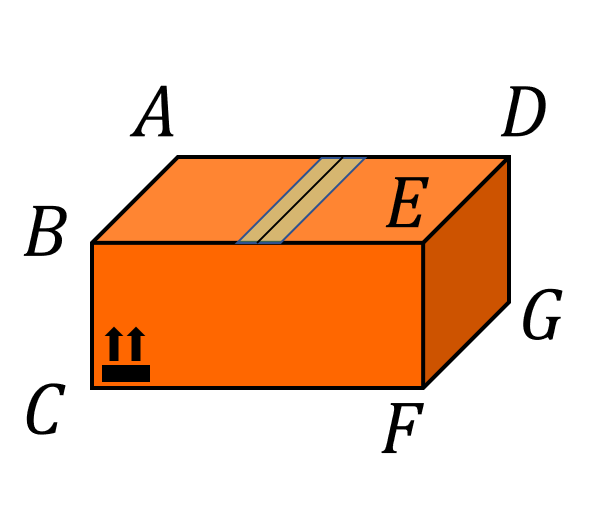
Fill in the blanks with the best description of the lines.
1. Lines and are considered ________ .
2. Lines and are considered ________ .
3. Lines and are considered ________ .
1. Lines and are considered .
The game of Chess

In the game of Chess, the piece known as the Rook can only move in a strait line.
One way we can model the game using geometry is to use points for the location of the pieces and lines for the their possible movement of the rook. For example moving the rook either up or down would give us a line. This is labeled in the diagram as .
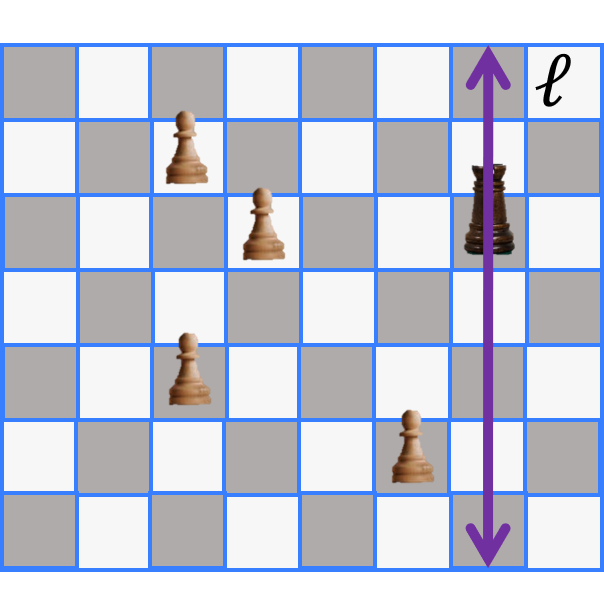
1. How many unique lines go through the white pieces and are perpendicular to line ?
2. How many unique lines go through the white pieces and are parallel to line ?
1. How many unique lines go through the white pieces and are perpendicular to line ?