0:00 / 0:00

Combining Transformations

Let y=af(b(x−h))+ky=af(b(x-h))+k be the transformed function of y=f(x), y=f(x),~ where a, b, h, k are real numbers. Then:

HorizontalVerticalb<0‾:a<0‾:horizontal reflection about thevertical reflection about they-axisx-axis∣b∣>1‾:∣a∣>1‾:horizontal compression of  1b  unitsvertical expansion of ’a’ units∣b∣<1‾:∣a∣<1‾:horizontal expansion of  1b  unitsvertical compression of ’a’ unitsh>0‾:k>0‾:horizontal translation ’h’ units rightvertical translation ’k units uph<0‾:k<0‾:horizontal translation ’h’ units leftvertical translation ’k’ units down\begin{array}{l c c l} \text{Horizontal}&&&\text{Vertical}\\\\ \underline{b<0}:&&&\underline{a<0}:\\ \text{horizontal reflection about the}&&&\text{vertical reflection about the}\\ \text{y-axis}&&&\text{x-axis}\\\\\\ \underline{|b|>1}:&&&\underline{|a|>1}:\\ \text{horizontal compression of}~~\displaystyle\frac{1}{b}~~\text{units}&&&\text{vertical expansion of 'a' units}\\\\\\ \underline{|b|<1}:&&&\underline{|a|<1}:\\ \text{horizontal expansion of}~~\displaystyle\frac{1}{b}~~\text{units}&&&\text{vertical compression of 'a' units}\\\\\\ \underline{h>0}:&&&\underline{k>0}:\\ \text{horizontal translation 'h' units right}&&&\text{vertical translation 'k units up}\\\\\\ \underline{h<0}:&&&\underline{k<0}:\\ \text{horizontal translation 'h' units left}&&&\text{vertical translation 'k' units down} \end{array}


If the point (x, y) is a point on the parent function f(x), then the point on the transformed function (y=af(b(x−h))+k\left(y=af(b(x-h)\right)+k becomes:
(x, y)→(xb+h, ay+k)(x,~y)\rightarrow\Big(\frac{x}{b}+h,~ay+k\Big)

PAGE BREAK
Example
Let y=f(x) y=f(x)~ have the following table of values:
xy−46−23062340\begin{array}{|c|c|}\hline x&y\\\hline -4&6\\\hline -2&3\\\hline 0&6\\\hline 2&3\\\hline 4&0\\\hline \end{array}
Let's look at the following transformations:
  1. y=−2f(x−1)+1y=-2f(x-1)+1
  2. y=13f(−2(x+3))−2y=\frac{1}{3}f(-2(x+3))-2

Part a.

y=−2f(x−1)+1y=-2f(x-1)+1

The transformations that are applied are:
Horizontal‾Vertical‾Reflection about the x-axisExpansion by a factor of 2Translation 1 unit rightTranslation 1 unit up\begin{array}{l c c l} \underline{\text{Horizontal}}&&&\underline{\text{Vertical}}\\\\ &&&\text{Reflection about the x-axis}\\\\ &&&\text{Expansion by a factor of 2}\\\\ \text{Translation 1 unit right}&&&\text{Translation 1 unit up} \end{array}

The table of values for the transformed function is:
xy−3−11−1−51−113−551\begin{array}{|c|c|}\hline x&y\\\hline -3&-11\\\hline -1&-5\\\hline 1&-11\\\hline 3&-5\\\hline 5&1\\\hline \end{array}


PAGE BREAK

Part b.

y=13f(−2(x+3))−2y=\frac{1}{3}f(-2(x+3))-2

The transformations applied are:
Horizontal‾Vertical‾Reflection about the y-axisCompression by a factor of  12Compression by a factor of  13Translation 3 units leftTranslation 2 units down\begin{array}{l c c l} \underline{\text{Horizontal}}&&&\underline{\text{Vertical}}\\\\ \text{Reflection about the y-axis}&&&\\\\ \text{Compression by a factor of}~~ \frac{1}{2}&&&\text{Compression by a factor of}~~\frac{1}{3}\\\\ \text{Translation 3 units left}&&&\text{Translation 2 units down} \end{array}

The table of values for the transformed function is:
xy−10−2−1−30−4−1−5−2\begin{array}{|c|c|}\hline x&y\\\hline -1&0\\\hline -2&-1\\\hline -3&0\\\hline -4&-1\\\hline -5&-2\\\hline \end{array}

0:00 / 0:00

Example: Combining Transformations

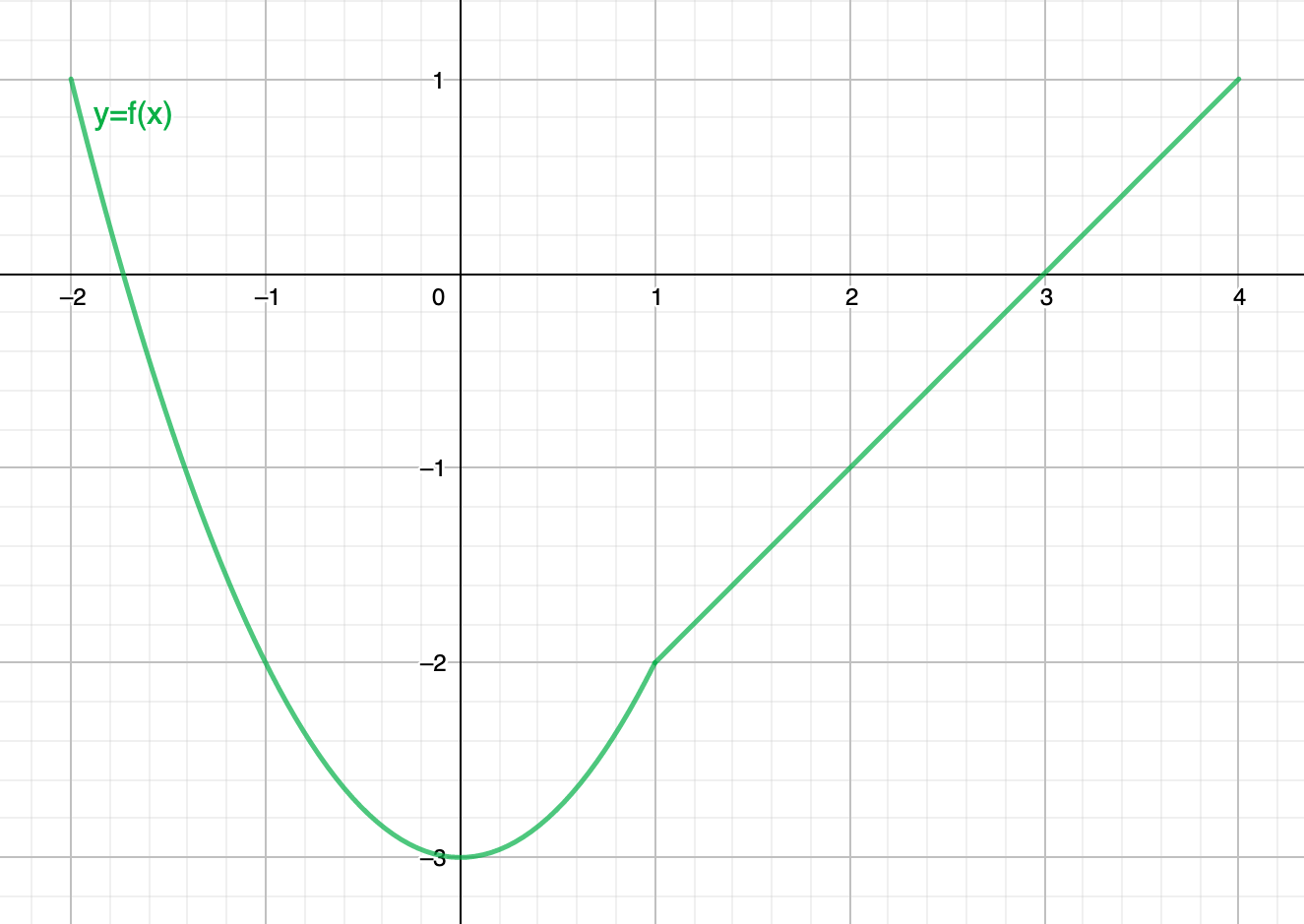
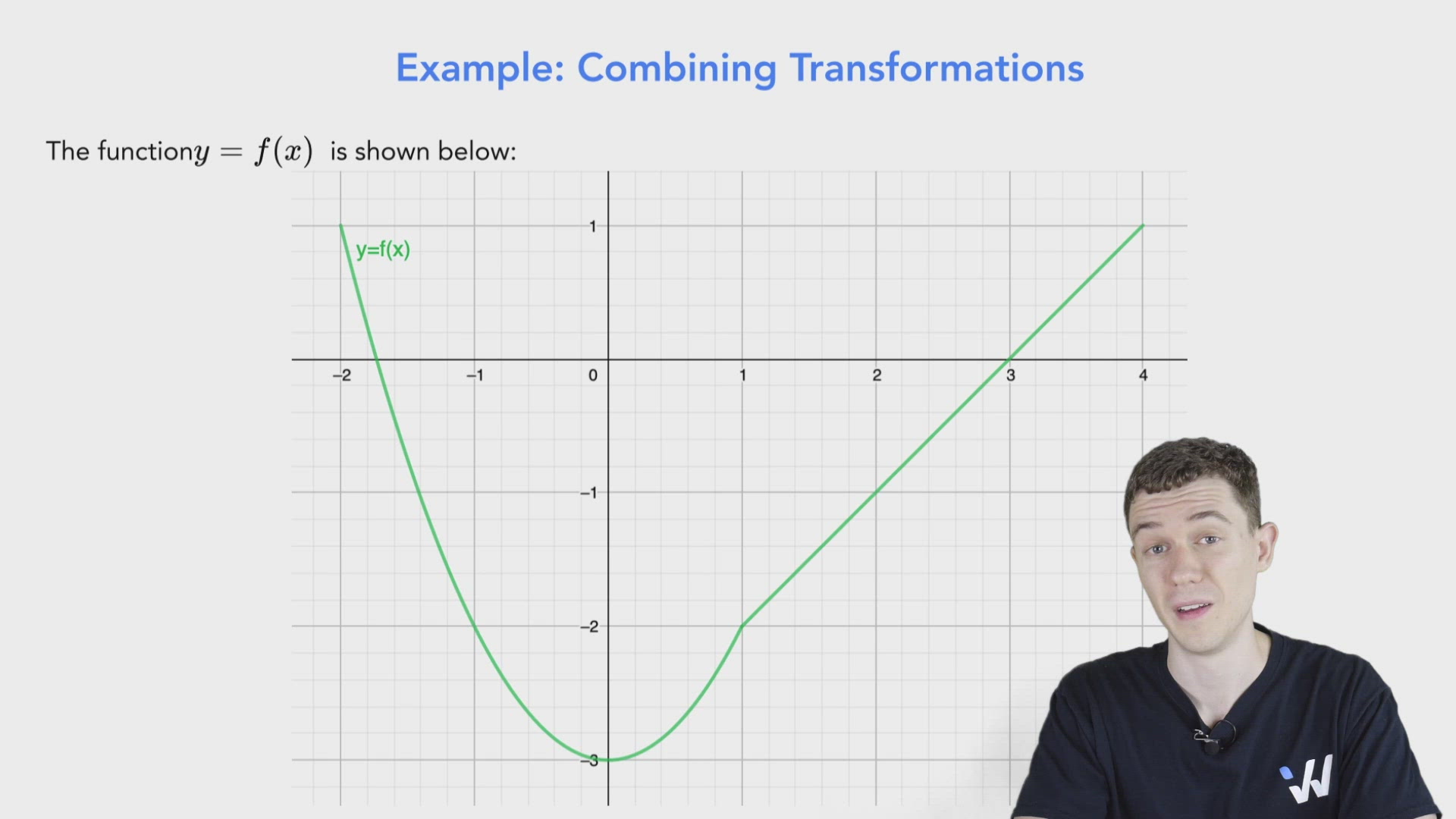
The functiony=f(x) y=f(x)~ is shown below:

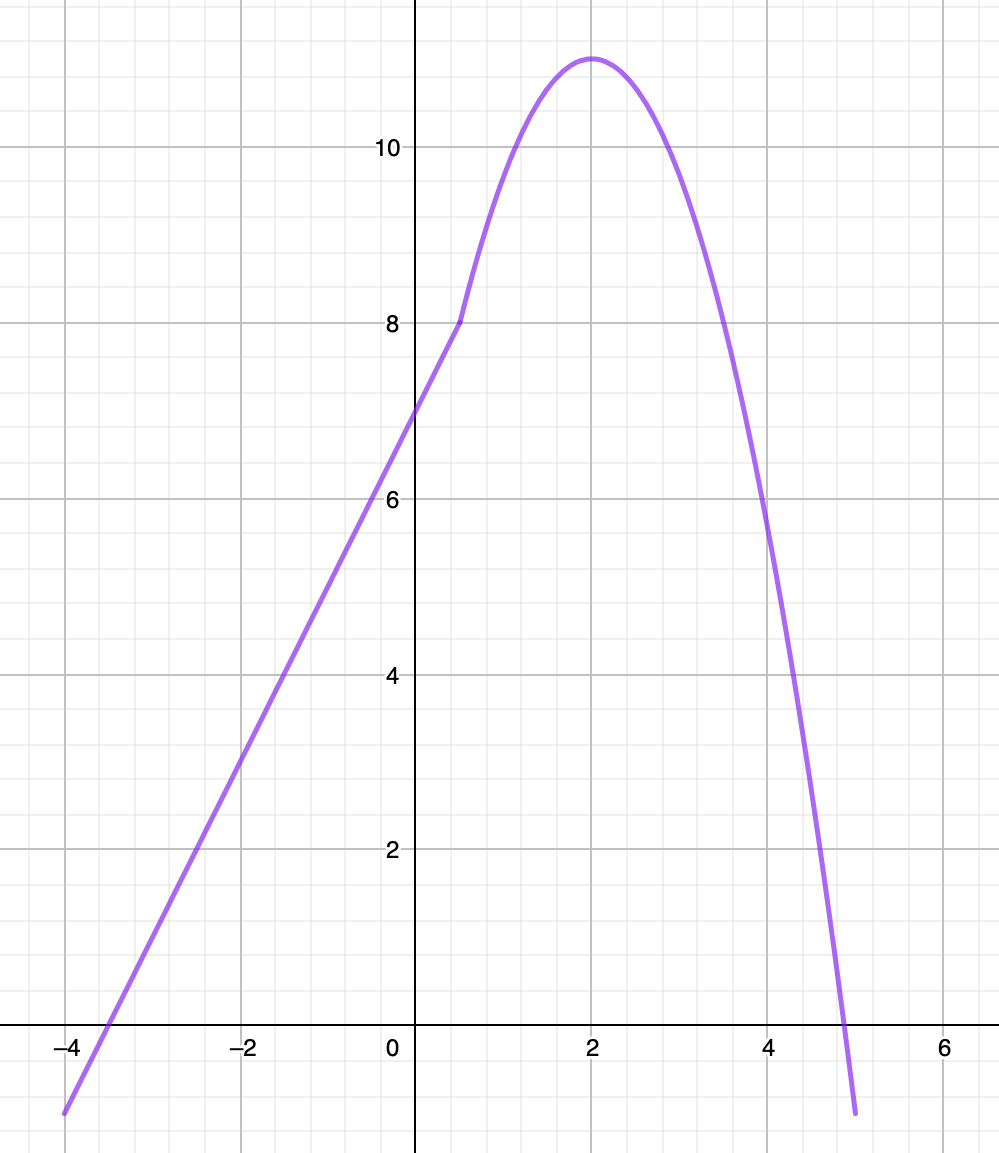
Graph y=−3f(−23(x−2))+2, y=-3f(-\frac{2}{3}(x-2))+2,~ identifying the transformations that occured.


The transformations that occurred are:
Horizontal‾Vertical‾Reflection about the y-axisReflection about the x-axisExpansion by a factor of  32Expansion by a factor of 3Translation 2 units rightTranslation 2 units up\begin{array}{l c c l} \underline{\text{Horizontal}}&&&\underline{\text{Vertical}}\\\\ \text{Reflection about the y-axis}&&&\text{Reflection about the x-axis}\\\\ \text{Expansion by a factor of}~~ \frac{3}{2}&&&\text{Expansion by a factor of 3}\\\\ \text{Translation 2 units right}&&&\text{Translation 2 units up} \end{array}

The table of values for y=f(x) y=f(x)~ and y=−3f(−23(x−2))+2y=-3f(-\frac{2}{3}(x-2))+2:
xf(x)−210−31−23041x−3f(−23(x−2))+25−12110.58−2.52−4−1\begin{array}{c c c c} \begin{array}{|c|c|}\hline x&f(x)\\\hline -2&1\\\hline 0&-3\\\hline 1&-2\\\hline 3&0\\\hline 4&1\\\hline \end{array}&&& \begin{array}{|c|c|}\hline x&-3f(-\frac{2}{3}(x-2))+2\\\hline 5&-1\\\hline 2&11\\\hline 0.5&8\\\hline -2.5&2\\\hline -4&-1\\\hline \end{array} \end{array}
Sketch:

The following table of values is for the function y=f(x):y=f(x):
xy−810−67.5−45−36−210\begin{array}{|c|c|} \hline x&y\\\hline -8&10\\\hline -6&7.5\\\hline -4&5\\\hline -3&6\\\hline -2&10\\\hline \end{array}

Which of the following is a table of values for y=2f(−12(x−1))+1y=2f(-\frac{1}{2}(x-1))+1?

Practice: Combining Transformations

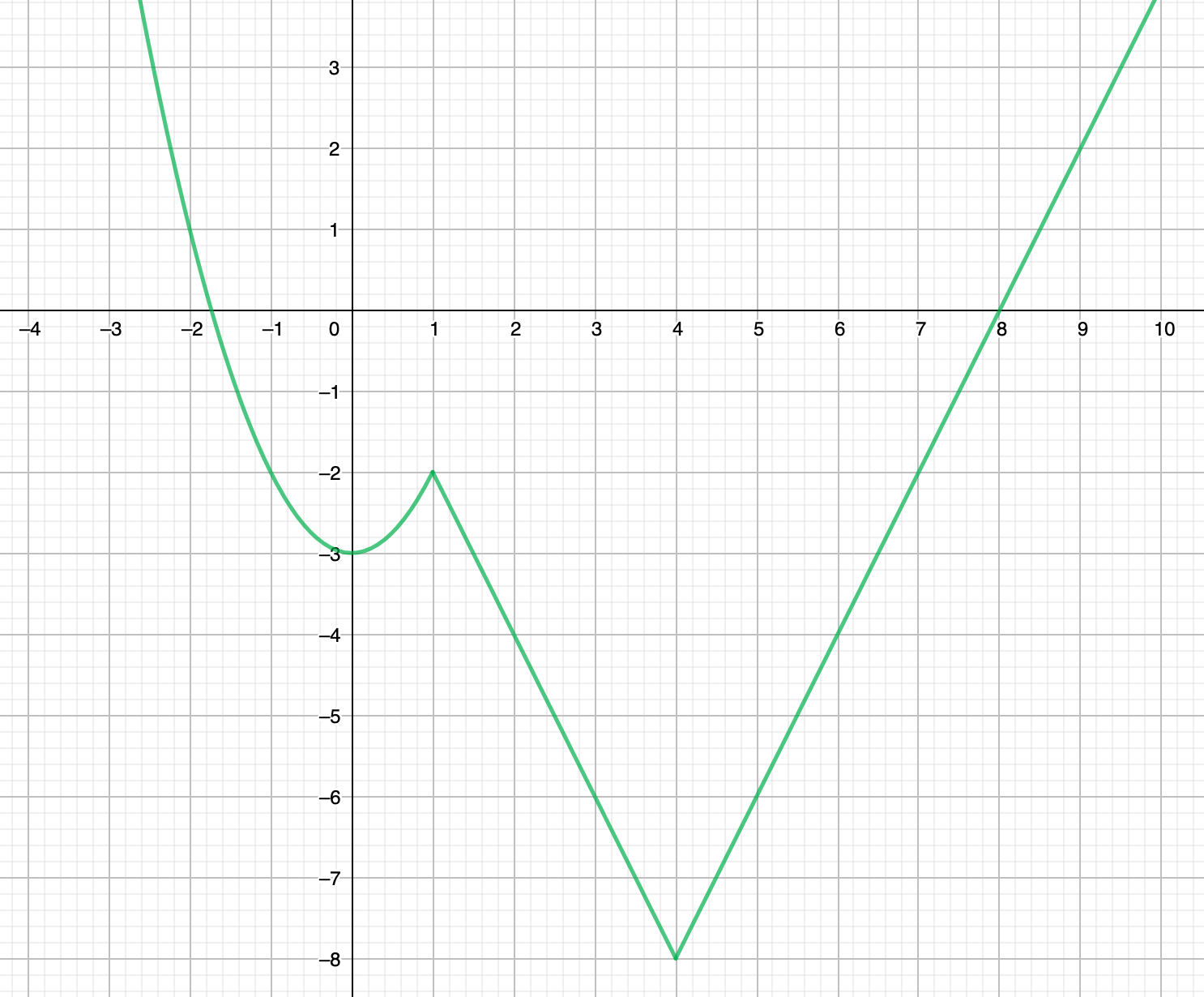
Sketch y=−12(13x+2)2−1y=-\frac{1}{2}\Big(\frac{1}{3}x+2\Big)^2-1.

Practice: Combining Transformations

If the point (6,−4) (6, -4)~ is on the graph of the function y=−4f(−5x+1)−2y=-4f(-5x+1)-2, then what point must be on the graph of the function y=f(x)?y=f(x)?
Extra Practice