Popular Courses
Find My Course
0:00 / 0:00
Arithmetic Series
What is a Series?
- A series is the sum of the terms of a sequence, usually denoted .
- An arithmetic series is the sum of the terms of an arithmetic sequence.
- A partial sum of a series is the sum of the first terms of the sequence, denoted .
Example
Consider the arithmetic sequence .
We can find the associated arithmetic series by replacing the commas with signs:
The partial sum of the first three terms is:
Gauss's Method for Arithmetic Series
As a child, famous mathematician Gauss was asked to add the numbers from 1 to 100. This is how he did it:
Define the arithmetic series .
Let's write the series in two different ways and add up corresponding pairs:
If we add the series to itself in this way, what do you notice about the sum of each pair?
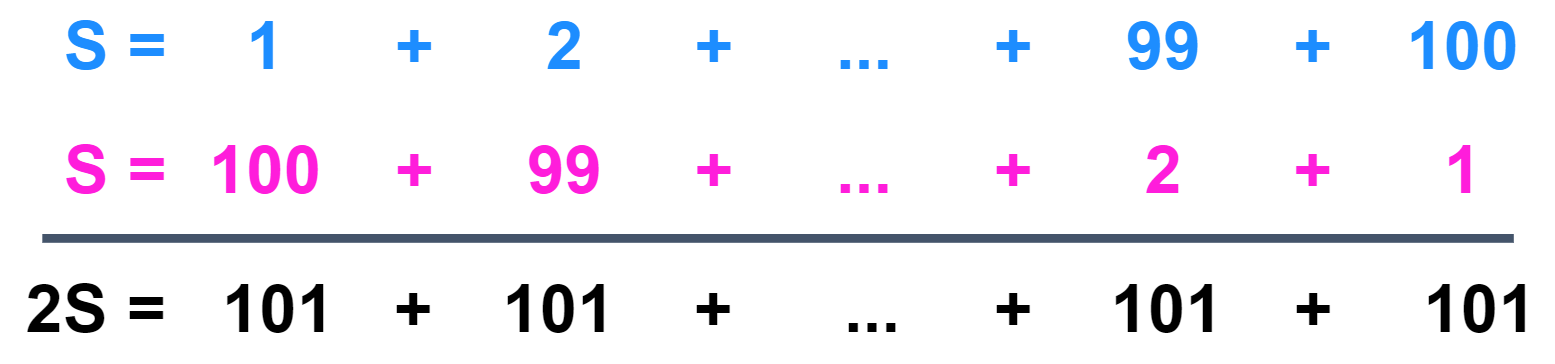
During this process, we added . The sum of each pair of terms is always , and this happens 100 times:
General Formula
The partial sum of an arithmetic series can be calculated with the formula:
- is the number of terms to add
- is the first term, and is the last term we want to include
Another Formula for Arithmetic Series
If you know the first term, , and the common difference, , we have another formula for arithmetic series:
Example
Compute for the sequence
The first term is
The common difference is

0:00 / 0:00
Example: Arithmetic Series

A charity is celebrating its 40th anniversary and poses a challenge to celebrate the occasion.
The first donor is to give a single $5 bill, and each subsequent donor is asked to give one more $5 bill than the previous donor. This will continue up until the 40th donation.
How much money will be raised by the end of this challenge?
The series is given by .
Since this is an arithmetic series, we can use either of the formulas.
Method 1
There are terms, the first term is and the last term is .
Method 2
There are terms, the first term is , and the common difference is .
Practice: Arithmetic Series
Match each arithmetic series with the proper values.
A.
B.
C.
D.
Practice: Arithmetic Series
What is the sum of the first 10 terms of an arithmetic series with and ?
Practice: Arithmetic Series

A space shuttle is launching off from Earth towards the Moon. Every second, the spacecraft travels 100m farther than it did the previous second. If it starts at rest for the first second, how far has the space shuttle travelled after 30 seconds?