Wize High School Algebra II Textbook (Common Core) > Sequences & Series
Geometric Sequences
Popular Courses
Find My Course
0:00 / 0:00
Geometric Sequences
A geometric sequence is a sequence where every number is the result of multiplying the previous number by some constant multiple.
We call this multiple the common ratio, we can find it by taking any number in the sequence and dividing it by the previous number.
Examples
- Is a geometric sequence?Yes
- What is the common ratio?2
- Is a geometric sequence?Yes
- What is the common ratio?0.8
- Is a geometric sequence?Yes
- What is the common ratio?-3
- Is a geometric sequence?No
- What is the common ratio?No common ratio -- this is an arithmetic sequence with common difference of 2
General Term
If the first term is and the common ratio is , then the geometric sequence looks like this:
The general term of a geometric sequence is an exponential relation given by:
0:00 / 0:00
Example: Geometric Sequences
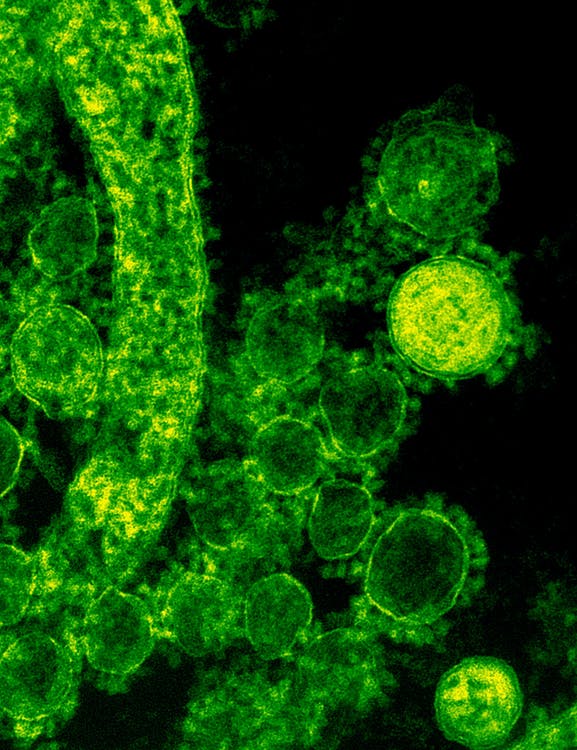
A petri dish contains 10 individual bacterial cells at the end of the first day of an experiment. It is observed that each cell splits into 2 daughter cells every 8 hours. Researchers are interested in predicting the number of bacteria after days.
a) What is the common ratio if we want to model the number of bacteria at the end of each day?
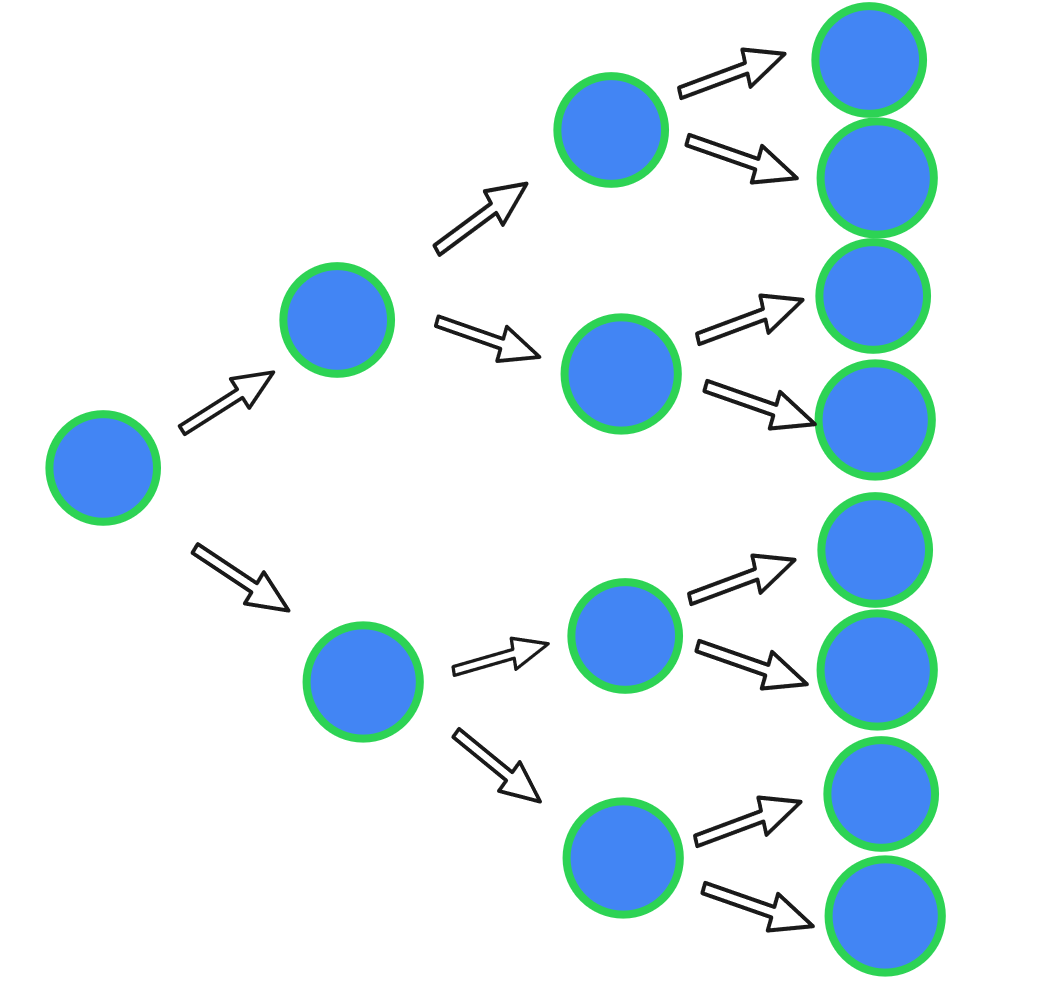
Since each cell splits into 2 after 8 hours, those two cells split into 4 after 16 hours, and finally into 8 cells after 24 hours.
That means that every day, each cell from the day before turns into 8 new cells, so the common ratio is .
b) How many bacterial cells are there at the end of the fourth day?
Let's write out the first four terms of the resulting sequence:
We can see that there are 5120 bacteria after four days.
c) Write the general term for the number of bacteria, , at the end of the day.
- The first term is the number of bacteria after the first day:
- The common ratio we found to be
Using the formula for a geometric sequence, , we can write the general term:
Practice: Geometric Sequences
Given the sequence
a) is this a geometric sequence?
b) what is the next term in the sequence?
c) write an expression for the general term of the sequence.
Practice: Geometric Sequences
Given a geometric sequence with terms and , determine .
Practice: Geometric Sequences
A radioactive substance loses a (constant) fraction of its mass every year as seen in the table below.
After how many years is there 128 kg of mass remaining?
[Use technology to graph the general term as a function of ]