
0:00 / 0:00
Geometric Series
A geometric series is the sum of the terms of a geometric sequence.
Wize Concept
Recall, for a geometric sequence:
- is the first term (also called )
- is the common ratio (found by dividing any term by the term that comes before it)
The sum of the first terms of a geometric series (called the partial sum) is given by:
Note: an equivalent formula can be written using the first term, , and the th term, :
Example
Consider the geometric sequence
What is the associated geometric series?
2+6+18+54+...
What is the common ratio?
3
What is the sum of the first 4 terms of this series?
The first term is , and we want to find the sum of the first terms:
When is small, we can easily check:
How to derive the Geometric Series Formula
The sum of the first terms of a geometric series with as the common ratio is given by the formula:
Let's see how we can build this formula so we can better understand where it comes from.
1. We can begin with the expression for the first terms of a geometric series.
Note that since our first term is just , this is the same as . So to have exactly terms, the last term must be .
2. All of these have a common factor of . Factoring this out we have
3. In parenthesis, we have a polynomial. This can be replaced using . One way to verify this step is by performing long division.
4. We can reverse the order of subtraction in the top and the bottom. This is the same as factoring out a -1
5. Finally we cancel out the -1's and arrive at the formula for the sum of a geometric series.
These steps show us that that the following are equal:
0:00 / 0:00
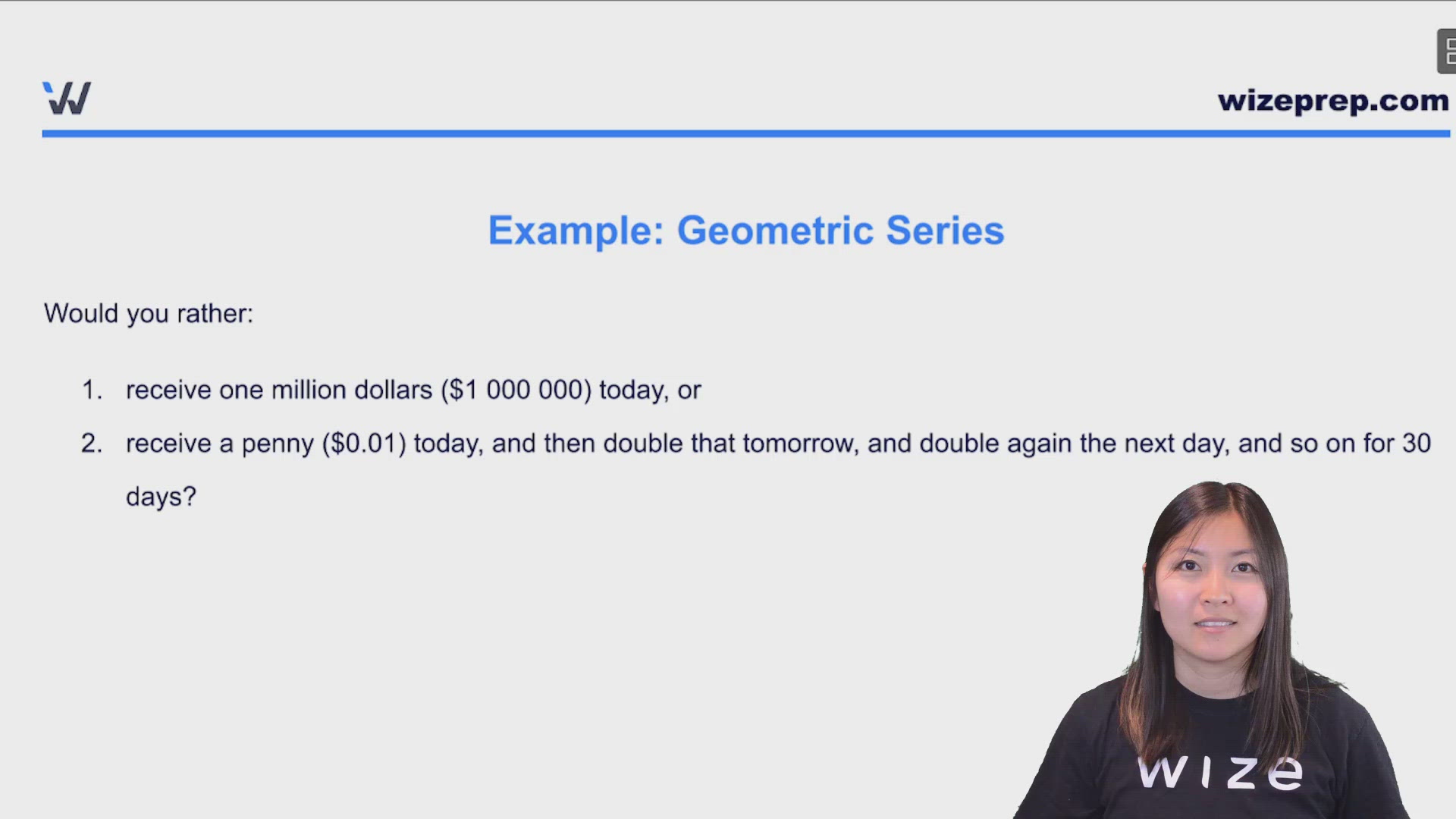
Example: Geometric Series
Would you rather:
- receive one million dollars ($1 000 000) today, or
- receive a penny ($0.01) today, and then double that tomorrow, and double again the next day, and so on for 30 days?
Let's use geometric series to calculate the total amount of money received in the second scenario, where days.
In this scenario, the geometric series is:
The first term of the series corresponds to the amount on the first day:
The common ratio is how much we multiply the amount by every day:
Therefore, by waiting 30 days, the second scenario allows you to receive more than 10 times what is offered in the first scenario!
This is the power of geometric growth, which is the same exponential growth but with discrete steps (not continuous).
Practice: Geometric Series
Select all of the options that are geometric series.
Practice: Geometric Series
a) Determine the sum of the geometric series .
b) Determine the number of terms in the geometric series whose sum is 3280.
Practice: Geometric Series

A diver wants to practice holding her breath once per day. On her first day of training, she holds her breath for 30 seconds. Every day, she manages to hold her breath 10% longer than the day before.
Over these two weeks, what was the average amount of time she managed to hold her breath every day?