Wize High School Algebra II Textbook (Common Core) > Sequences & Series
Pascal's Triangle and the Binomial Expansion
Popular Courses
Find My Course
0:00 / 0:00
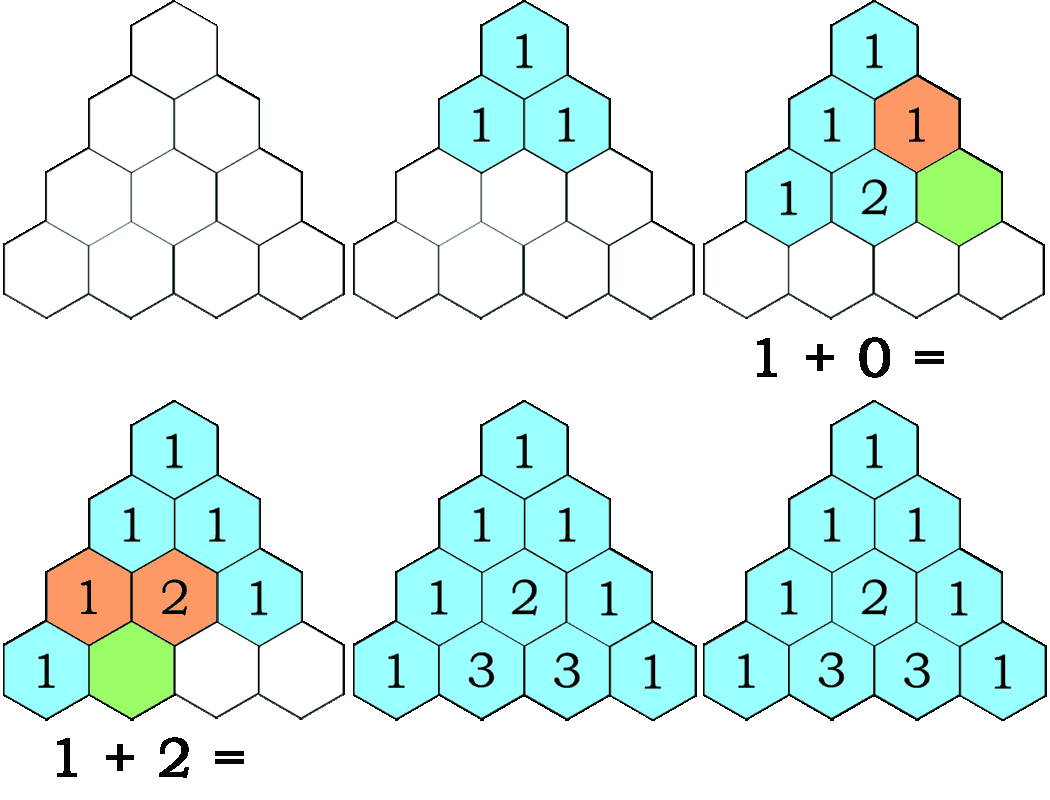
Pascal's Triangle
Pascal's Triangle is made by starting with a single 1 in the top row, then two 1s in the next row.
For each of the next rows, each number is the sum of the two numbers directly above it.
Wize Tip
- Every row is symmetric
- The rows are numbered starting with row 0
- You can tell which row you are looking at by the second entry: the second entry of row is always , e.g. the second entry of row 3 is 3.
0:00 / 0:00
Example: Pascal's Triangle and the Binomial Expansion
Expand and simplify using Pascal's triangle.
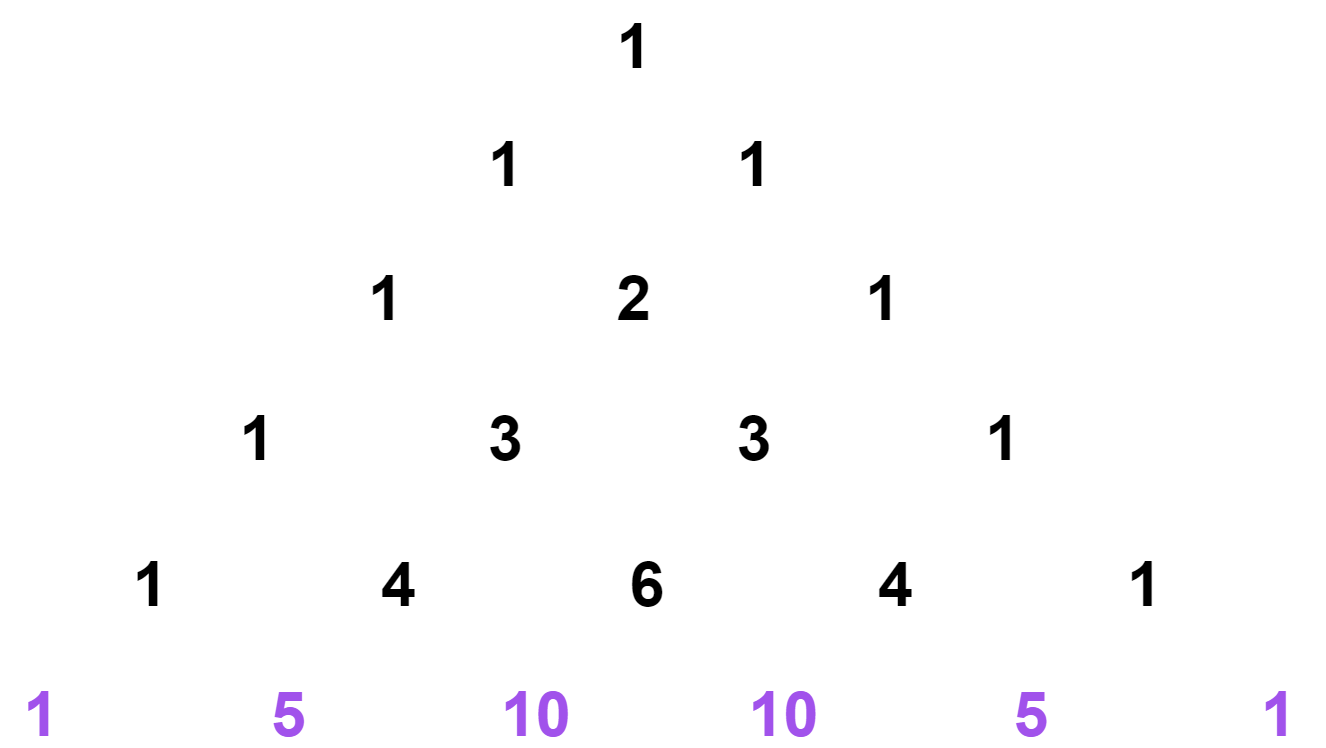
Step 1: Write out the n+1 row of the Pascal's triangle
We need to write out the 5th row of the Pascal's triangle:
(*remember that the triangle starts with row 0)
Step 2: Write out the binomial expansion of the form
Notice that the first term inside the brackets is and the second term is :
➡ Fill in the coefficients using Pascal's triangle:
➡ Fill in the terms:
➡ Fill in the terms:
Step 3: Simplify
Practice: Pascal's Triangle and the Binomial Expansion
Match each of the following powers of binomials with the appropriate row of Pascal's triangle.
A.
B.
C.
D.
Practice: Pascal's Triangle and the Binomial Expansion
a) Expand and simplify
b) Expand and simplify the first three terms of
Practice: Pascal's Triangle and the Binomial Expansion
How many possible ways are there to move the red checker down to the highlighted square?
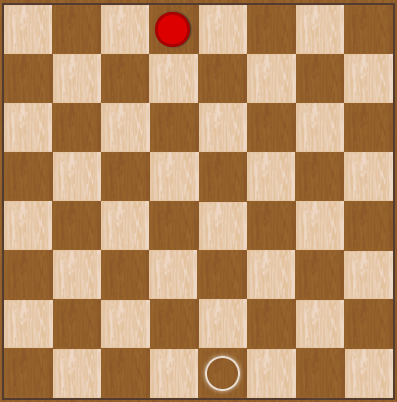
Note: a checker can only move diagonally by a single space (no jumping).