Wize High School Grade 12 Pre-Calculus Textbook > Rational Functions
Rational Functions
Popular Courses
Grade 12 Advanced Functions
Ontario High School
Grade 12 Pre-Calculus/Functions
Canada High School
Math 30-1
Alberta High School
Pre-Calculus 12
British Columbia High School
MATH 1LS3
McMaster University
MATH 206
Concordia University
MTH 103
Michigan State University
MATH 22
Pennsylvania State University
MAC 1140
University of Florida
MATH 150
Texas A&M University
MATH 41
Pennsylvania State University
MAT 170
Arizona State University - Tempe
MAC 1105
Florida State University
MAT 012
University of California - Davis
MTH 103A
Michigan State University
MTH 116
Michigan State University
MAC 1147
University of Florida
MATH 140
San Diego State University
MATH 2312
University of Houston
MA 15300
Purdue University

0:00 / 0:00
Rational Functions
A rational function can be expressed as:
where is the largest exponent in the numerator and is the largest exponent in the denomiator.
Properties of Rational Functions
- X-Intercepts can be found by setting and solving for
- Vertical asymptotes can be found by setting the denominator to 0 and solving for
- Horizontal asymptotes:
- If : There is a horizontal asymptote at
- If : There is a horizontal asymptote at
- If : There is no horizontal asymptote. There may be an oblique/diagonal asymptote.
- If factoring the numerator & denominator of , any terms that cancel out indicates where a missing point/hole in
- The domain is the set of all real numbers except where there are vertical asymptotes & missing points/holes
- The range is the set of all real numbers except where there are horizontal asymptotes in most cases
Watch Out!
Rational functions may only attain values strictly above or below horizontal asymptotes. This will affect the range.
Example 1
Let's look at .
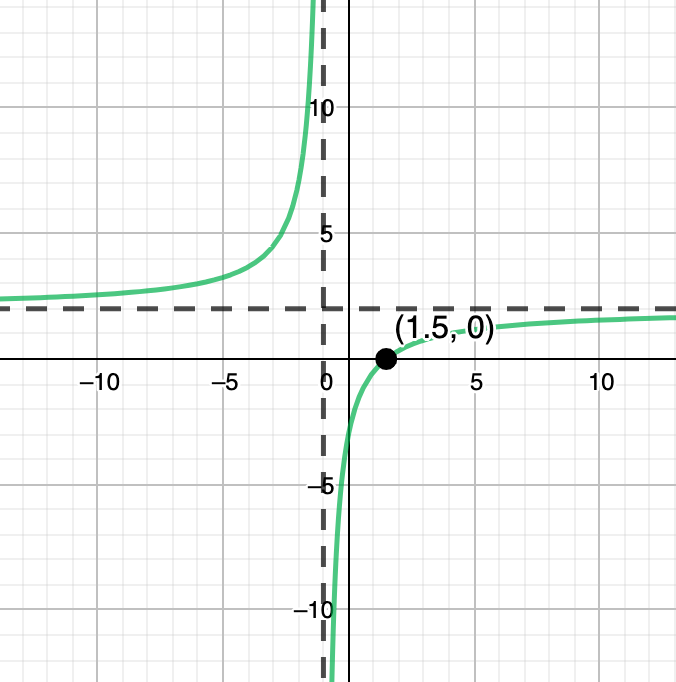
- -Intercept:
- Vertical Asymptote:
- Horizontal Asymptote:
- Missing Points/Holes: None
- Intervals of Increasing:
- Intervals of Decreasing: NA
- Domain:
- Range:

0:00 / 0:00
Example: Rational Functions
A graph of the function is sketched below:
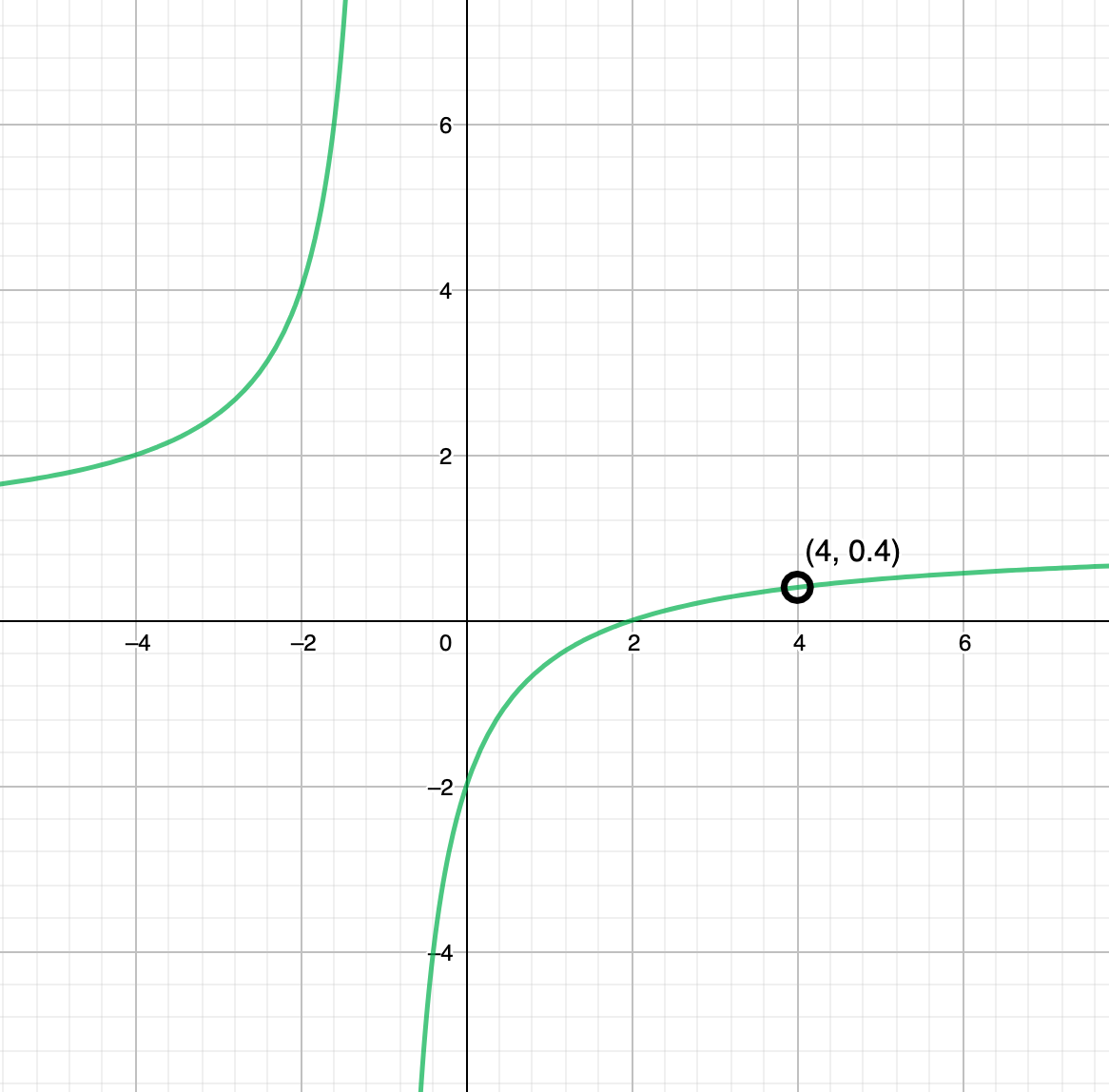
Identify the equations for any vertical & horizontal asymptotes, and missing points/holes.
Factor :
Vertical Asymptotes:
Let .
The vertical asymptote is at
Horizontal Asymptote:
The degree of the numerator is equivalent to the degree in the denominator.
Therefore, .
Missing Points/Holes
Missing points/holes exist whenever terms in the numerator and denominator cancel.
Since the term was eliminated, there is a missing point/hole at
0:00 / 0:00
Example: Rational Functions
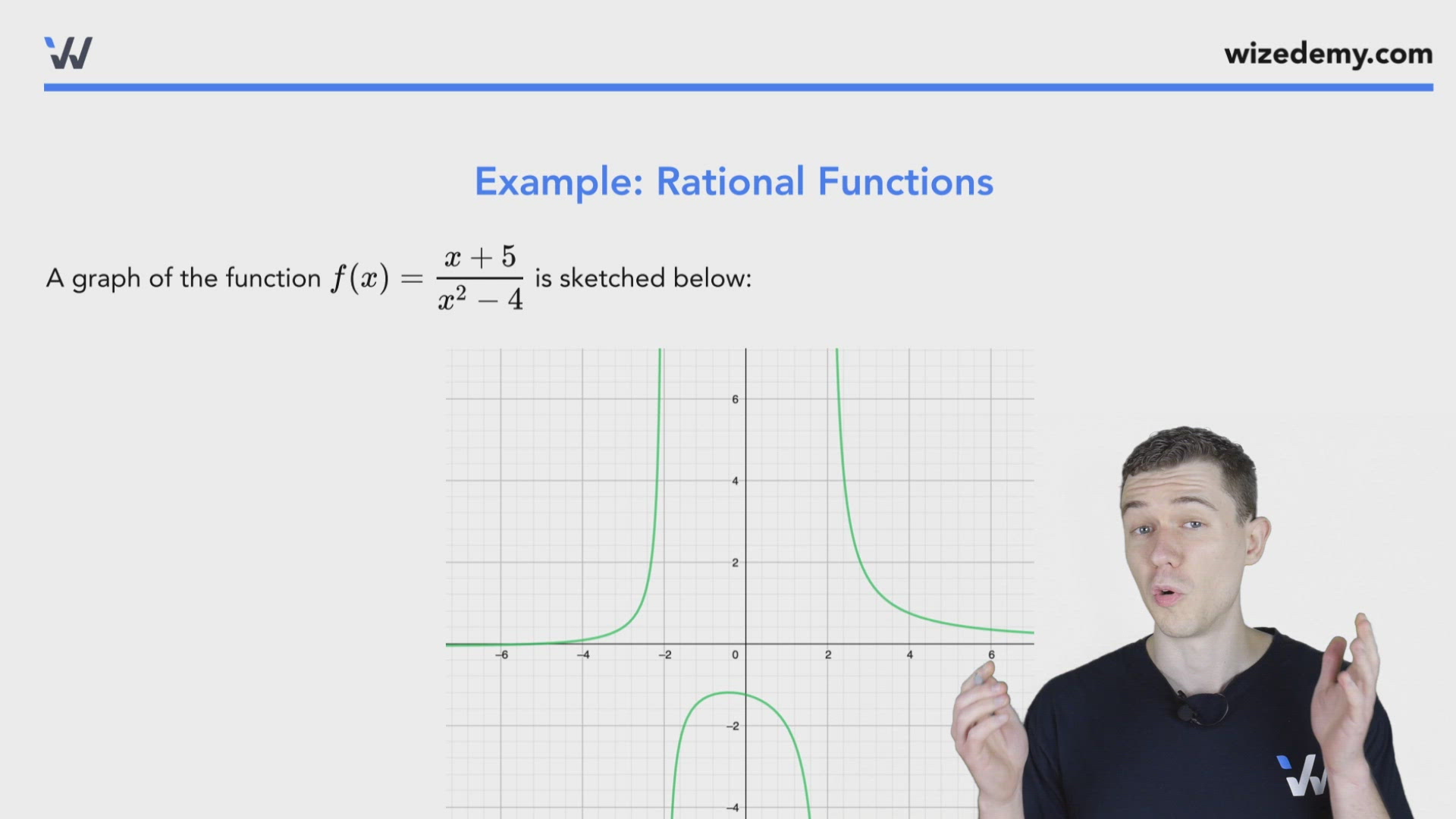
A graph of the function is sketched below:

Identify the equations for any vertical & horizontal or oblique asymptotes, and missing points/holes.
Factor :
Vertical Asymptotes:
Let and let
The vertical asymptotes are at
Horizontal Asymptote:
The degree of the numerator is less than the degree in the denominator.
Therefore, .
Missing Points/Holes
Missing points/holes exist whenever terms in the numerator and denominator cancel.
Since there are no terms the cancel out, there are no missing points/holes.
0:00 / 0:00
Example: Rational Functions
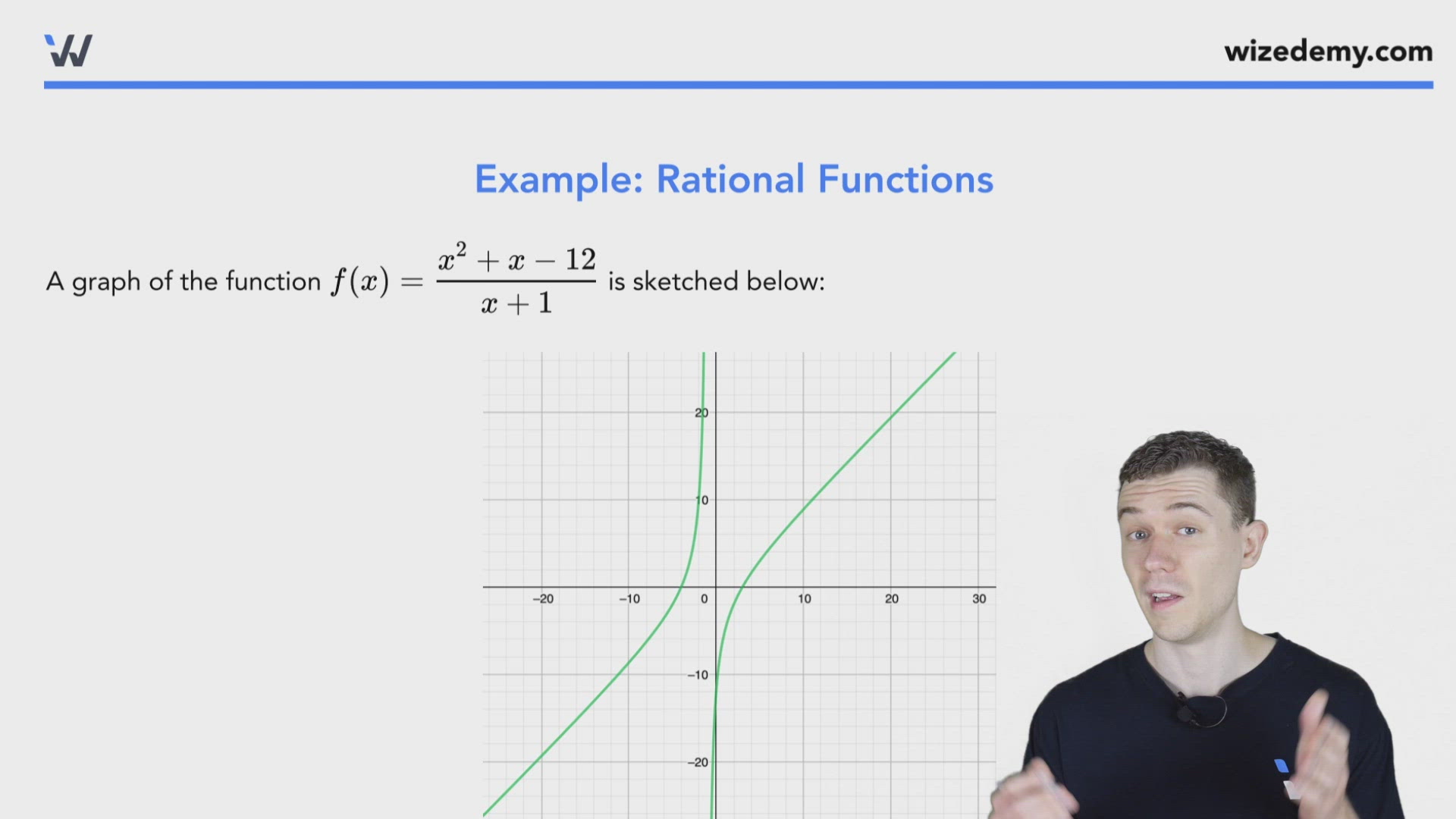
A graph of the function is sketched below:
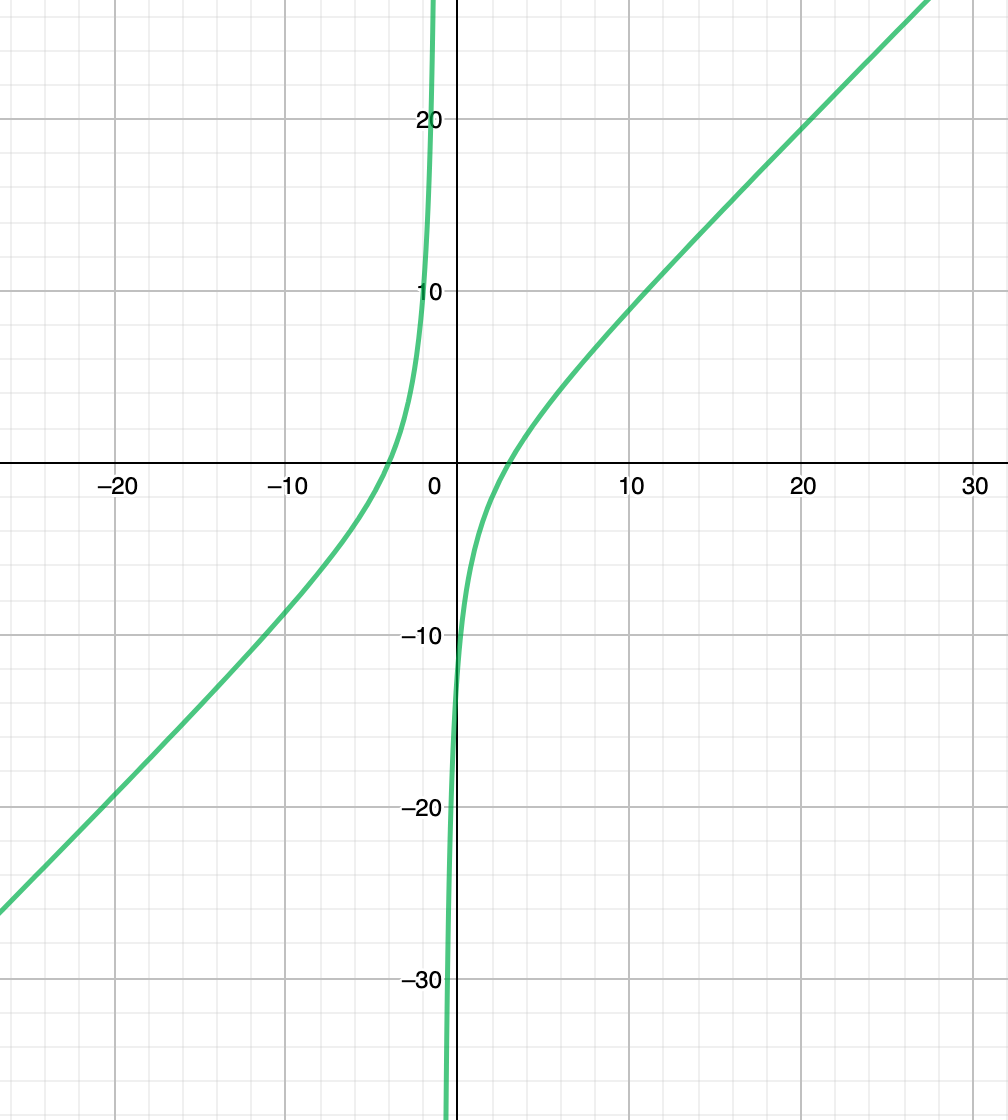
Identify the equations for any vertical & horizontal or oblique asymptotes, and missing points/holes.
Factor :
Vertical Asymptotes:
Let .
The vertical asymptote is at .
Horizontal Asymptote:
The degree of the numerator is greater than the degree in the denominator.
Therefore, there is an oblique asymptote which can be found by dividing :
The oblique asymptote does not count the remainder.
So, the oblique asymptote becomes the quotient .
Missing Points/Holes
Missing points/holes exist whenever terms in the numerator and denominator cancel.
Since there are no terms the cancel out, there are no missing points/holes.
Practice: Rational Functions
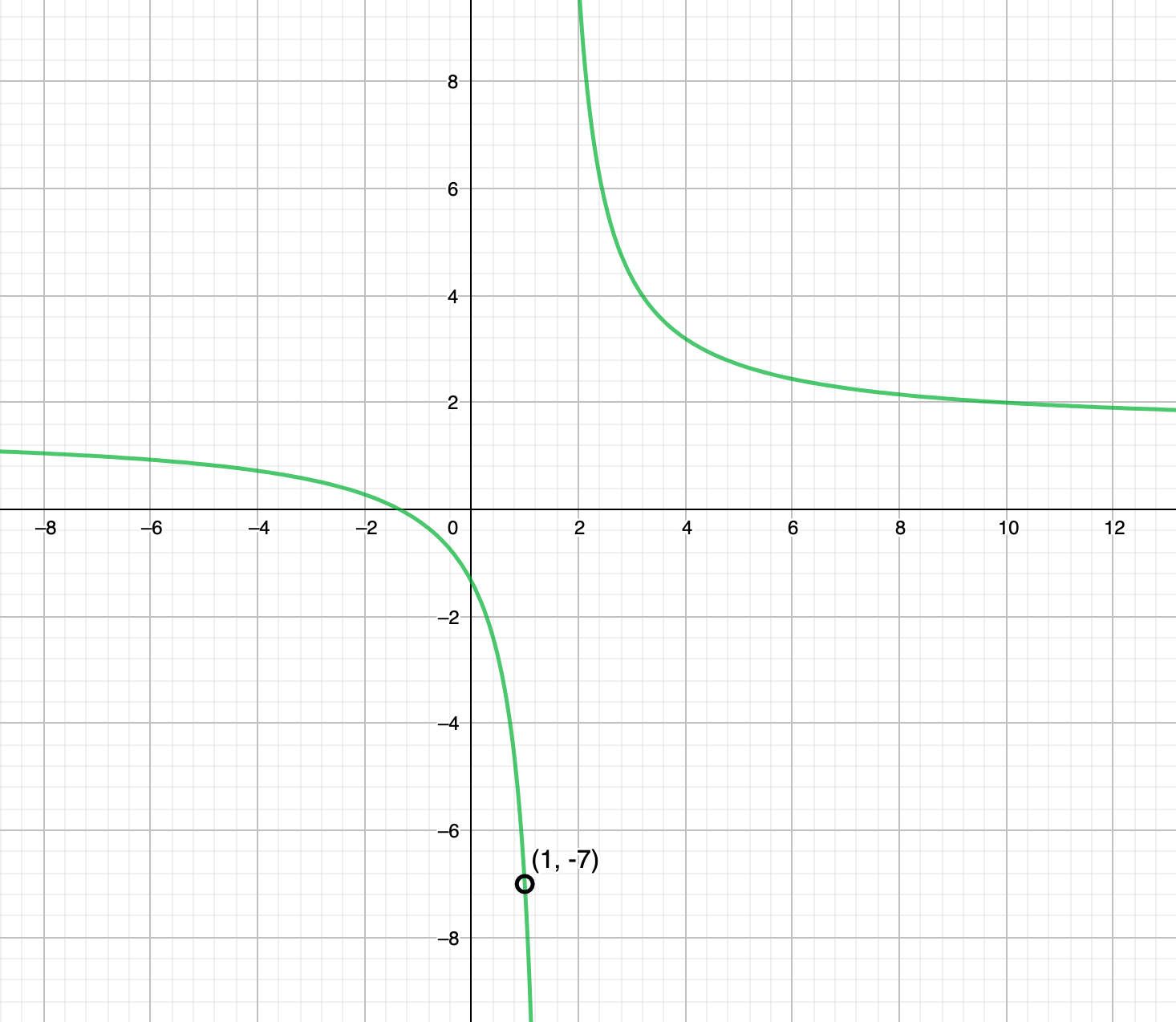
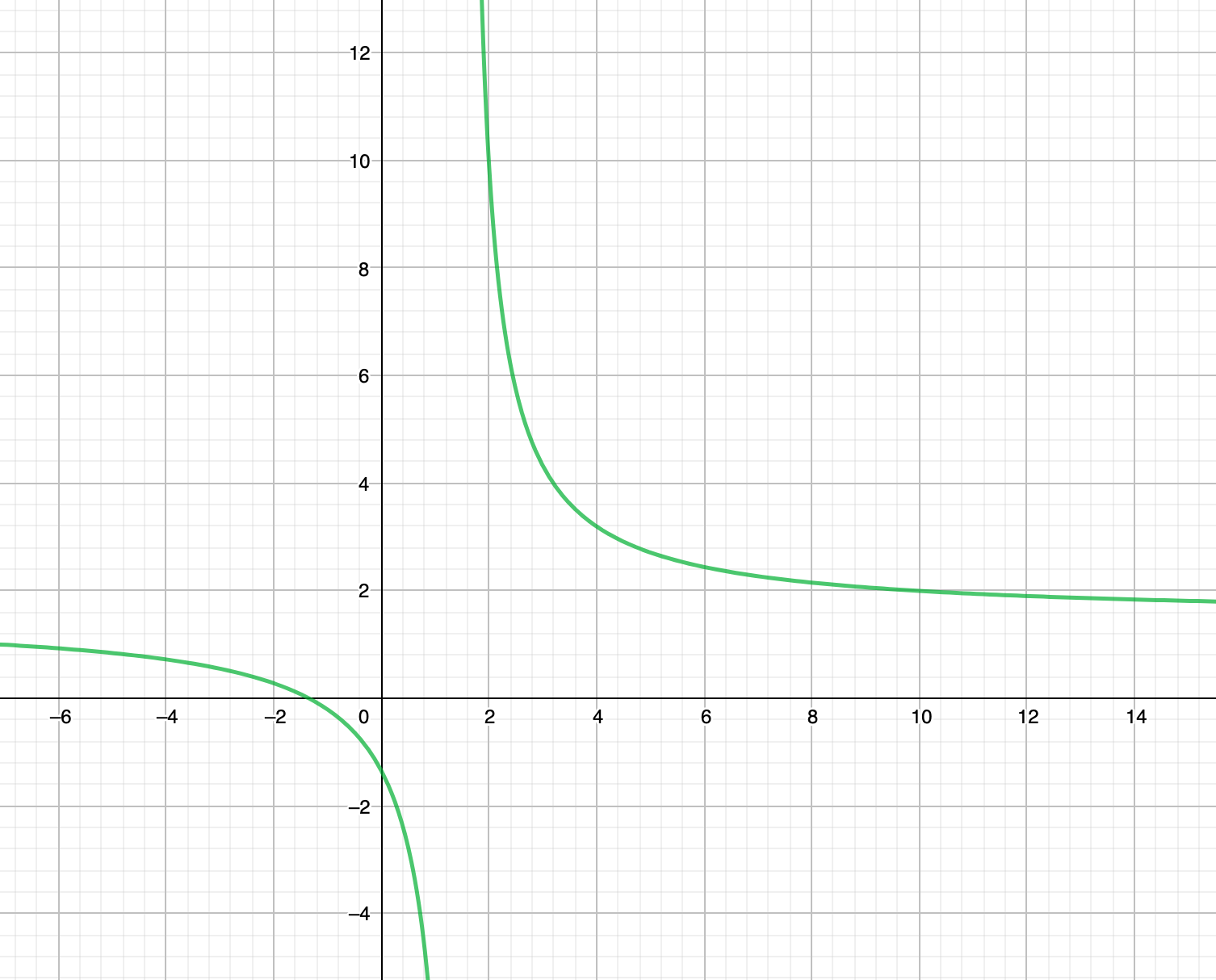
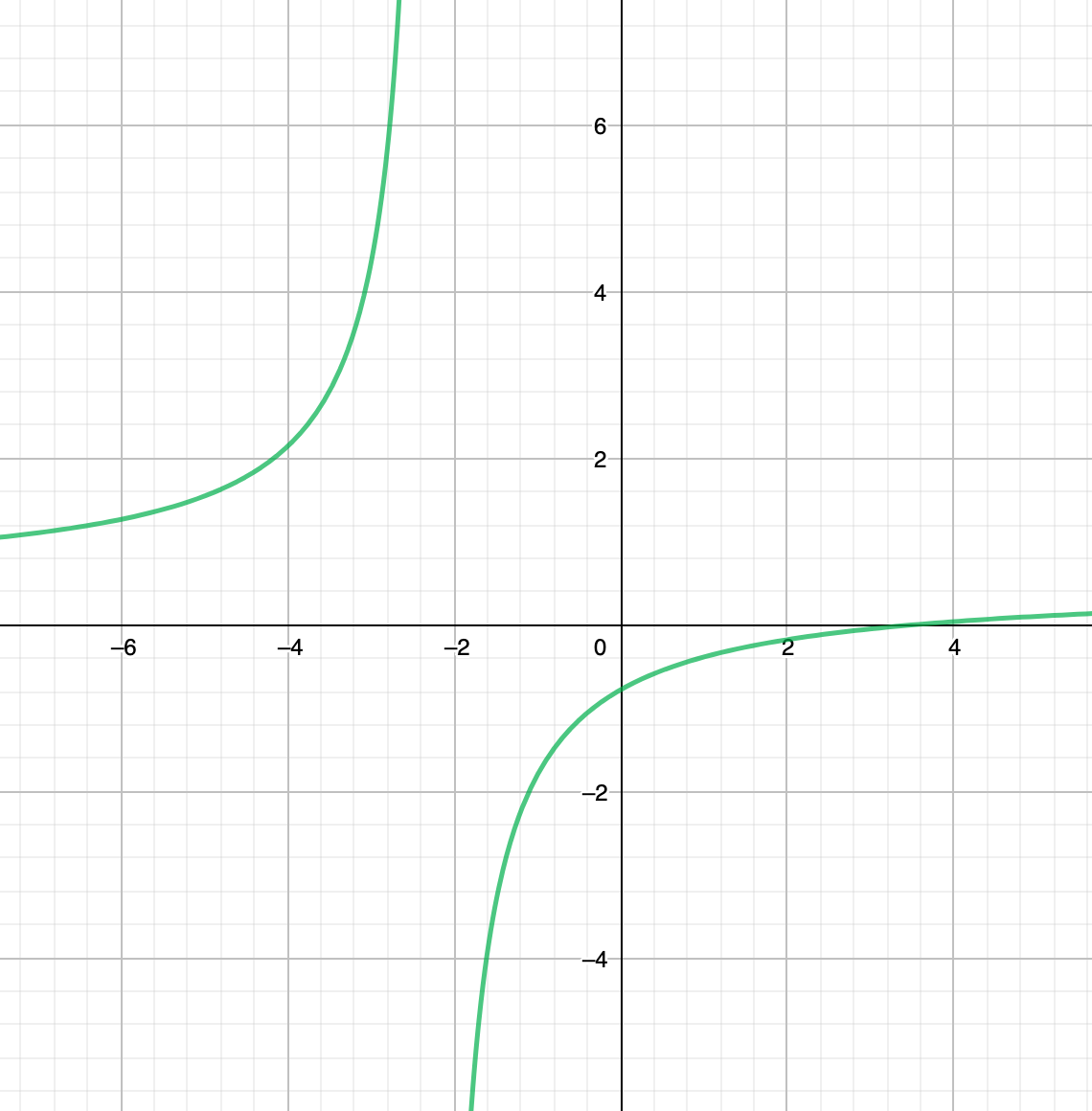
Match the reciprocal function with the correct sketch of its graph.
A.
B.
C.
Identify the vertical asymptotes, the horizontal asymptotes, the x-intercepts, and any missing points of:
Practice: Rational Functions
Match the equation for the rational function with its appropriate properties.
A.
A missing point at
B.
A vertical asymptote at
A horizontal asymptote at
C.
A vertical asymptote at
An x-intercept at
D.
A vertical asymptote at
An x-intercept at