Wize High School Grade 12 Pre-Calculus Textbook > Trigonometric Ratios (Radians)
Special Angles & Unit Circle in Radians
Popular Courses
Grade 12 Advanced Functions
Ontario High School
Grade 12 Pre-Calculus/Functions
Canada High School
Algebra II
US High School
Math 30-1
Alberta High School
Pre-Calculus 12
British Columbia High School
MATH 201
Concordia University
MATH 1149
Ohio State University
MAC 1140
University of Florida
MATH 150
Texas A&M University
MATH 41
Pennsylvania State University
MAC 1105
Florida State University
MAT 012
University of California - Davis
MTH 116
Michigan State University
MTH 103A
Michigan State University
MAC 1147
University of Florida
MATH 140
San Diego State University
MA 15800
Purdue University
MAC 1140C
University of Central Florida
MAC 1114C
University of Central Florida
MATH 102
California State University - Northridge

0:00 / 0:00
Special Angles & Unit Circle in Radians
The unit circle is a special case of a general circle and can be defined as:
Since the radius is 1, the trigonometric ratios become:

The Unit Circle and Special Triangles
There are 2 special triangles.
and

The special triangles are taken from the unit circle.
Each special angle on the unit circle has a matching set of coordinate points.

The C.A.S.T system describes where the trigonometric functions are positive.
- Cosine is positive in quadrant I & IV.
- All trigonometric functions are positive in quadrant I.
- Sine is positive in quadrant I & II.
- Tangent is positive in quadrant I & III.
Example
Let's evaluate using the unit circle.
Since is in quadrant II, then .
So, .
0:00 / 0:00
Reciprocal Trigonometric Ratios: Special Angles & Unit Circle
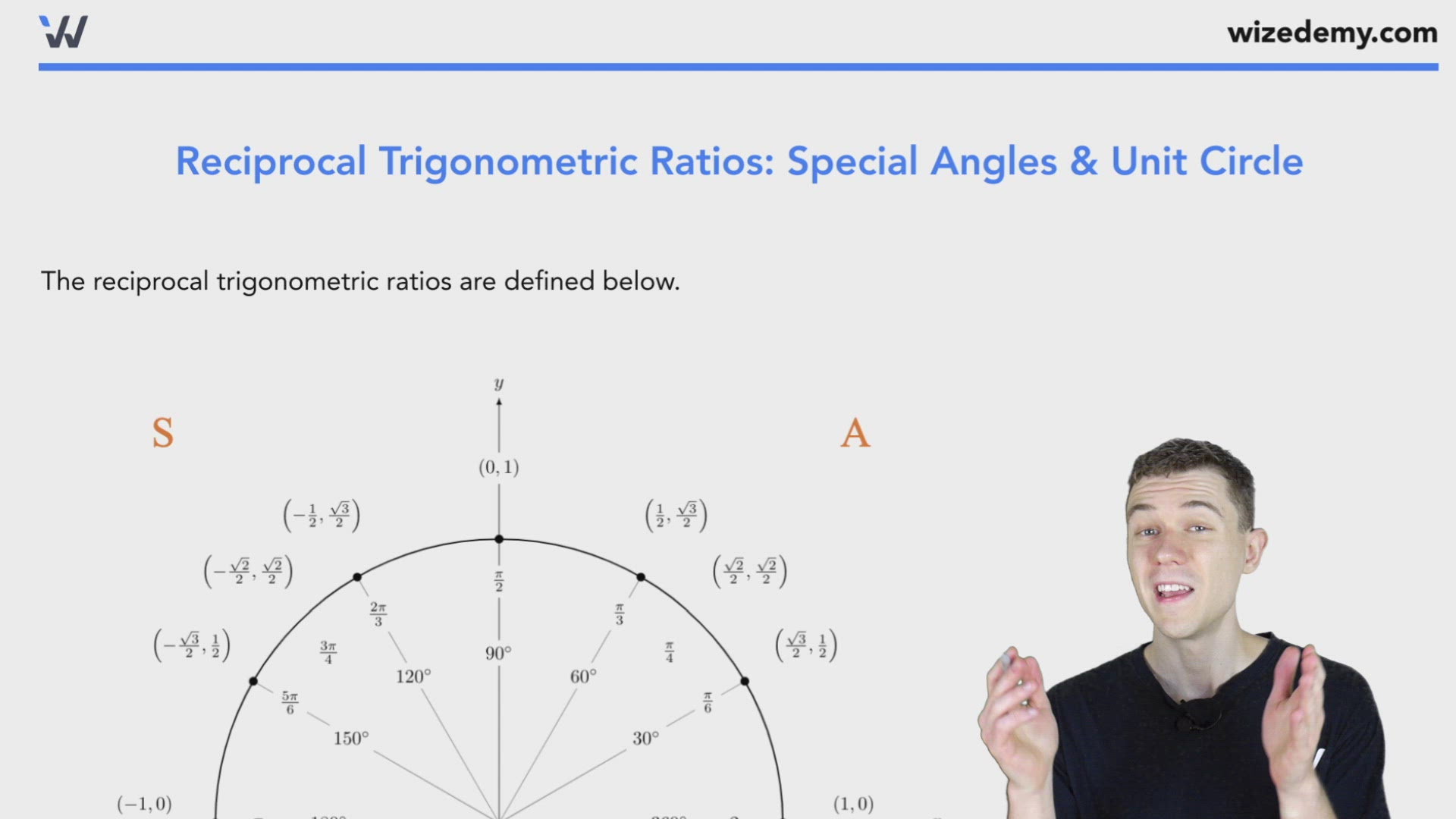
The reciprocal trigonometric ratios are defined below.
The C.A.S.T system also describes where the reciprocal trigonometric functions are positive.
- Cosine is positive in quadrant I & IV Secant is positive in quadrant I & IV.
- All trigonometric functions are positive in quadrant I All reciprocal trigonometric functions are positive in quadrant I.
- Sine is positive in quadrant I & II Cosecant is positive in quadrant I & II.
- Tangent is positive in quadrant I & III Cotangent is positive in quadrant I & III.
Example
Let's evaluate .
First,
Therefore,
0:00 / 0:00
Example: Trigonometric Ratios, the Unit Circle, & Special Angles
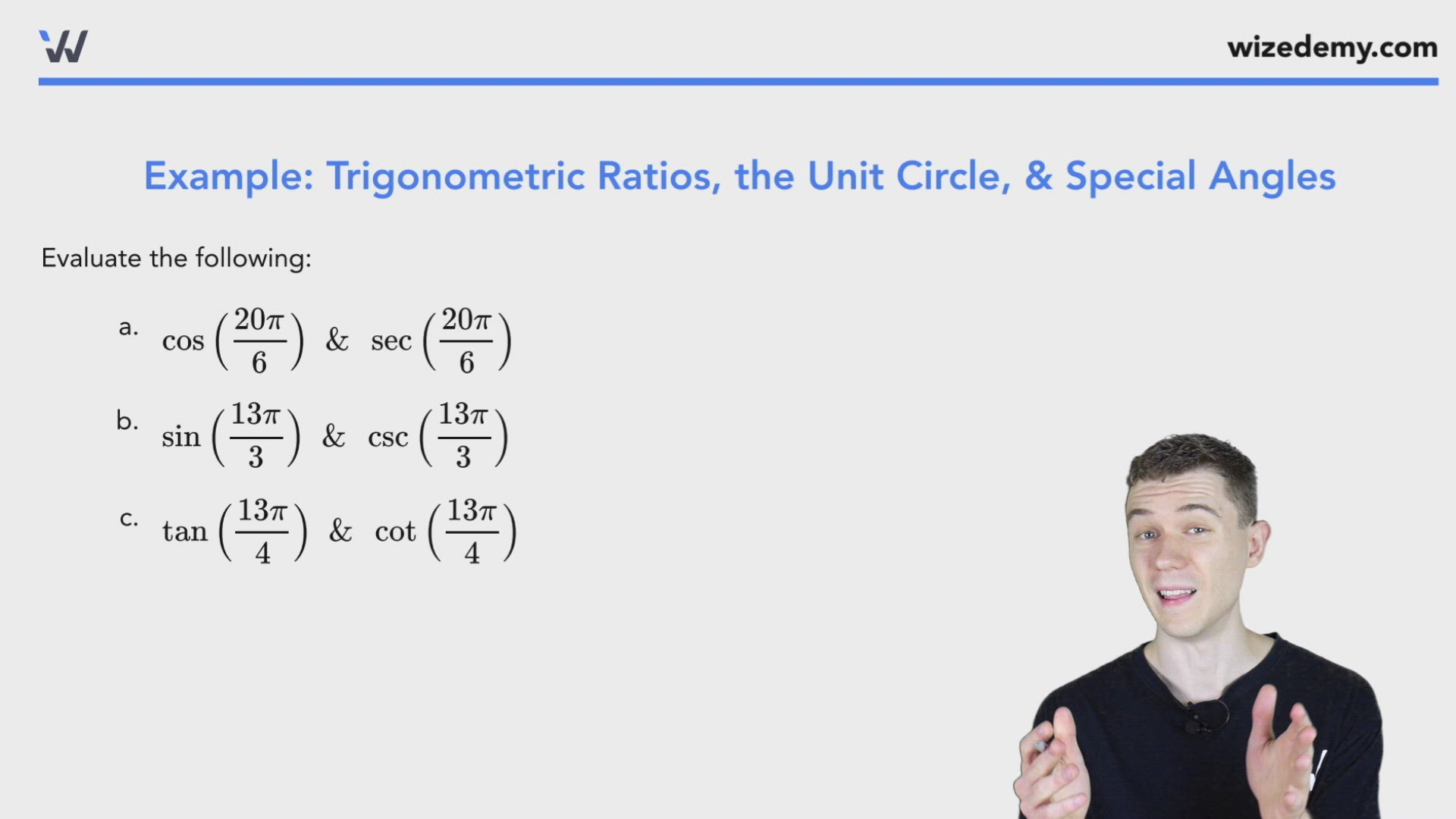
Evaluate the following:
a.
The angle is in quadrant IlI.
So, both will be negative.
Thus,
b.
The angle is in quadrant I.
So, both will be positive.
Thus,
c.
The angle is in quadrant III.
So, both will be positive.
Thus,
Practice: Trigonometric Ratios, the Unit Circle, & Special Angles
Let . Find:
Leave answers in exact form, and rationalize all denominators.
Practice: Trigonometric Ratios, the Unit Circle, & Special Angles
The terminal arm of some angle has an endpoint of . It intersects the unit circle at some point . What are the coordinate points of

Practice: Trigonometric Ratios, the Unit Circle, & Special Angles
Let for some in the domain . Determine the 5 other trigonometric ratios. Leave the answer in exact form.