0:00 / 0:00

Pythagorean Identities

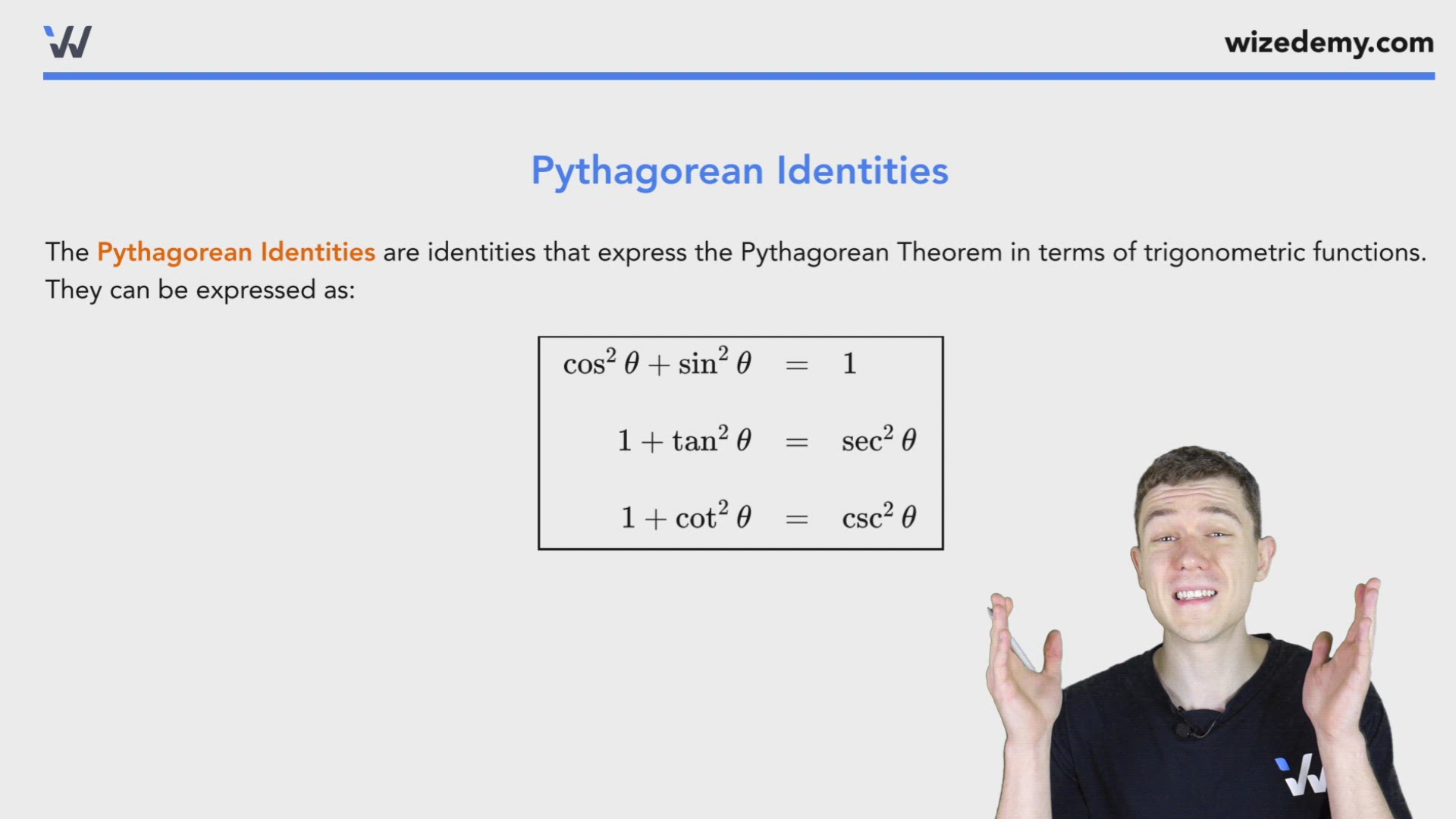
The Pythagorean Identities are identities that express the Pythagorean Theorem in terms of trigonometric functions. They can be expressed as:
cos2θ+sin2θ=11+tan2θ=sec2θ1+cot2θ=csc2θ\boxed{\begin{array}{rcl} \cos^2\theta+\sin^2\theta&=&1\\\\ 1+\tan^2\theta&=&\sec^2\theta\\\\ 1+\cot^2\theta&=&\csc^2\theta \end{array}}

PAGE BREAK

Proof Using the Unit Circle

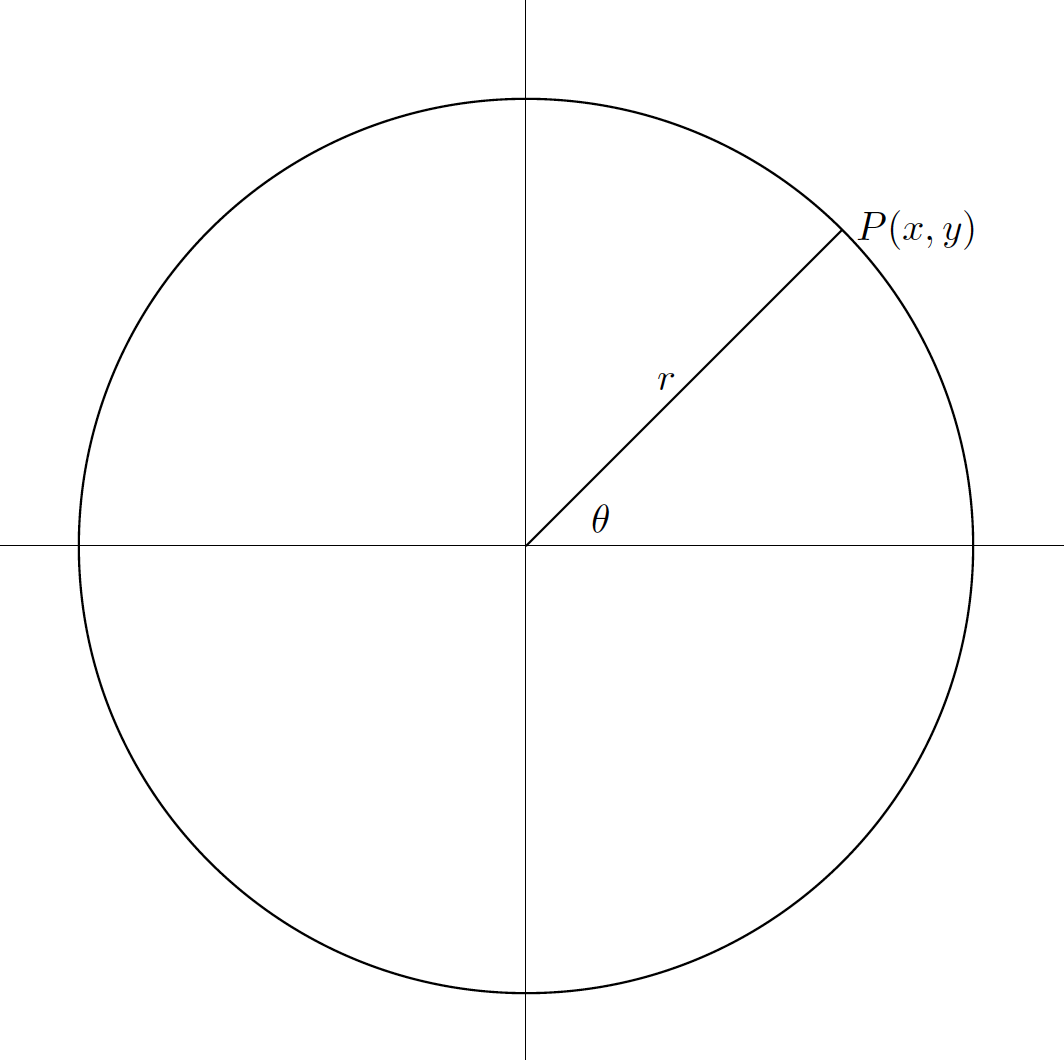
Let P(x,y)P(x,y) be a point on a circle centered at (0,0)(0,0) with radius rr (shown below).

The equation of the circle is expressed by x2+y2=r2\boxed{x^2+y^2=r^2}.


PAGE BREAK

We can manipulate the equation of the circle to derive the Pythagorean Identities.
a.x2+y2=r2x2r2+y2r2=1(xr)2+(yr)2=1sinθ=yr, cosθ=xr(cosθ)2+(sinθ)2=1cos2θ+sin2θ=1Pythagorean Identityb.cos2θ+sin2θ=1(cos2θcos2θ)+(sin2θcos2θ)=(1cos2θ)tanθ=sinθcosθ, sec=1cosθ1+tan2θ=sec2θPythagorean Identityc.cos2θ+sin2θ=1(cos2θsin2θ)+(sin2θsin2θ)=(1sin2θ)cotθ=cosθsinθ, csc=1sinθcot2θ+1=csc2θPythagorean Identity\begin{array}{rcl} \textbf{a.}\\\\ &x^2+y^2&=&r^2\\\\ &\dfrac{x^2}{r^2}+\displaystyle\frac{y^2}{r^2}&=&1\\\\ &\Bigg(\displaystyle\frac{x}{r}\Bigg)^2+\Bigg(\displaystyle\frac{y}{r}\Bigg)^2&=&1&&{\color{red}\footnotesize\sin\theta=\frac{y}{r},~\cos\theta=\frac{x}{r}}\\\\ &(\cos\theta)^2+(\sin\theta)^2&=&1\\\\ &\cos^2\theta+\sin^2\theta&=&1&&{\color{Red}\footnotesize\textbf{Pythagorean Identity}}\\\\\hline\\ \textbf{b.}\\\\ &\cos^2\theta+\sin^2\theta&=&1\\\\ &\Bigg(\dfrac{\cos^2\theta}{\cos^2\theta}\Bigg)+\Bigg(\dfrac{\sin^2\theta}{\cos^2\theta}\Bigg)&=&\Bigg(\dfrac{1}{\cos^2\theta}\Bigg)&&{\color{Red}\footnotesize\tan\theta=\frac{\sin\theta}{\cos\theta},~\sec=\frac{1}{\cos\theta}}\\\\ &1+\tan^2\theta&=&\sec^2\theta&&{\color{Red}\footnotesize\textbf{Pythagorean Identity}}\\\\\hline\\ \textbf{c.}\\\\ &\cos^2\theta+\sin^2\theta&=&1\\\\ &\Bigg(\dfrac{\cos^2\theta}{\sin^2\theta}\Bigg)+\Bigg(\dfrac{\sin^2\theta}{\sin^2\theta}\Bigg)&=&\Bigg(\dfrac{1}{\sin^2\theta}\Bigg)&&{\color{Red}\footnotesize\cot\theta=\frac{\cos\theta}{\sin\theta},~\csc=\frac{1}{\sin\theta}}\\\\ &\cot^2\theta+1&=&\csc^2\theta&&{\color{Red}\footnotesize\textbf{Pythagorean Identity}} \end{array}


0:00 / 0:00

Example: Pythagorean Identities


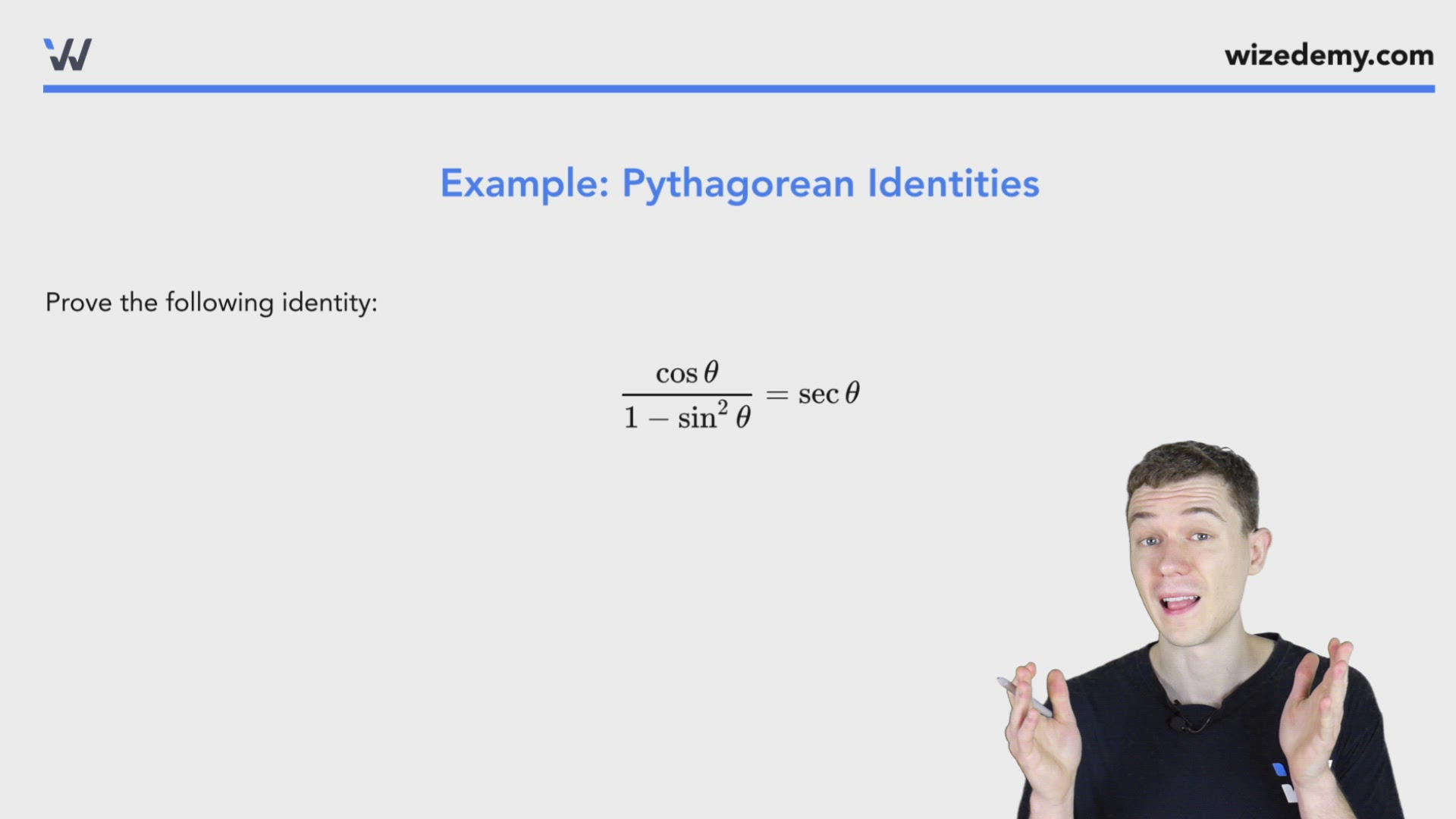
Prove the following identity:

cosθ1sin2θ=secθ\dfrac{\cos\theta}{1-\sin^2\theta}=\sec\theta


LHSRHSPythagorean Identitycosθ1sin2θsecθcosθcos2θsecθReciprocal Identity1cosθsecθsecθsecθ\begin{array}{cc|cc}\\ \textbf{LHS}&&\textbf{RHS}\\\hline\\ \color{red}{\scriptsize\text{Pythagorean Identity}}&\dfrac{\cos\theta}{1-\sin^2\theta}&\sec\theta\\\\\\ &\dfrac{\cos\theta}{\cos^2\theta}&\sec\theta\\\\\\ \color{red}{\scriptsize\text{Reciprocal Identity}}&\dfrac{1}{\cos\theta}&\sec\theta\\\\\\ &\sec\theta&\sec\theta \end{array}

Since LHS = RHS, then the following identity has been proved.

Practice: Pythagorean Identities

Simplify (1cos2θ)(cscθ)(1-\cos^2\theta)(\csc\theta) into one trigonometric function.

Practice: Pythagorean Identities

cos2θ+cos2θtan2θ\cos^2\theta+\cos^2\theta\tan^2\theta is equivalent to which of the following?

Practice: Pythagorean Identities

Which of the following is equivalent to sinθ1cosθ+sinθ1+cosθ\dfrac{\sin\theta}{1-\cos\theta}+\dfrac{\sin\theta}{1+\cos\theta}?
Extra Practice