0:00 / 0:00

Double Angle Identities

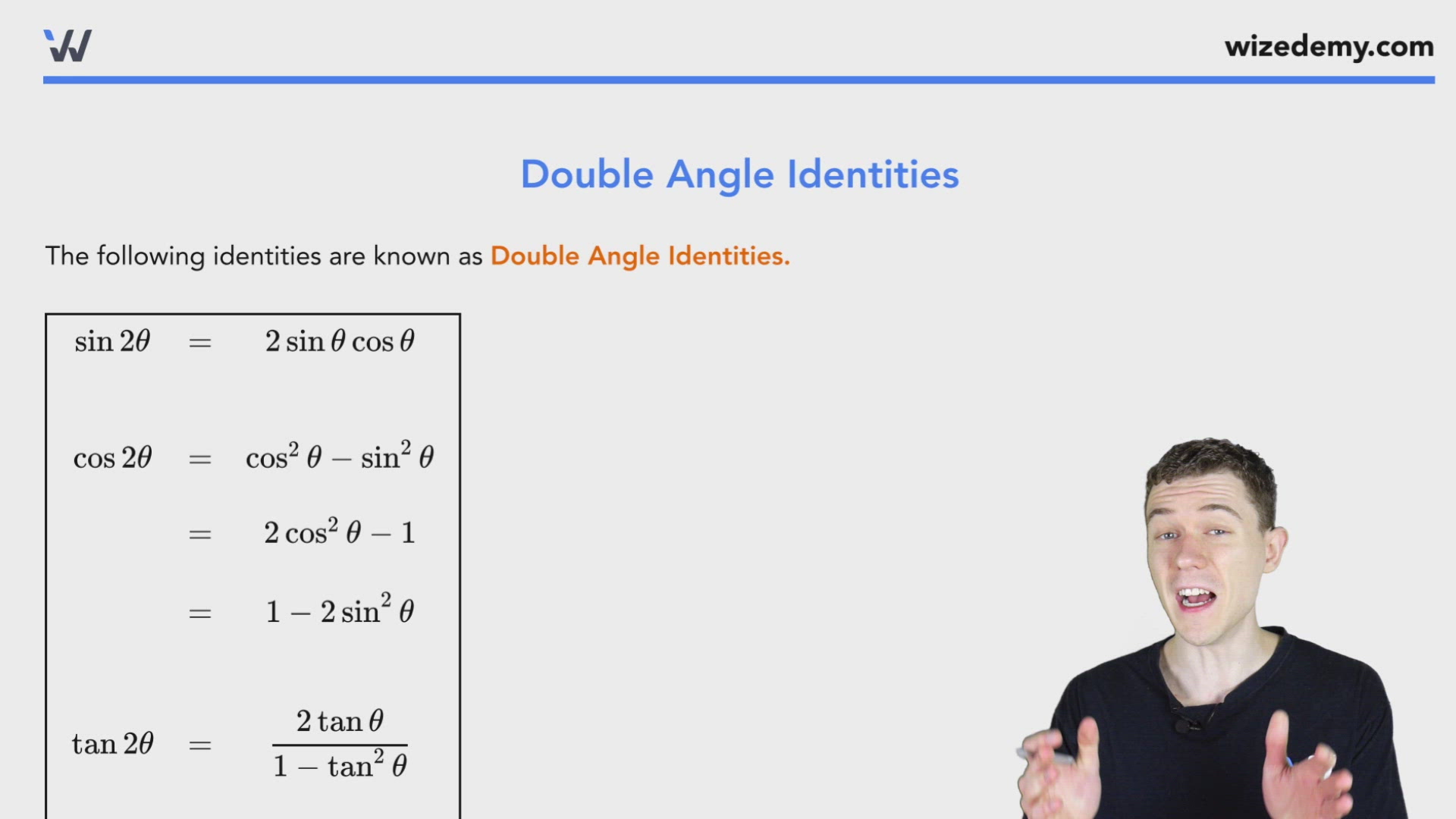
The following identities are known as Double Angle Identities.

sin2θ=2sinθcosθcos2θ=cos2θsin2θ=2cos2θ1=12sin2θtan2θ=2tanθ1tan2θ\boxed{\begin{array} {} \sin2\theta&=&2\sin\theta\cos\theta\\\\\\ \cos2\theta&=&\cos^2\theta-\sin^2\theta\\\\ &=&2\cos^2\theta-1\\\\ &=&1-2\sin^2\theta\\\\\\ \tan2\theta&=&\dfrac{2\tan\theta}{1-\tan^2\theta}\\\\ \end{array}}

PAGE BREAK


Example

Simplify cos2(4θ)sin2(4θ)\cos^2(4\theta)-\sin^2(4\theta) into one trigonometric function

Let a=4θa=4\theta be an angle measured in radians. Then,

cos2(4θ)sin2(4θ)=cos2(a)sin2(a)\begin{array}{rcl} \cos^2(4\theta)-\sin^2(4\theta)&=&\cos^2(a)-\sin^2(a)\\\\ \end{array}
Therefore,

cos2(a)sin2(a)=cos(2a)cos2(4θ)sin2(4θ)=cos(8θ)\begin{array}{rcl} \cos^2(a)-\sin^2(a)&=&\cos(2a)\\\\ \cos^2(4\theta)-\sin^2(4\theta)&=&\cos(8\theta) \end{array}


So, cos2(4θ)sin2(4θ)=cos(8θ)\boxed{\cos^2(4\theta)-\sin^2(4\theta)=\cos(8\theta)}
0:00 / 0:00

Double Angle Identities


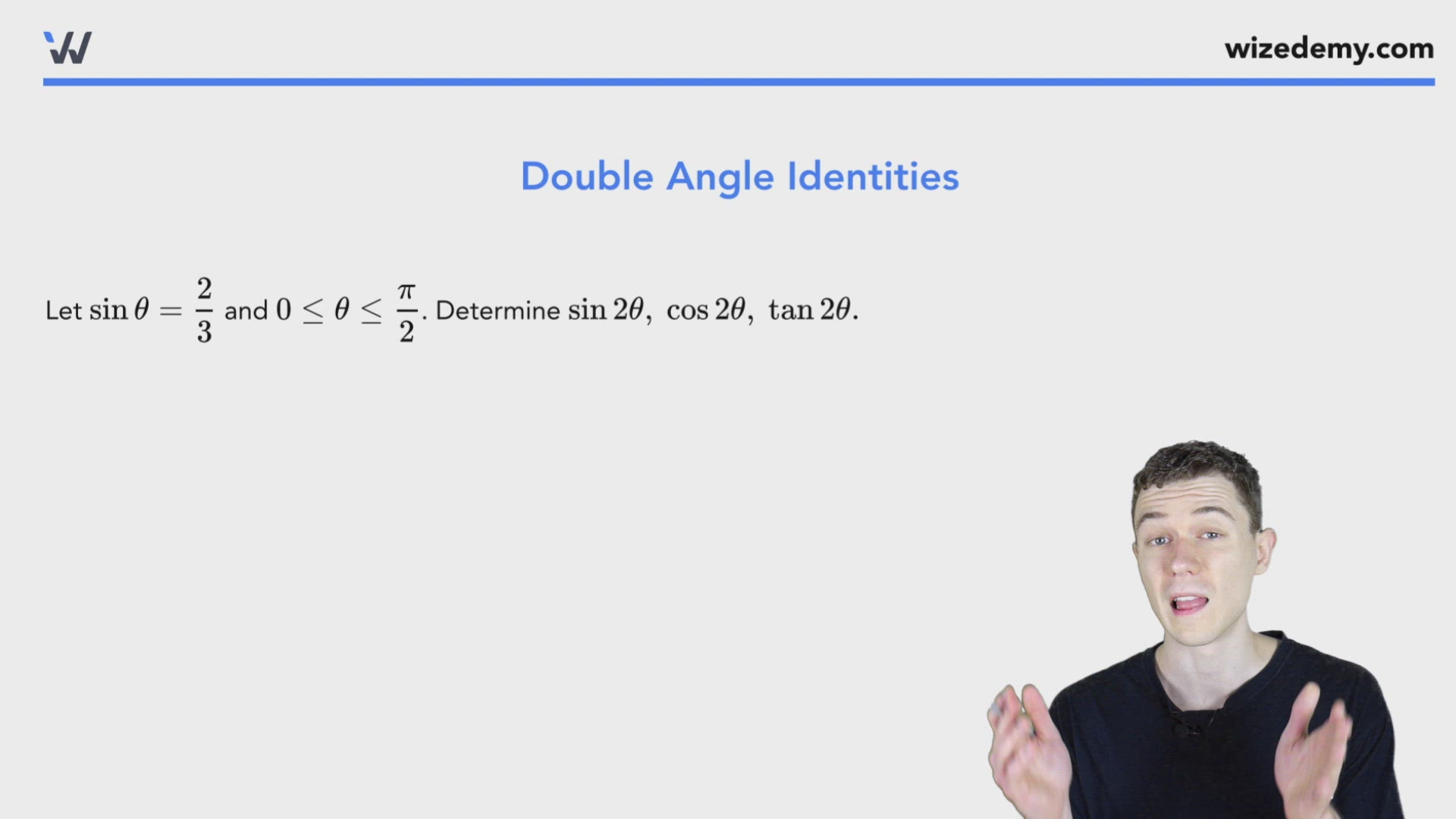
Let sinθ=23\sin\theta=\dfrac{2}{3} and 0θπ20\leq{\theta}\leq{}\dfrac{\pi}{2}. Determine sin2θ, cos2θ, tan2θ.\sin2\theta,~\cos2\theta, ~\tan2\theta.


Since sinθ=23=yr\sin\theta=\dfrac{2}{3}=\dfrac{y}{r}, then using Pythagorean Theorem, we can find 'x' and the other trigonometric ratios
x2+y2=r2x2+22=32x=94x=5\begin{array}{rcl} x^2+y^2&=&r^2\\\\ x^2+2^2&=&3^2\\\\ x&=&\sqrt{9-4}\\\\ x&=&\sqrt{5} \end{array}  cosθ=53sinθ=23tanθ=25\begin{array}{rcl} \therefore~\cos\theta&=&\dfrac{\sqrt{5}}{3}\\\\ \sin\theta&=&\dfrac{2}{3}\\\\ \tan\theta&=&\dfrac{2}{\sqrt{5}} \end{array}


sin2θ:\underline{\sin2\theta}: cos2θ:\underline{\cos2\theta}: tan2θ:\underline{\tan2\theta}:
sin2θ=2sinθcosθ=2(23)(53)=459\begin{array}{rcl} \sin2\theta&=&2\sin\theta\cos\theta\\\\ &=&2\Bigg(\dfrac{2}{3}\Bigg)\Bigg(\dfrac{\sqrt{5}}{3}\Bigg)\\\\ &=&\boxed{\dfrac{4\sqrt{5}}{9}} \end{array} cos2θ=cos2θsin2θ=(53)2(23)2=(59)(49)=19\begin{array}{rcl} \cos2\theta&=&\cos^2\theta-\sin^2\theta\\\\ &=&\Bigg(\dfrac{\sqrt{5}}{3}\Bigg)^2-\Bigg(\dfrac{2}{3}\Bigg)^2\\\\ &=&\Bigg(\dfrac{5}{9}\Bigg)-\Bigg(\dfrac{4}{9}\Bigg)\\\\ &=&\boxed{\dfrac{1}{9}} \end{array} tan2θ=2tanθ1tan2θ=2(25)(1(25)2)=(45)(145)=(45)(15)=205\begin{array}{rcl} \tan2\theta&=&\dfrac{2\tan\theta}{1-\tan^2\theta}\\\\ &=&\dfrac{2\cdot\Bigg(\dfrac{2}{\sqrt{5}}\Bigg)}{\Bigg(1-\Bigg(\dfrac{2}{\sqrt{5}}\Bigg)^2\Bigg)}\\\\ &=&\dfrac{\Bigg(\dfrac{4}{\sqrt{5}}\Bigg)}{\Bigg(1-\dfrac{4}{5}\Bigg)}\\\\ &=&\dfrac{\Bigg(\dfrac{4}{\sqrt{5}}\Bigg)}{\Bigg(\dfrac{1}{5}\Bigg)}\\\\ &=&\dfrac{20}{\sqrt{5}} \end{array}
0:00 / 0:00

Half-Angle Identities

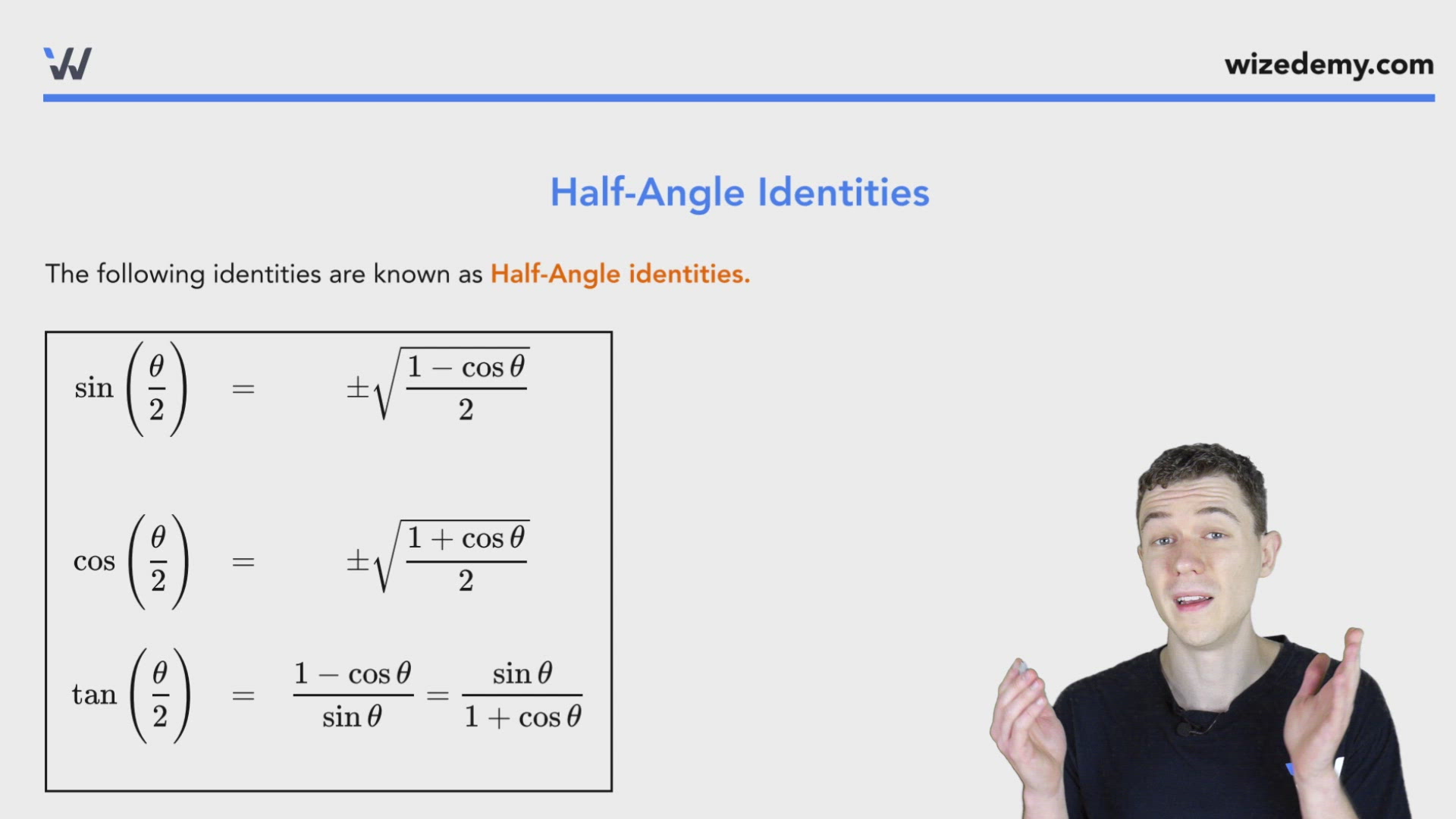
The following identities are known as Half-Angle identities.

sin(θ2)=±1cosθ2cos(θ2)=±1+cosθ2tan(θ2)=1cosθsinθ=sinθ1+cosθ\boxed{\begin{array} {} \sin\Bigg(\dfrac{\theta}{2}\Bigg)&=&\pm\sqrt{\dfrac{1-\cos\theta}{2}}\\\\\\ \cos\Bigg(\dfrac{\theta}{2}\Bigg)&=&\pm\sqrt{\dfrac{1+\cos\theta}{2}}\\\\ \tan\Bigg(\dfrac{\theta}{2}\Bigg)&=&\dfrac{1-\cos\theta}{\sin\theta}=\dfrac{\sin\theta}{1+\cos\theta}\\\\ \end{array}}

PAGE BREAK


Example

Let cosθ=47\cos\theta=\dfrac{4}{7} and 0θπ20\leq{}\theta\leq{}\dfrac{\pi}{2}. Find tan(θ2)\tan\Bigg(\dfrac{\theta}{2}\Bigg).


Since cosθ=47=xr\cos\theta=\dfrac{4}{7}=\dfrac{x}{r}, then, using Pythagorean Theorem, we can find yy and find sinθ\sin\theta.
x2+y2=r242+y2=72y=7242y=33\begin{array}{rcl} x^2+y^2&=&r^2\\\\ 4^2+y^2&=&7^2\\\\ y&=&\sqrt{7^2-4^2}\\\\ y&=&\sqrt{33} \end{array}  sinθ=337\therefore~\sin\theta=\dfrac{\sqrt{33}}{7}


Therefore,

tan(θ2)=1cosθsinθ=(147)(337)=37337=333\begin{array}{rcl} \tan\Bigg(\dfrac{\theta}{2}\Bigg)&=&\dfrac{1-\cos\theta}{\sin\theta}\\\\ &=&\dfrac{\Bigg(1-\dfrac{4}{7}\Bigg)}{\Bigg(\dfrac{\sqrt{33}}{7}\Bigg)}\\\\ &=&\dfrac{\dfrac{3}{7}}{\dfrac{\sqrt{33}}{7}}\\\\ &=&\boxed{\dfrac{3}{\sqrt{33}}} \end{array}
0:00 / 0:00

Example: Half Angle Identities

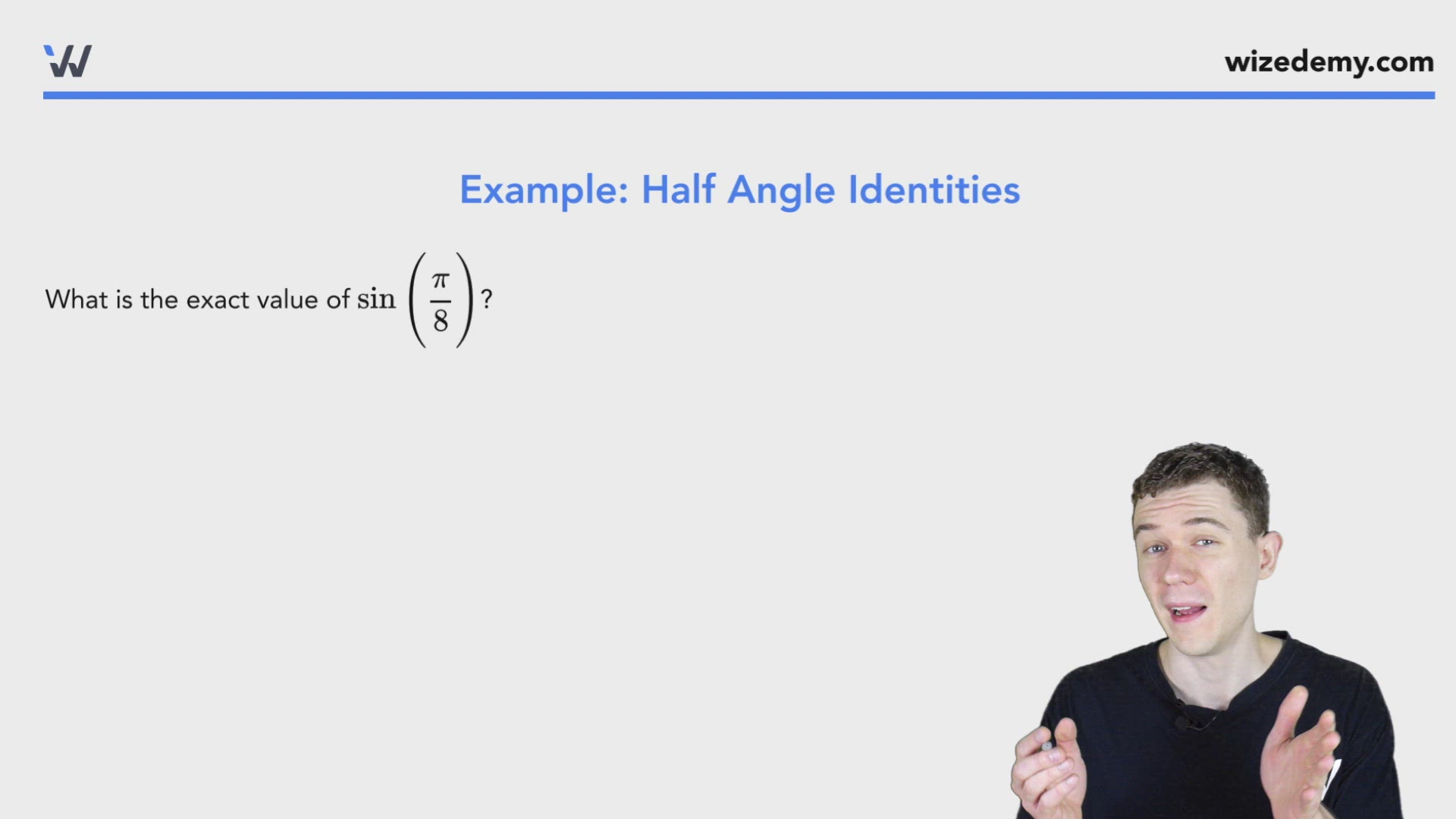
What is the exact value of sin(π8)\sin\Bigg(\dfrac{\pi}{8}\Bigg)?

Let θ2=π8\dfrac{\theta}{2}=\dfrac{\pi}{8}

So, θ=π4\theta=\dfrac{\pi}{4}

Using the half-angle identity, we get:

sin(π8)=sin(π42)=±1cosπ42=±1222=±2222=±224=±222\begin{array}{rcl} \sin\Bigg(\dfrac{\pi}{8}\Bigg)=\sin\Bigg(\dfrac{\frac{\pi}{4}}{2}\Bigg)&=&\pm\sqrt{\dfrac{1-\cos\frac{\pi}{4}}{2}}\\\\ &=&\pm\sqrt{\dfrac{1-\frac{\sqrt{2}}{2}}{2}}\\\\ &=&\pm\sqrt{\dfrac{\frac{2-\sqrt{2}}{2}}{2}}\\\\ &=&\pm\sqrt{\dfrac{2-\sqrt{2}}{4}}\\\\ &=&\pm\dfrac{\sqrt{2-\sqrt{2}}}{2} \end{array}

Practice: Double & Half Angle Identities


Let tanθ=83\tan\theta=\dfrac{8}{3} and 0θπ20\leq{}\theta\leq{}\dfrac{\pi}{2}.


Practice: Double & Half Angle Identities


Determine the exact value for each of the following:

Practice: Double & Half Angle Identities

True or False? 1tan2θ1+tan2θ=cos2θ\dfrac{1-\tan^2\theta}{1+\tan^2\theta}=\cos2\theta

Extra Practice