Wize High School Grade 12 Pre-Calculus Textbook > Combination of Functions
Sum & Difference of Functions
Popular Courses
Grade 12 Advanced Functions
Ontario High School
Grade 12 Pre-Calculus/Functions
Canada High School
Algebra II
US High School
Math 30-1
Alberta High School
Pre-Calculus 12
British Columbia High School
MATH 201
Concordia University
MAC 1140
University of Florida
MAT 170
Arizona State University - Tempe
MAC 1105
Florida State University
MAT 012
University of California - Davis
MTH 103A
Michigan State University
MTH 116
Michigan State University
MAC 1147
University of Florida
MATH 140
San Diego State University
MATH 2312
University of Houston
MA 15800
Purdue University
MAC 1140C
University of Central Florida
MATH 102
California State University - Northridge
MATH 1302
University of Texas at Arlington
M 305G
The University of Texas at Austin

0:00 / 0:00
Sum & Difference
Functions can be combined through addition and subtraction.
Let and be two continuous functions defined on the interval .
- The sum of 2 functions, and , can be expressed as .
- The difference of 2 functions, and , can be expressed as .
Wize Tip
Both functions must be defined at a point for the combination to be defined.
Example
Let and . Find:

0:00 / 0:00
Example: Sum & Difference of Functions
Given and , determine:
- Algebraically
- Graphically
1.
a.
b.
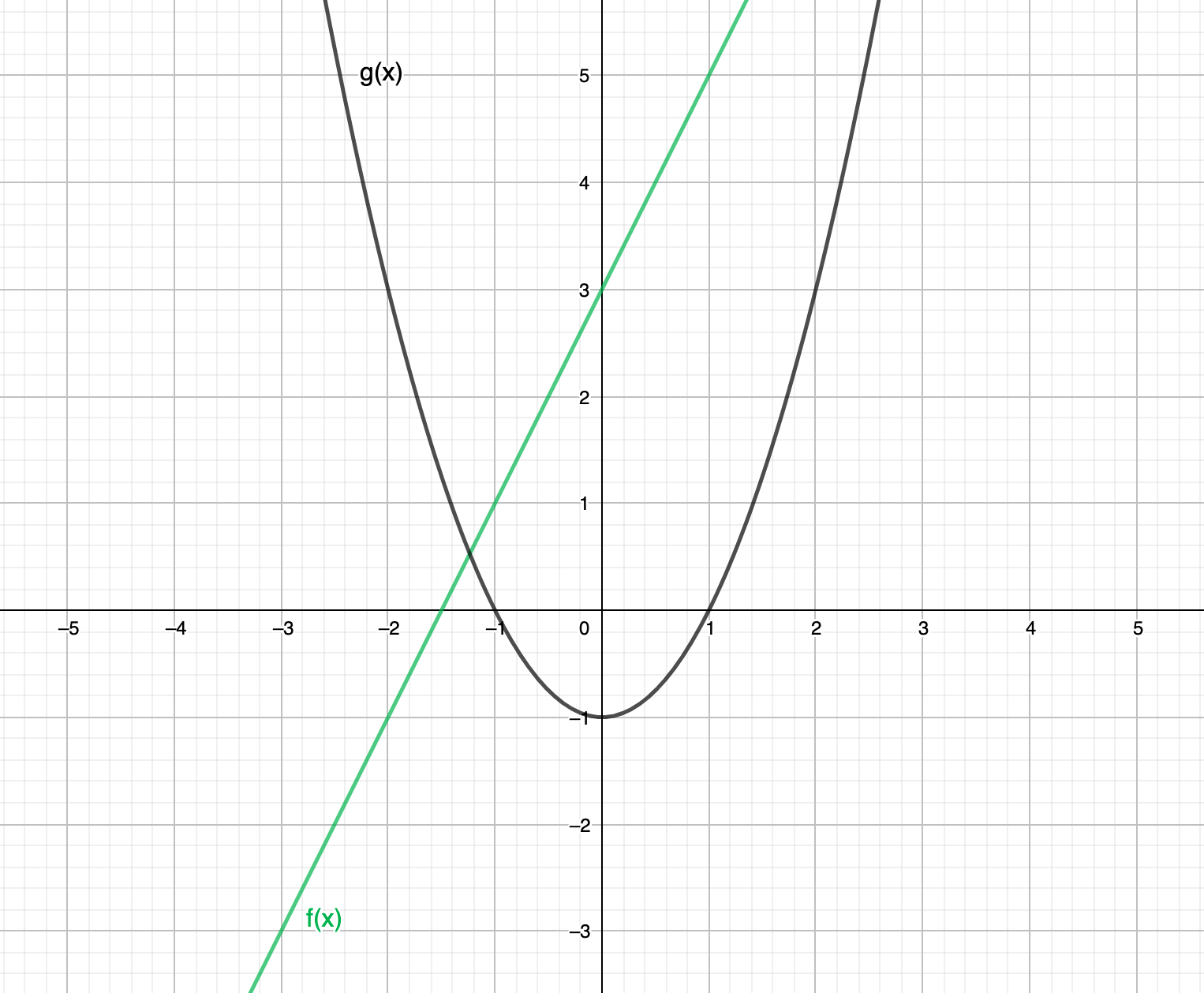
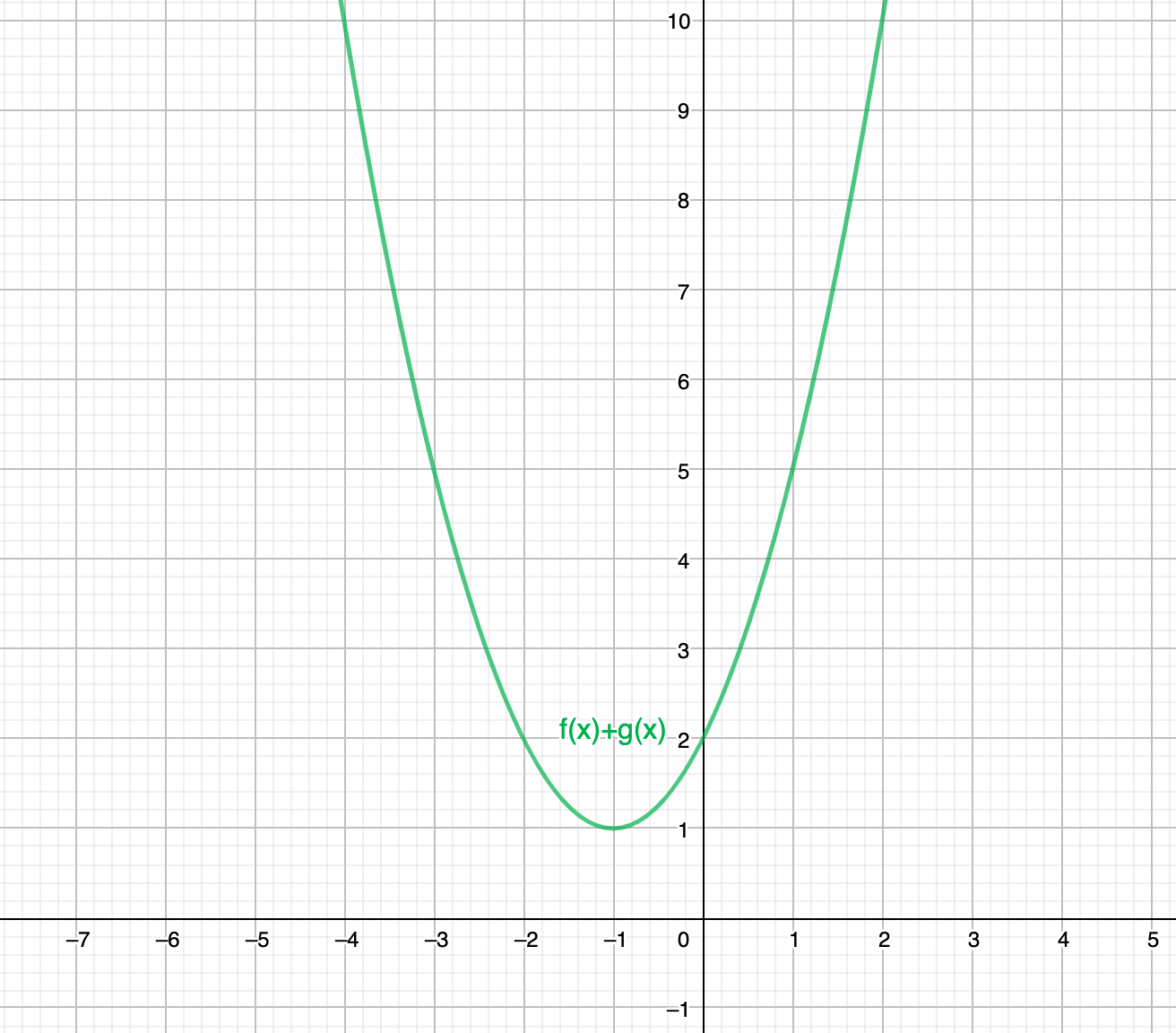
The solution is
Practice: Sum & Difference of Functions
Let and . Determine the following:
Practice: Sum & Difference of Functions
If and , determine:
Practice: Sum & Difference of Functions
Maisy went grocery shopping at Fresh-co and used her off coupon. She then went to London Drugs and used her 25% coupon.