Product & Quotient of Functions

Product & Quotient of Functions
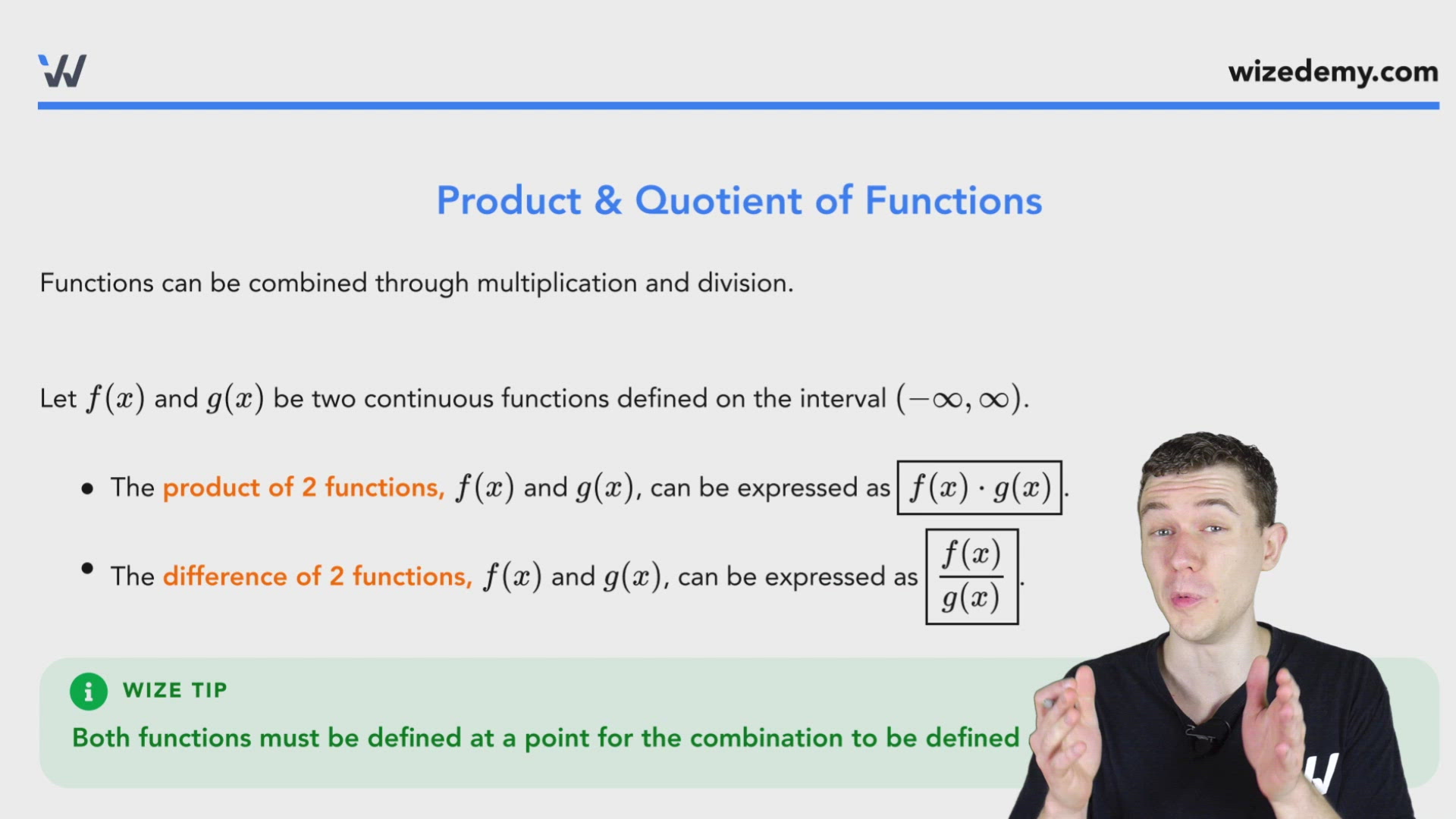
Functions can be combined through multiplication and division.
Let f(x) and g(x) be two continuous functions defined on the interval (−∞,∞).
- The product of 2 functions, f(x) and g(x), can be expressed as f(x)⋅g(x).
- The quotient of 2 functions, f(x) and g(x), can be expressed as g(x)f(x).
Example
Let f(x)=x2−4 and g(x)=x−2. Find:
- f(x)⋅g(x)
- g(x)f(x)
1.2.f(x)⋅g(x)g(x)f(x)=====(x2−4)⋅(x−2)x3−2x2−4x+8(x−2)(x2−4)(x−2)(x−2)(x+2)x+2

Example: Product & Quotient of Functions
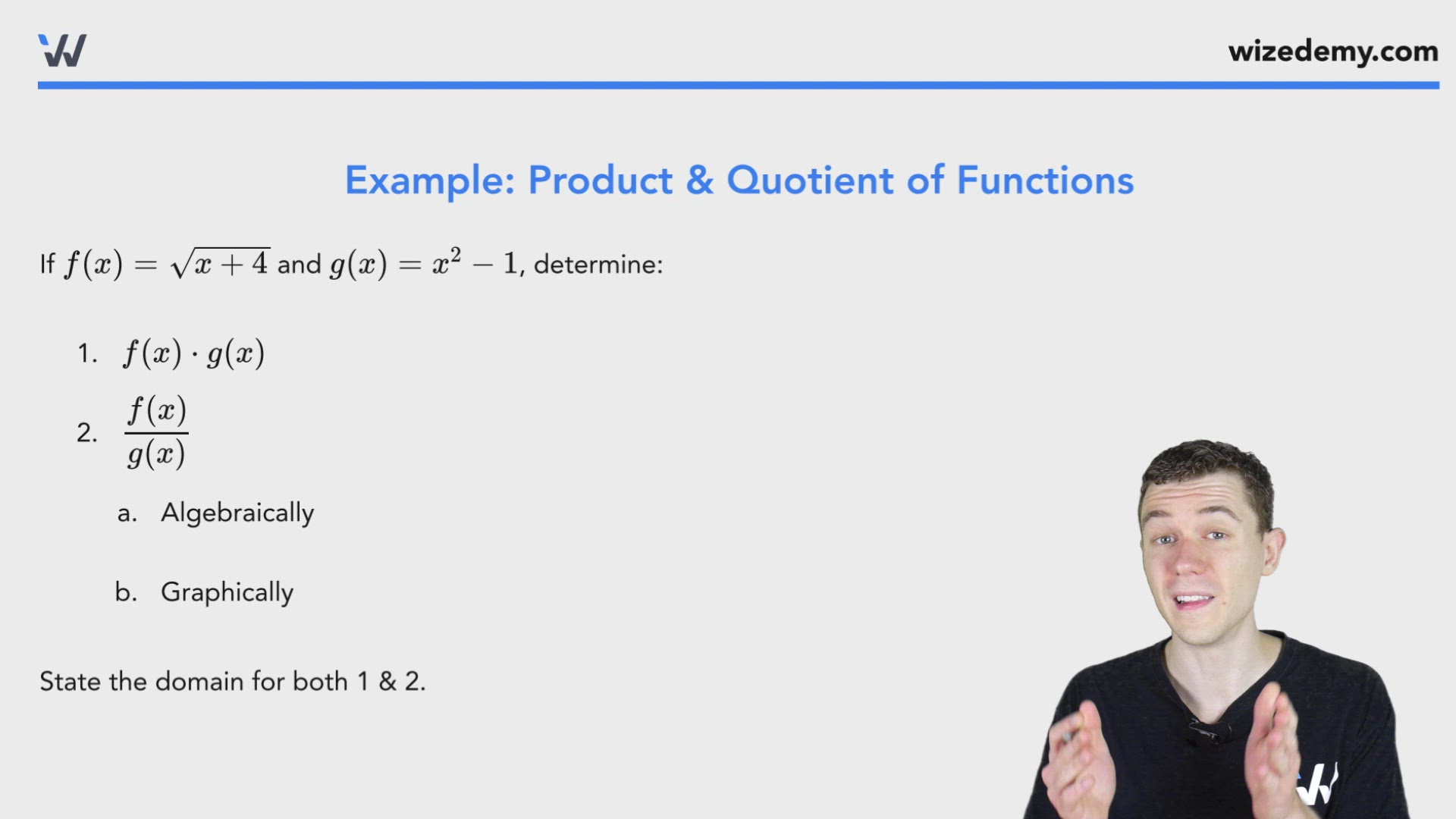
If f(x)=x+4 and g(x)=x2−1, determine:
- f(x)⋅g(x)
- g(x)f(x)
- Algebraically
- Graphically
State the domain for both 1 & 2.
1. f(x)⋅g(x)
a. f(x)⋅g(x)==(x+4)(x2−1)(x2−1)x+4
The domain is x≥4.
b.
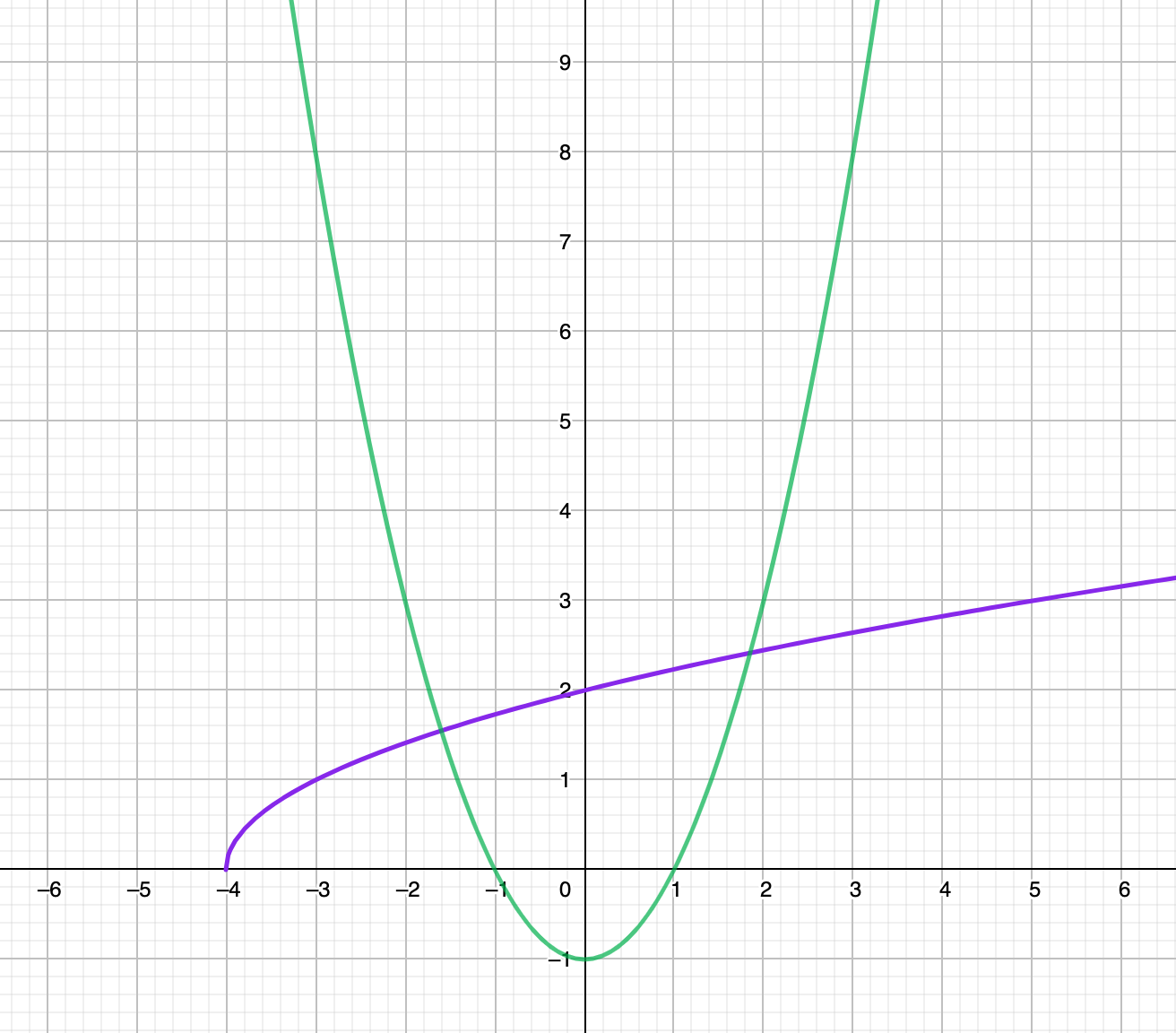
x−4−3−2−101234f(x)012325678g(x)15830−103815f(x)⋅g(x)08320203687302
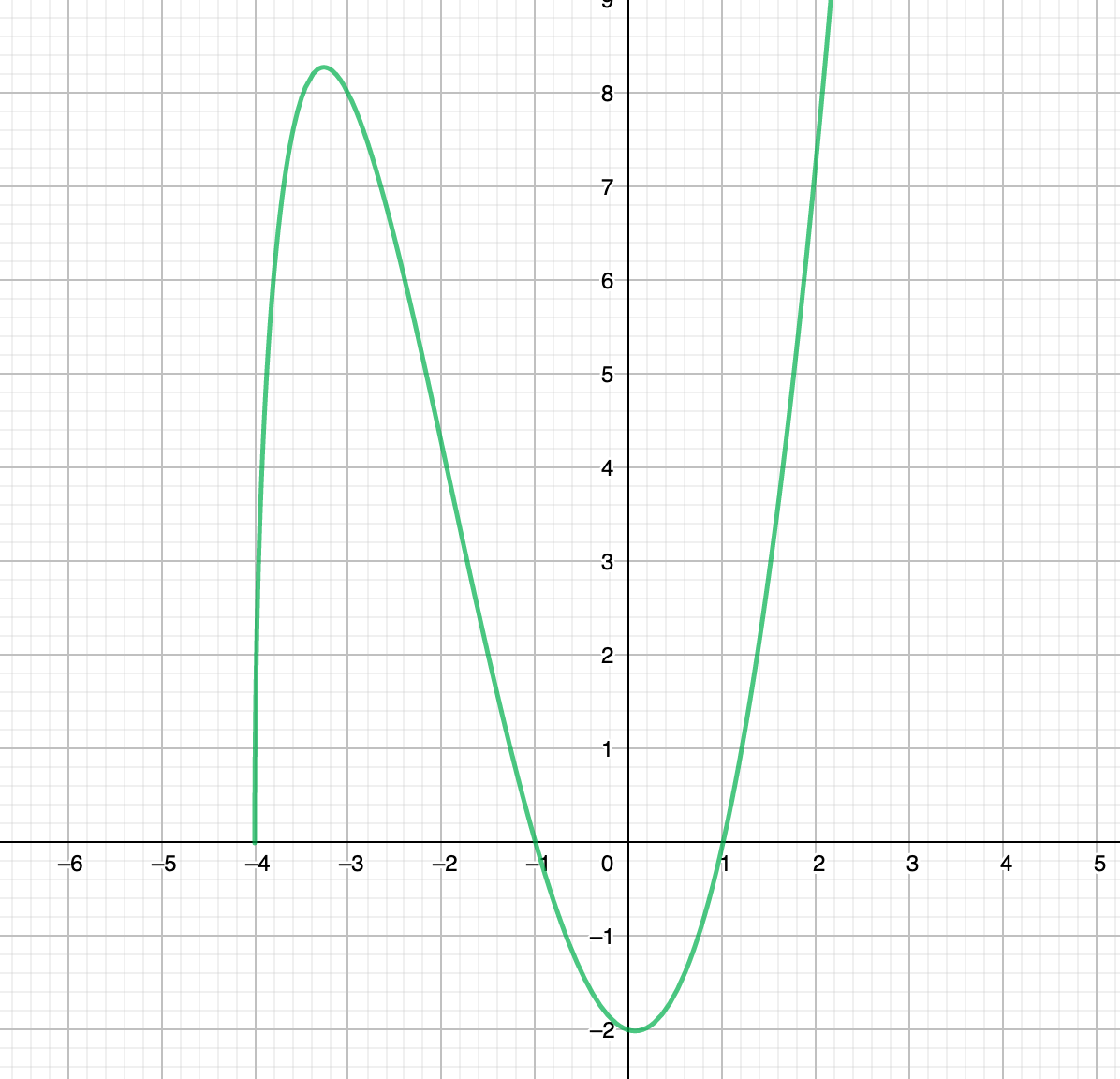
The graph of f(x)g(x):

The domain is x≥4.
2. g(x)f(x)
g(x)f(x)=(x2−1)x+4
The domain is x≥−4, x=±1, or in interval notation: [−4,−1)∪(−1,∞)
x−4−3−2−101234f(x)012325678g(x)15830−103815g(x)f(x)01/8320203687302
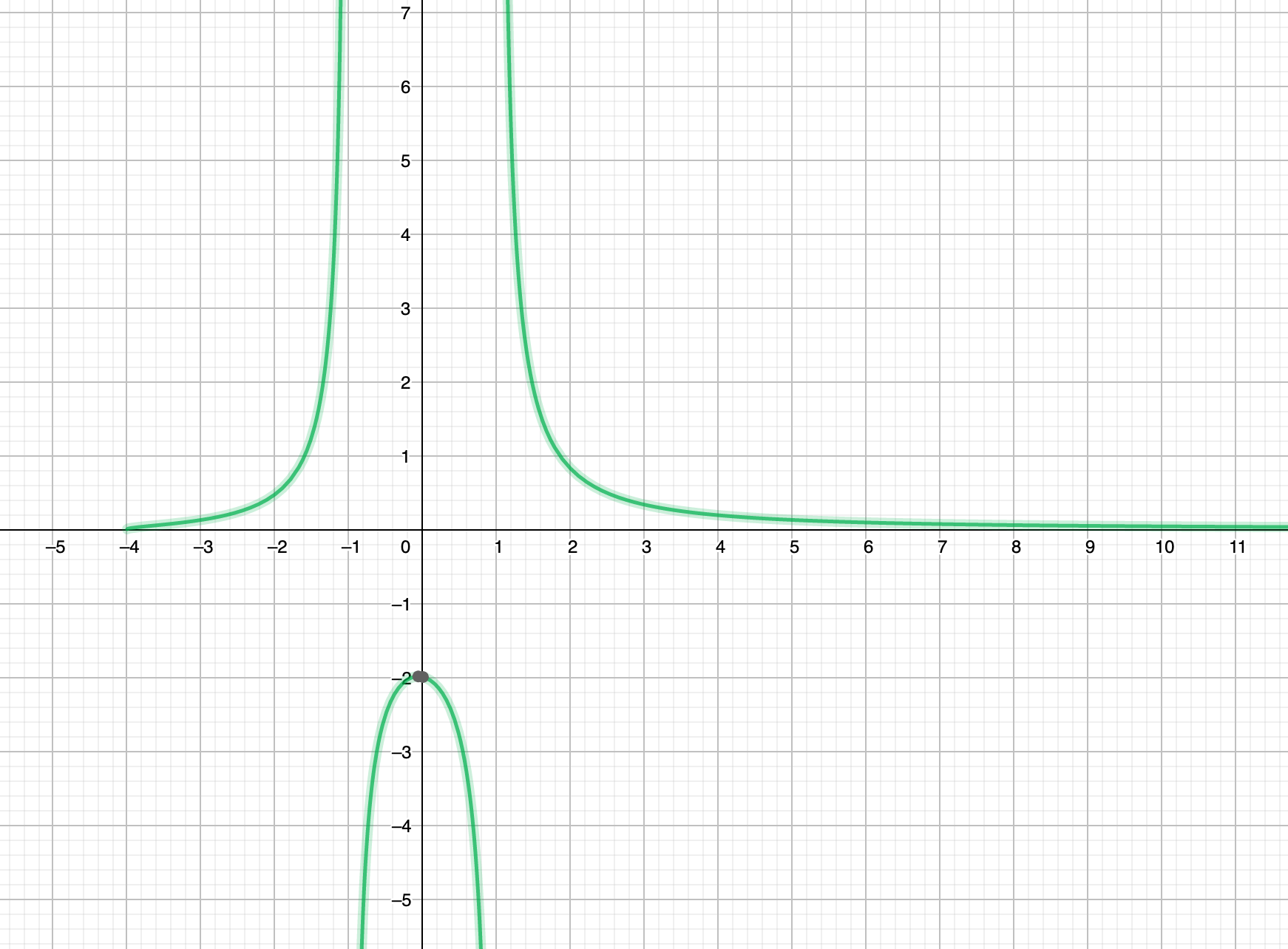
The graph of g(x)f(x):

The domain is x≥−4, x=±1.
Practice: Product & Quotient of Functions
If f(x)=x+2 and g(x)=x−3, then sketch a graph of y=g(x)f(x) and determine the domain.
Practice: Product & Quotient of Functions
Determine the domain of f(x)g(x) if f(x)=log2x and g(x)=x.