Wize High School Algebra II Textbook (Common Core) > Quadratic Equations & Complex Numbers
Solving Quadratic Equations with Complex Solutions
0:00 / 0:00
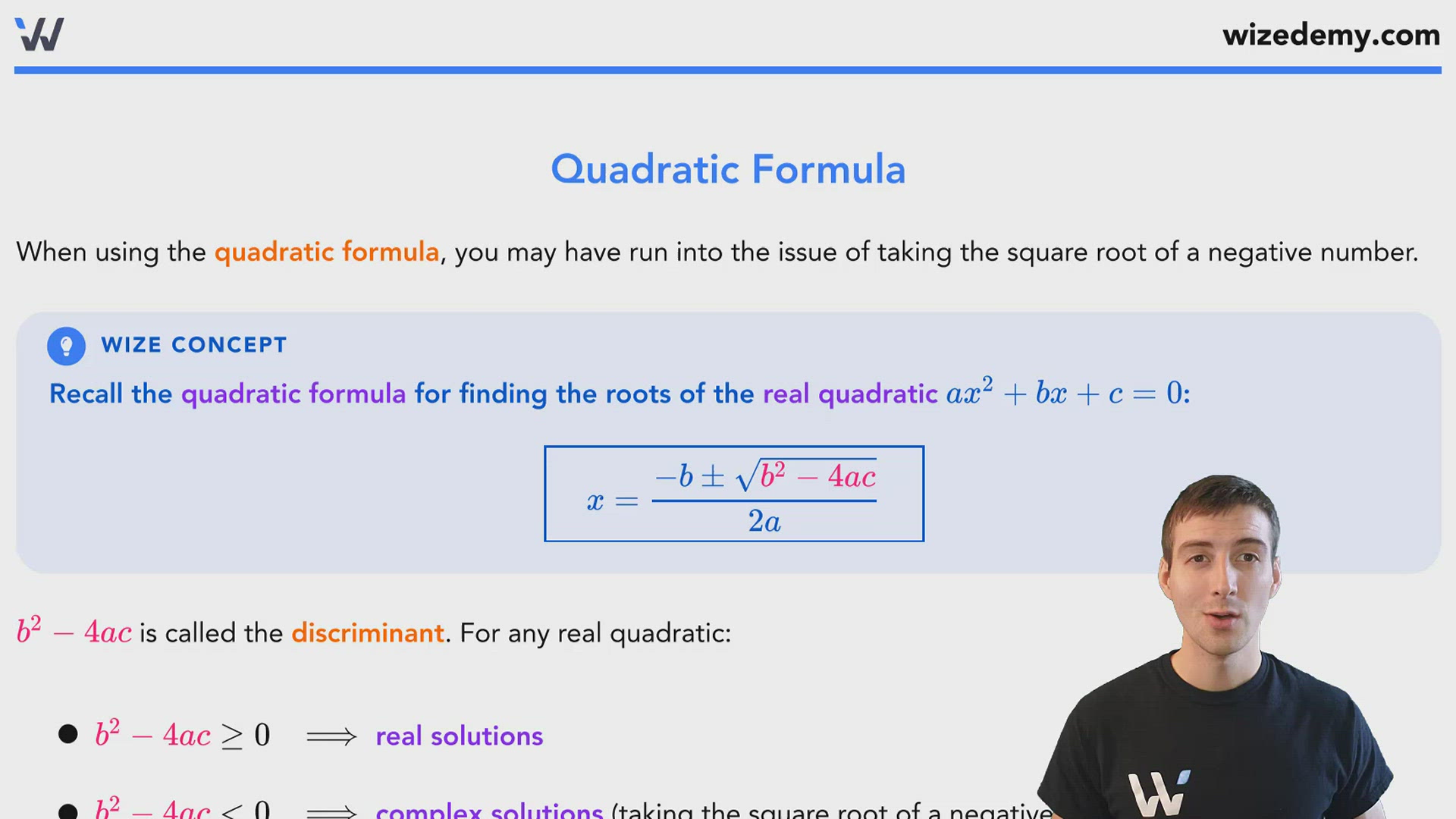
Quadratic Formula
When using the quadratic formula, you may have run into the issue of taking the square root of a negative number.
Wize Concept
Recall the quadratic formula for finding the roots of the real quadratic :
is called the discriminant. For any real quadratic:
- real solutions
- complex solutions (taking the square root of a negative number)
Wize Tip
Complex solutions always come in conjugate pairs!
If is one root, then the other root is .
Example
Find the roots of the real quadratic .
We want to find the values of such that .
We have . Let's apply the quadratic formula.
Wize Concept
The quadratic formula works even if the quadratic has complex coefficients.
Note: you may need to find square roots of a complex number. Remember to use polar form to find the roots!
0:00 / 0:00
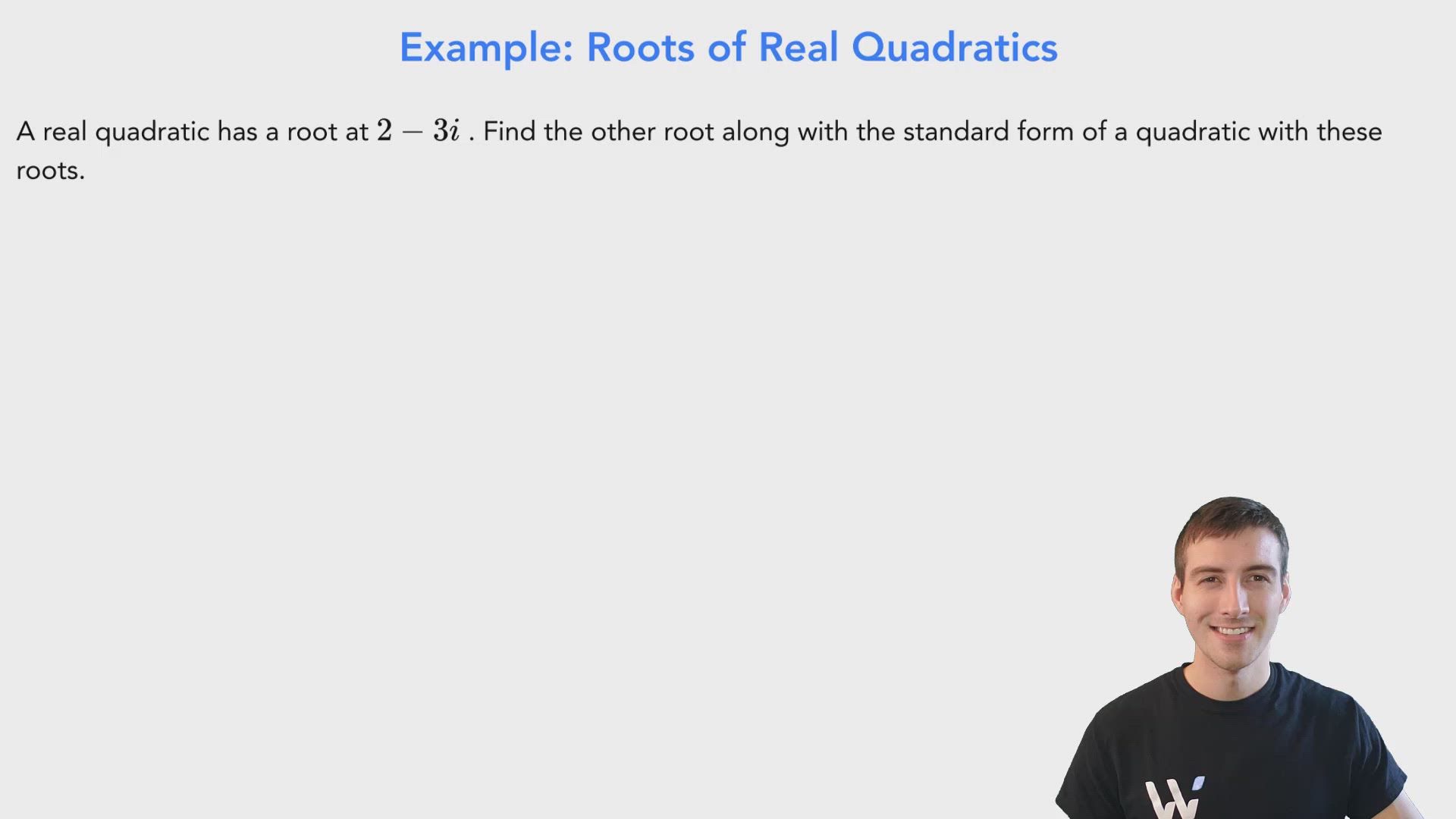
Example: Roots of Real Quadratics
A real quadratic has a root at . Find the other root along with the standard form of a quadratic with these roots.
Since we are given one root of a real quadratic and the root is complex, the other root is the complex conjugate: .
We can find the real quadratic by multiplying the two factors that yield these roots:
and are the factors that, when set to be equal to zero, yield the desired roots.