0:00 / 0:00

Basics of Complex Numbers

We define ii to be the imaginary unit, an imaginary number such that i2=1i^2=−1.

Complex Numbers in Standard Form

Complex numbers in standard form (or Cartesian form) are numbers of the form a+bia+bi where a, bRa,\ b\in\mathbb{R}.
The set of complex numbers is denoted C\mathbb{C}.
In the standard form z=a+bi Cz=a+bi\ \in\mathbb{C}:
  • aa is called the real part of zz, denoted: Re(z)=a\text{Re}(z)=a
  • bb is called the imaginary part of zz, denoted: Im(z)=b\text{Im}(z)=b
PAGE BREAK

Complex Plane

The set of real numbers R\mathbb{R} is a subset of C\mathbb{C} (every real number is a complex number whose imaginary part is 00).

Real numbers: 1D objects represented on the number line. We can think of real numbers as either:
  • a point on the line
  • a vector: an arrow from the origin to the point, indicating size (distance from 0) and direction (positive/negative)

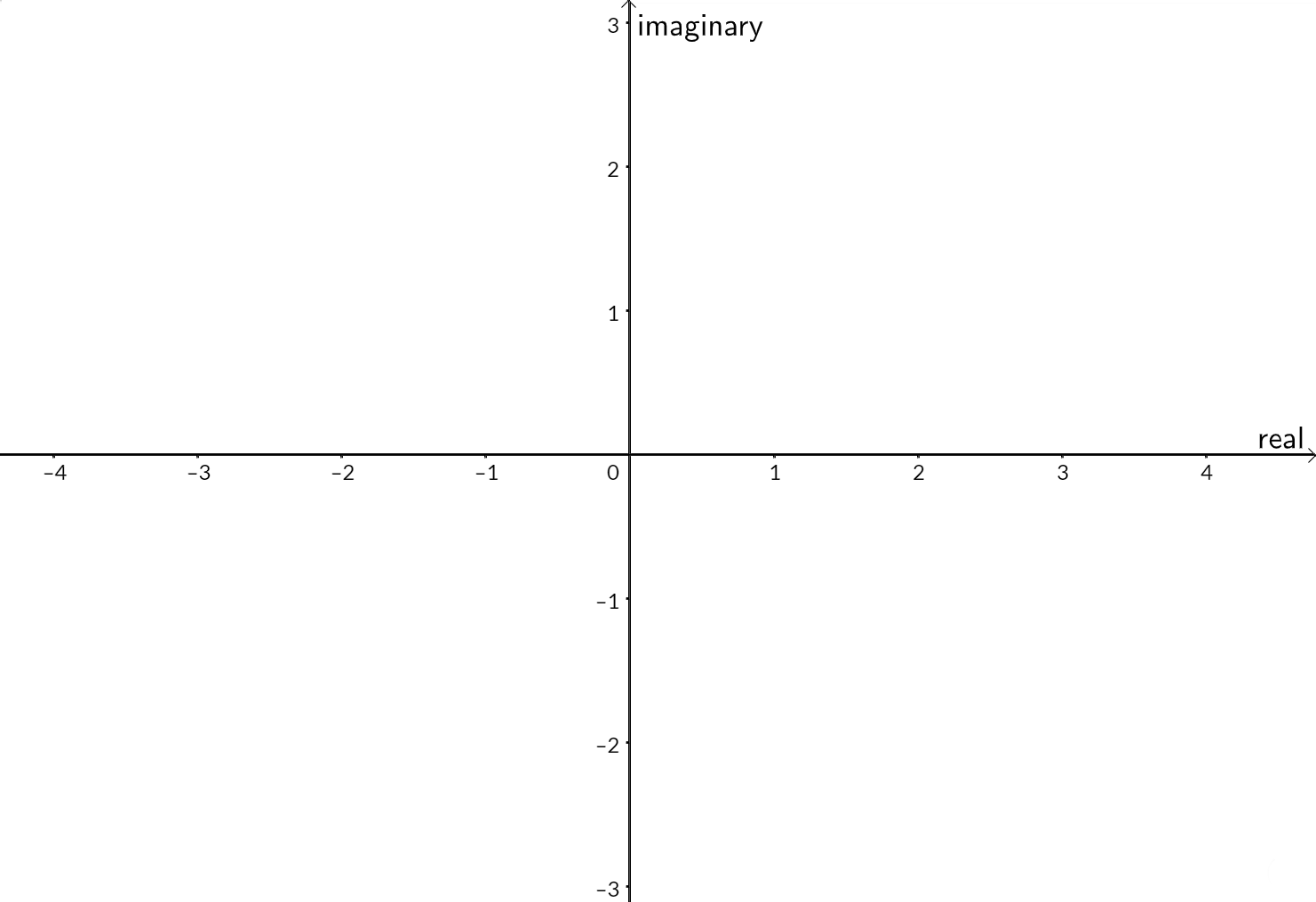
Complex numbers: 2D objects represented on the complex plane. We can think of complex numbers as either:
  • a point on the plane
  • a vector: an arrow from the origin to the point, indicating size and direction.
0:00 / 0:00

Operations With Complex Numbers

Addition and Subtraction

Let z=a+bi,  w=c+diz=a+bi,\ \ w=c+di:
  • z+w=(a+bi)+(c+di)=(a+c)+(b+d)iz+w=(a+bi)+(c+di) = (a+c) + (b+d)i
  • zw=(a+bi)(c+di)=(ac)+(bd)iz-w=(a+bi)-(c+di) = (a-c) + (b-d)i
In other words, we add/subtract like terms: keep the real parts together, and keep the imaginary parts together.
Example
Compute the sum of the complex numbers 3+2i3+2i and 1+5i-1+5i.
(3+2i)+(1+5i)=3+(1)+2i+5i=2+7i(\colorOne3+2i)+(\colorOne{-1}+5i) = \colorOne3+(\colorOne{-1}) + 2i+5i = 2 + 7i
PAGE BREAK

Multiplication

Expand using the usual rules of multiplication (keeping in mind i2=1i^2=-1):

(a+bi)(c+di)=a(c+di)+bi(c+di)=ac+a(di)+(bi)c+(bi)(di)=(acbd)+(ad+bc)i\begin{aligned} (a+bi)\colorTwo{(c+di)} &= a\colorTwo{(c+di)} + bi\colorTwo{(c+di)}\\[0.5em] &= a\colorTwo c+a\colorTwo{(di)}+(bi)\colorTwo c+(bi) \colorTwo{(di) }\\[0.5em] &= (a\colorTwo c-b\colorTwo d)+(a\colorTwo d+b\colorTwo c)i \end{aligned}
Example
Compute (62i)(1+3i)(6-2i)(1+3i).

(62i)(1+3i)=6(1)+(6)(3i)+(2i)(1)+(2i)(3i)=6+18i2i6i2=6+16i6(1)=12+16i\begin{array}{rcl} (6-2i)(1+3i)&=& 6(1)+(6)(3i)+(-2i)(1)+(-2i)(3i)\\[0.5em] &=& 6+18i-2i-6i^2\\[0.5em] &=&6+16i-6(-1)\\[0.5em] &=&12+16i\\[1.5em] \end{array}
PAGE BREAK

Complex Conjugate

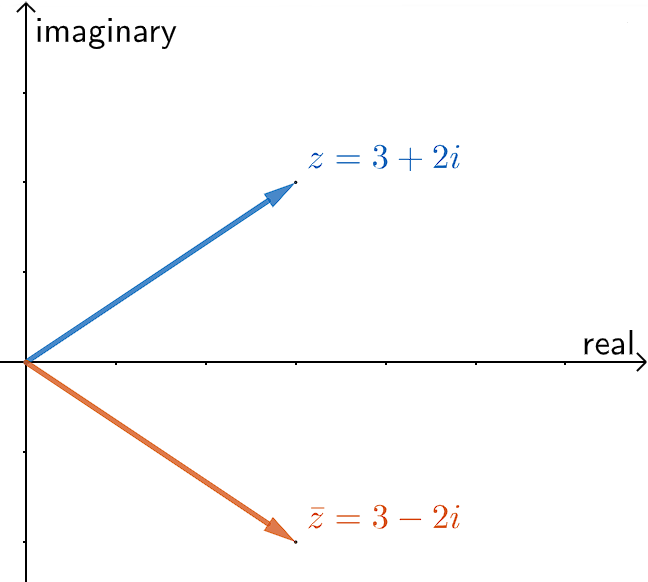
The complex conjugate of z=a+biz=a+bi is the complex number
zˉ=abi\boxed{\quad \bar{z}=a−bi \quad}
On the complex plane, zˉ\bar{z} is the reflection of zz across the real axis:

Properties
Let z,wCz,w \in \Complex with z=a+biz = a+bi.
  • zzˉ=(a+bi)(abi)=a2+b2z\bar{z}=(a+bi)(a−bi)=a^2+b^2
  • (z±w)=z±w\overline{(z\pm w)}=\overline{z}\pm\overline{w}
  • (zˉ)=z\overline{(\bar{z})}=z
  • (zw)=zˉwˉ\overline{(zw)} = \bar z \bar w
  • (zw)=zˉwˉ\overline{\left(\dfrac{z}{w}\right)} =\dfrac{\bar{z}}{\bar{w}}
  • If Im(z)=0\text{Im}(z)=0, then z=a\overline{z}=a
PAGE BREAK

Division

To divide complex numbers, "rationalize" the denominator by multiplying top and bottom by the conjugate:
a+bic+di=a+bic+dicdicdi=(a+bi)(cdi)c2+d2\dfrac{a+bi}{c+di} = \dfrac{a+bi}{c+di}\cdot\dfrac{\colorTwo{c-di}}{\colorTwo{c-di}} = \dfrac{(a+bi)(c-di)}{c^2+d^2}
Example
Given z=1+i,  w=2+3iz=1+i,\ \ w = 2+3i, compute zw\dfrac{z}{w}.
1+i2+3i=1+i2+3i23i23i=(1+i)(23i)(2)2+(3)2=23i+2i3i213=(23(1))+(3+2)i13=5i13\begin{aligned} \dfrac{1+i}{2+3i} &= \dfrac{1+i}{2+3i}\cdot\dfrac{\colorTwo{2-3i}}{\colorTwo{2-3i}}\\[1.5em] &=\dfrac{(1+i)(2-3i)}{(2)^2+(3)^2}\\[1.5em] &=\dfrac{2-3i+2i-3i^2}{13}\\[1.5em] &=\dfrac{\Big(2-3(-1)\Big)+\Big( -3 + 2 \Big)i}{13}\\[1.5em] &=\dfrac{5-i}{13}\\[1.5em] \end{aligned}
PAGE BREAK

Modulus

The modulus (or absolute value) of a complex number z=a+biz=a+bi is defined as:

z=a2+b2\boxed{\quad \lvert z\rvert =\sqrt{a^2 + b^2} \quad}
On the complex plane, the modulus is the length of the vector from 0\vec 0 to zz:

Properties
Let z,wCz,w \in \Complex with z=a+biz = a+bi.
  • z=zzˉ(since zzˉ=a2+b2)\left|z\right|=\sqrt{z\bar{z}} \quad (\text{since } z\bar z = a^2 + b^2)
  • zw=zw\left|zw\right|=\left|z\right|\left|w\right|
  • z=z\left|\overline{z}\right|=\left|z\right|
  • If Im(z)=0\text{Im}(z)=0, then z=a|z|=|a|
0:00 / 0:00

Example: Basics of Complex Numbers

Perform the following operations.

Part A) (62i)+(i)(45i)(6-2i)+(i)(-4-5i)

(62i)+(i)(45i)=62i4i5i2=62i4i+5=116i\begin{array}{rcl} (6-2i)+(i)(-4-5i) &=& 6-2i-4i-5i^2\\[0.5em] &=&6-2i-4i+5\\[0.5em] &=& 11-6i\\[0.5em] \end{array}

Part B) i1+i1ii\dfrac{i}{1+i}-\dfrac{1-i}{i}

i1+i1ii=i(i)(1i)(1+i)(1+i)(i)(cross multiply for common denominator)=i2(12i2)i+i2=1(1(1))i1=31+i1i1i(rationalize denominator)=3+3i(1)2i2=3+3i2\begin{array}{rcl} \dfrac{i}{\colorTwo{1+i}}-\dfrac{1-i}{\colorOne i} &=& \dfrac{i(\colorOne i) - (1-i)(\colorTwo{1+i})}{(\colorTwo{1+i})(\colorOne i)} \quad\text{(cross multiply for common denominator)}\\[1.5em] &=& \dfrac{i^2 - (1^2-i^2)}{i+i^2}\\[1.5em] &=& \dfrac{-1 - (1-(-1))}{i-1}\\[1.5em] &=& \dfrac{-3}{-1+i} \cdot \colorFour{\dfrac{-1-i}{-1-i}} \quad\text{(rationalize denominator)}\\[1.5em] &=& \dfrac{3+3i}{(-1)^2-i^2}\\[1.5em] &=& \dfrac{3+3i}{2}\\[1.5em] \end{array}
PAGE BREAK

Part C) (2i)(2+i)\overline{(2-i)(2+i)}

(2i)(2+i)=(2)2+(1)2=(5)=5\begin{array}{rcl} \overline{(2-i)(2+i)}&=&\overline{(2)^2+(1)^2}\\[0.5em] &=& \overline{(5)}\\[0.5em] &=& 5 \end{array}
The conjugate of a real number is simply the real number itself (no imaginary part to negate).

Part D) 13i1+3i\left|\dfrac{1-3i}{-1+3i}\right|

13i1+3i=13i1+3i=(1)2+(3)2(1)2+(3)2=1010=1\begin{array}{rcl} \left|\dfrac{1-3i}{-1+3i}\right| &=& \dfrac{|1-3i|}{|-1+3i|}\\[1.5em] &=& \dfrac{\sqrt{(1)^2+(-3)^2}}{\sqrt{(-1)^2+(3)^2}}\\[1.5em] &=& \dfrac{\sqrt{10}}{\sqrt{10}}\\[1.5em] &=& 1 \end{array}

Practice: Operations with Complex Numbers

Perform the following operations.
Simplify: 12i[(1)(i)+(1i)]\dfrac{1}{2i}[(-1)(-i) + (1-i)]