Popular Courses
MATH 211
University of Calgary
Linear Algebra
University Study Guides
MATH 152
University of British Columbia
MATH 1600A/B
Western University
Linear Algebra
General Course
MAT188H1
University of Toronto
MATH 125
University of Alberta
Linear Algebra
University Study Guides
SC/MATH 1025 3.00
York University
MATH 102
University of Alberta
MATH 115
University of Waterloo
MATH 101
University of Victoria
MATH-1270
University of Windsor
MATH 1210
University of Manitoba
MATH 111
Queen's University
MATH 1104
Carleton University
MATH*1210
University of Guelph
MATH 1300
University of Manitoba
MATH 232
Simon Fraser University
MAT 1302
University of Ottawa

0:00 / 0:00
Polar Form
Consider a complex number in standard form: .
Polar form is an another way of representing complex numbers, where we define:
- Magnitude:
- Direction: is the angle swept out (in radians) from the positive x-axis to the vector pointing to .
- real component (x-component):
- imaginary component (y-component):
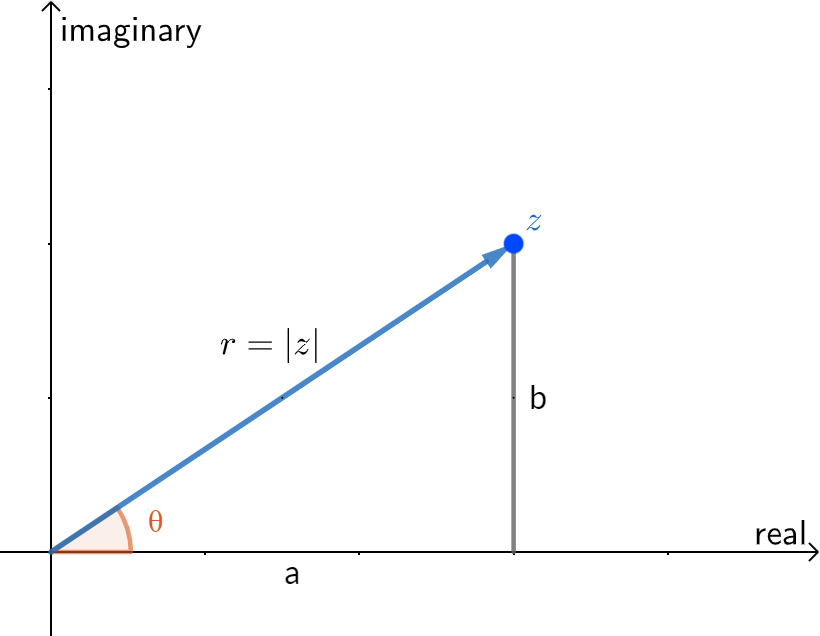
Polar Form
Using trigonometry, can be written as .
Simplifying, we obtain the polar form of :
We sometimes use the more compact notation, :
Notes:
- It is standard convention for to be in the interval .
- is also called the argument of , denoted .
Wize Tip
The range of is only (bottom-right and top-right quadrants), so take care when finding :
- If is in the top-left quadrant, add to
- If is in the bottom-left quadrant, subtract to
Euler's Formula
Euler's formula states:
Therefore, every complex number can be written as:
The expression is sometimes called the exponential form of , but we will refer to this as the polar form as well.
Multiplication
Multiplying complex numbers is much faster in polar form.
Let , be complex numbers. Then:
Wize Tip
To multiply two complex numbers: multiply the magnitudes, and add the angles.
0:00 / 0:00
Geometric Interpretation of Multiplication
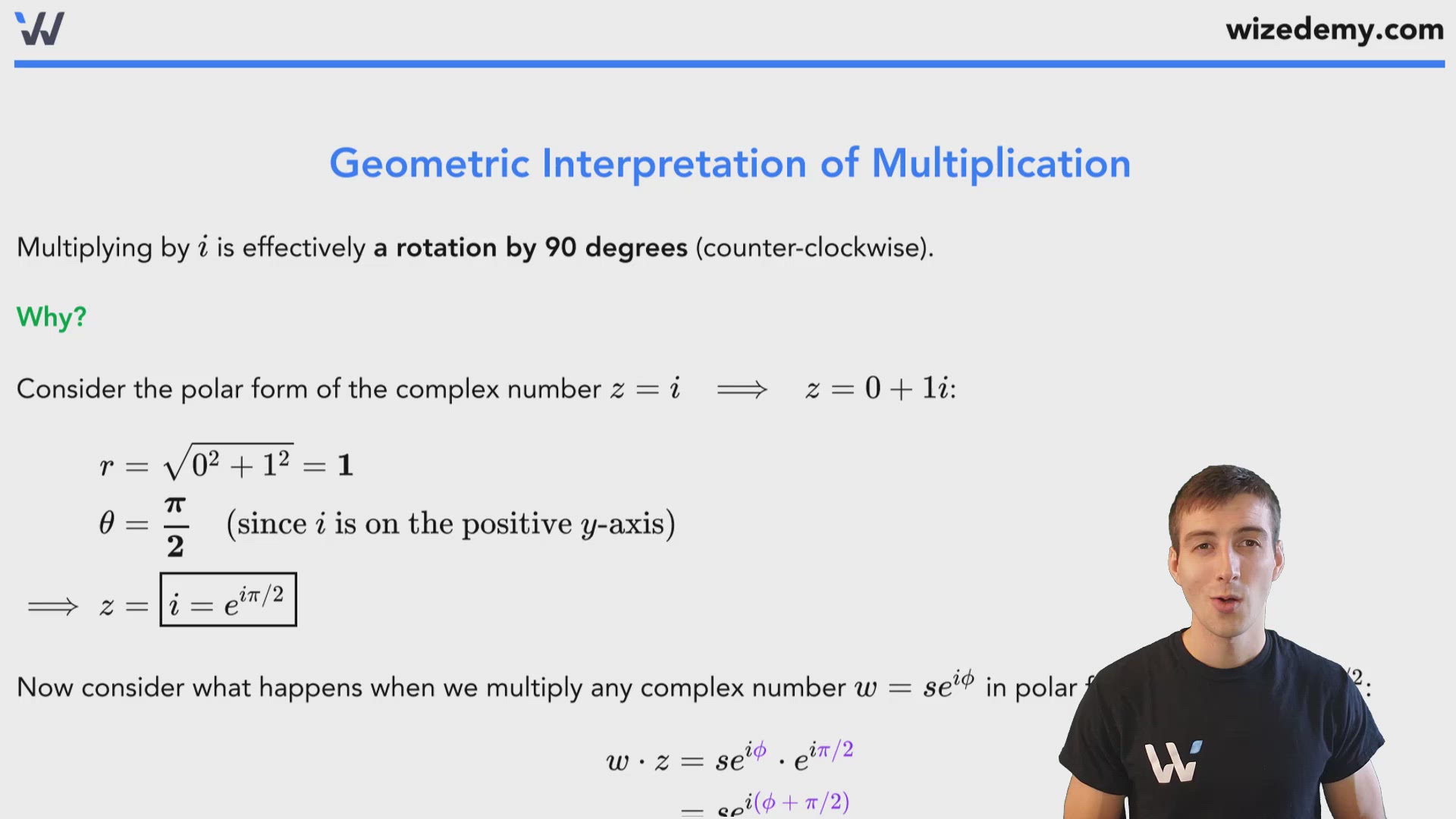
Multiplying by is effectively a rotation by 90 degrees (counter-clockwise).
Why?
Consider the polar form of the complex number :
Now consider what happens when we multiply any complex number in polar form by :
Wize Concept
Recall, multiplying complex numbers in polar form is easy: multiply the magnitudes, and add the angles
The result has the same magnitude, but we added to the existing angle: this is a rotation by 90 degrees!
Example
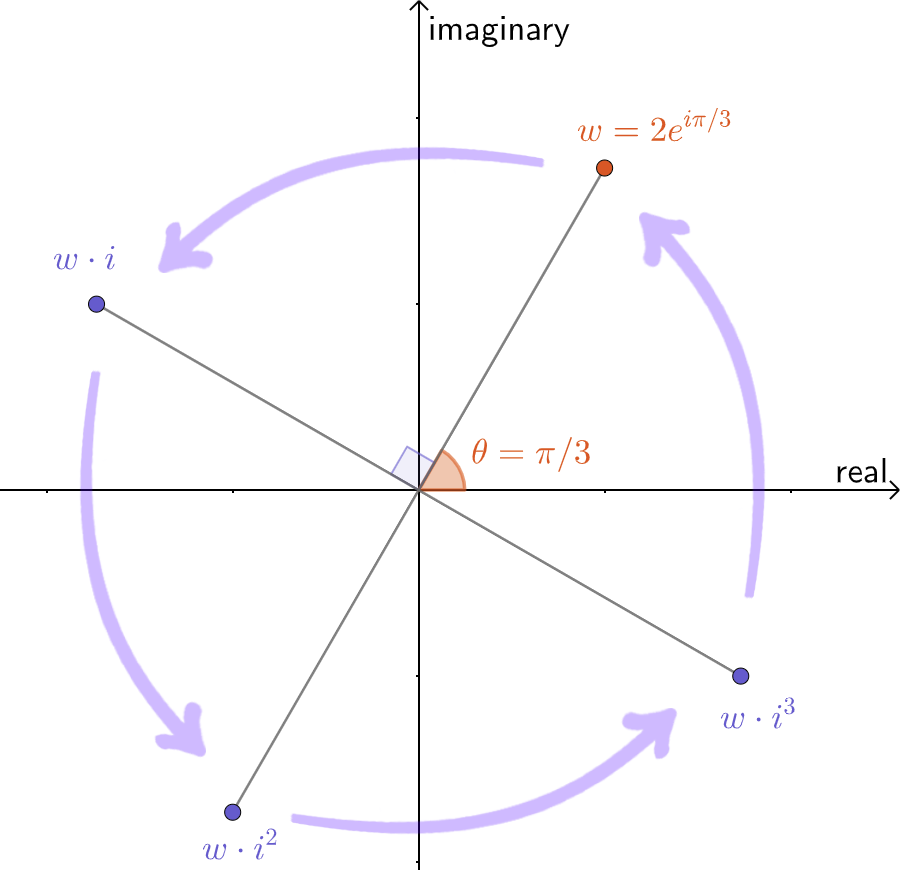
Consider the complex number . In polar form, we get .
Repeated multiplication by is the same as adding to the angle each time:
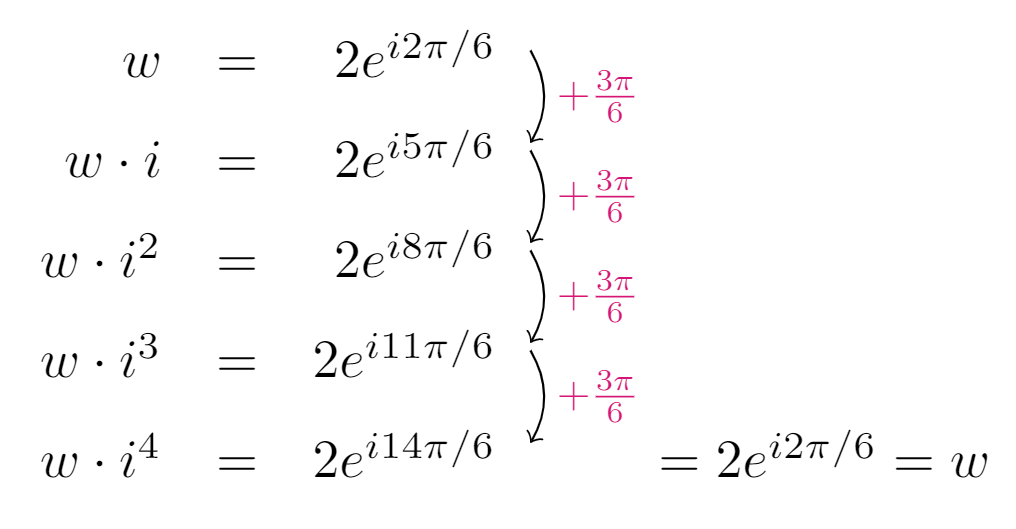
However, notice that the angle , so we have come full circle. We rotated 90 degrees four times!
0:00 / 0:00
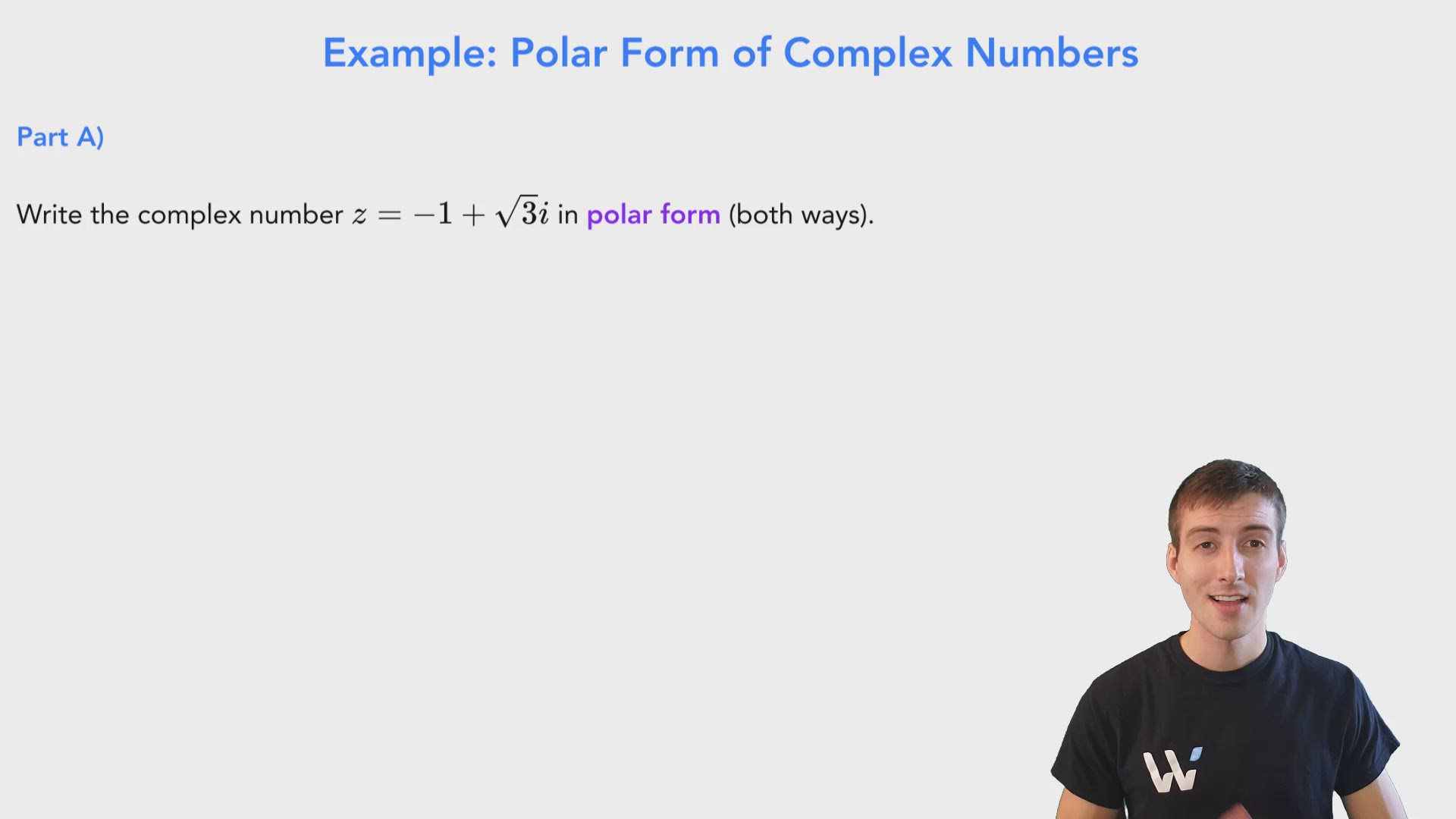
Example: Polar Form of Complex Numbers
Part A)
Write the complex number in polar form (both ways).
Considering the standard from is written , we see that and .
To find we note that is in quadrant 2 (top-left) of the complex plane, so we must add to the result of :
Then the polar form of is
Part B)
Write the complex number in standard form.
Part C)
Write the complex number in standard form.
Part D)
Multiply and , and write the product in standard form.
We can use the polar form of to simplify multiplication.
Now we multiply:
Practice: Polar Form
Write in polar form.
Practice: Multiplying Complex Numbers
Using polar form, find the product of and , and write the answer in standard form.