Wize University Linear Algebra Textbook > Complex Numbers
Basics of Complex Numbers
Popular Courses
MATH 211
University of Calgary
Algebra II
US High School
Linear Algebra
University Study Guides
MATH 1ZC3
McMaster University
MATH 152
University of British Columbia
MATH 1600A/B
Western University
Linear Algebra
General Course
MAT188H1
University of Toronto
MATH 125
University of Alberta
Linear Algebra
University Study Guides
SC/MATH 1025 3.00
York University
NMM 1412A/B
Western University
MATH 102
University of Alberta
MATH 115
University of Waterloo
MATH 1B03
McMaster University
MATH 101
University of Victoria
MATH-1270
University of Windsor
MATH 1210
University of Manitoba
MATH 111
Queen's University
MATH 1104
Carleton University

0:00 / 0:00
Basics of Complex Numbers
We define to be the imaginary unit, an imaginary number such that .
Complex Numbers in Standard Form
Complex numbers in standard form (or Cartesian form) are numbers of the form where .
The set of complex numbers is denoted .
In the standard form :
- is called the real part of , denoted:
- is called the imaginary part of , denoted:
Complex Plane
The set of real numbers is a subset of (every real number is a complex number whose imaginary part is ).
Real numbers: 1D objects represented on the number line. We can think of real numbers as either:
- a point on the line
- a vector: an arrow from the origin to the point, indicating size (distance from 0) and direction (positive/negative)

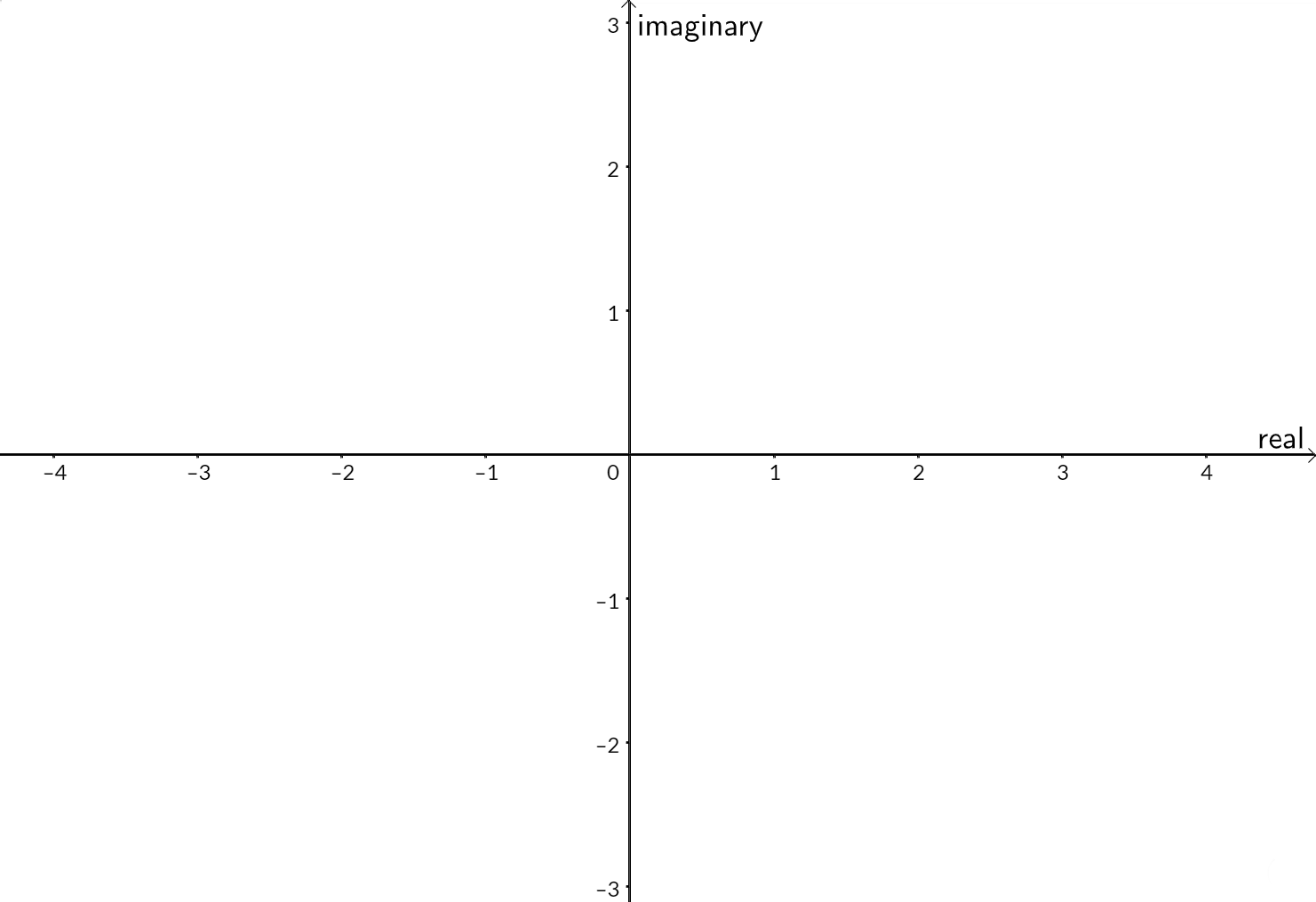
Complex numbers: 2D objects represented on the complex plane. We can think of complex numbers as either:
- a point on the plane
- a vector: an arrow from the origin to the point, indicating size and direction.

0:00 / 0:00
Operations With Complex Numbers
Addition and Subtraction
Let :
In other words, we add/subtract like terms: keep the real parts together, and keep the imaginary parts together.
Example
Compute the sum of the complex numbers and .
Multiplication
Expand using the usual rules of multiplication (keeping in mind ):
Example
Compute .
Complex Conjugate
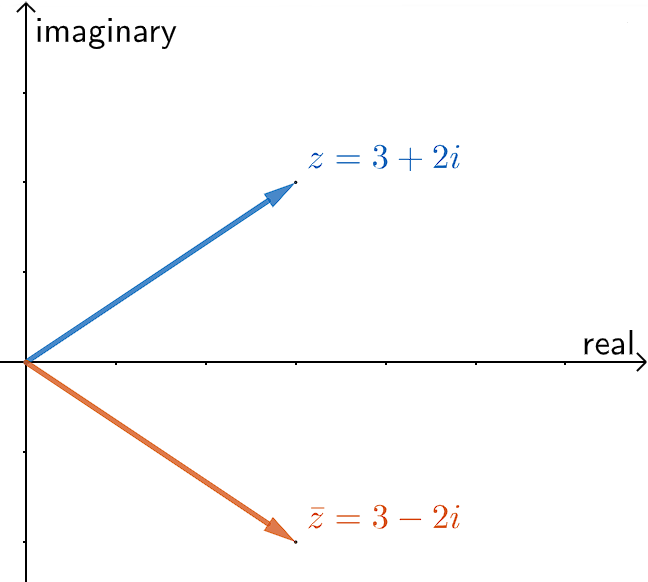
The complex conjugate of is the complex number
On the complex plane, is the reflection of across the real axis:
Properties
Let with .
- If , then
Division
To divide complex numbers, "rationalize" the denominator by multiplying top and bottom by the conjugate:
Example
Given , compute .
Modulus
The modulus (or absolute value) of a complex number is defined as:
On the complex plane, the modulus is the length of the vector from to :
Properties
Let with .
- If , then

0:00 / 0:00
Example: Basics of Complex Numbers
Perform the following operations.
Part A)
Part B)
Part C)
The conjugate of a real number is simply the real number itself (no imaginary part to negate).
Part D)
Practice: Operations with Complex Numbers
Perform the following operations.
Simplify: