0:00 / 0:00

Powers and Roots of Complex Numbers

Powers

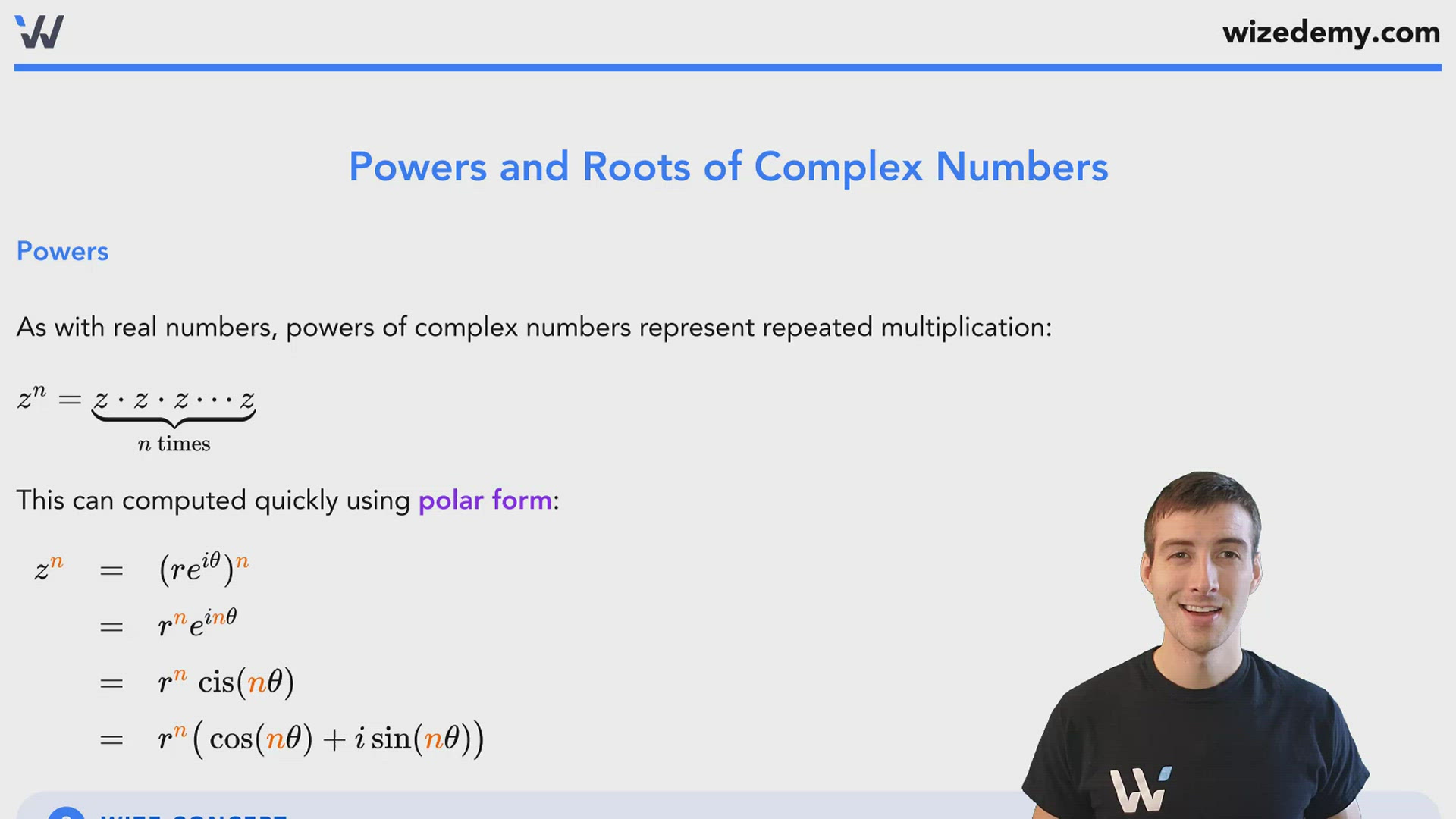
As with real numbers, powers of complex numbers represent repeated multiplication:
zn=zzzzn timesz^n=\underbrace{z\cdot z\cdot z\cdots z}_{n \text{ times}}\qquad
This can computed quickly using polar form:
zn=(reiθ)n=rneinθ=rn  cis(nθ)=rn(cos(nθ)+isin(nθ))\begin{array}{rcl} z^{\colorFour{n}}&=&(re^{i\theta})^{\colorFour{n}}\\[0.5em] &=& r^{\colorFour n} e^{i \colorFour n \theta}\\[0.5em] &=&r^{\colorFour n}\;\text{cis}(\colorFour n\theta)\\[0.5em] &=&r^{\colorFour n}\big(\cos(\colorFour n\theta) + i\sin(\colorFour n\theta)\big) \end{array}
Wize Concept
This result is closely related to De Moivre's formula:
(cosθ+isinθ)n=cos(nθ)+isin(nθ)\boxed{\quad \Big( \cos\theta + i \sin\theta \Big)^{\colorFour n} = \cos (\colorFour n\theta) + i \sin (\colorFour n\theta) \quad}

PAGE BREAK

Roots of Complex Numbers

A complex number zz is an nthn^{th} root of wCw \in \Complex if zn=wz^n = w (equivalently, z=w1/nz = w^{1/n}).
Every complex number (except 0) has exactly nn distinct nthn^{\text{th}} roots in C\mathbb{C}.
How to Find Roots
  1. Express both zz and ww in polar form, z=reiθz=re^{i\theta} and w=seiϕw=se^{i\phi}. Then: zn=w    rneinθ=seiϕ\begin{aligned} z^n &= w\\ \implies r^ne^{in\theta}&=se^{i\phi} \end{aligned}
  2. Solve rn=sr^n=s to get: r=sn\boxed{r=\sqrt[n]{s}}
  3. Solve einθ=eiϕe^{in\theta}=e^{i\phi} to get (for any integer k\colorTwo k): nθ=ϕ+2πk    θ=ϕ+2πkn(adding mutliples of 2π does not change the angle)n\theta=\phi \colorTwo{+2\pi k} \quad\implies\quad \boxed{\theta = \frac{\phi \colorTwo{+2\pi k}}{n}} \quad \text{(adding mutliples of $2\pi$ does not change the angle)}
  4. Using these results, the nthn^{\text{th}} roots of ww are: z1=sn  ei(ϕ)/nz2=sn  ei(ϕ + 2π1)/nz3=sn  ei(ϕ + 2π2)/nzn=sn  ei(ϕ + 2π(n1))/n\begin{array}{rcl} z_1&=&\sqrt[n]{s}\;e^{i(\phi)/n}\\[0.5em] z_2&=&\sqrt[n]{s}\;e^{i(\phi\colorTwo{\ +\ 2\pi\cdot1})/n}\\[0.5em] z_3&=&\sqrt[n]{s}\;e^{i(\phi\colorTwo{\ +\ 2\pi\cdot2})/n}\\[0.5em] \vdots&&\vdots\\[0.5em] z_n&=&\sqrt[n]{s}\;e^{i(\phi\colorTwo{\ +\ 2\pi\cdot(n-1)})/n}\\[0.5em] \end{array}
Wize Tip
Simply put, if zn=wz^n = w, there are nn roots z1,z2,,znz_1, z_2, \dots, z_n. Let w=seiϕw = se^{i\phi}.
  • Magnitude: always r=snr = \sqrt[n]{s}
  • Angle: start with ϕn\dfrac{\phi}{n}, then add 2πn\dfrac{2\pi}{n} to each successive root
The nthn^{\text{th}} roots of ww are evenly spread out by angles of 2πn\dfrac{2\pi}{n}on the complex plane.

0:00 / 0:00

Example: Powers of Complex Numbers

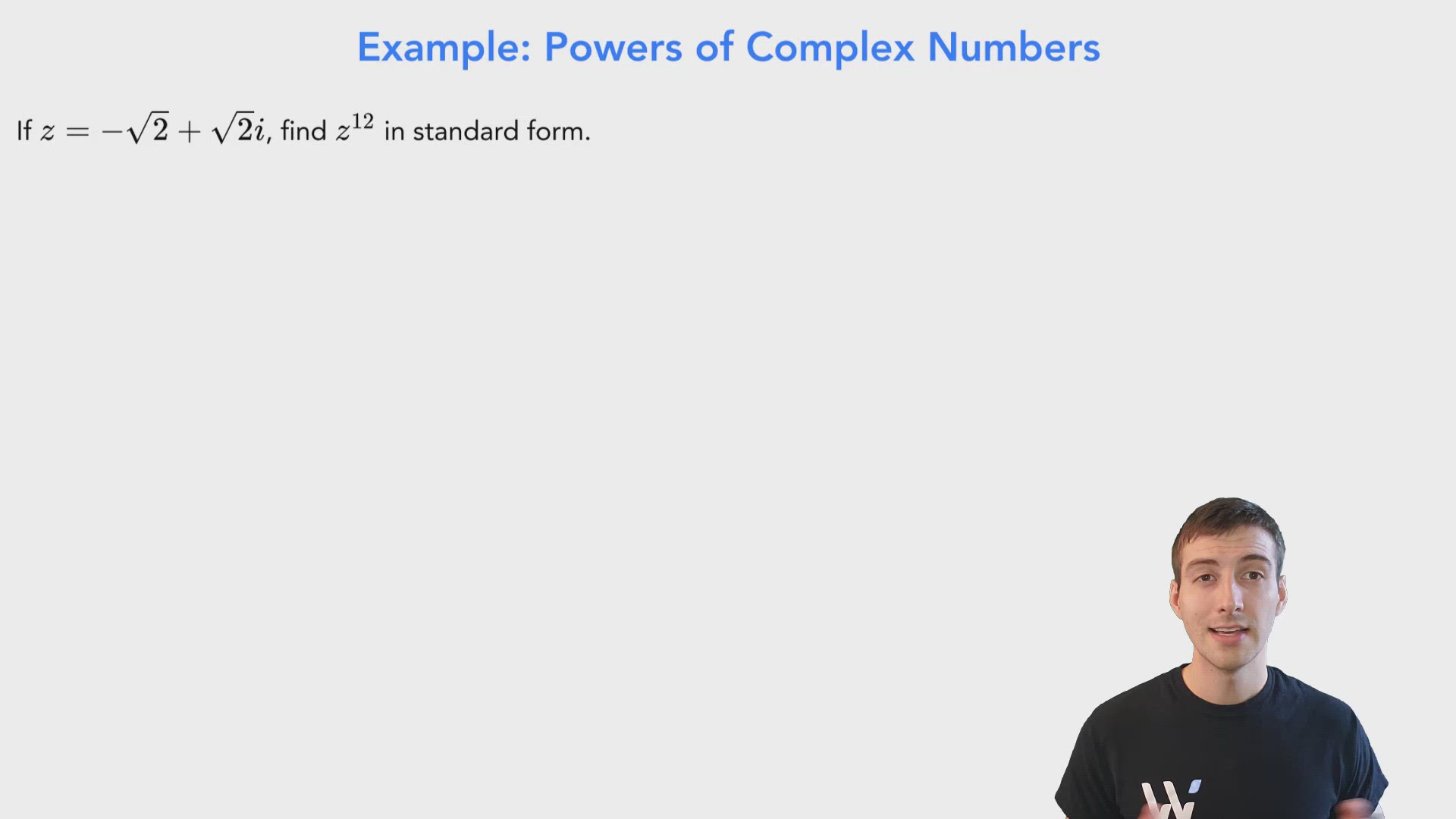
If z=2+2iz=-\sqrt{2}+\sqrt{2}i, find z12z^{12} in standard form.
We note that zz is in quadrant 2 (top-left), so we will have to add π\pi to tan1(ba)\tan^{-1}\left( \dfrac{b}{a} \right):
r=(2)2+(2)2=2r=\sqrt{(-\sqrt{2})^2+(\sqrt{2})^2}=2
θ=tan1(22)+π=tan1(1)+π=3π4\theta=\tan^{-1}\left(\frac{\sqrt{2}}{-\sqrt{2}}\right)\textcolor{green}{+\pi}=\tan^{-1}(-1)+\pi=\frac{3\pi}{4}
So z=2ei3π/4z = 2e^{i3\pi/4}. Then:
z12=(2ei3π/4)12=212e(i3π/4)12=212ei9π=212(cos(9π)+isin(9π))=212(cos(π)+isin(π))(by periodicity, angle 9π is equivalent to angle π)=212(1+i0)=212\begin{array}{rcl} z^{12}&=&(2e^{i3\pi/4})^{12}\\[0.5em] &=&2^{12}e^{(i3\pi/4)\cdot12}\\[0.5em] &=&2^{12}\,e^{i9\pi}\\[0.5em] &=&2^{12}\,\big(\cos(9\pi)+i\sin(9\pi)\big)\\[0.5em] &=&2^{12}\,\big(\cos(\pi)+i\sin(\pi)\big) \quad \text{(by periodicity, angle $9\pi$ is equivalent to angle $\pi$)}\\[0.5em] &=&2^{12}\,\big(-1+i\cdot 0)\\[0.5em] &=&\boxed{-2^{12}} \end{array}
0:00 / 0:00

Example: Roots of Complex Numbers

Find all complex numbers such that z5=3212iz^5=\dfrac{\sqrt{3}}{2}-\dfrac{1}{2}i.

Let w=3212iw=\dfrac{\sqrt{3}}{2}-\dfrac{1}{2}i. We are looking for the 5th5^{\text{th}} roots of ww. Start by writing w=seiϕw=se^{i\phi} (polar form).
ww is in quadrant 4 (bottom-right), so we do not need to add/subtract π\pi to find ϕ=tan1(ba)\phi = \tan^{-1}\left( \dfrac{b}{a} \right).
s=(32)2+(12)2=1s=\sqrt{(\frac{\sqrt{3}}{2})^2+(-\frac{1}{2})^2}=1
ϕ=tan1((12)/(32))=tan1(13)=π6\phi=\tan^{-1}\left((-\frac{1}{2})/(\frac{\sqrt{3}}{2})\right)=\tan^{-1}\left(-\frac{1}{\sqrt{3}}\right)=-\dfrac{\pi}{6}
We can now find the value of rr and the values of θ\theta for each root:
r=s5=15=1r=\sqrt[5]{s}=\sqrt[5]{1}=1
θ1=π6+2π05=π30θ2=π6+2π15=11π30θ3=π6+2π25=23π30θ4=π6+2π35=35π30=7π6θ5=π6+2π45=47π30\begin{array}{rcl} \theta_1&=&\dfrac{-\frac{\pi}{6}+2\pi\cdot0}{5}=-\dfrac{\pi}{30}\\[1.5em] \theta_2&=&\dfrac{-\frac{\pi}{6}+2\pi\cdot1}{5}=\dfrac{11\pi}{30}\\[1.5em] \theta_3&=&\dfrac{-\frac{\pi}{6}+2\pi\cdot2}{5}=\dfrac{23\pi}{30}\\[1.5em] \theta_4&=&\dfrac{-\frac{\pi}{6}+2\pi\cdot3}{5}=\dfrac{35\pi}{30}=\dfrac{7\pi}{6}\\[1.5em] \theta_5&=&\dfrac{-\frac{\pi}{6}+2\pi\cdot4}{5}=\dfrac{47\pi}{30}\\[1.5em] \end{array}
The five distinct 5th5^{th}roots of ww are therefore the following equally spaced complex numbers:
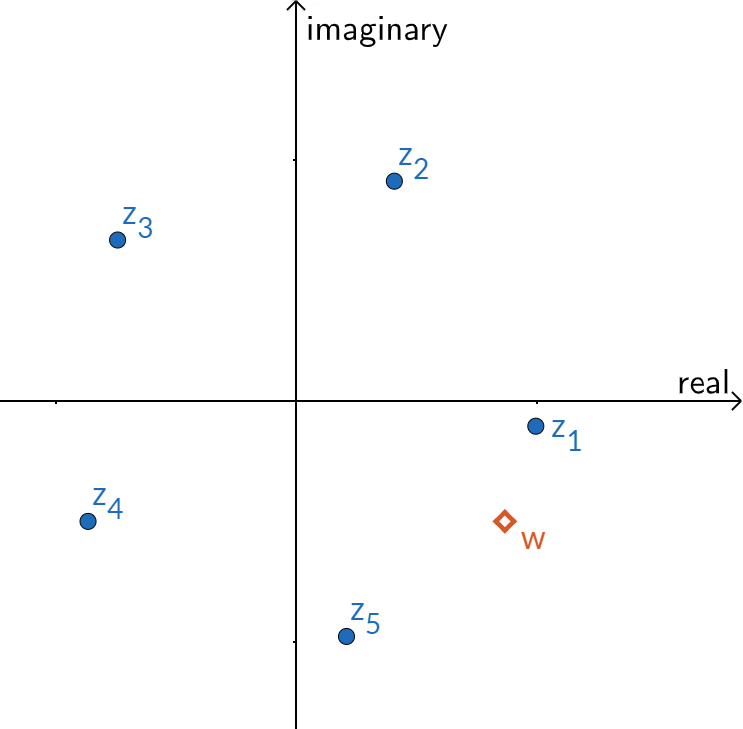
z1=eiπ/30z2=ei11π/30z3=ei23π/30z4=ei7π/6z5=ei47π/30\begin{array}{rcl} z_1&=&e^{-i\pi/30}\\[0.5em] z_2&=&e^{i11\pi/30}\\[0.5em] z_3&=&e^{i23\pi/30}\\[0.5em] z_4&=&e^{i7\pi/6}\\[0.5em] z_5&=&e^{i47\pi/30}\\[0.5em] \end{array}

Practice: Powers of Complex Numbers

Given u=3212iu=-\dfrac{\sqrt{3}}{2}-\dfrac{1}{2}i, find u60u^{60}.

Practice: Roots of Complex Numbers

Find all three complex cube roots of 8.
Extra Practice