Wize University Linear Algebra Textbook > Complex Numbers
Quadratic Formula
Popular Courses
MATH 211
University of Calgary
Linear Algebra
University Study Guides
MATH 152
University of British Columbia
Linear Algebra
General Course
MATH 125
University of Alberta
Linear Algebra
University Study Guides
SC/MATH 1025 3.00
York University
MATH 102
University of Alberta
MATH 115
University of Waterloo
MATH-1270
University of Windsor
MATH 1210
University of Manitoba
MATH 111
Queen's University
MATH 1104
Carleton University
MATH 1300
University of Manitoba
MAT 1302
University of Ottawa
MATH 1107
Carleton University
MATH 114
University of Waterloo
MTH 116
Michigan State University
MATH-1260
University of Windsor
MA-UY 2034
New York University
0:00 / 0:00
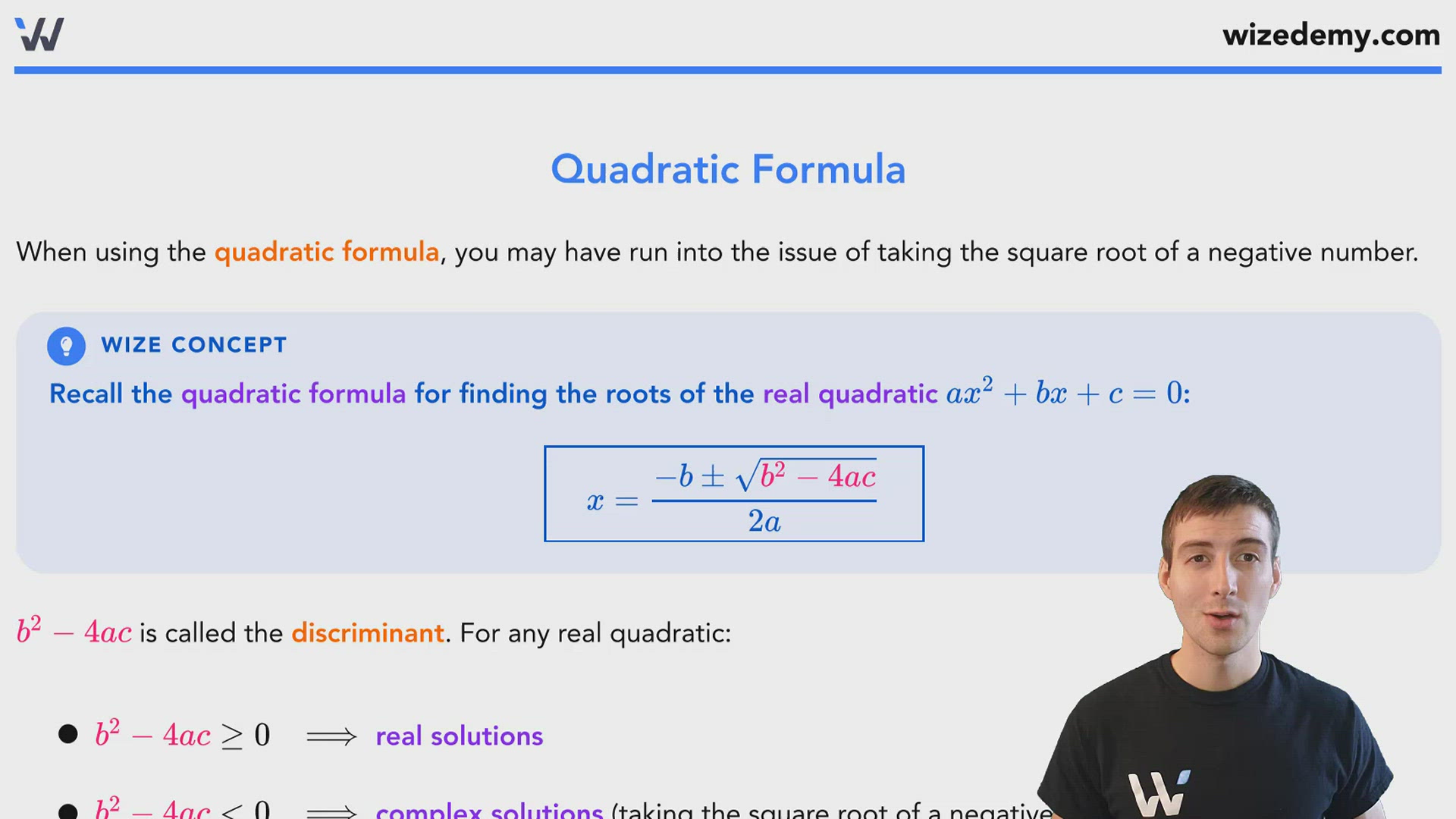
Quadratic Formula
When using the quadratic formula, you may have run into the issue of taking the square root of a negative number.
Wize Concept
Recall the quadratic formula for finding the roots of the real quadratic :
is called the discriminant. For any real quadratic:
- real solutions
- complex solutions (taking the square root of a negative number)
Wize Tip
Complex solutions always come in conjugate pairs!
If is one root, then the other root is .
Example
Find the roots of the real quadratic .
We want to find the values of such that .
We have . Let's apply the quadratic formula.
Wize Concept
The quadratic formula works even if the quadratic has complex coefficients.
Note: you may need to find square roots of a complex number. Remember to use polar form to find the roots!
0:00 / 0:00
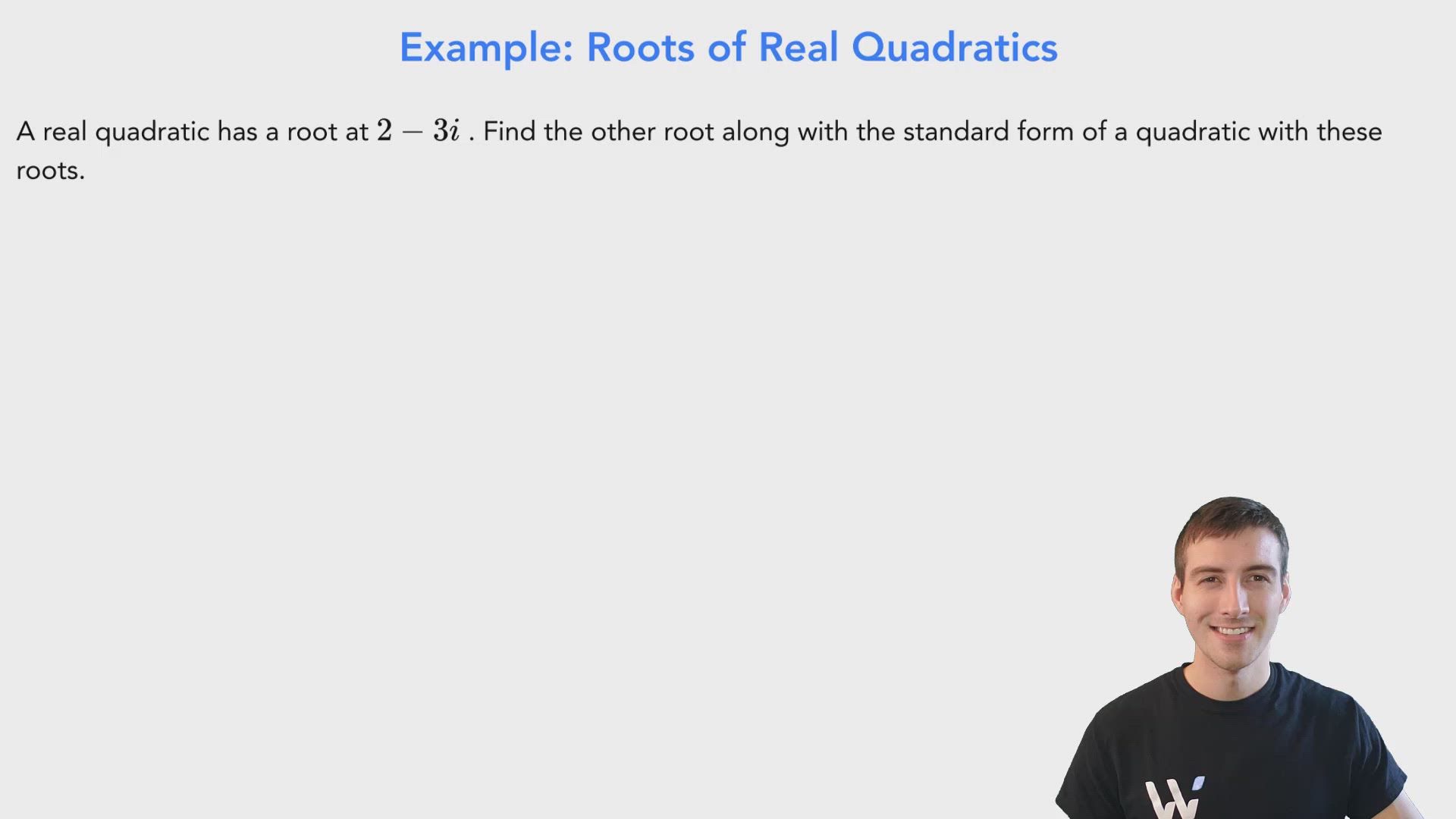
Example: Roots of Real Quadratics
A real quadratic has a root at . Find the other root along with the standard form of a quadratic with these roots.
Since we are given one root of a real quadratic and the root is complex, the other root is the complex conjugate: .
We can find the real quadratic by multiplying the two factors that yield these roots:
and are the factors that, when set to be equal to zero, yield the desired roots.
0:00 / 0:00
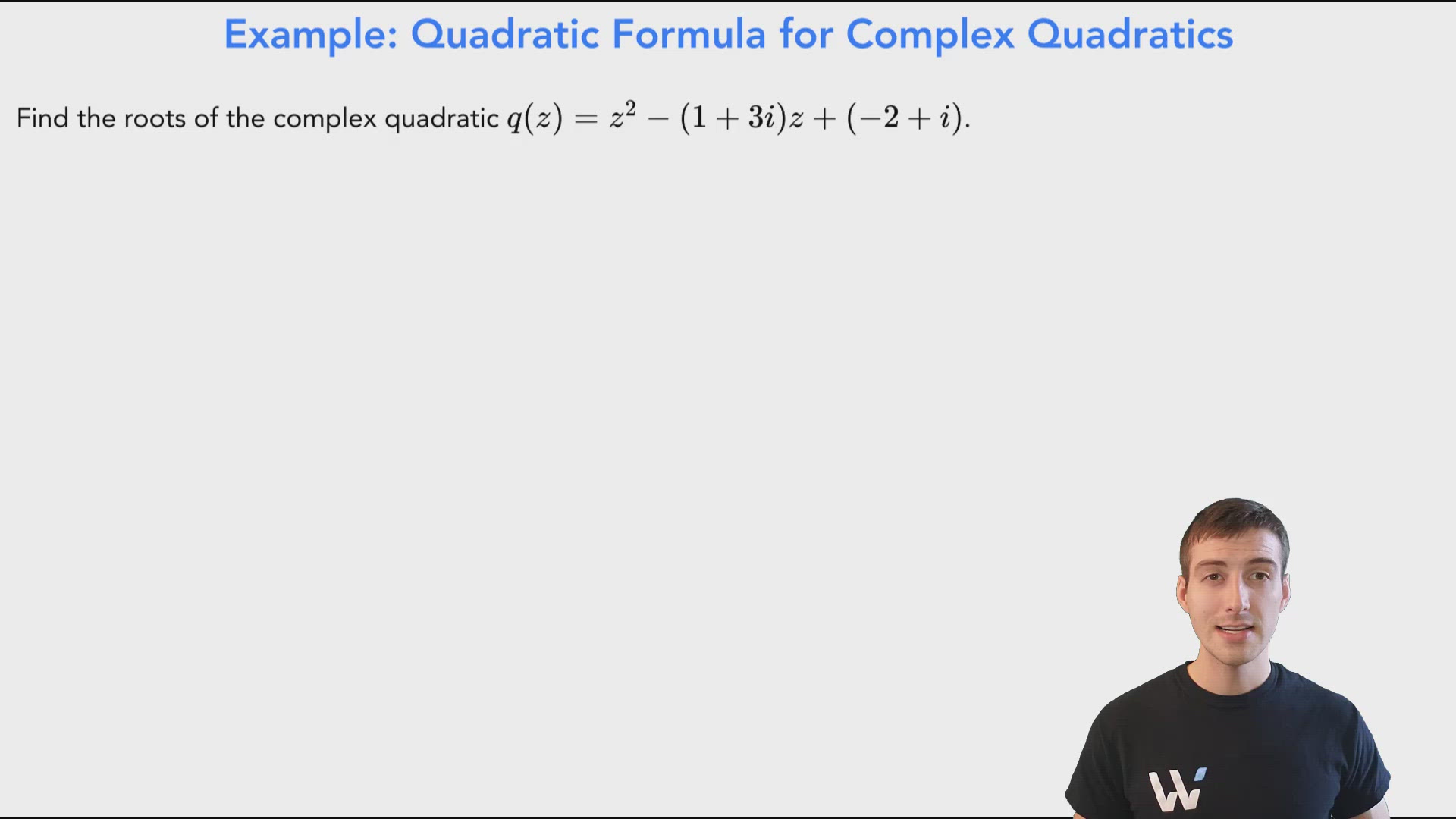
Example: Quadratic Formula for Complex Quadratics
Find the roots of the complex quadratic .
Note that .
Applying the quadratic formula:
At this step, we notice that we must take the square root of a complex number. Convert to polar form :
The square roots are of the form , with values of :
We can now continue finding the roots using the fact that :
Practice: Quadratic with Complex Coefficients
Find the roots of .