0:00 / 0:00

Linear Transformations

Transformations are functions that map one vector to another vector.
T:RnRmT:\mathbb{R}^n\to\mathbb{R}^m is a linear transformation if for all scalars c,dRc,d \in \reals and for all vectors x1, x2Rn\vec{x}_1,\ \vec x_2 \in \reals^n, then
T(cx1+dx2)=cT(x1)+dT(x2)\boxed{\quad T(c\vec{x}_1+d\vec{x}_2)=c\,T(\vec{x}_1)+d\, T(\vec{x}_2) \quad}
If T:RnRmT:\mathbb{R}^n\to\mathbb{R}^m is a linear transformation, then there exists a matrix AA that is said to induce TT:
T(x)=Ax\boxed{\quad T\left(\vec{x}\right)=A\vec{x} \quad}

Wize Concept
This is an important fact: every linear transformation is equivalent to multiplying by some matrix!

Wize Tip
You can quickly check whether or not a transformation is linear:
  • Make sure all components consist of only multiples of variables being added or subtracted.
  • Not allowed in linear transformations:
  • multiplying variables together
  • applying non-linear functions (trig functions, exponentials, raising to a power other than 1, etc.)
  • If T(0)0T(\vec 0) \neq \vec 0, then TT is not linear.
  • adding a number on its own (no variable)     \implies not linear

PAGE BREAK

Finding the Matrix Associated with a Linear Transformation

The matrix AA that induces TT is given by applying TT to every column of the identity matrix.
Denoting the ithi^{th} column of InI_n as ei\vec e_i, we get:
A=[T(e1)T(e2)T(en)]=[T[100]T[010]T[001]]\begin{array}{rcllll} A &=& {\huge[} T\left(\vec{e}_1\right) & T\left(\vec{e}_2\right) & \cdots & T\left(\vec{e}_n\right) {\huge]} \\[1em] &=& \left[ T \begin{bmatrix} 1\\ 0\\ \vdots\\ 0\\ \end{bmatrix} \right. & T \begin{bmatrix} 0\\ 1\\ \vdots\\ 0\\ \end{bmatrix} & \cdots & T \left. \begin{bmatrix} 0\\ 0\\ \vdots\\ 1\\ \end{bmatrix} \right] \end{array}
Example
Suppose T:R3R2T:\reals^3 \to \reals^2 is given by T([xyz])=[x+yz]T \left( \begin{bmatrix} x\\ y\\ z\\ \end{bmatrix} \right) = \begin{bmatrix} x+y\\ z\\ \end{bmatrix} . Find the matrix that induces TT.
The input of TT is a vector in R3\reals^{\colorTwo{3}}, so we apply TT to the columns of I3I_{\colorTwo{3}}:
A=[T([100])T([010])T([001])]=[110001]A = \left[ \begin{array}{rrr} T \left( \begin{bmatrix} 1\\ 0\\ 0\\ \end{bmatrix} \right) & T \left( \begin{bmatrix} 0\\ 1\\ 0\\ \end{bmatrix} \right) & T \left( \begin{bmatrix} 0\\ 0\\ 1\\ \end{bmatrix} \right) \end{array} \right] = \left[ \begin{array}{rrr} 1 & 1 & 0\\ 0 & 0 & 1\\ \end{array} \right]
0:00 / 0:00

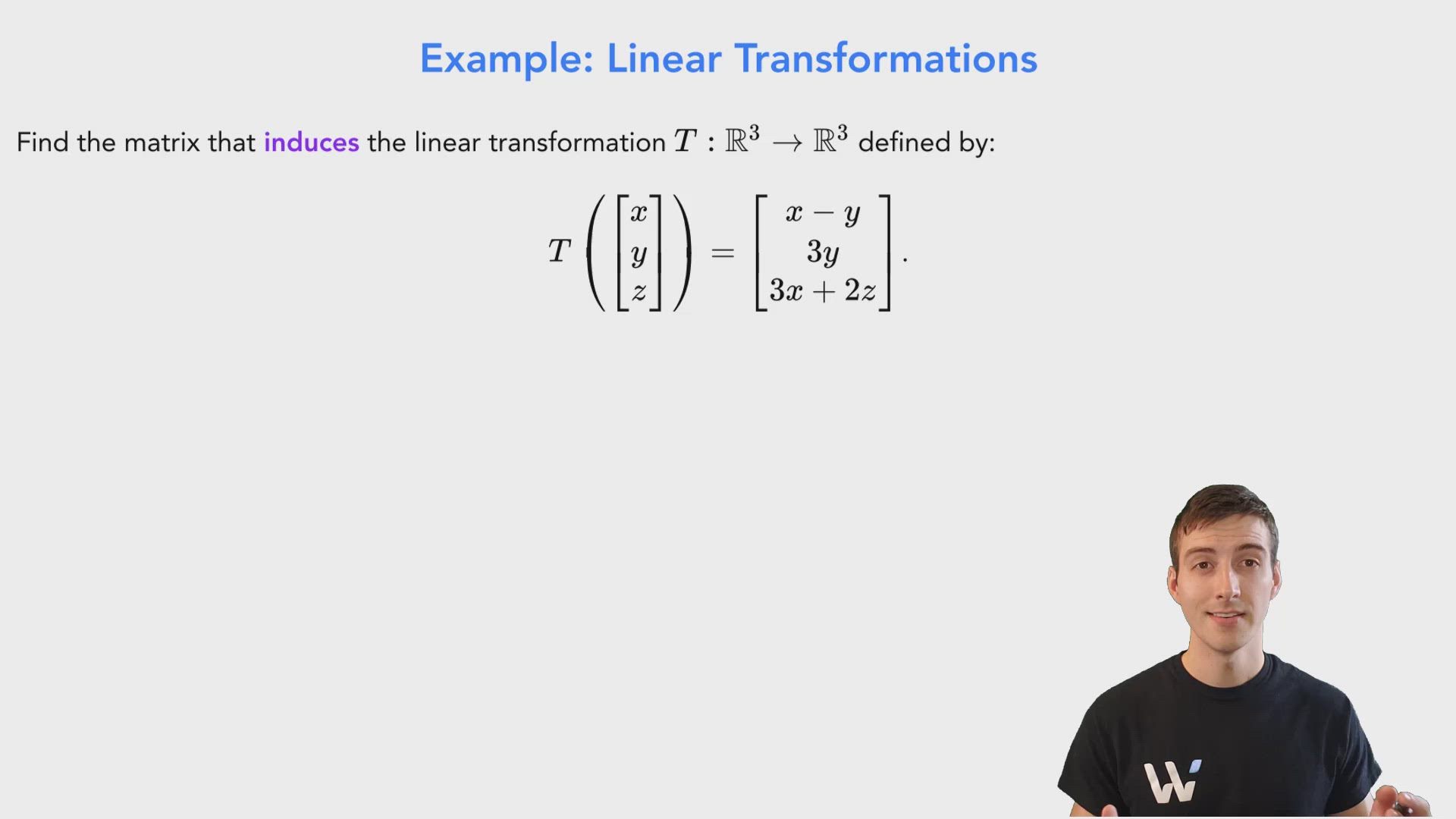
Example: Linear Transformations

Find the matrix that induces the linear transformation T:R3R3T: \reals^3 \to \reals^3 defined by:
T([xyz])=[xy3y3x+2z]T\left(\begin{bmatrix} x\\y\\z \end{bmatrix}\right) = \begin{bmatrix} x-y\\3y\\3x+2z \end{bmatrix}.
Step 1
Define the following vectors by applying TT to the columns of I3I_3:
u=T([100])v=T([010])w=T([001])    u=[103(0)3(1)+2(0)]v=[013(1)3(0)+2(0)]w=[003(0)3(0)+2(1)]    u=[103]v=[130]w=[002]\begin{array}{llll} &\vec u=T\left(\begin{bmatrix} 1\\0\\0 \end{bmatrix}\right) & \vec v=T\left(\begin{bmatrix} 0\\1\\0 \end{bmatrix}\right) & \vec w=T\left(\begin{bmatrix} 0\\0\\1 \end{bmatrix}\right)\\[2em] \implies &\vec u=\begin{bmatrix} 1-0\\3(0)\\3(1)+2(0) \end{bmatrix} &\vec v=\begin{bmatrix} 0-1\\3(1)\\3(0)+2(0) \end{bmatrix} &\vec w=\begin{bmatrix} 0-0\\3(0)\\3(0)+2(1) \end{bmatrix}\\[2em] \implies &\vec u=\begin{bmatrix} 1\\0\\3 \end{bmatrix} & \vec v=\begin{bmatrix} -1\\3\\0 \end{bmatrix} &\vec w=\begin{bmatrix} 0\\0\\2 \end{bmatrix} \end{array}
Step 2
A=[u  v  w]=[110030302]A =[\vec u\ \ \vec v\ \ \vec w] = \boxed{ \begin{bmatrix} 1&-1&0\\ 0&3&0\\ 3&0&2 \end{bmatrix} }
Wize Tip
Notice that each row could have been found directly by inspection!
E.g. compare row 1: we see that there is 1 in the column for xx, and -1 in the column for y      xyy \ \iff\ x-y.

0:00 / 0:00

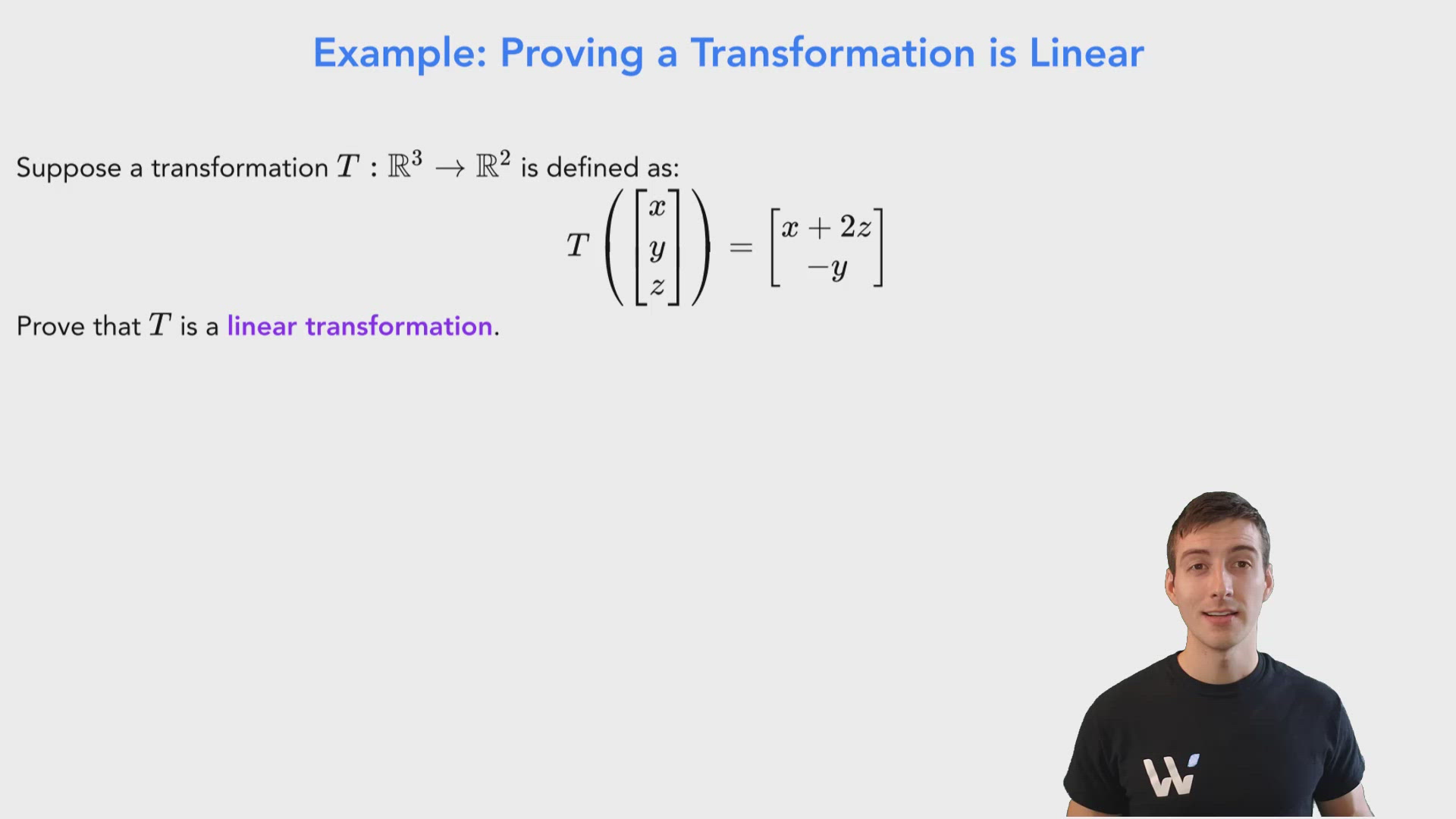
Example: Proving a Transformation is Linear

Suppose a transformation T:R3R2T:\reals^3 \to \reals^2 is defined as:
T([xyz])=[x+2zy]T \left( \begin{bmatrix} x\\ y\\ z\\ \end{bmatrix} \right) = \begin{bmatrix} x+2z\\ -y\\ \end{bmatrix}
Prove that TT is a linear transformation.
Let x=[xyz],  u=[uvw]R3\vec x = \begin{bmatrix} x\\ y\\ z\\ \end{bmatrix},\ \ \vec u = \begin{bmatrix} u\\ v\\ w\\ \end{bmatrix} \in \reals^3 and let c,dRc,d \in \reals.
Our goal is to show that T(cx+du)=cT(x)+dT(u)T(c\vec{x}+d\vec{u})=c\,T(\vec{x})+d\, T(\vec{u}). Starting with the LHS:
T(cx+du)=T(c[xyz]+d[uvw])=T([cx+ducy+dvcz+dw])=[(cx+du)+2(cz+dw)(cy+dv)]=[c(x+2z)+d(u+2w)c(y)+d(v)]=c[x+2zy]+d[u+2wv]=cT(x)+dT(u)\begin{array}{rcl} T(c\vec{x}+d\vec{u}) &=& T\left( c\begin{bmatrix} x\\ y\\ z\\ \end{bmatrix} + d\begin{bmatrix} u\\ v\\ w\\ \end{bmatrix} \right)\\[2em] &=& T\left( \begin{bmatrix} \colorOne{cx+du}\\ cy+dv\\ \colorTwo{cz+dw}\\ \end{bmatrix} \right)\\[2em] &=& \begin{bmatrix} (\colorOne{cx+du}) + 2(\colorTwo{cz+dw})\\[0.5em] -(cy+dv)\\ \end{bmatrix}\\[2em] &=& \begin{bmatrix} c(x+2z)+d(u+2w)\\[0.5em] c(-y)+d(-v)\\ \end{bmatrix}\\[2em] &=& c\begin{bmatrix} x+2z\\[0.5em] -y\\ \end{bmatrix} + d\begin{bmatrix} u+2w\\[0.5em] -v\\ \end{bmatrix}\\[2em] &=& c\,T\left( \vec x \right) + d\,T\left( \vec u \right)\\[2em] \end{array}
Therefore, TT is in fact a linear transformation.

Practice: Identifying Non-Linear Transformations

Select all of the following transformations that are non-linear.

Practice: Linear Transformations

Suppose T:R2R3T:\mathbb{R}^2\to\mathbb{R}^3 is a linear transformation where
T[25]=[123],T[38]=[101]T\begin{bmatrix}2\\5\end{bmatrix}=\begin{bmatrix}1\\2\\3\end{bmatrix},\quad T\begin{bmatrix}3\\8\end{bmatrix}=\begin{bmatrix}-1\\0\\1\end{bmatrix}.
Find the matrix that induces TT.
Extra Practice