Wize University Linear Algebra Textbook > Linear Transformations
Composition and Inverse
Popular Courses
MATH 211
University of Calgary
Linear Algebra
University Study Guides
MATH 152
University of British Columbia
MATH 1600A/B
Western University
Linear Algebra
General Course
MATH 204
Concordia University
MAT188H1
University of Toronto
Linear Algebra
University Study Guides
NMM 1411A/B
Western University
SC/MATH 1025 3.00
York University
APSC 174
Queen's University
MATH 102
University of Alberta
MATH 115
University of Waterloo
MAT133Y1
University of Toronto
MATH 1B03
McMaster University
MAT223H1
University of Toronto
MATH-1270
University of Windsor
MATH 1210
University of Manitoba
MATH-1250
University of Windsor
MATH 223
McGill University
0:00 / 0:00
Composition and Inverse
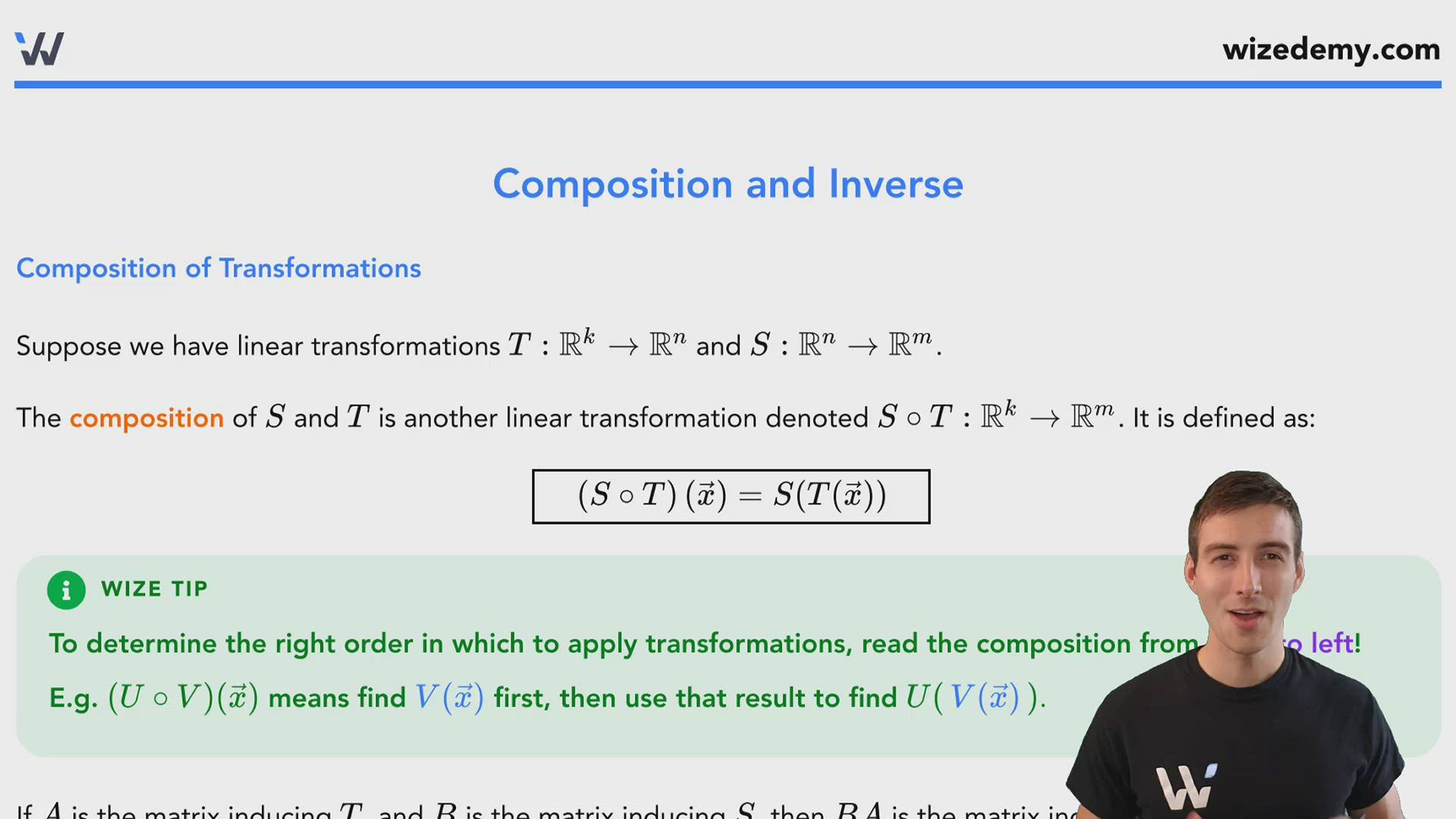
Composition of Transformations
Suppose we have linear transformations and .
The composition of and is another linear transformation denoted . It is defined as:
Wize Tip
To determine the right order in which to apply transformations, read the composition from right to left!
E.g. means find first, then use that result to find .
If is the matrix inducing , and is the matrix inducing , then is the matrix inducing :
Inverse of a Linear Transformation
Suppose and are linear transformations.
We say that and are inverses of one another if, for every :
and
Wize Tip
Geometrically, the inverse transformation "undoes" the original transformation.
E.g. The inverse of a rotation by is a rotation by .
Matrix Form of the Inverse Transformation
If is the matrix inducing , then has an inverse transformation if and only if is invertible.
The inverse is unique and denoted by , and is induced by the matrix .
0:00 / 0:00
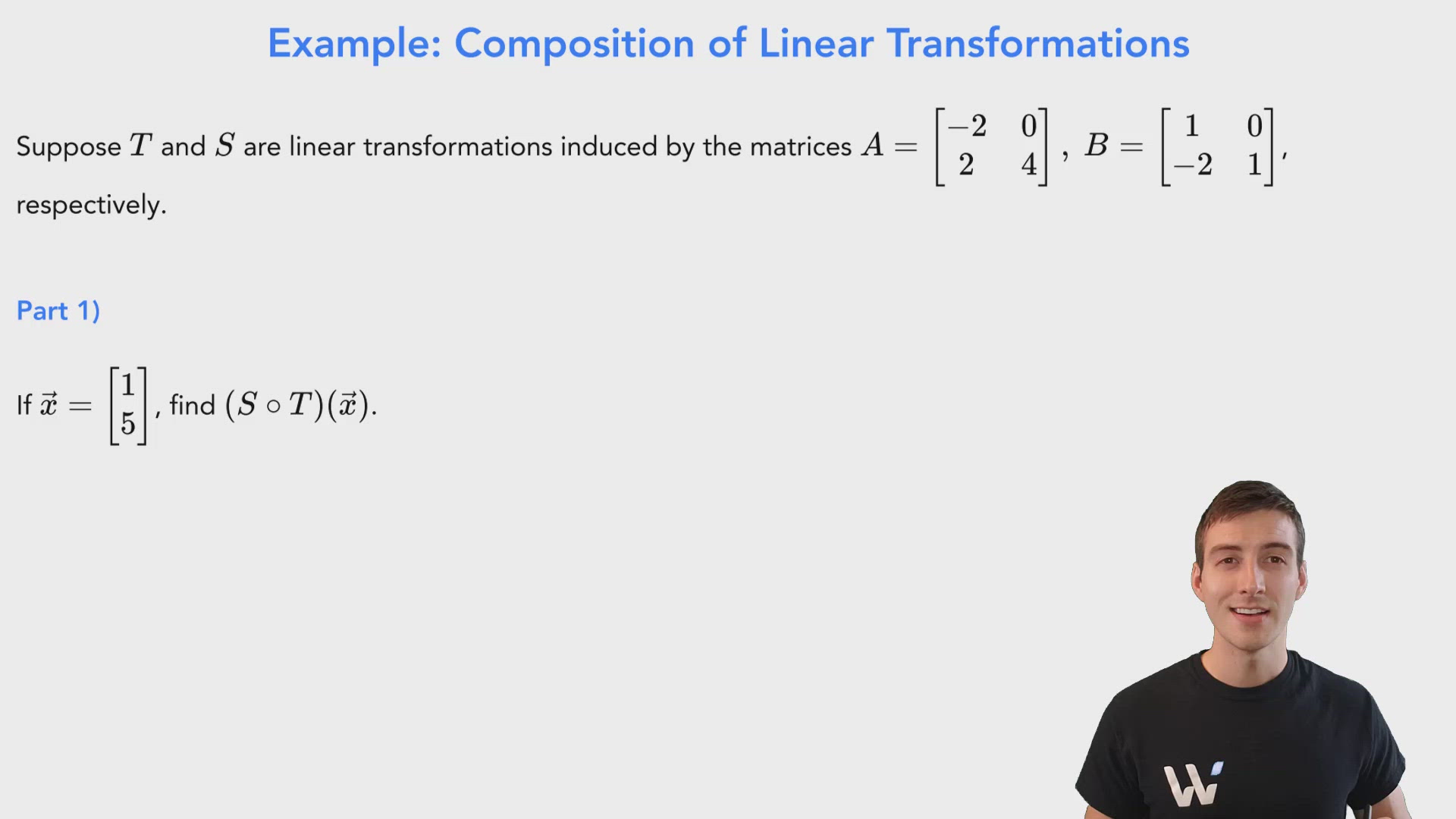
Example: Composition of Linear Transformations
Suppose and are linear transformations induced by the matrices , respectively.
Part 1)
If , find .
Note that is the matrix that induces .
Part 2)
Find the matrix inducing .
Since is induced by the matrix , must be induced by .
We know that for any vector :
Therefore, the matrix inducing is given by :
Practice: Composition of Linear Transformations
Let be a linear transformation defined by .
Let be the linear transformation induced by the matrix .
Find the vector such that .