Wize University Linear Algebra Textbook > Linear Transformations

Special Linear Transformations in R2\reals^2

0:00 / 0:00

Special Linear Transformations in R2\colorOne{\mathbb{R}^2}

Rotation

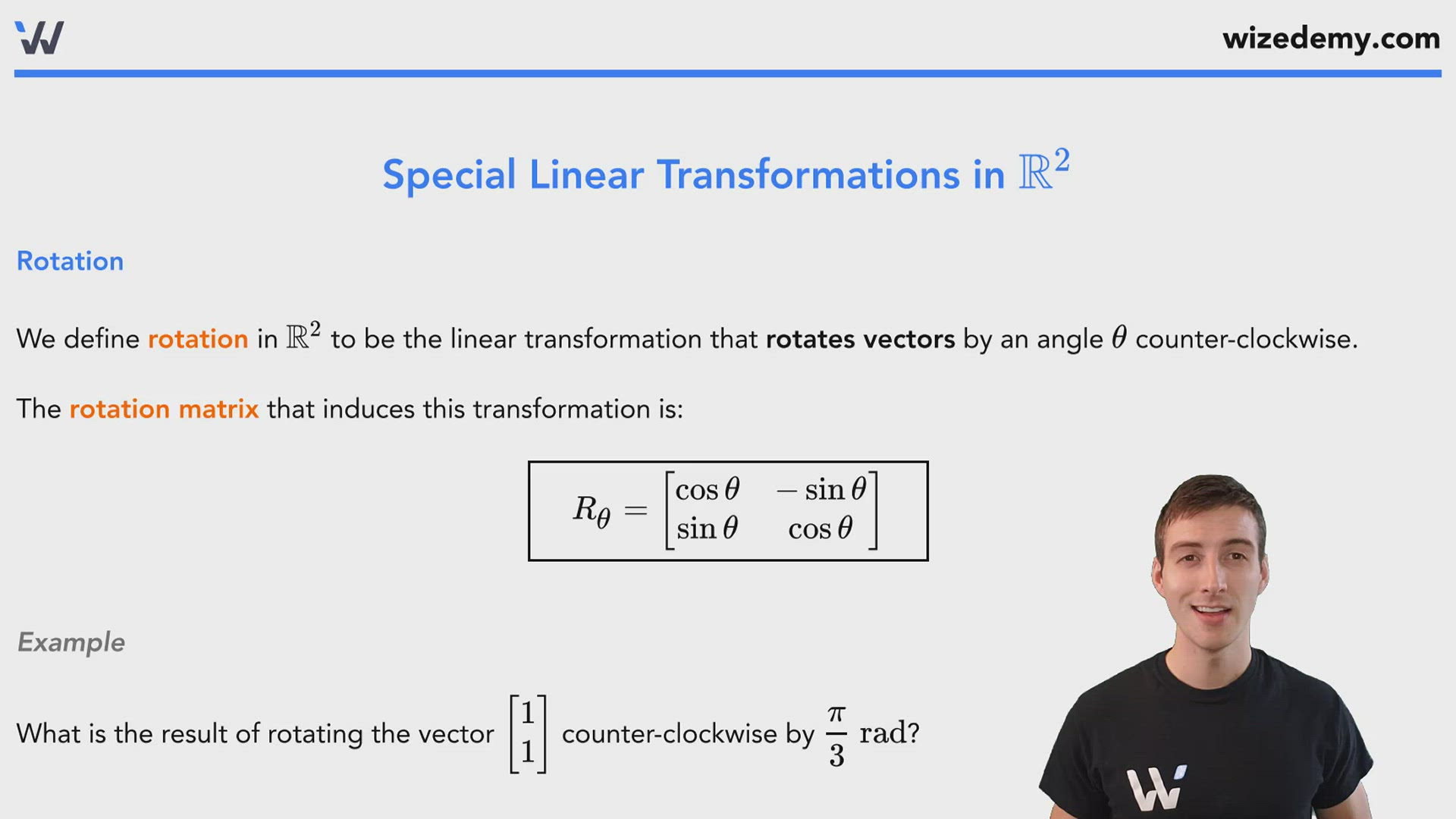
We define rotation in R2\reals^2 to be the linear transformation that rotates vectors by an angle θ\theta counter-clockwise.
The rotation matrix that induces this transformation is:
Rθ=[cosθsinθsinθcosθ]\boxed{\quad R_{\small \theta} = \begin{bmatrix} \cos\theta & -\sin\theta\\ \sin\theta & \cos\theta \end{bmatrix} \quad}
Example
What is the result of rotating the vector [11]\begin{bmatrix} 1\\ 1\\ \end{bmatrix} counter-clockwise by π3 rad\dfrac{\pi}{3} \text{ rad}?
θ=π3    Rθ=Rπ3=[cosπ3sinπ3sinπ3cosπ3]=[1/23/23/21/2]\theta = \dfrac{\pi}{3} \quad \implies\quad R_{\small \theta} = R_{\normalsize\frac{\pi}{3}} = \begin{bmatrix} \cos\frac{\pi}{3} & -\sin\frac{\pi}{3}\\[0.5em] \sin\frac{\pi}{3} & \cos\frac{\pi}{3} \end{bmatrix} = \begin{bmatrix} 1/2 & -{\sqrt3}/{2}\\[0.5em] {\sqrt3}/{2} & {1}/{2} \end{bmatrix}
Then we just need to multiply: Rθ[11]=[1/23/23/21/2][11]=[1321+32]R_{\small \theta} \begin{bmatrix} 1\\[0.5em] 1\\ \end{bmatrix} = \begin{bmatrix} 1/2 & -{\sqrt3}/{2}\\[0.5em] {\sqrt3}/{2} & {1}/{2} \end{bmatrix} \begin{bmatrix} 1\\[0.5em] 1\\ \end{bmatrix} = \boxed{ \begin{bmatrix} \dfrac{1-\sqrt3}{2}\\[1em] \dfrac{1+\sqrt3}{2}\\ \end{bmatrix} }
PAGE BREAK

Reflection

About Line y=mx\colorThree{y=mx}
First, we will look at the linear transformation that reflects vectors in R2\reals^2 across the line y=mxy=mx.
The reflection matrix that induces this transformation is:
Qm=11+m2[1m22m2mm21]\boxed{\quad Q_m= \dfrac{1}{1+m^2}\begin{bmatrix} 1-m^2 & 2m\\[0.3em] 2m & m^2-1 \end{bmatrix} \quad}
About Line at Angle θ\colorThree{\theta}
We can also write this as a reflection in R2\reals^2 about the line set at an angle θ\theta counter-clockwise from the positive xx-axis.
This linear transformation is induced by the matrix:
Refθ=[cos2θsin2θsin2θcos2θ]\boxed{\quad \text{Ref}_{\small \theta} = \begin{bmatrix} \cos2\theta & \sin2\theta\\[0.3em] \sin2\theta & -\cos2\theta \end{bmatrix} \quad}
PAGE BREAK

Composition of Rotations and Reflections

The composition of two reflections or two rotations is a rotation.
two rotations:RθRϕ=Rθ+ϕtwo reflections:RefθRefϕ=R2(θϕ)\begin{array}{lrcl} \text{two rotations:} &R_{\small\theta} \circ R_{\small\phi} &=& \boxed{R_{\small\theta+\phi}} \\[1em] \text{two reflections:} &\text{Ref}_{\small\theta} \circ \text{Ref}_{\small\phi} &=& \boxed{R_{\small 2(\theta-\phi)}} \end{array}
The composition of a reflection and a rotation is a reflection.
reflection, then rotation:RθRefϕ=Refϕ+θ/2rotation, then reflection:RefϕRθ=Refϕθ/2\begin{array}{lrcl} \text{reflection, then rotation:} &R_{\small\theta} \circ \text{Ref}_{\colorTwo{\small\phi}} &=& \boxed{\text{Ref}_{\small \colorTwo\phi + \theta/2}} \\[1em] \text{rotation, then reflection:} &\text{Ref}_{\colorTwo{\small\phi}} \circ \text{R}_{\small\theta} &=& \boxed{\text{Ref}_{\small \colorTwo\phi - \theta/2}} \end{array}

PAGE BREAK

Projection

We define projection in R2\reals^2 to be the linear transformation that projects a vector onto the line set at an θ\theta counter-clockwise from the positive xx-axis.
This linear transformation is induced by the matrix:
Projθ=12[1+cos2θsin2θsin2θ1cos2θ]\boxed{\quad \text{Proj}_{\small \theta} = \dfrac{1}{2} \begin{bmatrix} 1+\cos2\theta & \sin2\theta\\[0.3em] \sin2\theta & 1-\cos2\theta \end{bmatrix} \quad}
0:00 / 0:00

Example: Special Linear Transformations

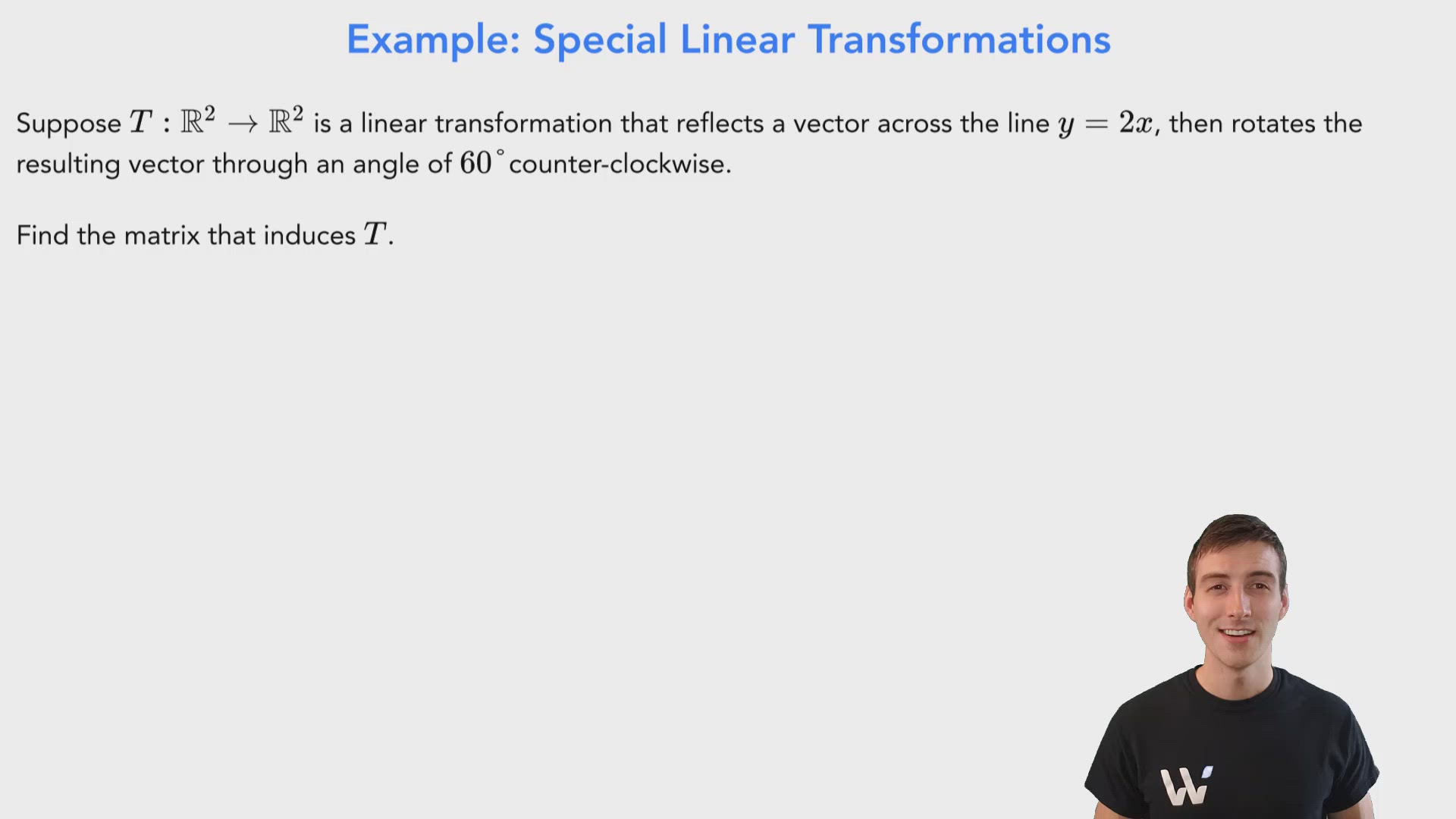
Suppose T:R2R2T:\mathbb{R}^2\to\mathbb{R}^2 is a linear transformation that reflects a vector across the line y=2xy = 2x, then rotates the resulting vector through an angle of 60°60\degreecounter-clockwise.
Find the matrix that induces TT.
The matrix inducing the reflection is given by:
Q2=11+22[1222(2)2(2)221]=15[3443]Q_2 = \dfrac{1}{1+2^2} \begin{bmatrix} 1-2^2 & 2(2) \\[0.3em] 2(2) & 2^2-1 \end{bmatrix} = \dfrac{1}{5} \begin{bmatrix} -3 & 4 \\[0.3em] 4 & 3 \end{bmatrix}
The rotation matrix is given by:
R60°=[cos(60°)sin(60°)sin(60°)cos(60°)]=[1/23/23/21/2]R_{\small 60\degree} = \begin{bmatrix} \cos(60\degree) & -\sin(60\degree) \\[0.3em] \sin(60\degree) & \cos(60\degree) \end{bmatrix} = \begin{bmatrix} 1/2 & -\sqrt{3}/2 \\[0.3em] \sqrt{3}/2 & 1/2 \end{bmatrix}
Then the matrix inducing TT is the product of these matrices (the rightmost happens first):
[1/23/23/21/2]R60°  15[3443]Q2=15[3/223233/233/2+223+3/2]=110[34343333+443+3]\begin{aligned} &\overbrace{ \begin{bmatrix} 1/2 & -\sqrt{3}/2 \\[0.5em] \sqrt{3}/2 & 1/2 \end{bmatrix}}^{\small R_{\small 60 \degree}} \ \ \overbrace{ \dfrac{1}{5} \begin{bmatrix} -3 & 4 \\[0.5em] 4 & 3 \end{bmatrix}}^{\small Q_{2}} \\[2em] = \dfrac{1}{5} &\begin{bmatrix} -3/2-2\sqrt{3} \quad & 2-3\sqrt{3}/2 \\[0.5em] -3\sqrt{3}/2+2 \quad & 2\sqrt{3}+3/2 \end{bmatrix}\\[2em] = \dfrac{1}{10} &\begin{bmatrix} -3-4\sqrt{3} \quad & 4-3\sqrt{3} \\[0.5em] -3\sqrt{3}+4 \quad & 4\sqrt{3}+3 \end{bmatrix} \end{aligned}

Practice: Special Linear Transformations

A linear transformation T:R2R2T: \reals^2 \to \reals^2 is the result of the following transformations (in order):
  1. first reflects across the line at an angle π4 rad\dfrac{\pi}{4} \text{ rad} below the positive xx-axis, then
  2. rotates vectors 30°30 \degree counter-clockwise.
Find the matrix that induces this transformation.

Practice: Special Linear Transformations

Find the matrix inducing the linear transformation S:R2R2S: \reals^2 \to \reals^2 that does the following:
  1. first, rotates vectors counter-clockwise by π2 rad\dfrac{\pi}{2} \text{ rad}, then
  2. projects the result onto the line x+3y=0-x+\sqrt3\cdot y=0 .
Extra Practice