Wize High School Grade 12 Pre-Calculus Textbook > Inequalities
Solving Polynomial Inequalities (Number Line)
Popular Courses
Grade 12 Advanced Functions
Ontario High School
Grade 12 Pre-Calculus/Functions
Canada High School
Algebra II
US High School
MATH 206
Concordia University
MAC 1140
University of Florida
MAC 1105
Florida State University
MAT 012
University of California - Davis
MATH 1148
Ohio State University
MATH 1148
Ohio State University
MTH 103A
Michigan State University
MAC 1147
University of Florida
MATH 140
San Diego State University
MAC 1140C
University of Central Florida
MA 15800
Purdue University
MATH 102
California State University - Northridge
M 305G
The University of Texas at Austin
MATH 1019
University of Cincinnati
MATH 1022
Temple University
MATH 1021
University of Cincinnati
MA 107
North Carolina State University
0:00 / 0:00
Solving Polynomial Inequalities Using a Number Line
A polynomial inequality can be solved in similar ways the polynomial equations are solved.
Step 1.
Factor the polynomial.
Step 2.
Identify the x-intercepts and your test points around the x-intercepts to determine where the polynomial exists.
Step 3.
Draw a table & a number line and use the test points around each x-intercept to see if the function is positive or negative.
Step 4.
Express the answer in an appropriate format.
Example
Let's look at the polynomial inequality .
Step 1.
It is already in factored form.
Step 2.
-intercepts:
Test points:
Step 3.
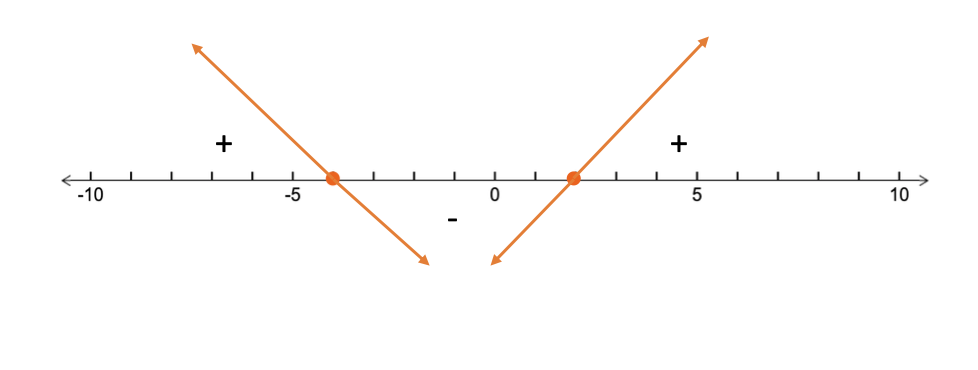
Step 4.
The solution relies on the inequality in the question .
We are looking for the part of the polynomial that lies above 0 (or equals to). Therefore, we want our polynomial to be positive.
The solution is .
0:00 / 0:00
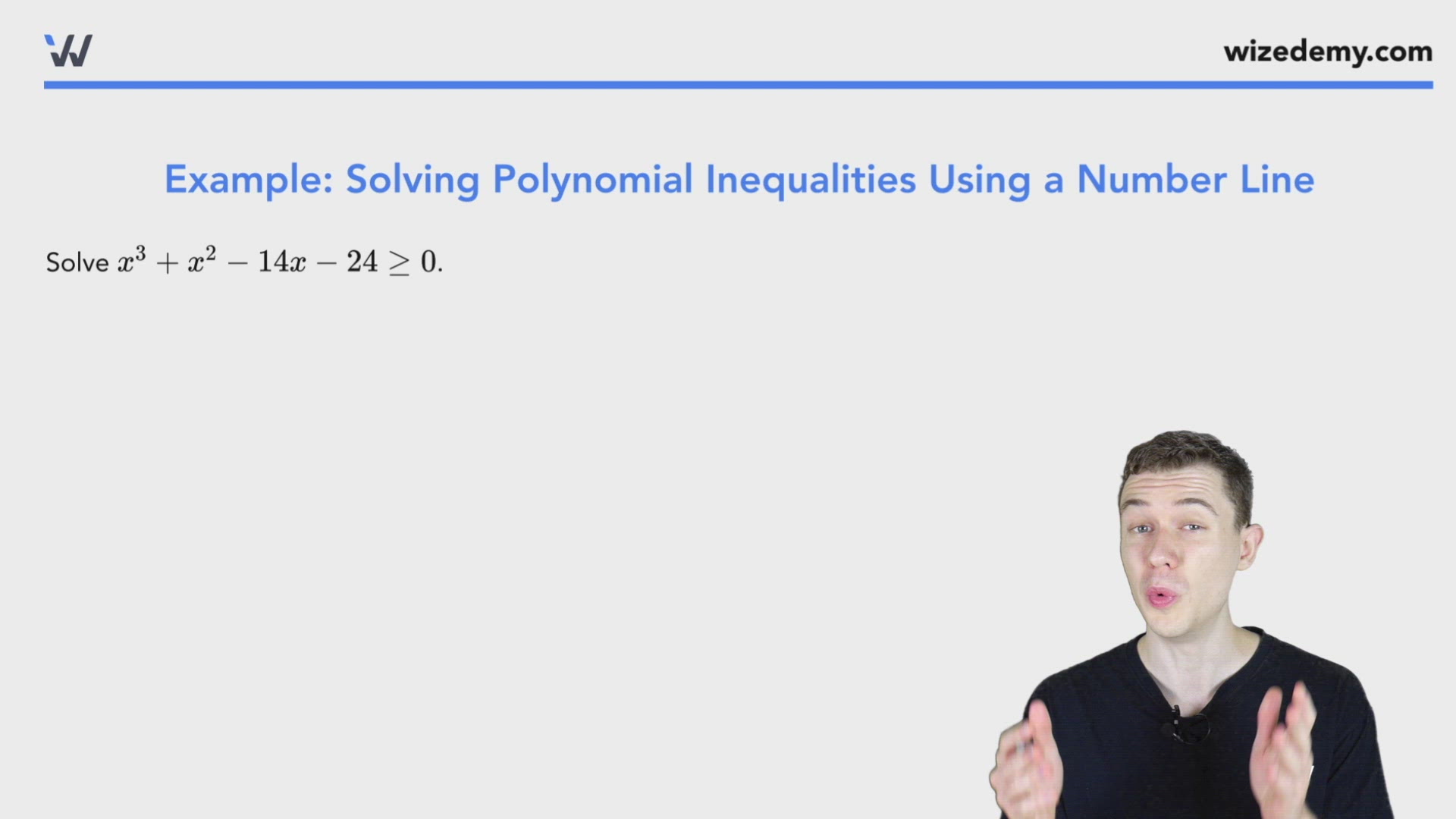
Example: Solving Polynomial Inequalities Using a Number Line
Solve .
Step 1.
Factor using synthetic division.
Let
The quotient becomes .
Our polynomial inequality can be written as .
Step 2.
X-Intercepts:
Test points:
Step 3.
. 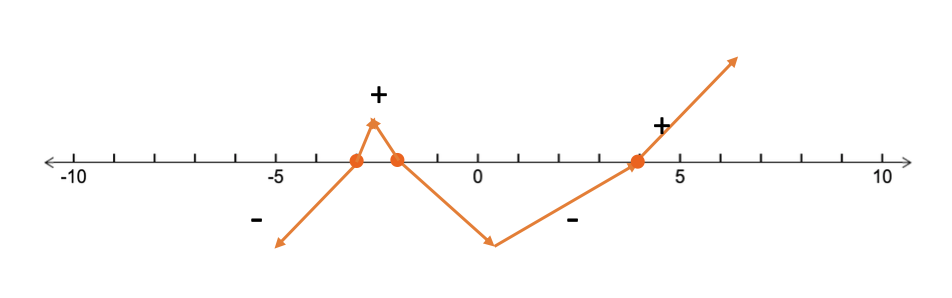
Step 4.
The solution relies on the inequality in the question .
We are looking for the part of the polynomial that lies above 0 (or equals to). Therefore, we want our polynomial to be positive.
The solution is .
Practice: Solving Polynomial Inequalities Using a Number Line
Match the polynomial with its correct solution.
A.
B.
C.
D.
Practice: Solving Polynomial Inequalities Using a Number Line
Solve .
Practice: Solving Polynomial Inequalities Using a Number Line
The graph of is shown below.
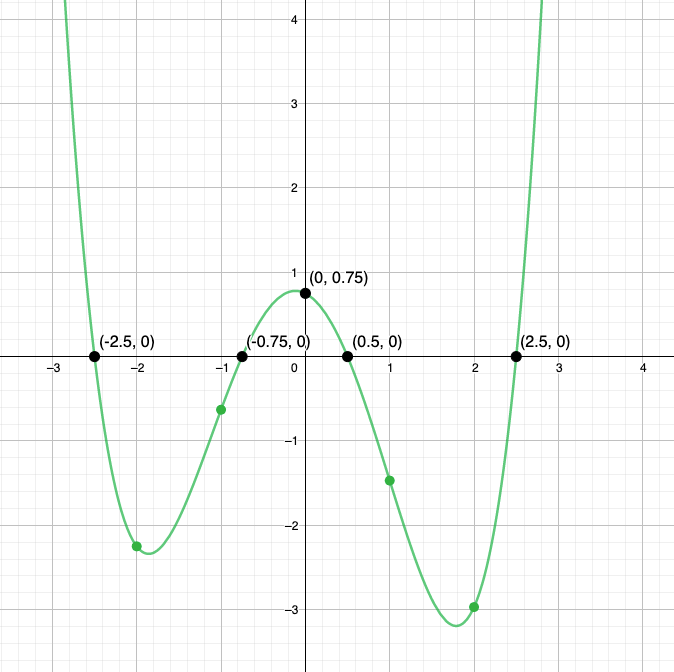
If the solution is , determine an inequality that describes . (Express in factored form.)