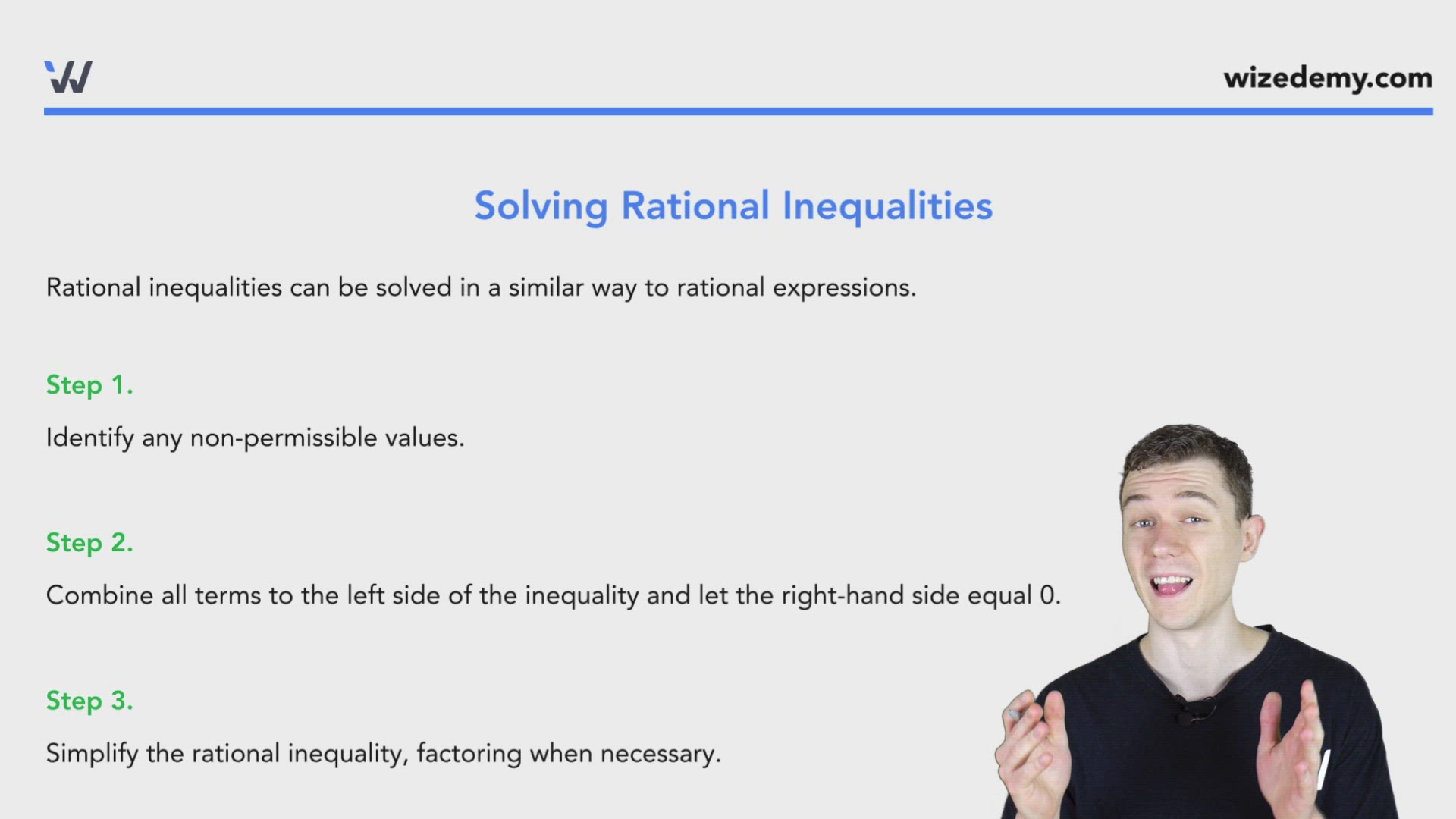
Solving Rational Inequalities
Rational inequalities can be solved in a similar way to rational expressions.
Step 1.
Identify any non-permissible values.
Step 2.
Combine all terms to the left side of the inequality and let the right-hand side equal 0.
Step 3.
Simplify the rational inequality, factoring when necessary.
Step 4.
Use a graph or a number line to determine where the rational expression is positive and negative.
Step 5.
State the intervals where the rational expression is positive or negative, identify any extraneous solutions.
Example
Solve for using both a number line and a graph.
Step 1.
Step 2.
Step 3.
Step 4.
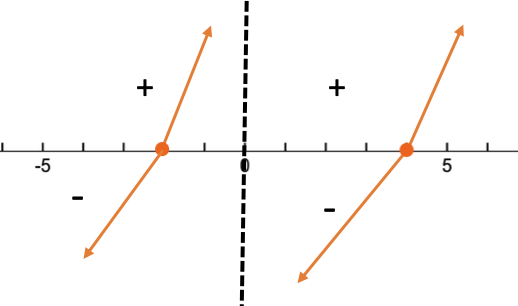
Number Line:
X-intercepts at
Vertical Asymptotes:
Test Points: -3, -1, 1, 5
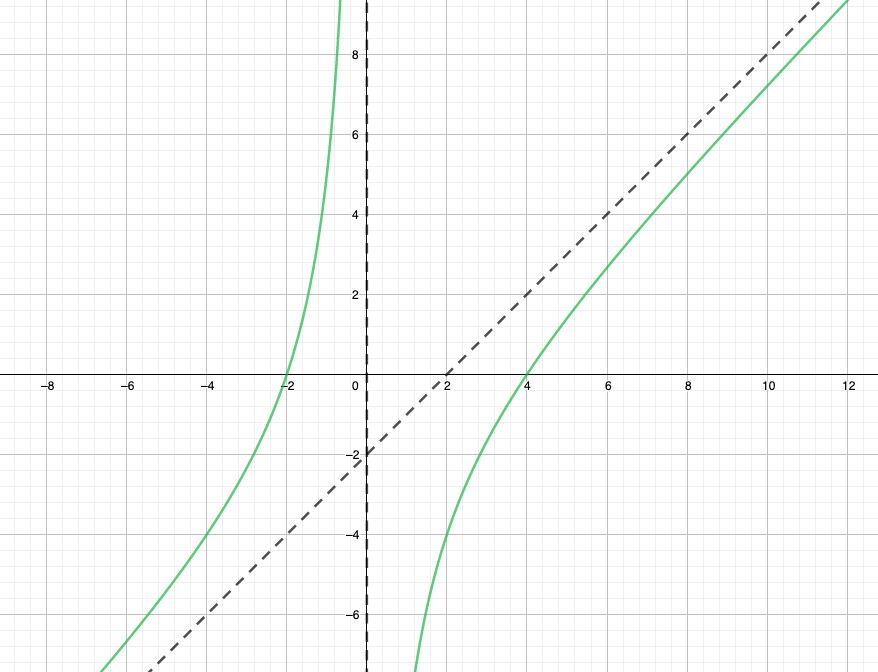
Graphing:
X-intercepts at
Vertical Asymptotes:
Horizontal Oblique Asymptotes: Obliqe asymptote at
Test Points: -3, -1, 1, 5
Step 5.
We are looking for the part of the rational expression that lies below
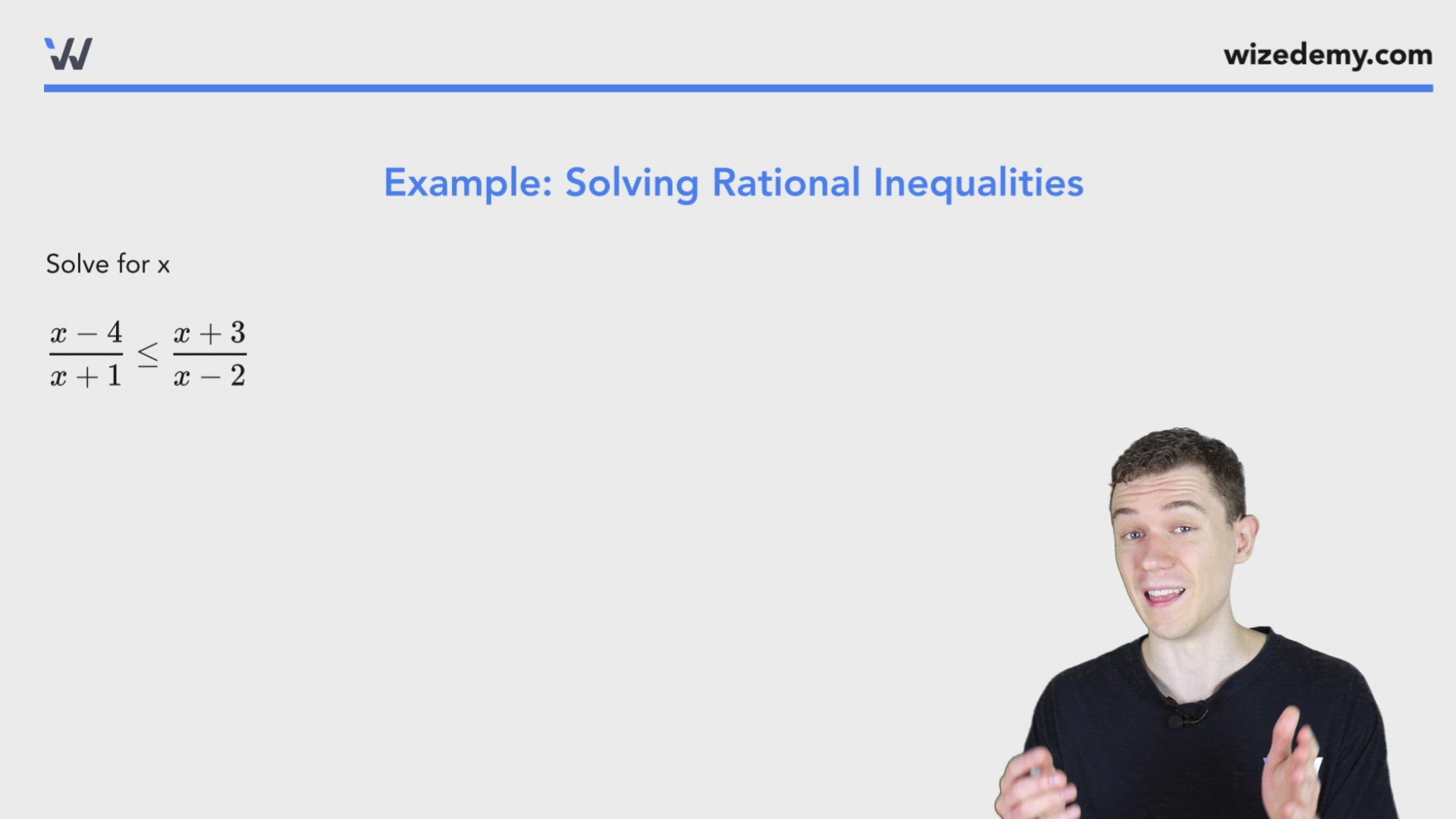
Example: Solving Rational Inequalities
Solve for x.
Step 1.
The NPV's, which are also equivalent to the vertical asymptotes, are .
Step 2.
Step 3.
Step 4.
X-Intercepts:
Vertical Asymptotes:
Horizontal Asymptotes:
Test Points: -2, 0, 1, 3
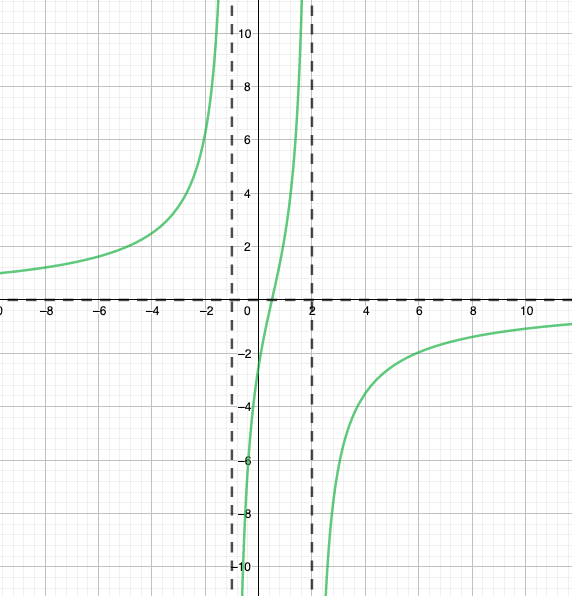
Step 5.
We want the part of the rational expression that is less than or equals to 0.