Wize University Linear Algebra Textbook > Vectors
Length of a Vector (Vector Norm)
Popular Courses
MATH 211
University of Calgary
MATH 1229A/B
Western University
Algebra II
US High School
Linear Algebra
University Study Guides
MATH 1ZC3
McMaster University
MATH 152
University of British Columbia
MATH 1600A/B
Western University
Linear Algebra
General Course
MAT188H1
University of Toronto
NMM 1411A/B
Western University
Linear Algebra
University Study Guides
SC/MATH 1025 3.00
York University
MTH 141
Toronto Metropolitan University
MATH 102
University of Alberta
MATH 115
University of Waterloo
MATH 1B03
McMaster University
MAT223H1
University of Toronto
MATH-1270
University of Windsor
MATH 1210
University of Manitoba
MATH-1250
University of Windsor

0:00 / 0:00
Vector Norm
The norm of a vector is the length or magnitude of , and it is denoted:
If , then we calculate the norm of as:
This looks like the Pythagorean theorem... because it is!
Example 1
Find the norm of the vector from the origin to the point .
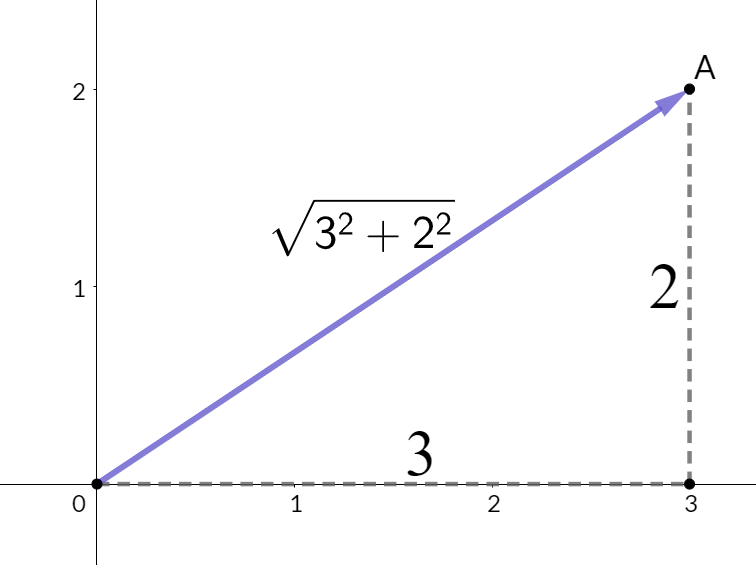
Then
Properties of the Norm
- is a scalar
- is always non-negative
- if and only if
Norm and Scalar Multiplication
For any vector and scalar :
Watch Out!
Since the norm is non-negative, we must take the absolute value of so that negative scalars become positive.
Example 2
Let and let . Find .
Start by finding
Then
Distance Between Two Points
If and are two points in , then the distance between points and is the norm of the vector :
0:00 / 0:00
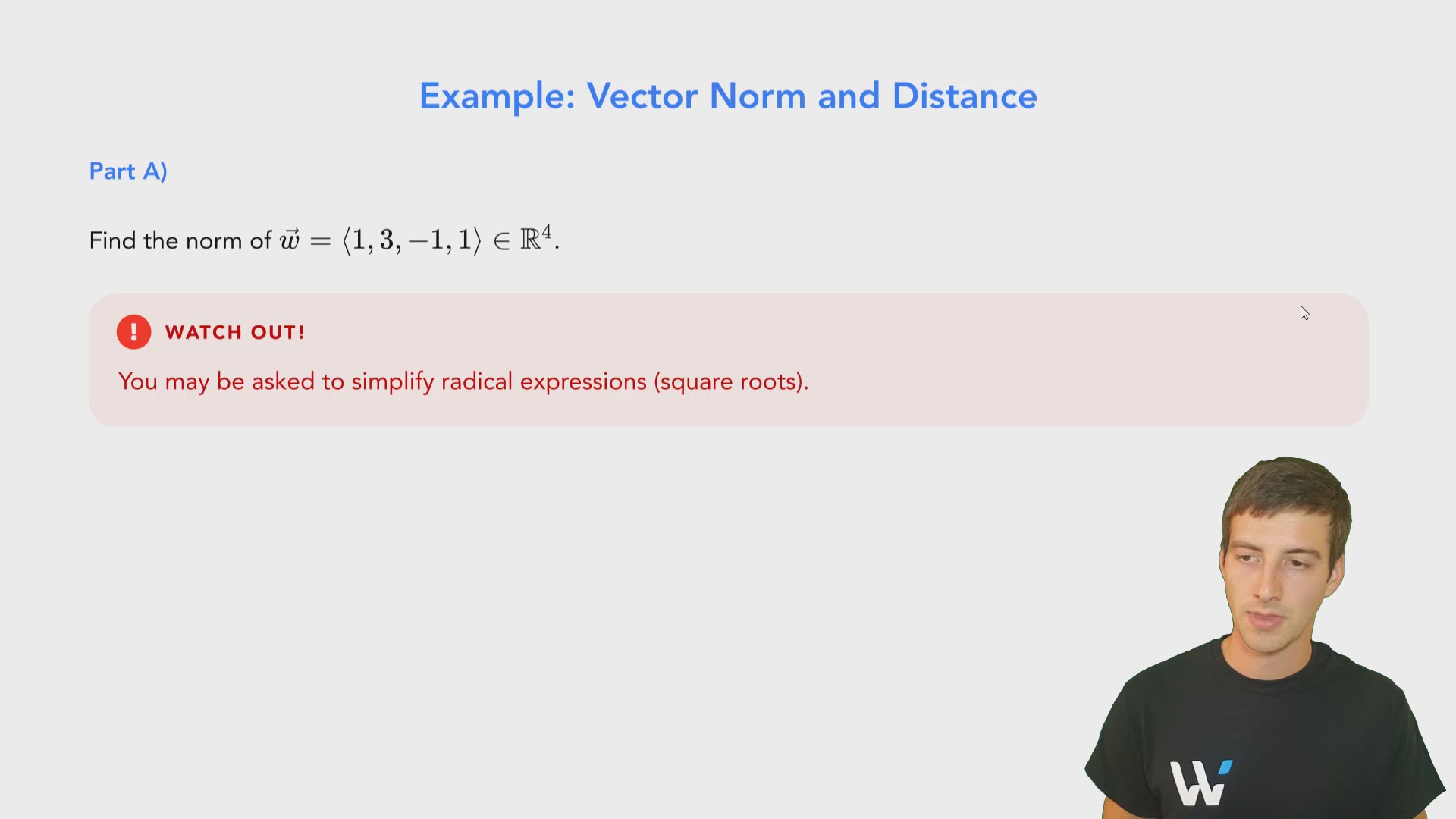
Example: Vector Norm and Distance
Part A)
Find the norm of .
Watch Out!
You may be asked to simplify radical expressions (square roots).
To simplify, think of a perfect square (e.g. 1, 4, 9, 16, ...) that can divide the number under the square root.
Since 4 is a perfect square that divides 12, we can write:
Part B)
Find the distance between the vectors and .
The answer is already in simplest form.
Practice: Vector Length
Given and , find all possible values of .
Practice: Properties of the Norm
Consider . Select all of the statements that are always true.
Practice: Distance Between Two Points/Vectors
Find the distance between the vectors and .