Wize University Linear Algebra Textbook > Vectors
Vector Properties
Popular Courses
MATH 211
University of Calgary
MATH 1229A/B
Western University
Algebra II
US High School
Linear Algebra
University Study Guides
MATH 152
University of British Columbia
MATH 1600A/B
Western University
Linear Algebra
General Course
MAT188H1
University of Toronto
Linear Algebra
University Study Guides
SC/MATH 1025 3.00
York University
MATH 115
University of Waterloo
MAT223H1
University of Toronto
MATH-1270
University of Windsor
MATH 1210
University of Manitoba
MATH-1250
University of Windsor
MATH 111
Queen's University
MATH 1104
Carleton University
MATH 136
University of Waterloo
MATH 1300
University of Manitoba
MAT 1302
University of Ottawa
0:00 / 0:00
Vector Properties
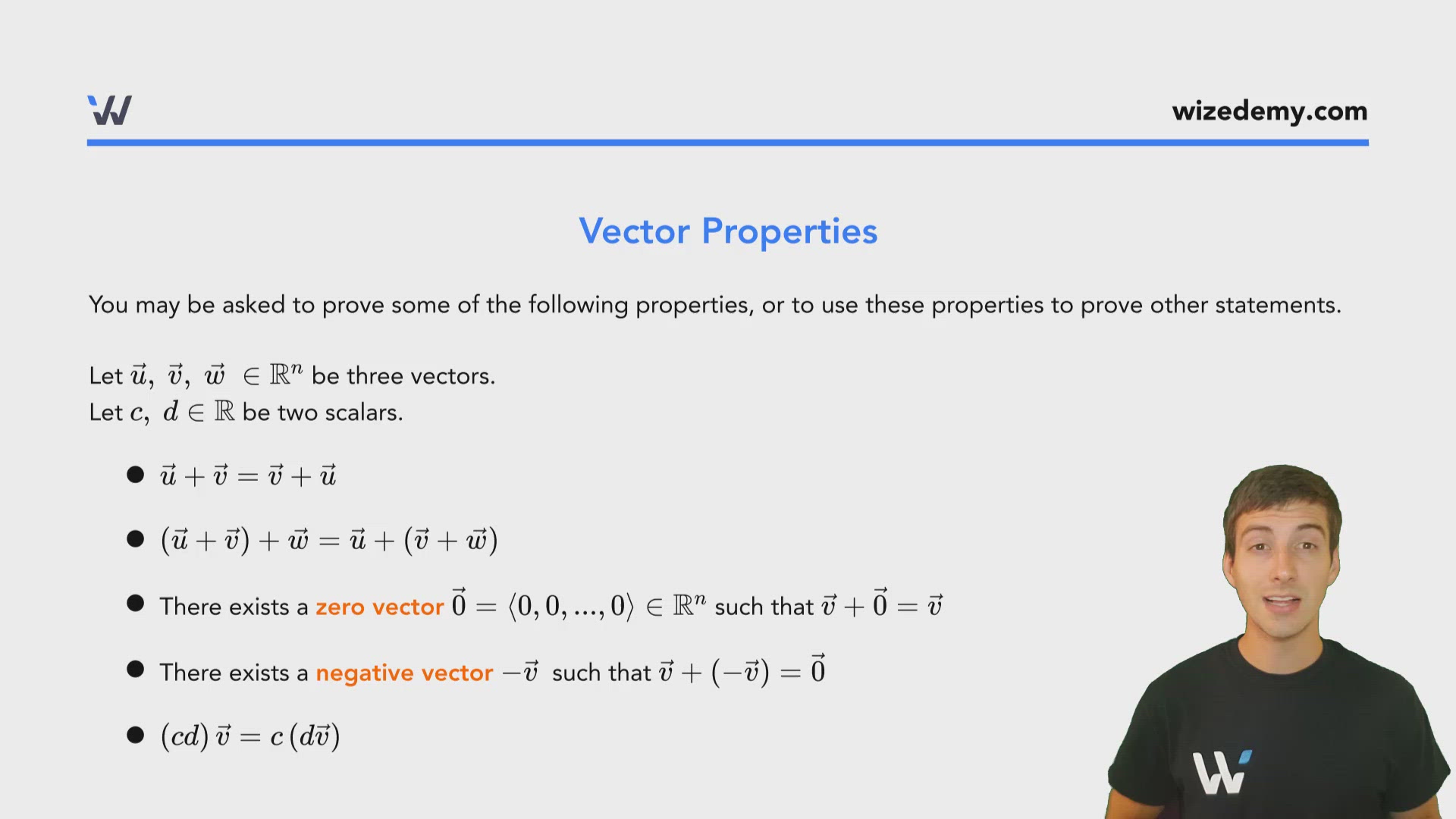
You may be asked to prove some of the following properties, or to use these properties to prove other statements.
Let be three vectors.
Let be two scalars.
- There exists a zero vector such that
- There exists a negative vector such that
Wize Tip
- To prove a statement involving vectors, it is often helpful to write out the components of each vector.
- To show that a statement is NOT always true, find one counter example (keep it simple with an example from )
0:00 / 0:00
Example: Proving Vector Properties
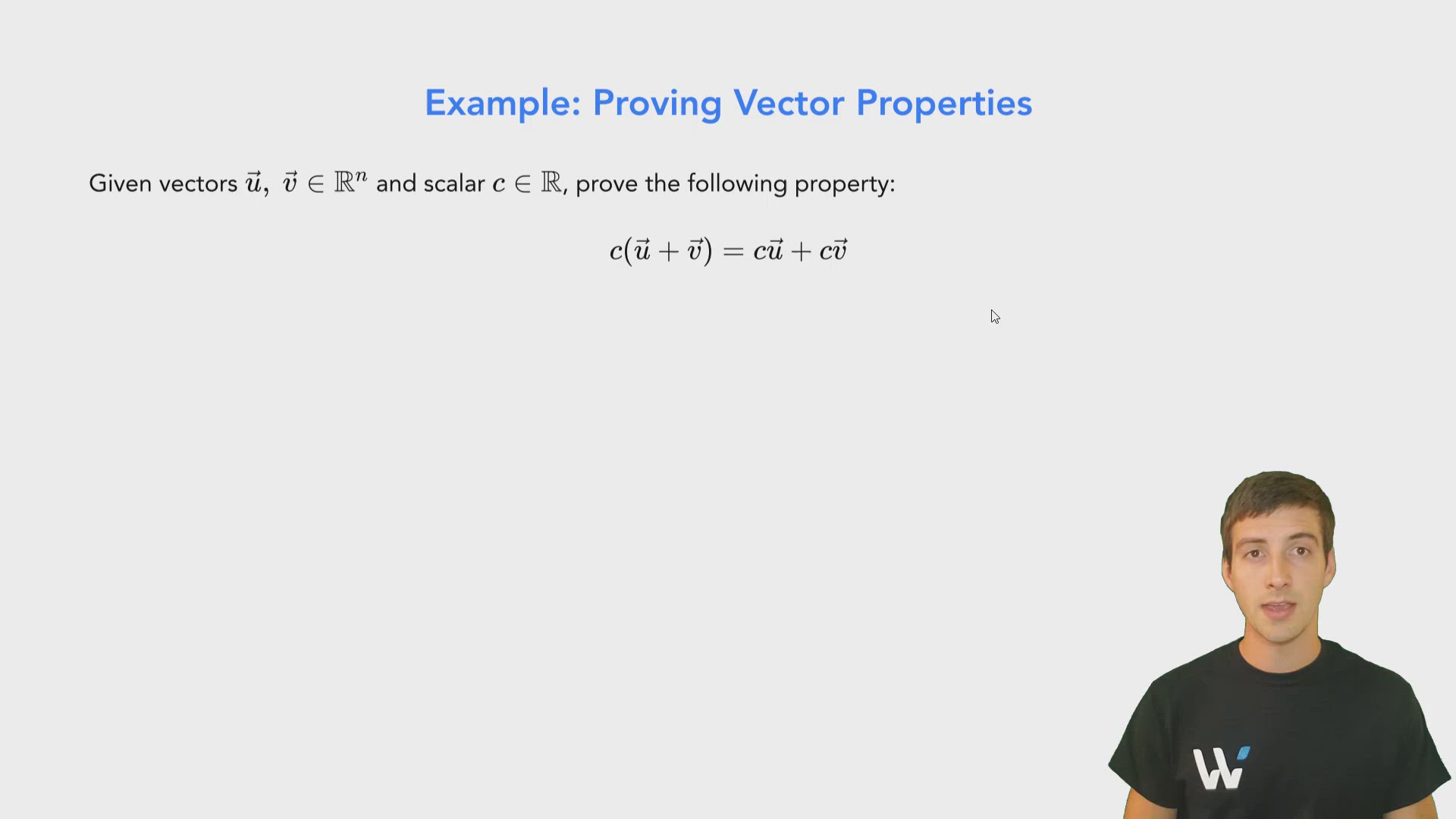
Given vectors and scalar , prove the following property:
Begin by writing out the components of and :
Then:
0:00 / 0:00
Example: Proving Vector Properties
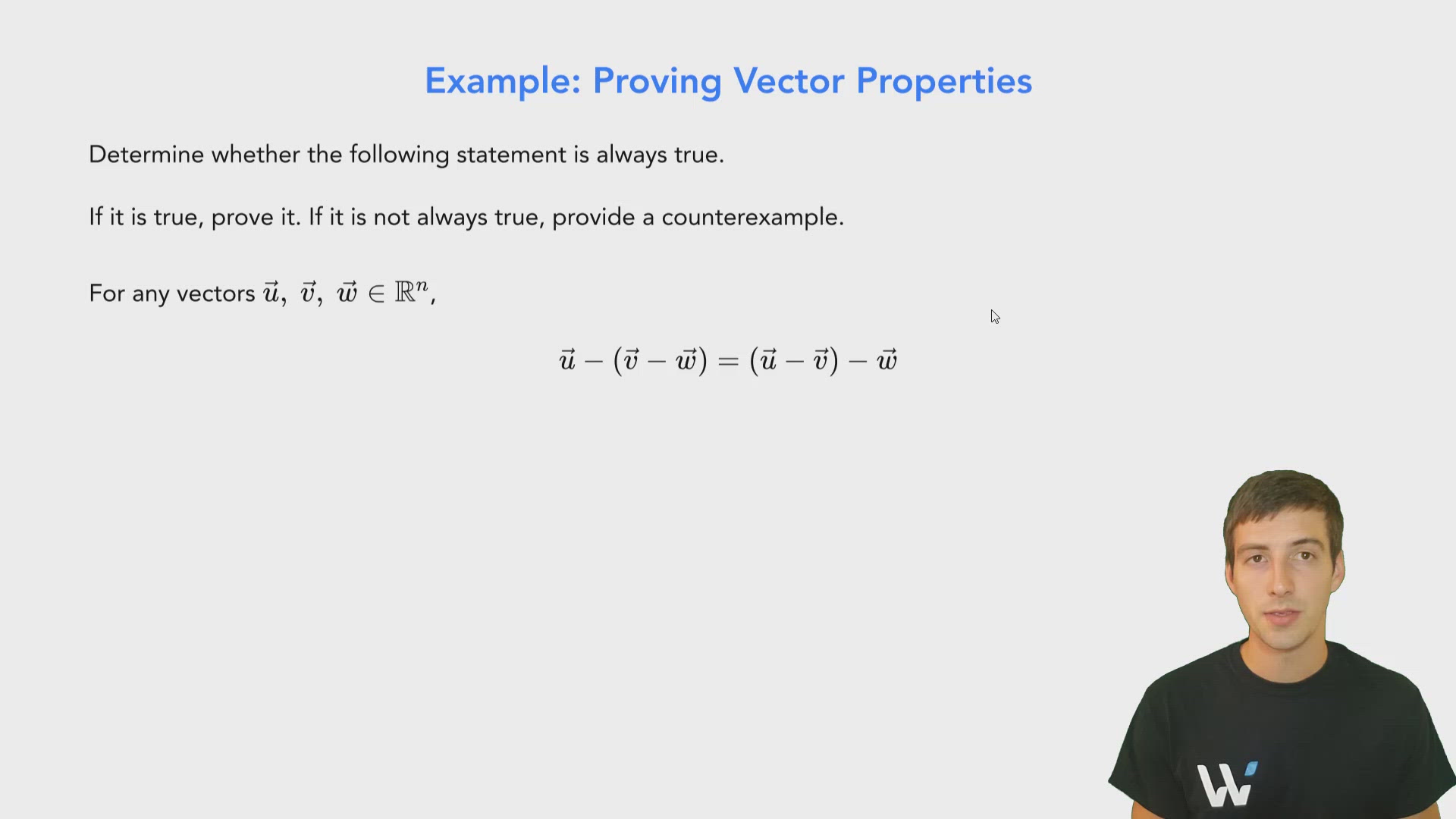
Determine whether the following statement is always true.
If it is true, prove it. If it is not always true, provide a counterexample.
For any vectors ,
Not always true.
Intuitively, we might think something isn't quite right when we try to distribute the negative on the LHS:
This leads us to think of a counterexample. Keep it simple with vectors in .
Let .
LHS
RHS
Since , this counterexample implies that the statement is not true in general.

Mark Yourself Question
- Grab a piece of paper and try this problem yourself.
- When you're done, check the "I have answered this question" box below.
- View the solution and report whether you got it right or wrong.
Practice: Vector Properties
Prove the following vector property: