Wize University Linear Algebra Textbook > Vectors
Vector Operations and Linear Combinations
Popular Courses
MATH 211
University of Calgary
MATH 1229A/B
Western University
Algebra II
US High School
Linear Algebra
University Study Guides
MATH 1ZC3
McMaster University
MATH 152
University of British Columbia
MATH 1600A/B
Western University
Linear Algebra
General Course
MAT188H1
University of Toronto
Linear Algebra
University Study Guides
SC/MATH 1025 3.00
York University
MTH 141
Toronto Metropolitan University
MATH 102
University of Alberta
MATH 115
University of Waterloo
MATH 1B03
McMaster University
MAT223H1
University of Toronto
MATH-1270
University of Windsor
MATH 1210
University of Manitoba
MATH-1250
University of Windsor
MATH 121B
Queen's University

0:00 / 0:00
Vector Operations
There are two main operations we perform on vectors:
- Scalar multiplication
- Vector addition
Scalar Multiplication
For any scalar , scalar multiplication of a vector is defined as:
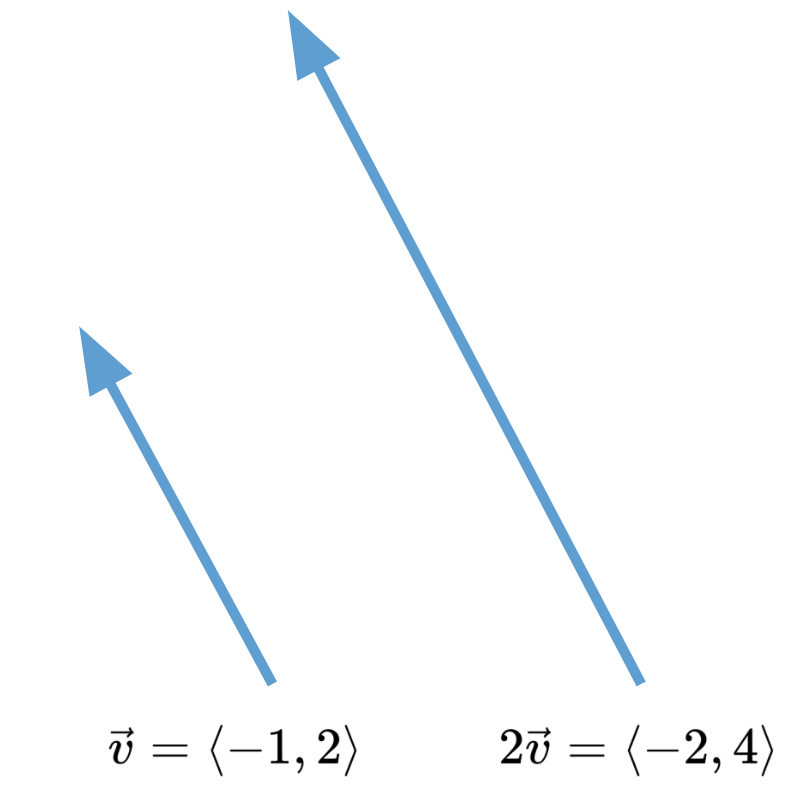
Geometrically, this is represented by stretching (or shrinking) the vector by a factor of without changing its direction.
Below we see that is twice as long as while still pointing in the same direction:
Collinear Vectors
Vectors and are collinear or parallel if there is a scalar such that .
Opposite Vectors
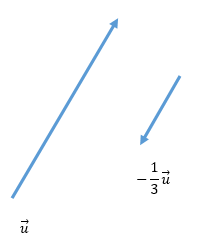
and point in opposite directions if one vector is a negative scalar multiple of the other.
Here we see that points in the opposite direction of since we multiplied by a negative number:
Negative Vectors
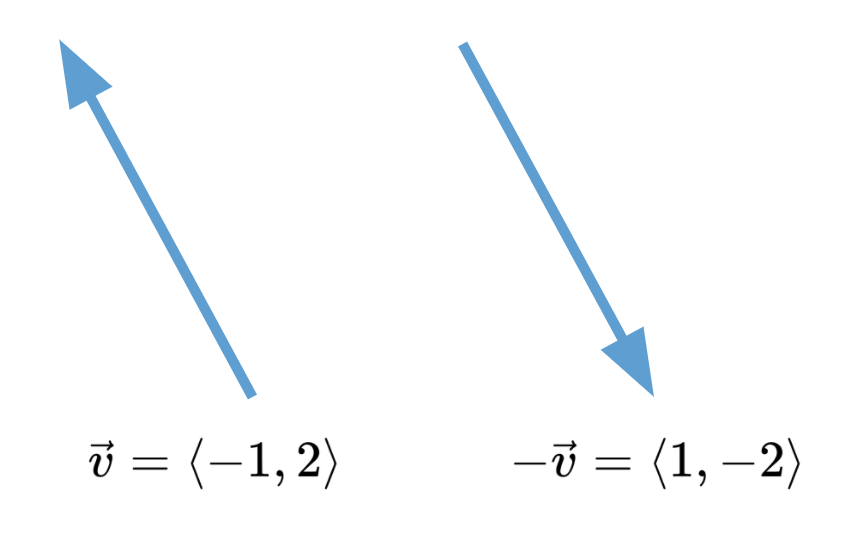
is the negative of : it has the same length as , but points in the opposite direction.
Vector Addition
For any two vectors and , vector addition is defined as:
Watch Out!
Vectors must be in the same space to add them! E.g. A vector in cannot be added to a vector in .
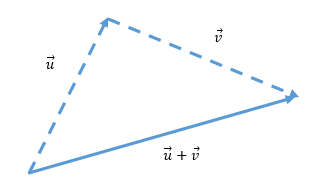
Geometrically, works by moving so that its tail is at the tip (arrowhead) of :
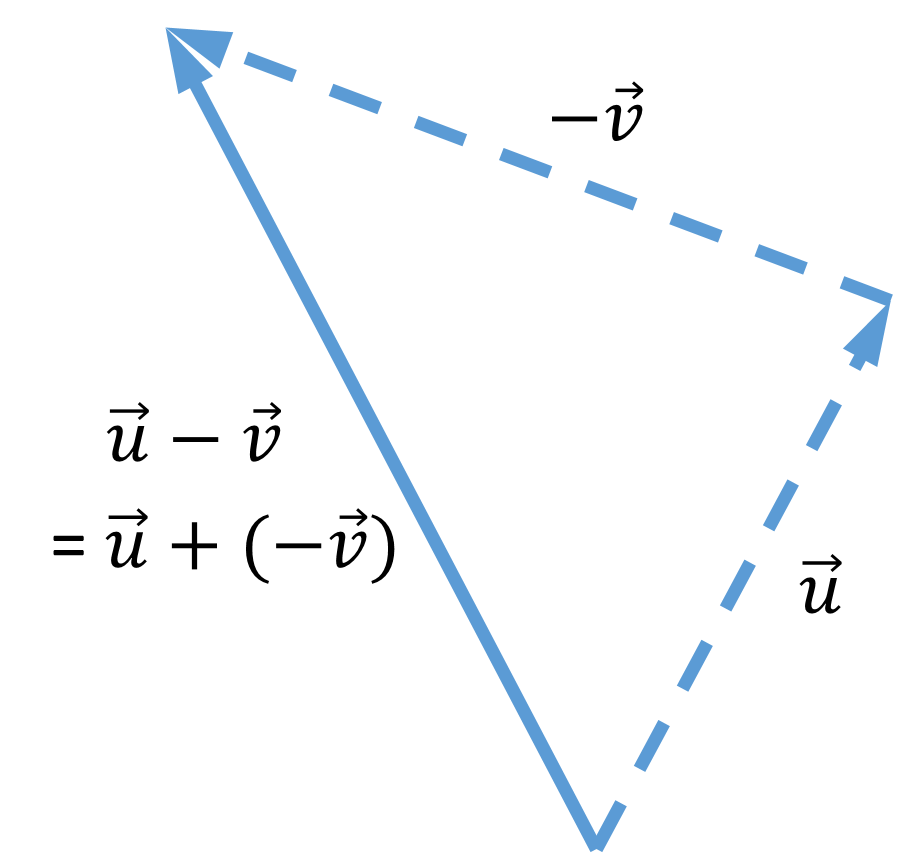
Vector subtraction is based on addition. It is defined as:
Vector Between Two Points
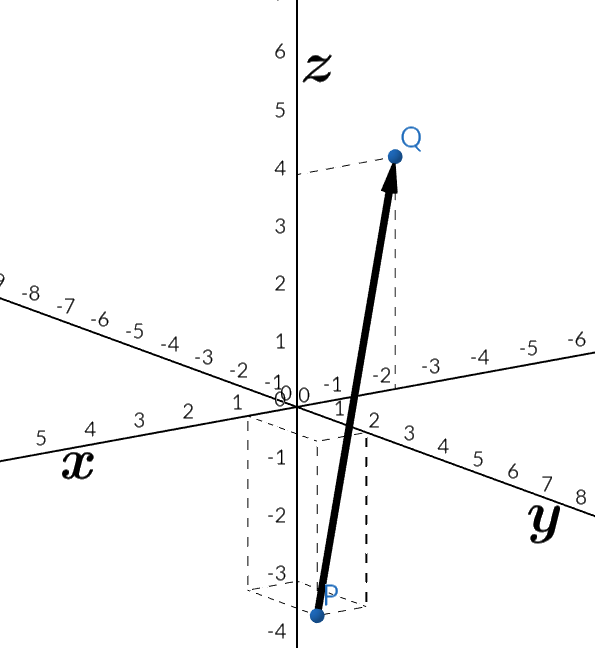
The vector that starts at point and ends at point is given by:
Wize Concept
Here we are using the position vectors of points and , denoted and .
Recall that position vectors are used to treat points as vectors that start at the origin and end at the corresponding point.
Example
Given the points and , find the position vector .
Linear Combinations
Let be vectors and let be scalars.
A linear combination of and can be written:
The result is also a vector in .
0:00 / 0:00
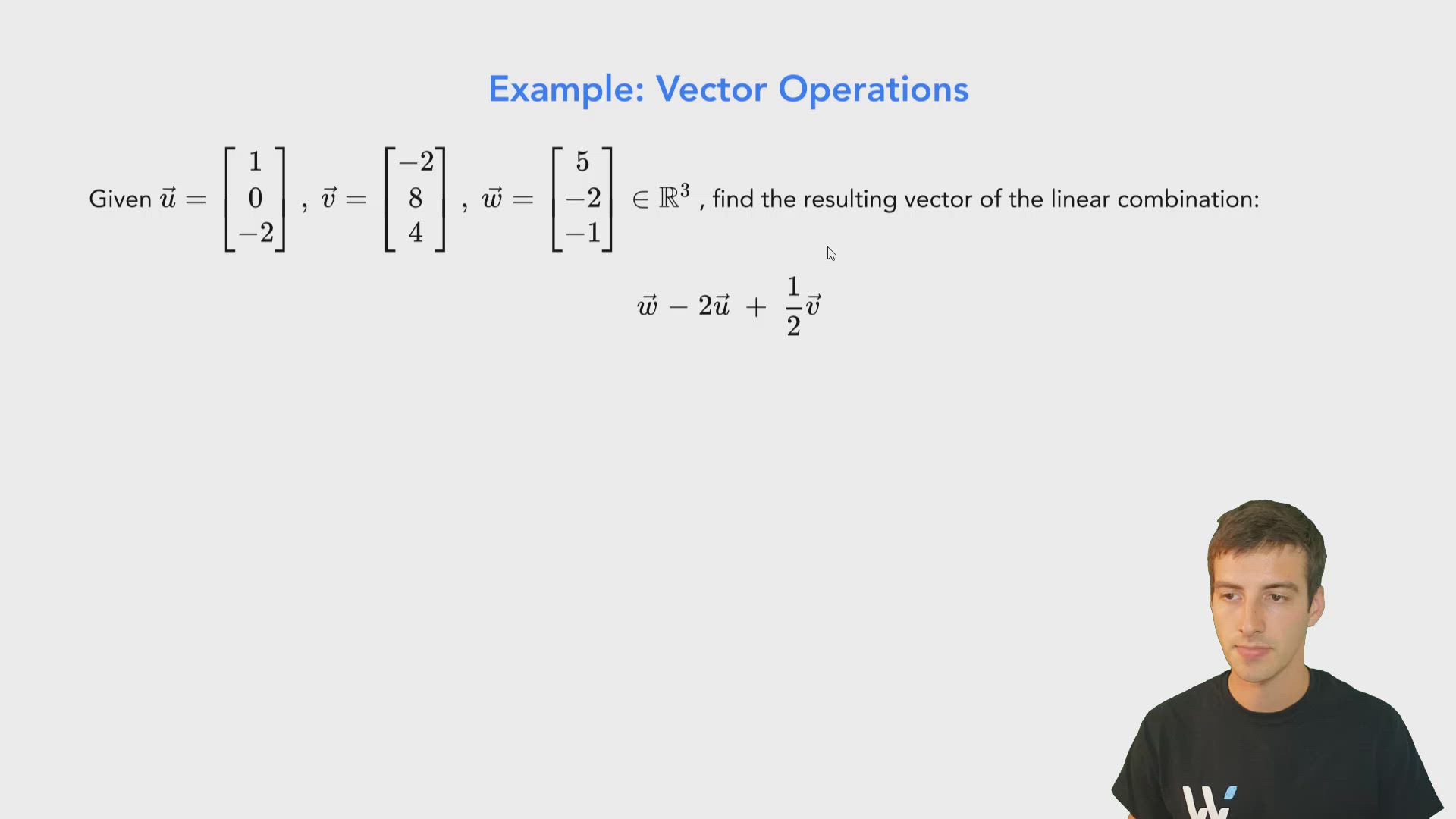
Example: Vector Operations
Given , find the resulting vector of the linear combination:
0:00 / 0:00
Example: Vector Operations
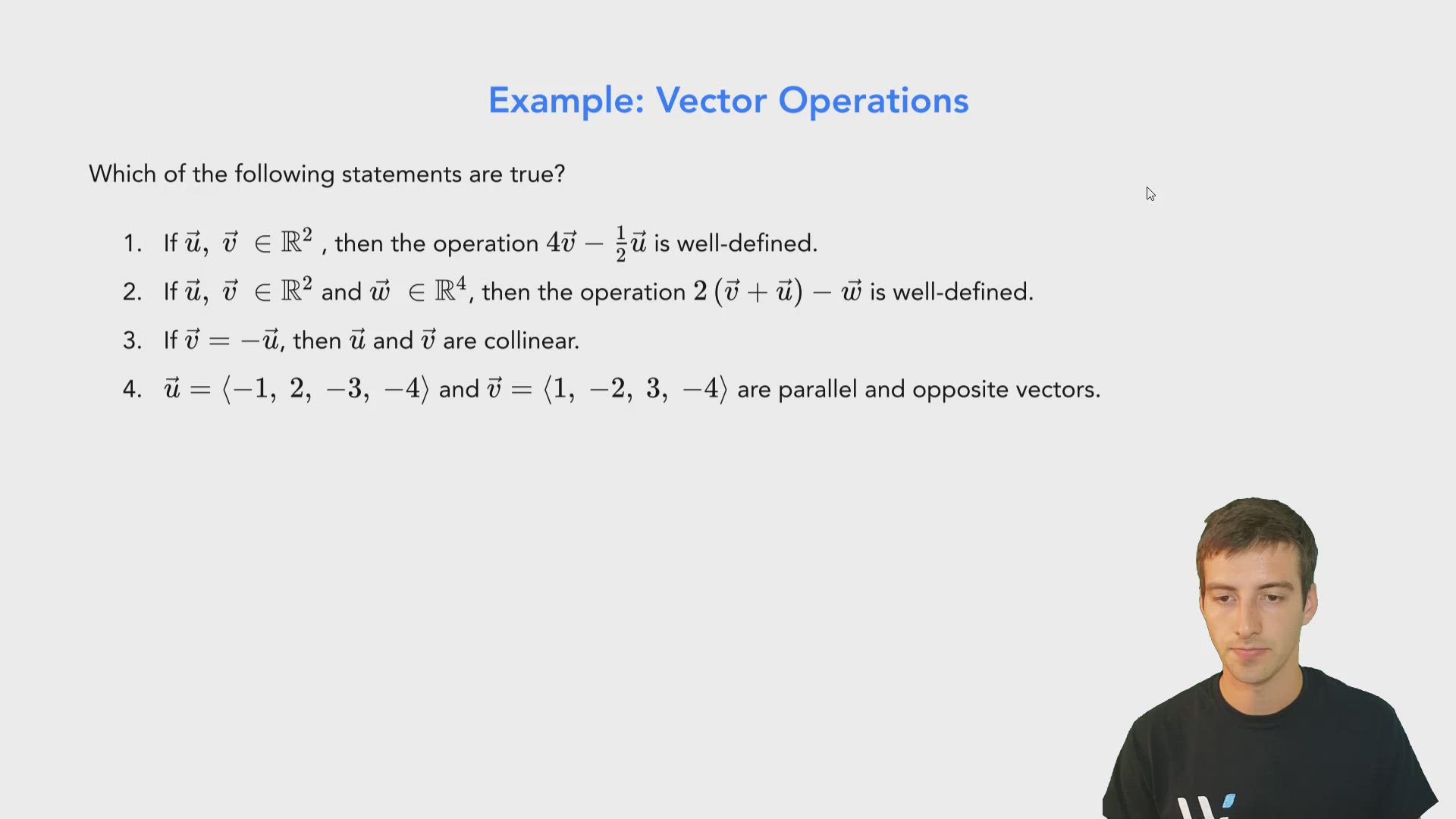
Which of the following statements are true?
- If , then the operation is well-defined.
- If and , then the operation is well-defined.
- If , then and are collinear.
- and are parallel and opposite vectors.
1. TRUE: Scalar multiplication is always valid. Since the two vectors are in the same space, , vector addition/subtraction is also well-defined.
2. FALSE: Vector addition/subtraction between vectors in different spaces is never valid.
3. TRUE: If one vector is the negative of another vector, that means they are a scalar multiples of one another (factor ), hence they are collinear.
4. FALSE: The first three components are indeed scalar multiples of one another (by a factor of -1); however, the last component fails to follow this rule. The vectors are therefore not scalar multiples of one another, thus they are neither parallel nor opposite vectors.

0:00 / 0:00
Example: Vector Operations
, , and are points in , and .
Find the coordinates of the point .
Since we know both and :
Now we can use the relationship between and :
And by the formula for a vector between two points, we can also write:
The boxed expressions are both representations of so they must be equal:
This gives us two equations (one for each component):
Practice: Collinear Vectors
Find the value of such that the vectors and are collinear.
Practice: Collinear Vectors
Given and , select all statements that are true.
Practice: Vector Operations
A parallelogram has sides , , and .
The following coordinates are known: , , and , where is the midpoint between and .
Find the vector .