Wize University Linear Algebra Textbook > Vectors
Basics of Vectors
Popular Courses
MATH 211
University of Calgary
MATH 1229A/B
Western University
Algebra II
US High School
Linear Algebra
University Study Guides
MATH 152
University of British Columbia
MATH 1600A/B
Western University
Linear Algebra
General Course
MATH 204
Concordia University
MAT188H1
University of Toronto
MATH 125
University of Alberta
Linear Algebra
University Study Guides
NMM 1411A/B
Western University
SC/MATH 1025 3.00
York University
MTH 141
Toronto Metropolitan University
MATH 102
University of Alberta
MATH 115
University of Waterloo
MAT223H1
University of Toronto
MATH-1270
University of Windsor
MATH 1210
University of Manitoba
MATH-1250
University of Windsor
0:00 / 0:00
Basics of Vectors
What is a vector?
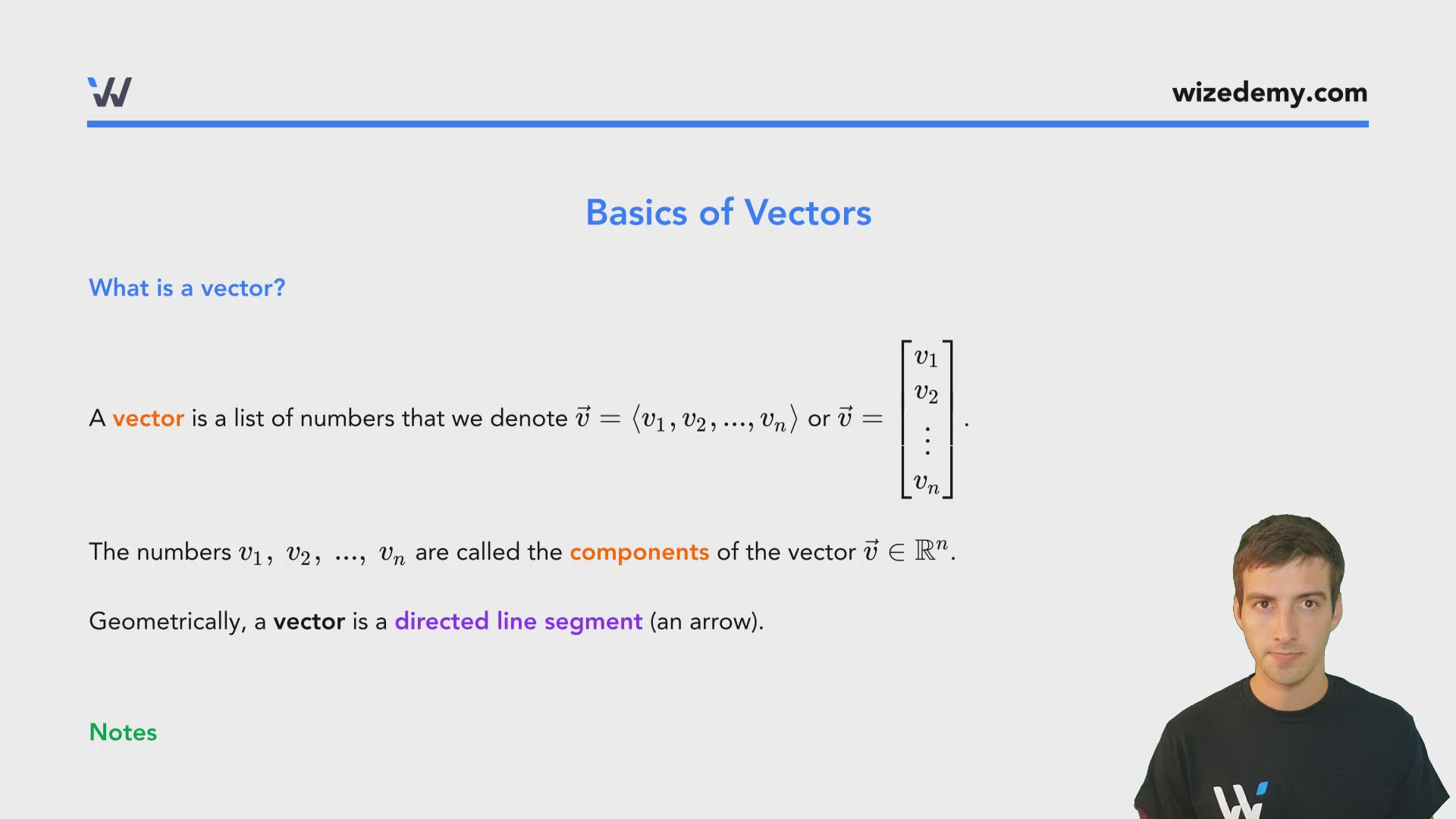
A vector is a list of numbers that we denote or .
The numbers are called the components of the vector .
Geometrically, a vector is a directed line segment (an arrow).
Notes
- We will write points with parentheses
- e.g. Point
- We will write vectors with angle brackets or as column vectors
- e.g. Vector
Example 1
The vector has three components, so it is in the space :
- -component:1
- -component:0
- -component:-2
We may write
Scalars and Vectors
Scalars consist of a single number, a magnitude (size).
Think: temperature, dollars, perimeter
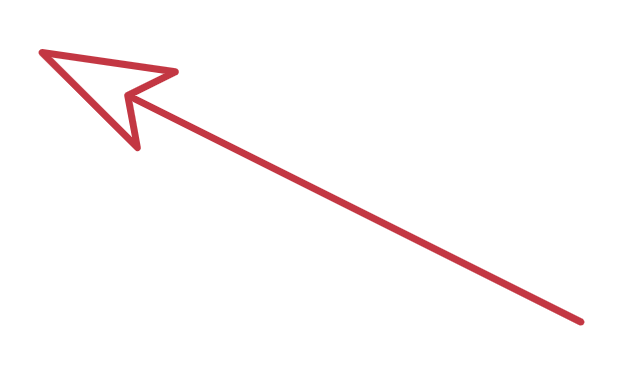
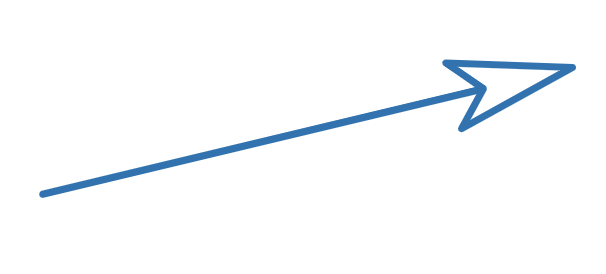
Vectors have both magnitude and direction.
Think: wind velocity, forces, displacement
Position Vectors
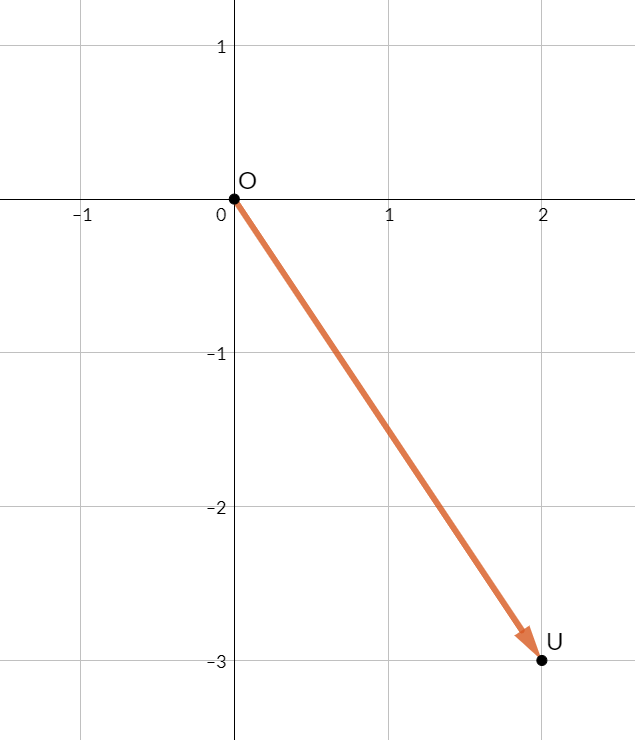
The position vector of a point is the vector starting at the origin and ending at the point , denoted .
Position vectors are used to distinguish between points and vectors.
Example 2
What is the position vector of the point ?
Equal Vectors
Vectors with the same magnitude and in the same direction are equal.
You are allowed to translate (move) a vector and it is still the same vector.
Furthermore, two vectors are equal if their corresponding components are all equal.
Watch Out!
Vectors from different spaces (different numbers of components) can never be equal!
Example 3
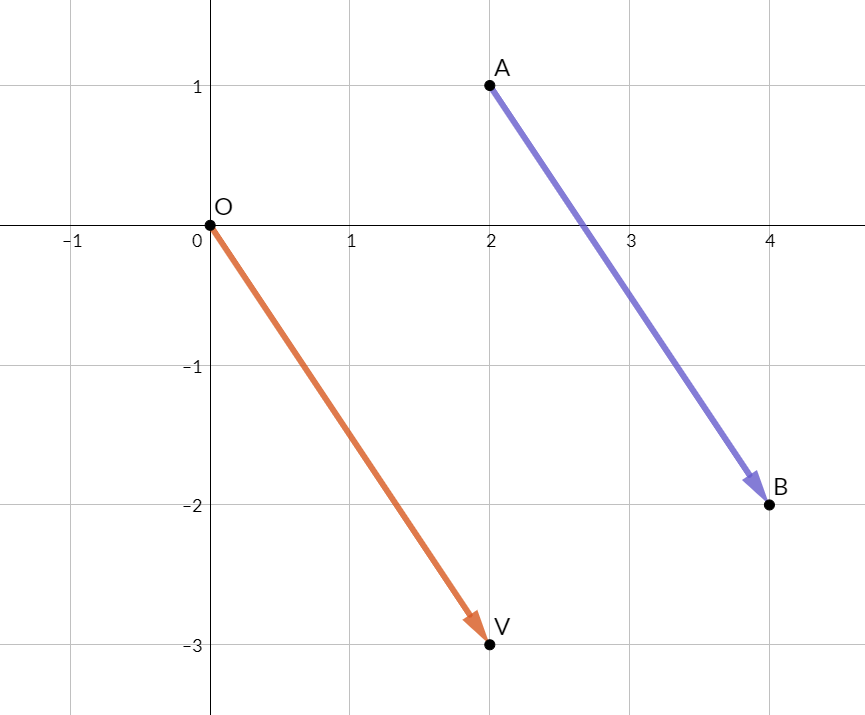
Even though the vector from to does not start at the origin, it has the same length and direction as .
Therefore, (they have the same position vector).
0:00 / 0:00
Example: Basics of Vectors
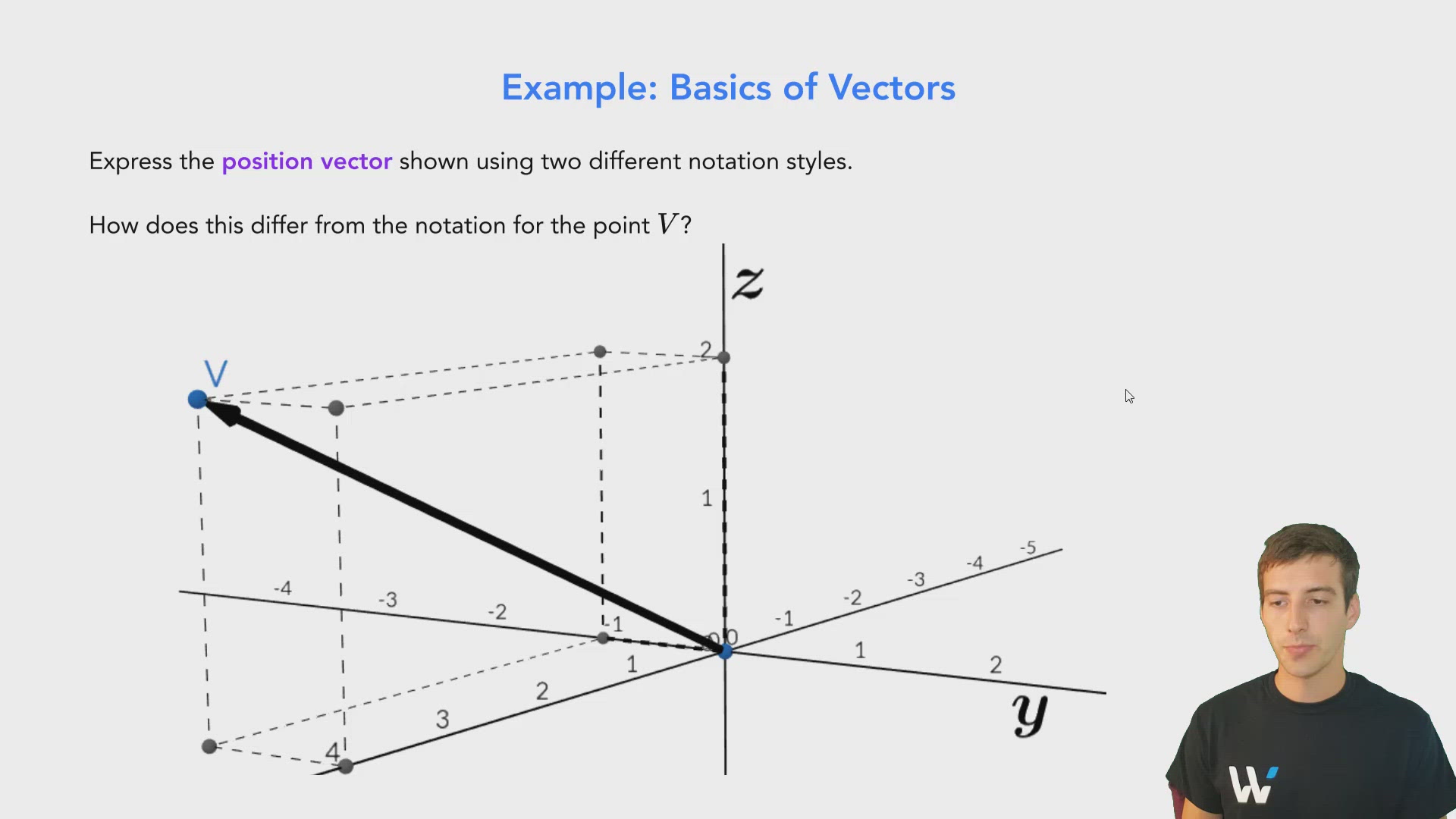
Express the position vector shown using two different notation styles.
How does this differ from the notation for the point ?
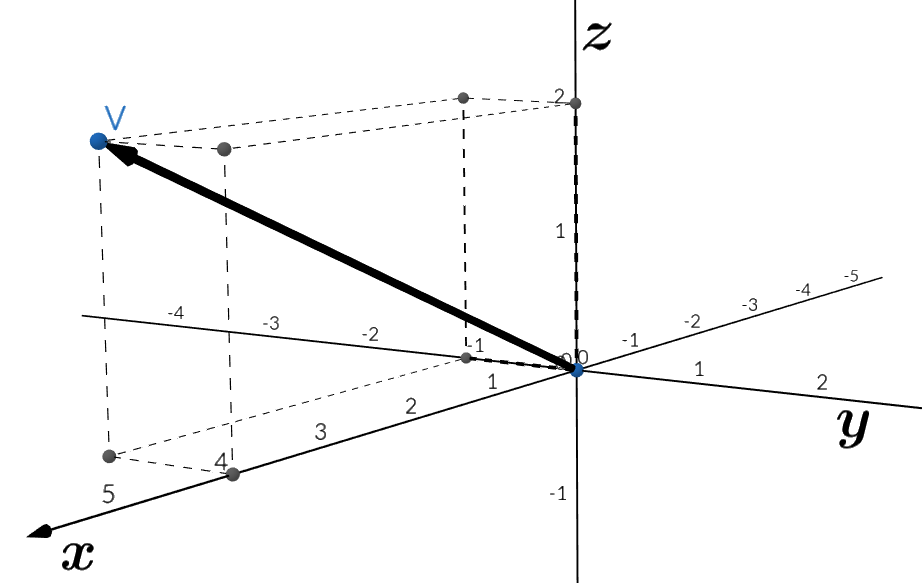
and we write the point with parentheses:
In what space does this vector lie?
0:00 / 0:00
Example: Equal Vectors
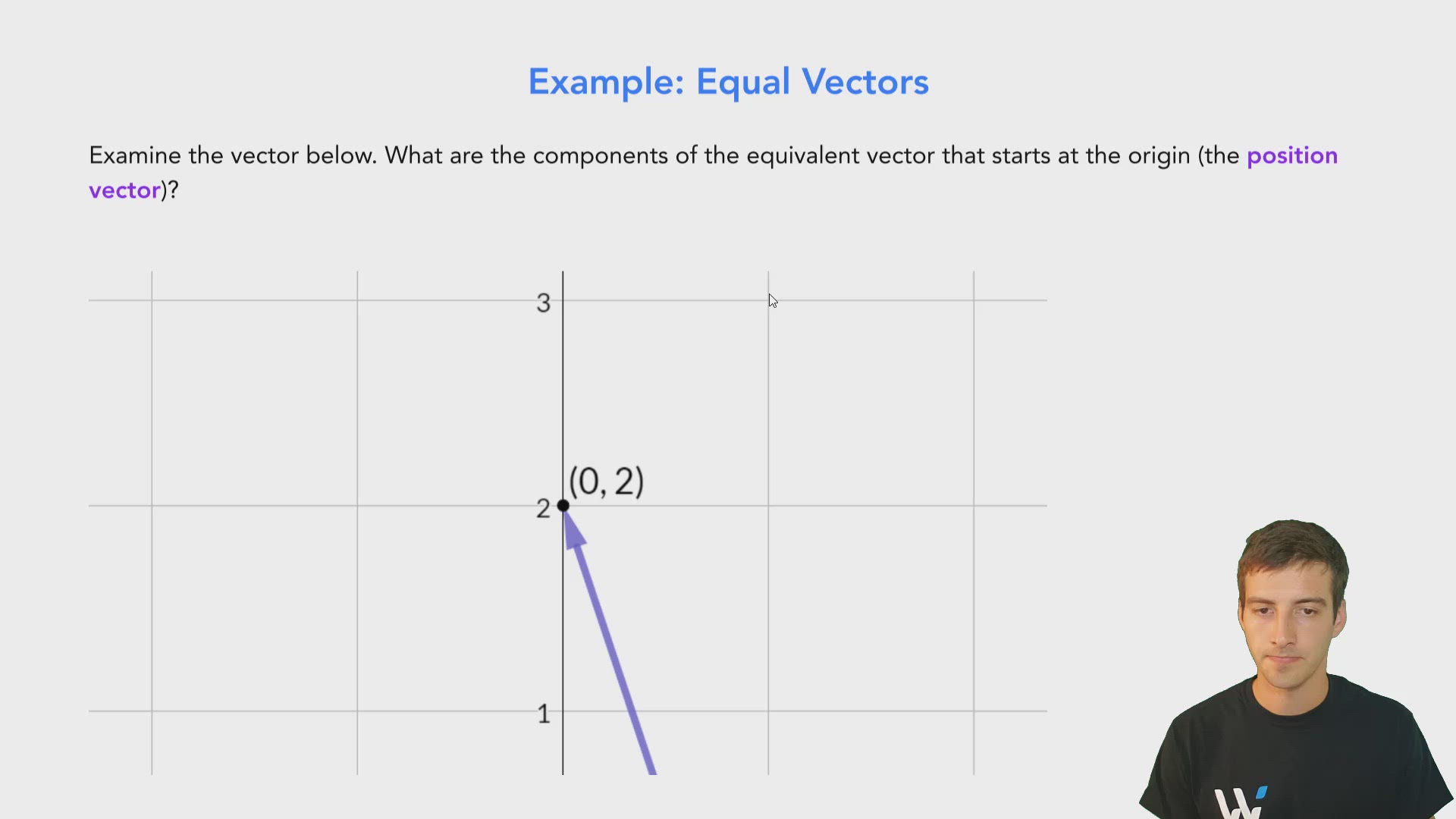
Examine the vector below. What are the components of the equivalent vector that starts at the origin (the position vector)?
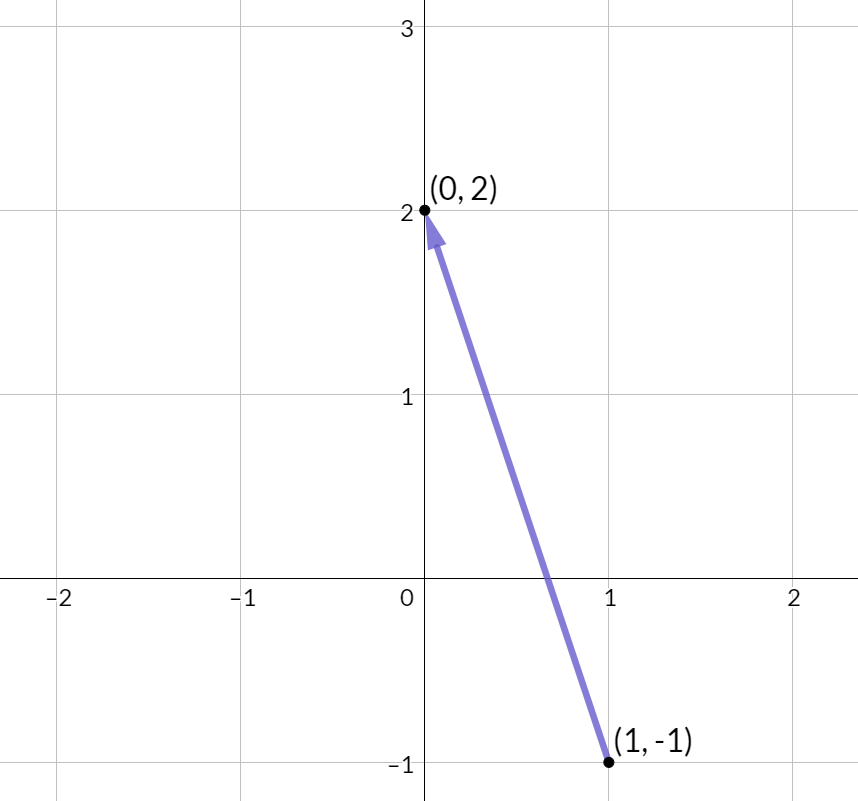
To move the tail of the vector to the origin, we can move the entire vector left 1 and up 1.
This would move the tip/head of the vector to the point .
Therefore, the position vector is equal to the vector seen above.
Practice: Basics of Vectors
Examine the following graph.
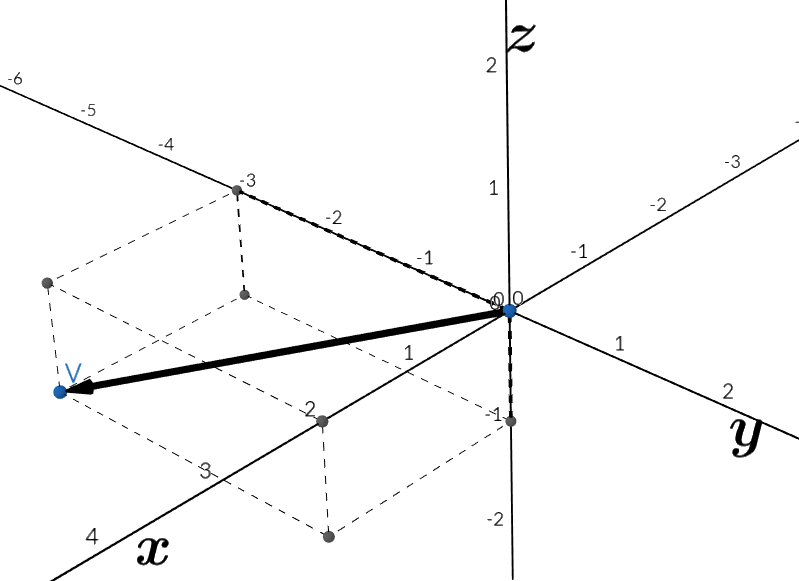
Determine the components of the vector shown.