Popular Courses
MATH 211
University of Calgary
MATH 1229A/B
Western University
Linear Algebra
University Study Guides
MATH 1ZC3
McMaster University
MATH 152
University of British Columbia
MATH 1600A/B
Western University
Linear Algebra
General Course
MAT188H1
University of Toronto
Linear Algebra
University Study Guides
SC/MATH 1025 3.00
York University
MATH 115
University of Waterloo
MATH 1B03
McMaster University
MAT223H1
University of Toronto
MATH-1270
University of Windsor
MATH 1210
University of Manitoba
MATH-1250
University of Windsor
MATH 111
Queen's University
MATH 1104
Carleton University
MATH 136
University of Waterloo
MATH 1300
University of Manitoba
0:00 / 0:00
Unit Vectors
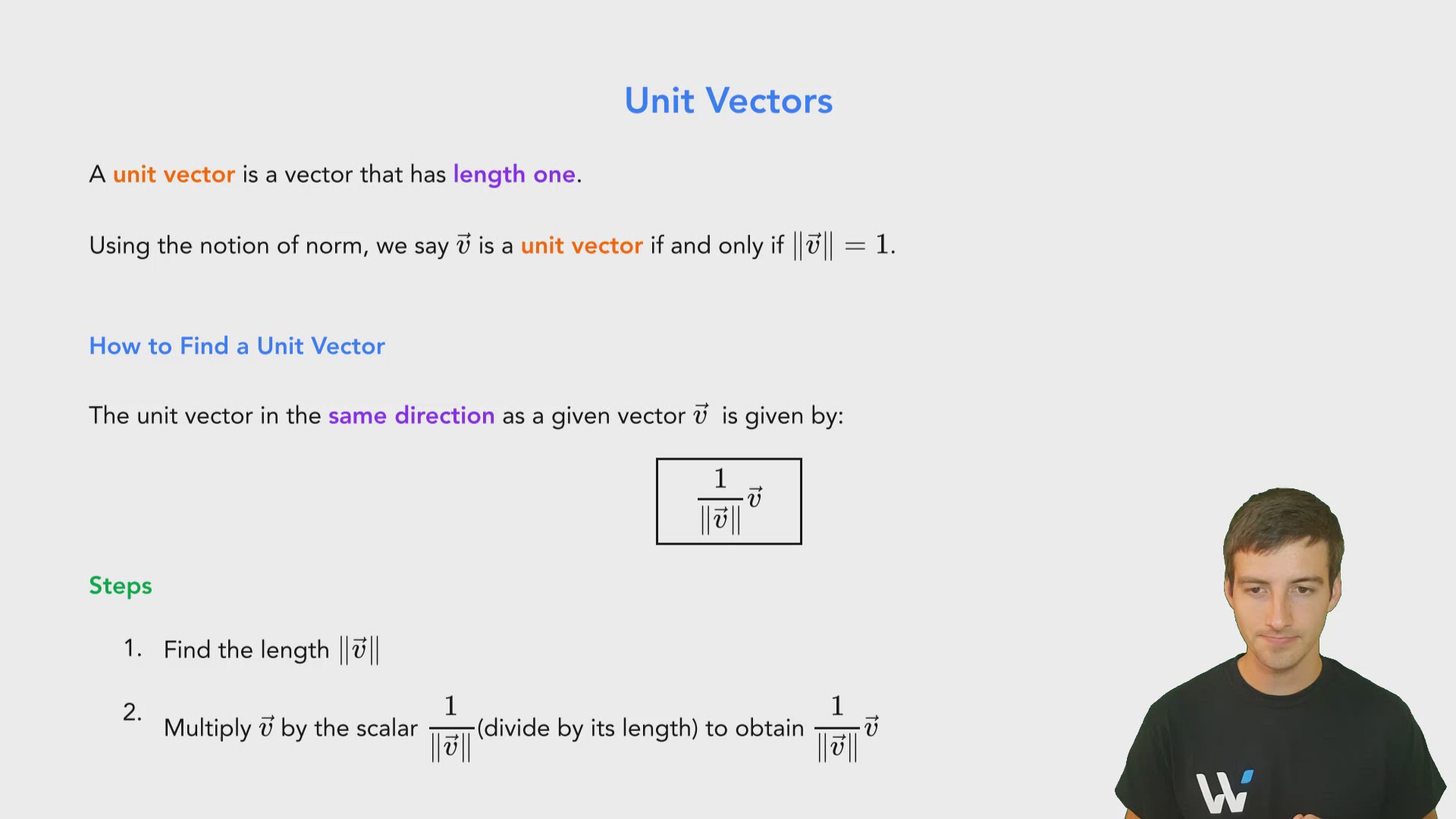
A unit vector is a vector that has length one.
Using the notion of norm, we say is a unit vector if and only if .
How to Find a Unit Vector
The unit vector in the same direction as a given vector is given by:
Steps
- Find the length
- Multiply by the scalar (divide by its length) to obtain
*This is sometimes called normalizing a vector.
Example 1
Find the unit vector in the same direction as the vector .
The unit vector in the same direction as is therefore:
Standard Basis Vectors
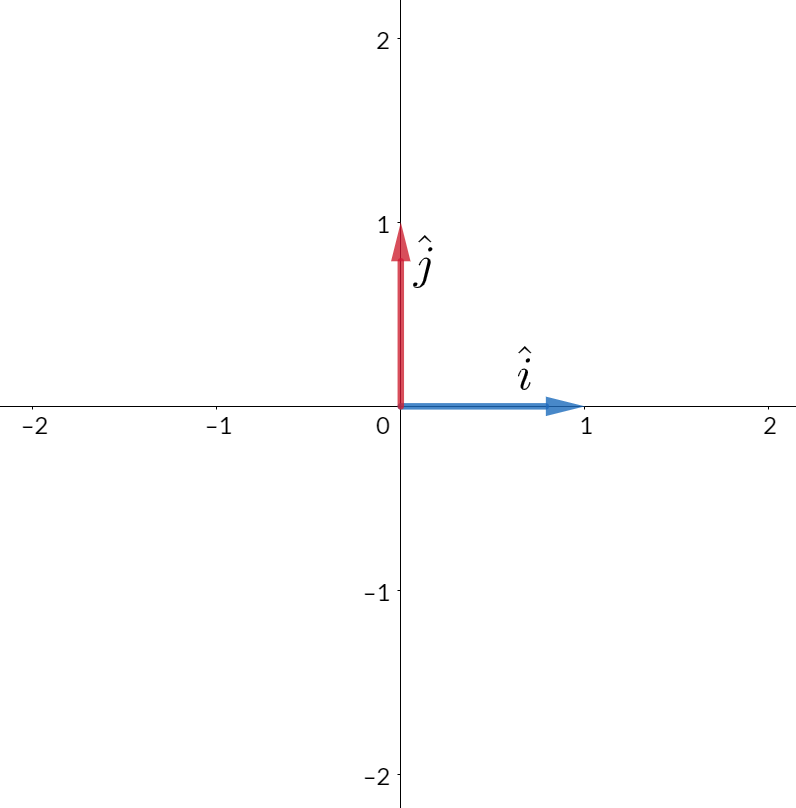
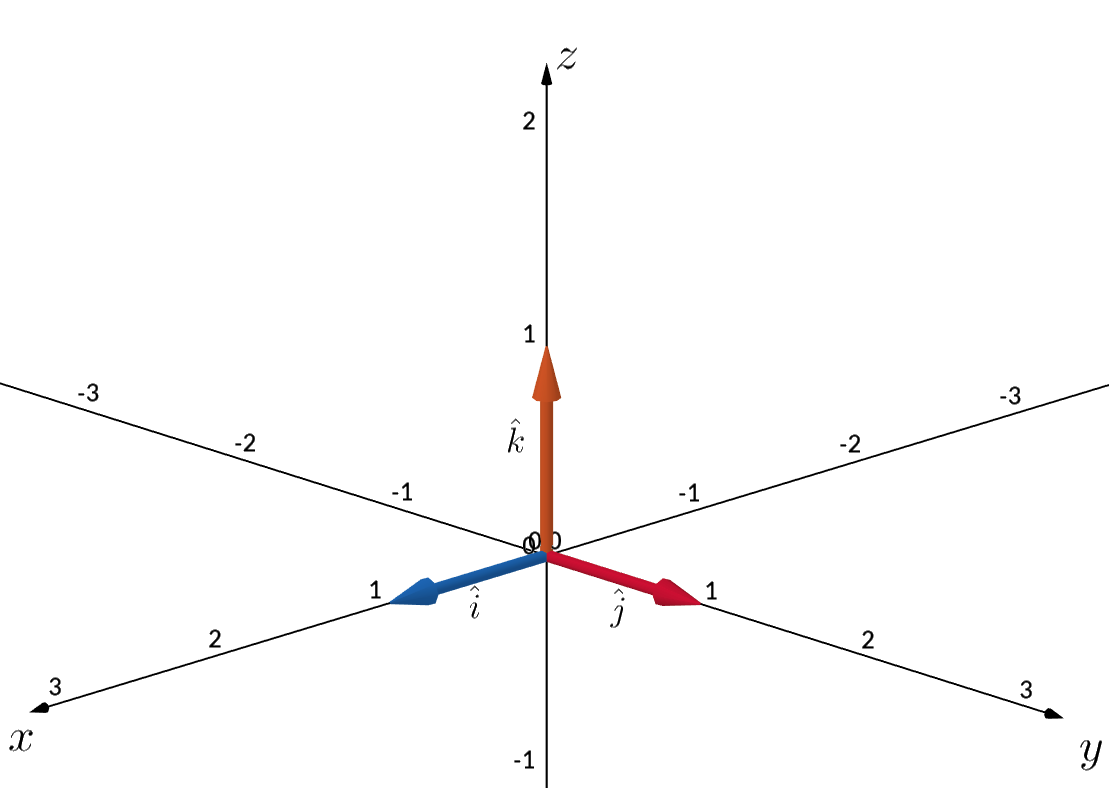
Standard basis vectors are unit vectors that run along each axis (positive side only).
In :
- runs along the positive -axis
- runs along the positive -axis
In :
- runs along the positive -axis
- runs along the positive -axis
- runs along the positive -axis
Decomposing Vectors with Unit Vectors
When plotting a point on a graph, we usually count along each axis one at a time. We are adding multiples of unit vectors!
Example 2
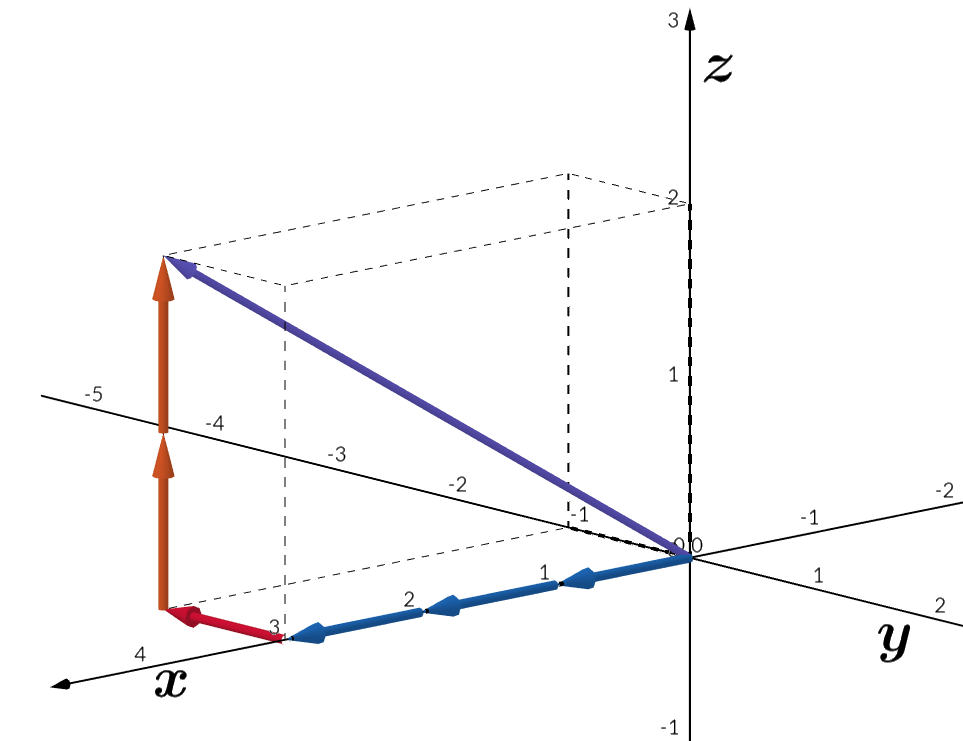
3
+ -1
+ 2
This is another notation for writing vectors!
Try writing out this expression with column vectors:
0:00 / 0:00
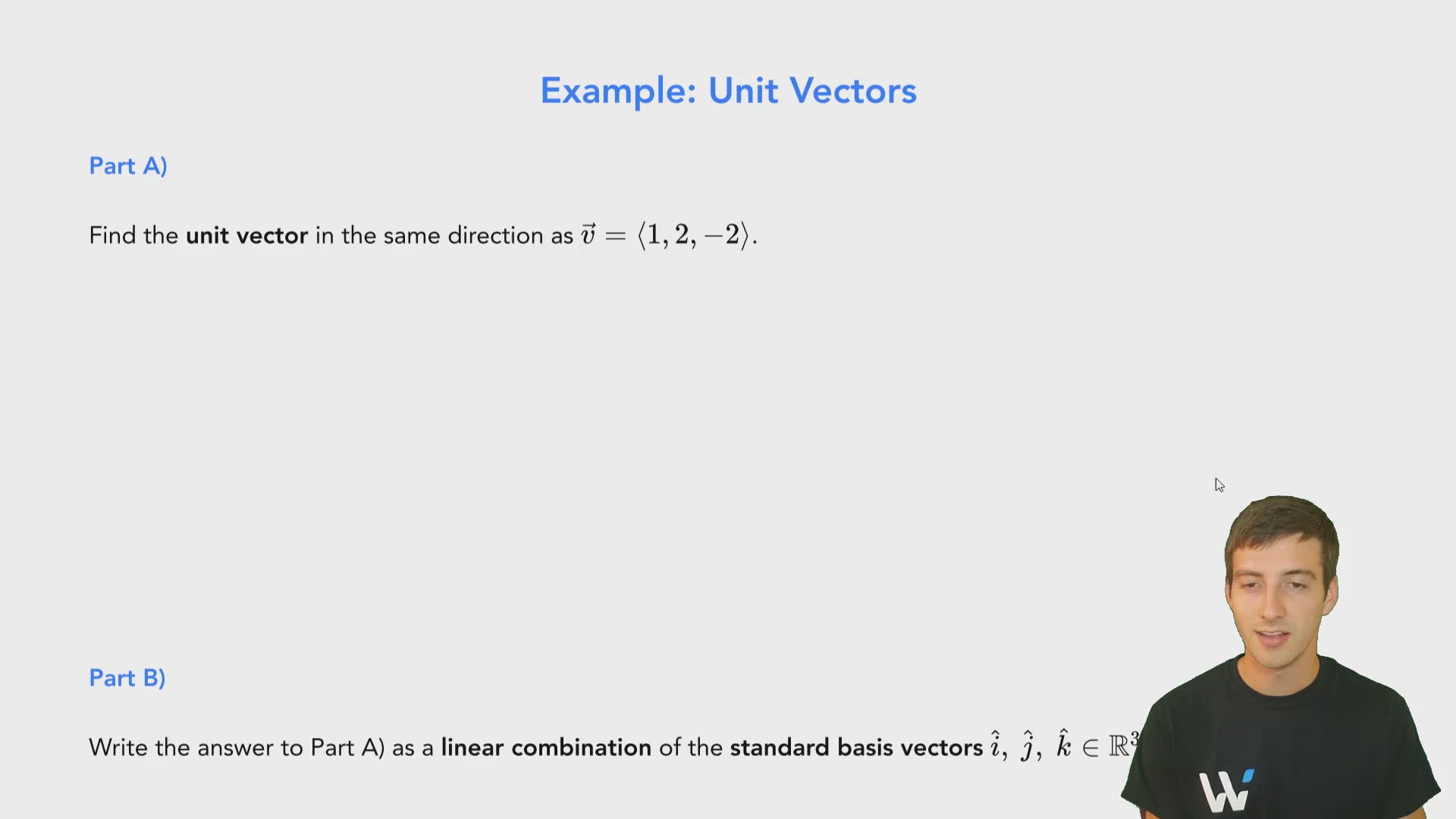
Example: Unit Vectors
Part A)
Find the unit vector in the same direction as .
First calculate :
Then the unit vector in the same direction as is given by:
Part B)
Write the answer to Part A) as a linear combination of the standard basis vectors .
Recall that the standard basis vectors in are defined to be:
So we can rewrite the vector as follows:
Practice: Unit Vectors
Find the value of such that is a unit vector.