Popular Courses
MATH 211
University of Calgary
MATH 1229A/B
Western University
Linear Algebra
University Study Guides
MATH 1ZC3
McMaster University
MATH 152
University of British Columbia
MATH 1600A/B
Western University
Linear Algebra
General Course
MATH 204
Concordia University
MAT188H1
University of Toronto
MATH 125
University of Alberta
Linear Algebra
University Study Guides
SC/MATH 1025 3.00
York University
MTH 141
Toronto Metropolitan University
MATH 102
University of Alberta
MATH 115
University of Waterloo
MATH 1B03
McMaster University
MAT223H1
University of Toronto
MATH-1270
University of Windsor
MATH 1210
University of Manitoba
MATH-1250
University of Windsor

0:00 / 0:00
Dot Product
Multiplying vectors by scalars is simple.
Multiplying vectors by vectors is not as straightforward, and there are two kinds of vectors products:
- Dot product: takes two vectors in and produces a single scalar
- Cross product: takes two vectors in and produces another vector in
The dot product (or scalar product) of and is defined to be:
Watch Out!
Like vector addition, the dot product only works if the vectors are in the same space!
Example
Given and , compute .
0:00 / 0:00
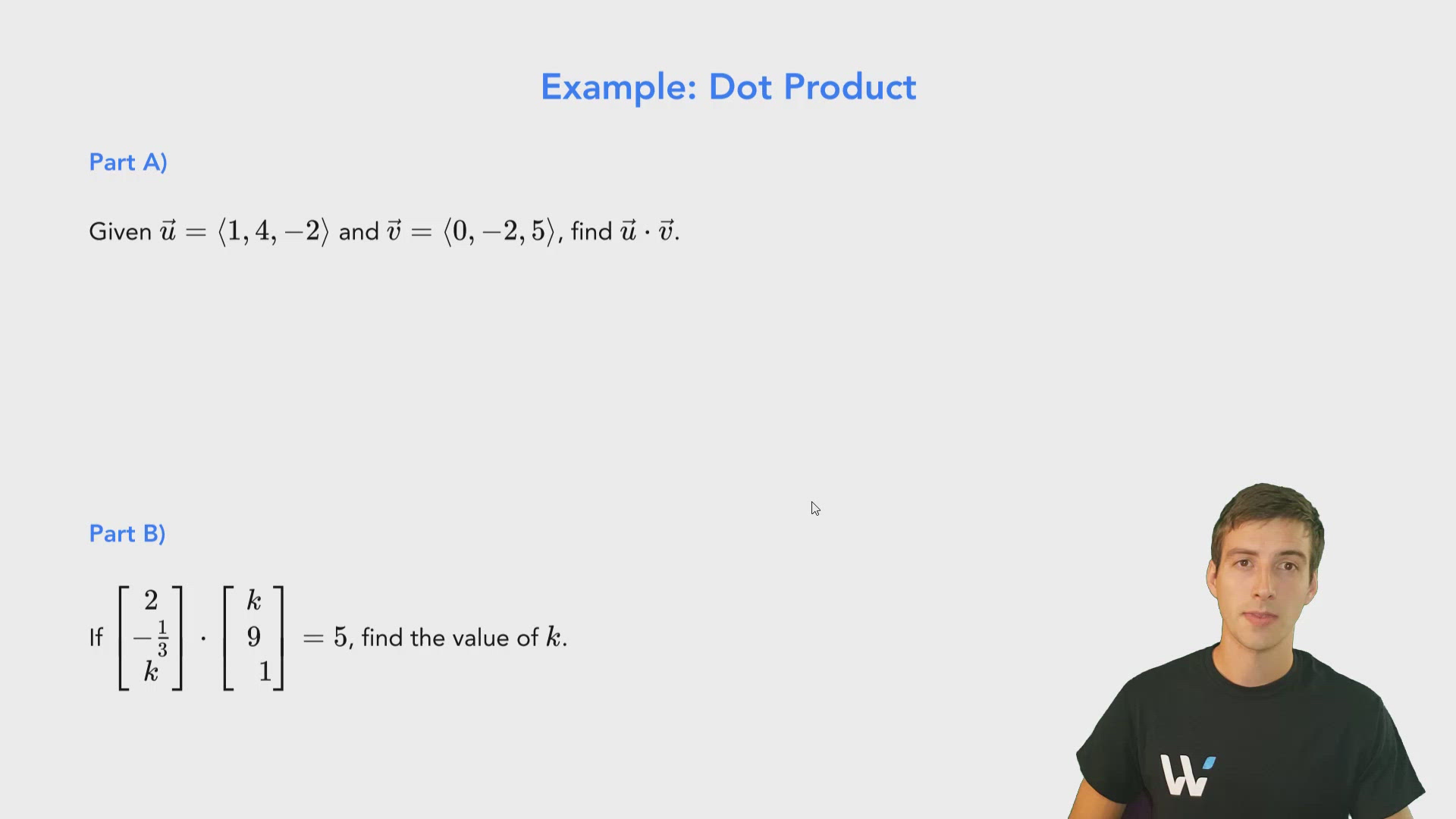
Example: Dot Product
Part A)
Given and , find .
Part B)
If , find the value of .
Practice: Dot Product
Fill in the blanks.
Part A)
Part B)
Given and , and ,
then d = .