Wize University Linear Algebra Textbook > Products of Vectors
Dot Product Properties
Popular Courses
MATH 211
University of Calgary
MATH 1229A/B
Western University
Linear Algebra
University Study Guides
MATH 1ZC3
McMaster University
MATH 152
University of British Columbia
MATH 1600A/B
Western University
Linear Algebra
General Course
MAT188H1
University of Toronto
Linear Algebra
University Study Guides
MATH 115
University of Waterloo
MATH 1B03
McMaster University
MAT223H1
University of Toronto
MATH-1270
University of Windsor
MATH 1210
University of Manitoba
MATH-1250
University of Windsor
MATH 1104
Carleton University
MATH 136
University of Waterloo
MATH 1300
University of Manitoba
SC/MATH 1021 3.00
York University
MATH 1107
Carleton University

0:00 / 0:00
Dot Product Properties
Orthogonal Vectors
Vectors and are orthogonal or perpendicular if and only if .

Shortcut in
Given a vector , we can "switch and flip" to find two non-trivial orthogonal vectors: and .
Wize Concept
Non-trivial usually means non-zero: the zero vector is orthogonal to all vectors since .
Properties
Let be vectors.
Let be a scalar.
0:00 / 0:00
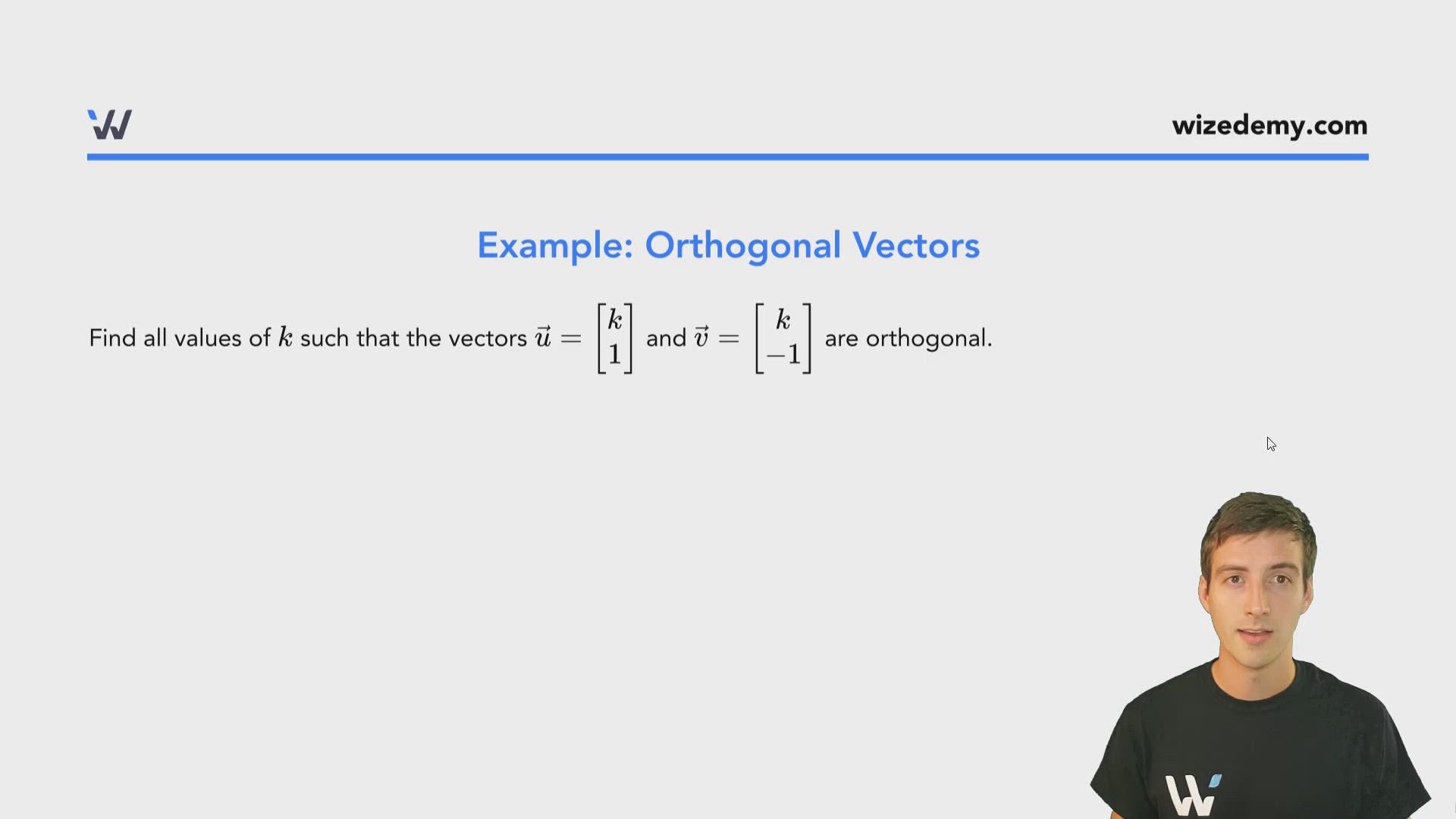
Example: Orthogonal Vectors
Find all values of such that the vectors and are orthogonal.
Watch Out!
When solving by taking the square root of a number, you must include both possibilities.
0:00 / 0:00
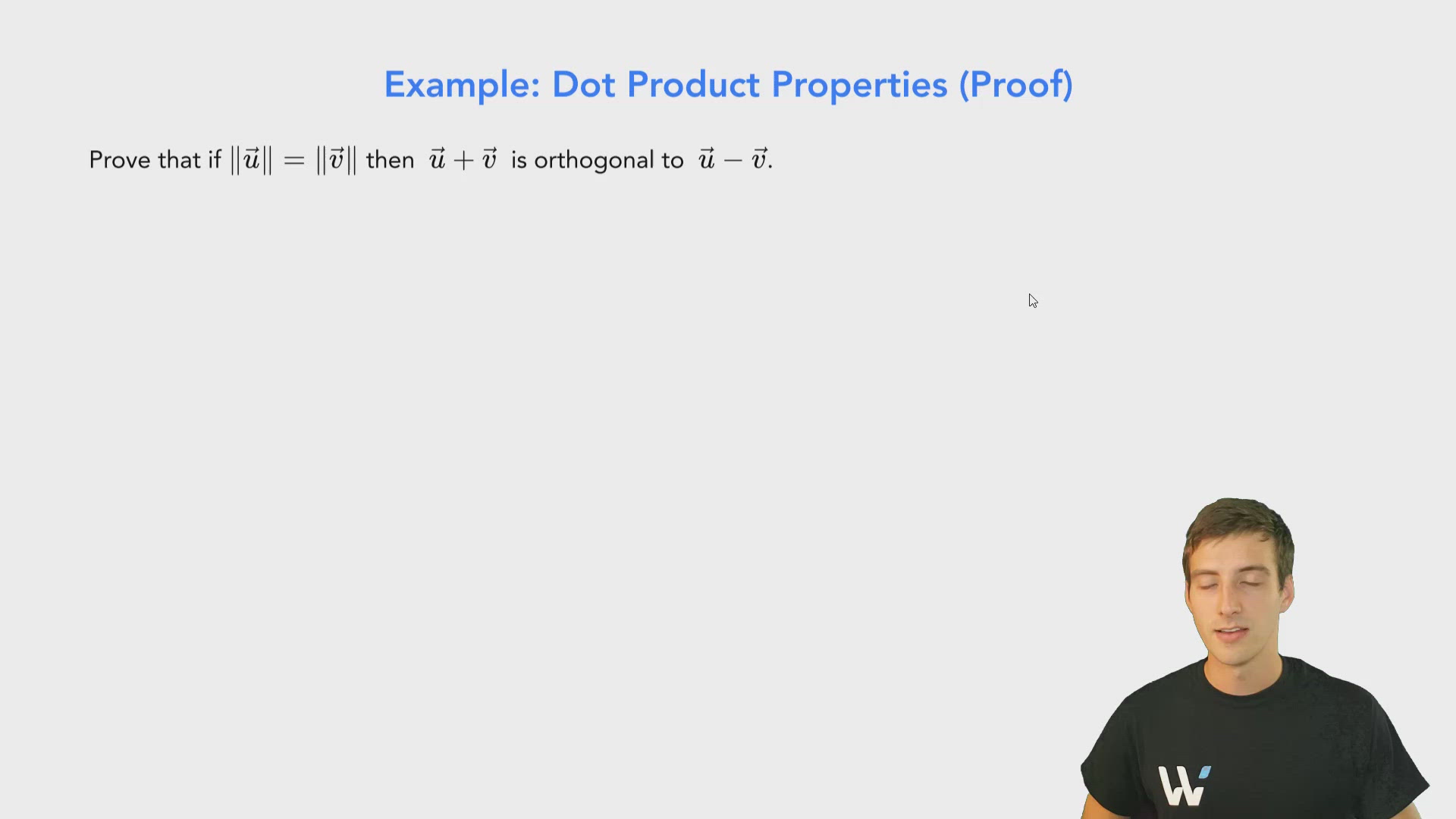
Example: Dot Product Properties (Proof)
Prove that if then is orthogonal to .
Two vectors are orthogonal if their dot product is 0, so let's find the dot product of and :
Since the dot product , the vectors and are orthogonal.
Practice: Properties of Dot Product
Given that and , find .
Practice: Dot Product Properties
Let be vectors and let be scalars. Select all expressions that are valid.