Wize High School Algebra II Textbook (Common Core) > Sampling and Estimating
Sampling Distribution for a Proportion
Popular Courses
Find My Course
0:00 / 0:00
Sampling Distribution of Proportions
By the Central LImit Theorem, if the sample size is large enough, then the sampling distribution for a proportion is approximately normal with mean and standard deviation , where,
- is the population proportion (the parameter).
We can then use the standardization formula for normal distribution to find the z-score, which will help us more easily calculate probabilities!
When a randomly selected sample size is drawn from a population, the sample proportion is denoted:
where X is the number of individuals with a certain characteristic.
When is the Sample Size "Large Enough"?
The sample size is large enough if
Example
A report from 2008 revealed that 12% of undergraduate students avoid enrolling in weekend courses. Based on a recent survey of 70 undergraduate students, 11 of the say that they avoid enrolling in weekend courses. Is the sample size large enough?
Sample is not large enough.
0:00 / 0:00
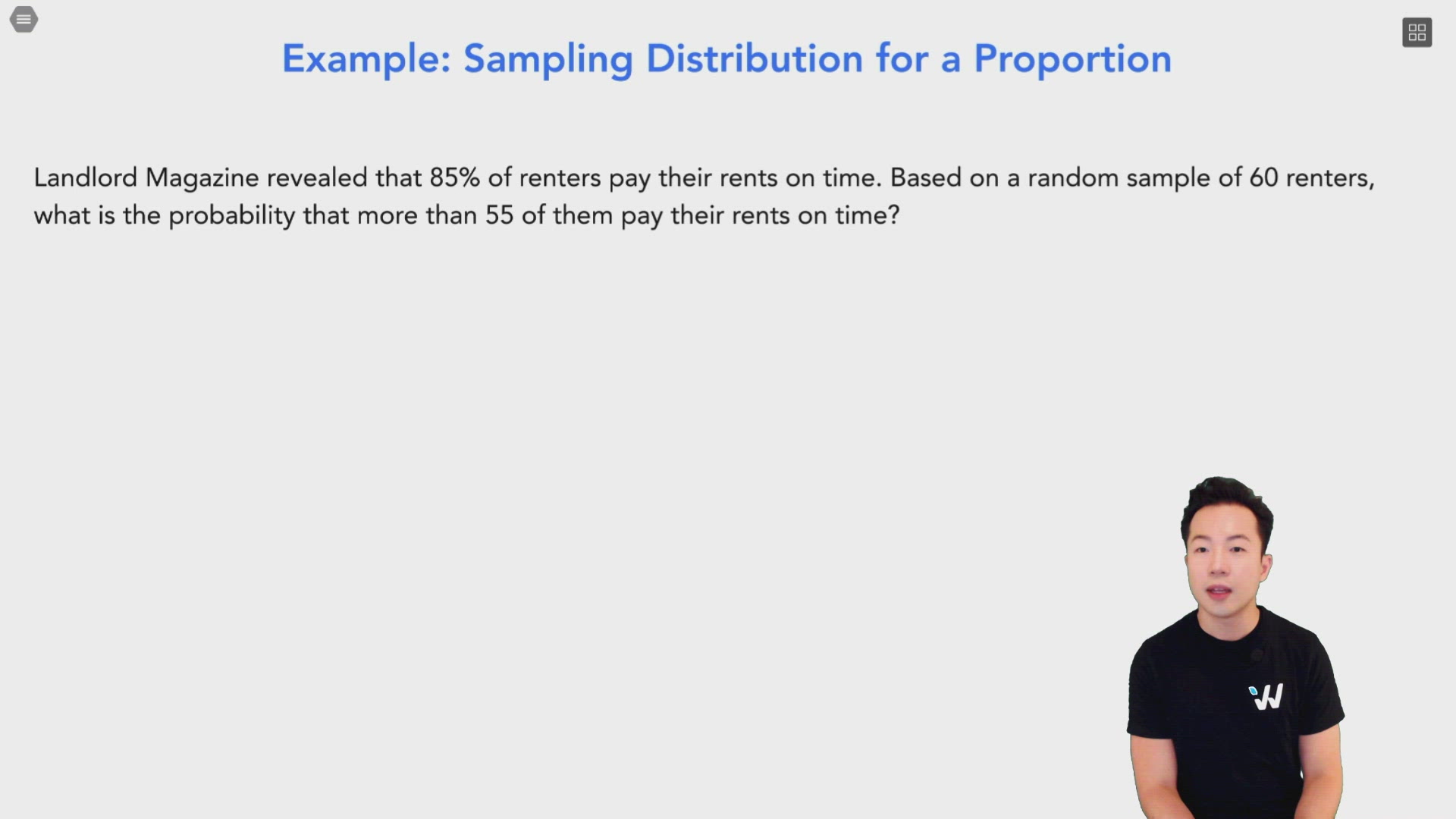
Example: Sampling Distribution for a Proportion
Landlord Magazine revealed that 85% of renters pay their rents on time. Based on a random sample of 60 renters, what is the probability that more than 55 of them pay their rents on time?
Using the z-table:
Miles claims that 4% of sales get refunded. You randomly select 200 transactions. What is the probability that more than 12 transactions in his sample got refunded?