Wize High School Grade 12 Pre-Calculus Textbook > Transformations

Vertical & Horizontal Expansions & Compressions

Create a free account to get started

Unlock full course notes by signing up

  • Video lessons taught by top educators
  • Practice questions with guided solutions
  • Written review notes for reference
  • Expert answers anytime from course tutors

Vertical Expansions (Stretches) & Compressions (Shrinks)


When we multiply a function by a real number, we get a function that has either been expanded/stretched vertically or compressed/shrinks vertically.


Vertical Expansion/Stretch

If y=f(x)y=f(x), then y=af(x)y=af(x) gives a vertical expansion/stretch when ∣a∣>1|a|>1 .

  • We say "There is a vertical expansion/stretch by a factor of 'a' "
  • All output values will be multiplied by 'a'

Vertical Compressions/Shrinks

If y=f(x),y=f(x), then y=af(x) y=af(x)~ gives a vertical compression (shrinks vertically) when ∣a∣<1|a|<1

  • We say "There is a vertical compression by a factor of 'a' " or
  • "The function f(x) has shrunk vertically by a factor of 'a' "
  • All output values will be multiplied by 'a'


Example

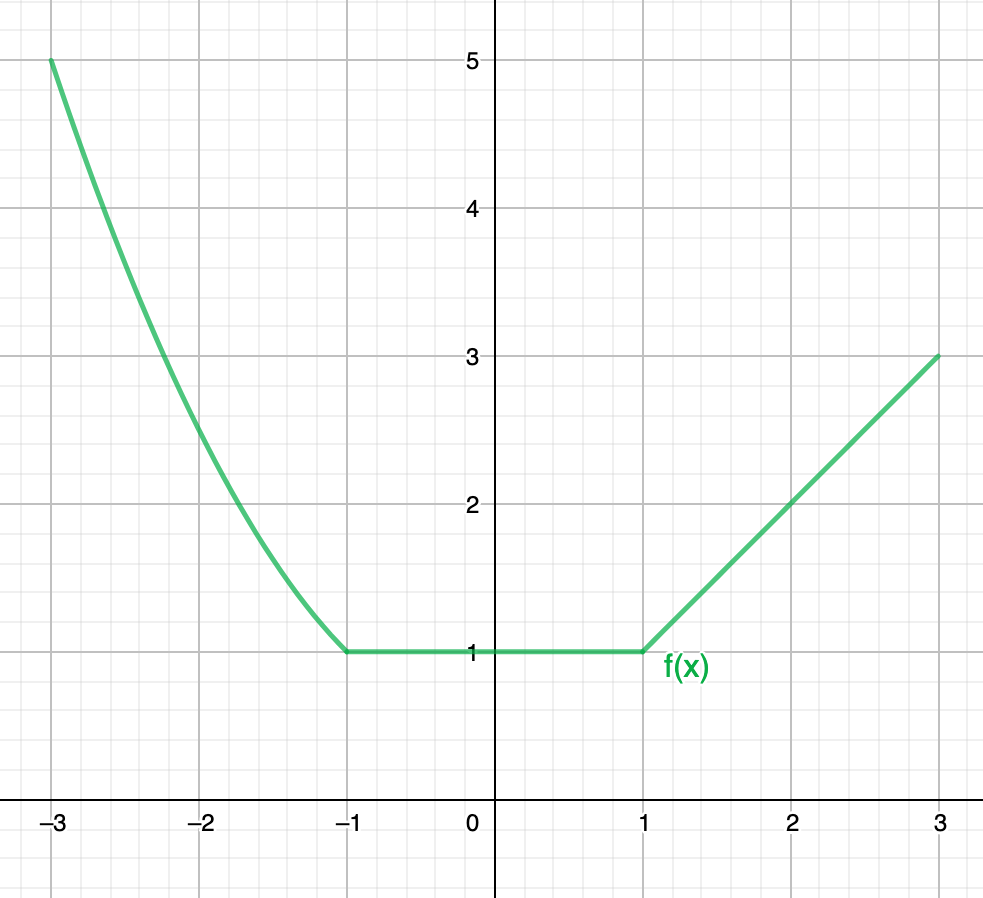
Let y=f(x)y=f(x) be shown below:

Image illustrating Vertical Expansions & Compressions xf(x)−35−1101112233\begin{array}{|c|c|} \hline\\ x&f(x)\\\\\hline -3&5\\\hline -1&1\\\hline 0&1\\\hline 1&1\\\hline 2&2\\\hline 3&3\\\hline \end{array}

Domain: [−3,3][-3,3]

Range: [1,5][1,5]


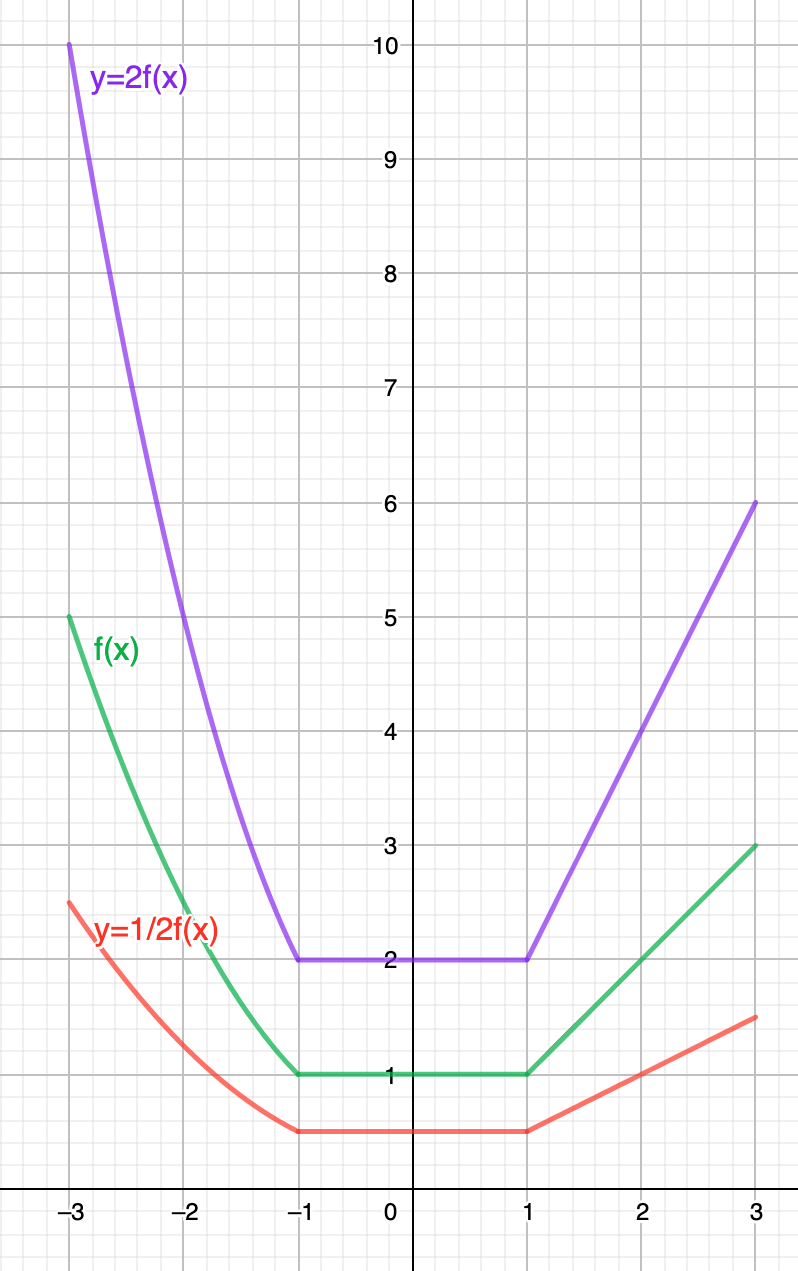
Let us look at the graphs of y=2f(x) & y=12f(x)y=2f(x)~\&~y=\frac{1}{2}f\left(x\right)on the same grid as y=f(x)y=f(x) and identify the transformations.


Image illustrating Vertical Expansions & Compressions x2f(x)12f(x)−3102.5−120.5020.5120.5241361.5\begin{array}{|c|c|c|} \hline\\ x&2f(x)&\displaystyle\frac{1}{2}f(x)\\\\\hline -3&10&2.5\\\hline -1&2&0.5\\\hline 0&2&0.5\\\hline 1&2&0.5\\\hline 2&4&1\\\hline 3&6&1.5\\\hline \end{array}


For y=2f(x):y=2f(x):

  • There is a vertical expansion by a factor of 2
  • a = 2
  • Domain: [−3,3][-3,3]
  • Range: [2,10][2,10]


For y=12f(x)y=\frac{1}{2}f(x):

  • There is a vertical compression by a factor of 12\frac{1}{2}
  • a = 12\frac{1}{2}
  • Domain: [−3.3][-3.3]
  • Range: [0.5,2.5][0.5,2.5]


Create a free account to get started

Unlock full course notes by signing up

  • Video lessons taught by top educators
  • Practice questions with guided solutions
  • Written review notes for reference
  • Expert answers anytime from course tutors

Horizontal Expansions & Compressions

When we multiply a function by a real number, we get a function that has either been expanded/stretched horizontally or compressed/shrinks horizontally.

Horizontal Expansion/Stretch

If y=f(x), y=f(x),~ then y=f(bx) y=f(bx)~gives a horizontal expansion when ∣b∣<1|b|<1

  • We say "There is a horizontal expansion/stretch by a factor of 1b\purple{\dfrac{1}{b}} "
  • All input values will be multiplied by b\displaystyle b

Horizontal Compressions/Shrinks

If y=f(x), y=f(x),~ then y=f(bx) y=f(bx)~ is a horizontal compression when ∣b∣>1|b|>1

  • We say "There is a horizontal compression by a factor of 1b\purple{\dfrac{1}{b}}" or
  • We say "The function f(x) shrinks horizontally by a factor of 1b\purple{\dfrac{1}{b}}"
  • All input values will be multiplied by b\displaystyle b


Example

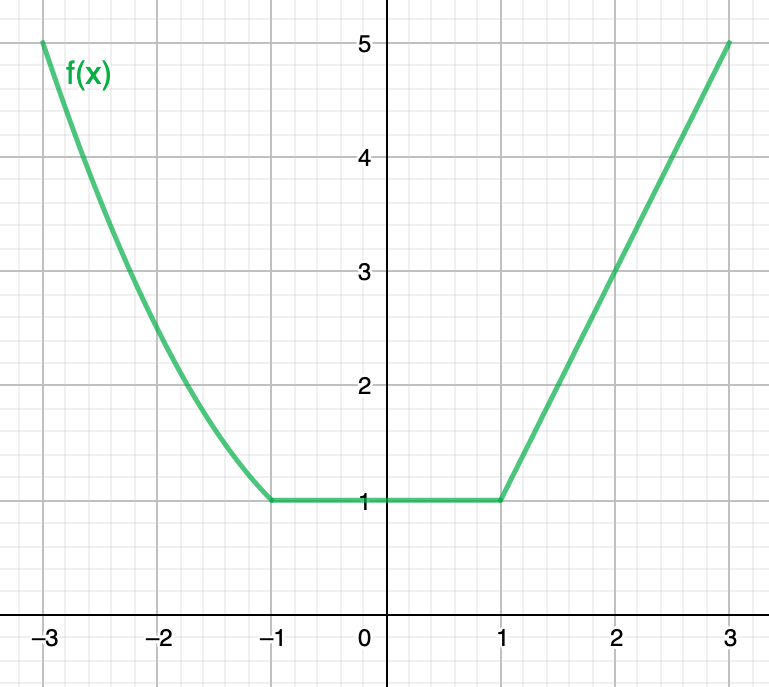
Let y=f(x) y=f(x)~ be shown below:

Image illustrating Horizontal Expansions & Compressions xy−35−1101112233\begin{array}{|c|c|}\hline x&y\\\hline -3&5\\\hline -1&1\\\hline 0&1\\\hline 1&1\\\hline 2&2\\\hline 3&3\\\hline \end{array}

Domain: [−3,3][-3,3]

Range: [1,5][1,5]


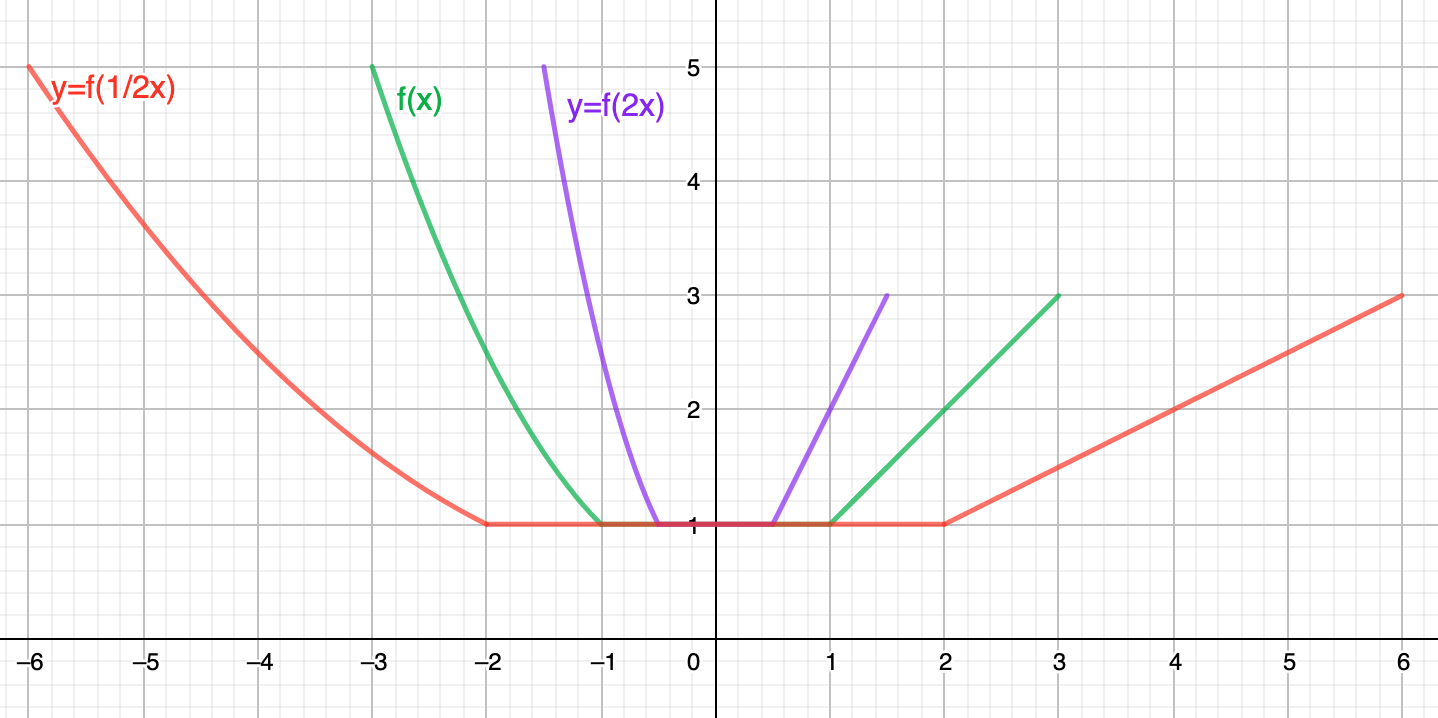
Let us look at the graphs of y=f(2x) & y=f(12x) y=f(2x)~\&~y=f\big(\frac{1}{2}x\big)~on the same grid as y=f(x) y=f(x)~and identify the transformations.

Image illustrating Horizontal Expansions & Compressions xy=f(2x)−1.55−0.51010.51121.53xy=f(12x)−65−2101214263\begin{array}{l c r} \begin{array}{|c|c|}\hline x&y=f(2x)\\\hline -1.5&5\\\hline -0.5&1\\\hline 0&1\\\hline 0.5&1\\\hline 1&2\\\hline 1.5&3\\\hline \end{array}& \begin{array}{|c|c|}\hline x&y=f(\frac{1}{2}x)\\\hline -6&5\\\hline -2&1\\\hline 0&1\\\hline 2&1\\\hline 4&2\\\hline 6&3\\\hline \end{array}& \end{array}


For y=f(2x):y=f(2x):

  • There is a horizontal compression by a factor of 12\frac{1}{2}
  • b = 2
  • Domain: [−1.5,1.5][-1.5,1.5]
  • Range: [1,5][1,5]


For y=f(12x)y=f\big(\frac{1}{2}x\big):

  • There is a horizontal expansison by a factor of 2
  • b = 12\frac{1}{2}
  • Domain: [−6,6][-6,6]
  • Range: [1,5][1,5]


Create a free account to get started

Unlock full course notes by signing up

  • Video lessons taught by top educators
  • Practice questions with guided solutions
  • Written review notes for reference
  • Expert answers anytime from course tutors

Example: Vertical & Horizontal Expansions & Compressions

For the function y=f(x) y=f(x)~ (graphed below), identify the transformation applied to y=f(x)y=f(x)and sketch the graph of the transformed function, stating the domain and range.
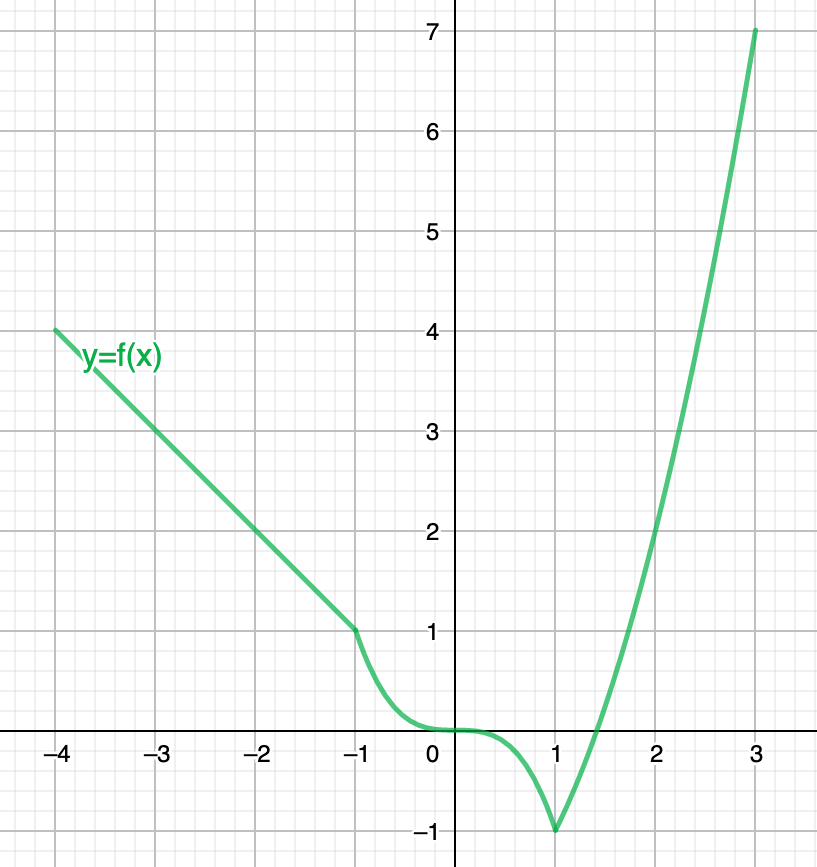
  1. y=2f(x)y=2f(x)
  2. y=f(4x)y=f(4x)
  3. y=3f(13x)y=3f\big(\frac{1}{3}x\big)
Image illustrating Example

Part A

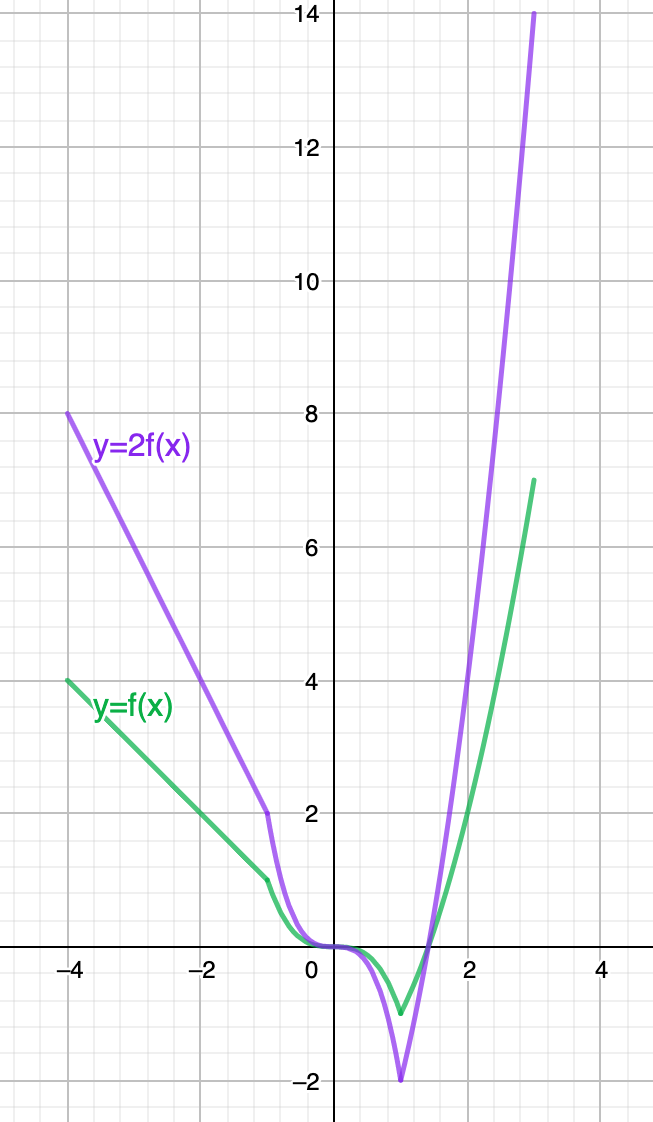
y=2f(x)y=2f(x)

There is a vertical expansion by a factor of 2 (a = 2)


The table of values for y=f(x) y=f(x)~ is:

xy−44−11011−12237\begin{array}{|c|c|} \hline x&y\\\hline -4&4\\\hline -1&1\\\hline 0&1\\\hline 1&-1\\\hline 2&2\\\hline 3&7\\\hline \end{array}


The table of values for y=2f(x) y=2f(x)~ is:

xy−48−12021−224314\begin{array}{|c|c|} \hline x&y\\\hline -4&8\\\hline -1&2\\\hline 0&2\\\hline 1&-2\\\hline 2&4\\\hline 3&14\\\hline \end{array}

Sketch:

Image illustrating Example


Domain: [−4,3][-4,3]

Range: [−2,14][-2,14]


Part B

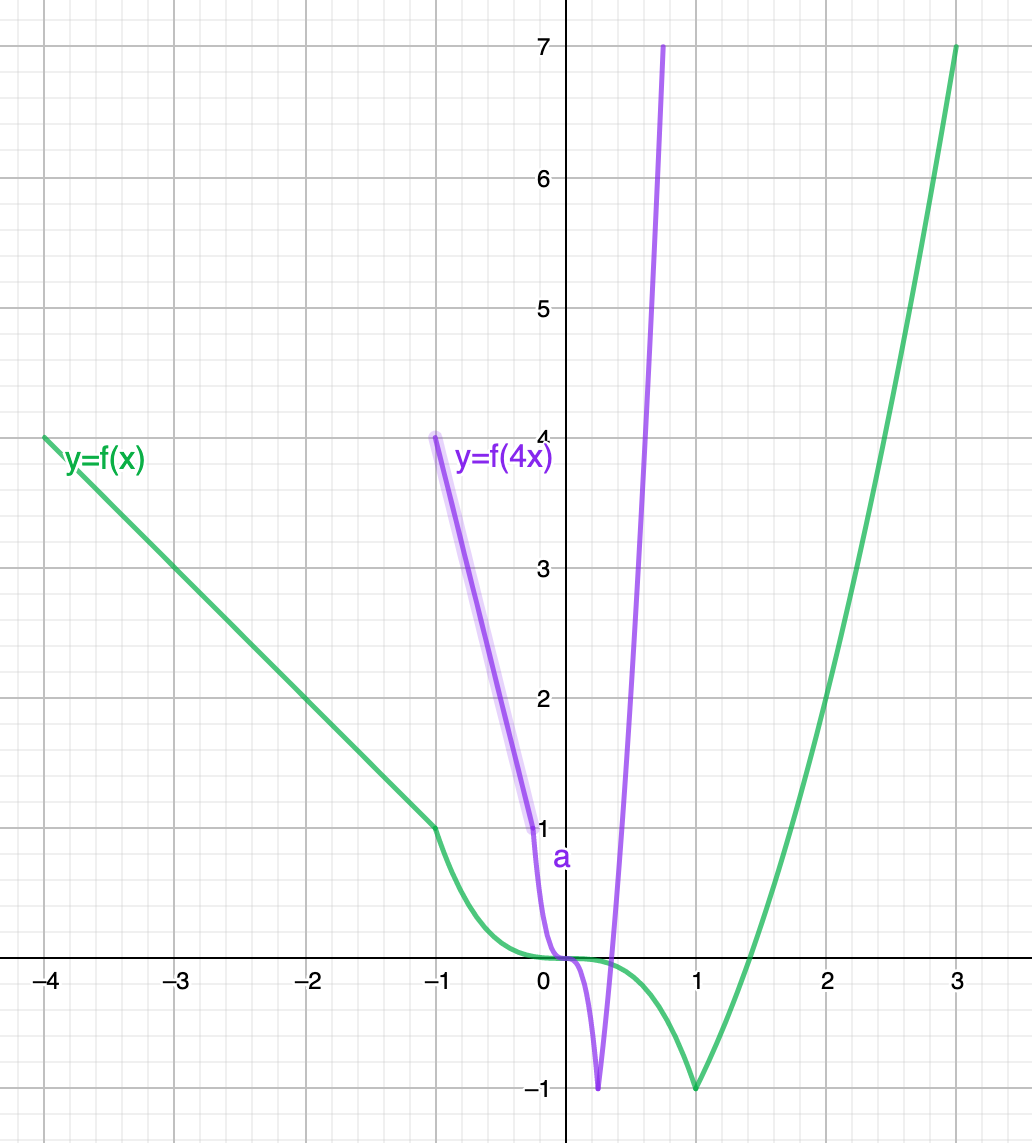
y=f(4x)y=f(4x)


There is a horizontal compression by a factor of 14\frac{1}{4} (b=4)(b=4)


The table of values for y=f(x) y=f(x)~ is:

xy−44−11011−12237\begin{array}{|c|c|} \hline x&y\\\hline -4&4\\\hline -1&1\\\hline 0&1\\\hline 1&-1\\\hline 2&2\\\hline 3&7\\\hline \end{array}


The table of values for y=f(4x) y=f(4x)~ is:

xy−14−0.251010.25−10.520.757\begin{array}{|c|c|} \hline x&y\\\hline -1&4\\\hline -0.25&1\\\hline 0&1\\\hline 0.25&-1\\\hline 0.5&2\\\hline 0.75&7\\\hline \end{array}

Sketch:

Image illustrating Example


Domain: [−1,0.75][-1,0.75]

Range: [−1,4][-1,4]


Part C

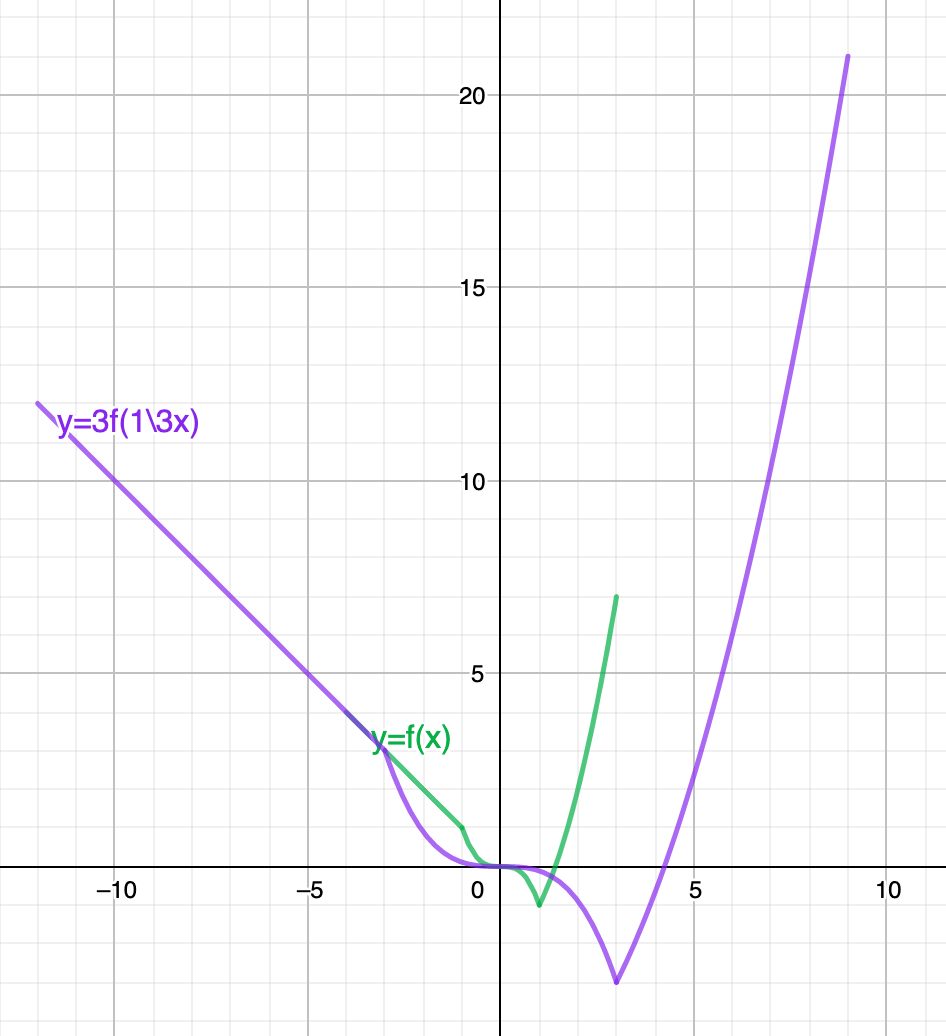
y=3f(13x)y=3f\big(\frac{1}{3}x\big)


There is a:

  • Vertical Expansion by a factor of 3
  • Horizontal Expansion by a factor of 3


The table of values for y=f(x) y=f(x)~ is:

xy−44−11011−12237\begin{array}{|c|c|} \hline x&y\\\hline -4&4\\\hline -1&1\\\hline 0&1\\\hline 1&-1\\\hline 2&2\\\hline 3&7\\\hline \end{array}


The table of values for y=3f(13x) y=3f\big(\frac{1}{3}x\big)~ is:

xy−1212−33033−366921\begin{array}{|c|c|} \hline x&y\\\hline -12&12\\\hline -3&3\\\hline 0&3\\\hline 3&-3\\\hline 6&6\\\hline 9&21\\\hline \end{array}

Sketch:

Image illustrating Example


Domain: [−12,9][-12,9]

Range: [−3,21][-3,21]

Create a free account to get started

Unlock full course notes by signing up

  • Video lessons taught by top educators
  • Practice questions with guided solutions
  • Written review notes for reference
  • Expert answers anytime from course tutors

Example: Vertical & Horizontal Expansions & Compressions

Graph the following transformed functions, identifying the parent functions and domain & range.

  1. y=12x2y=\frac{1}{2}x^2
  2. y=(3x)3y=(3x)^3

Part A

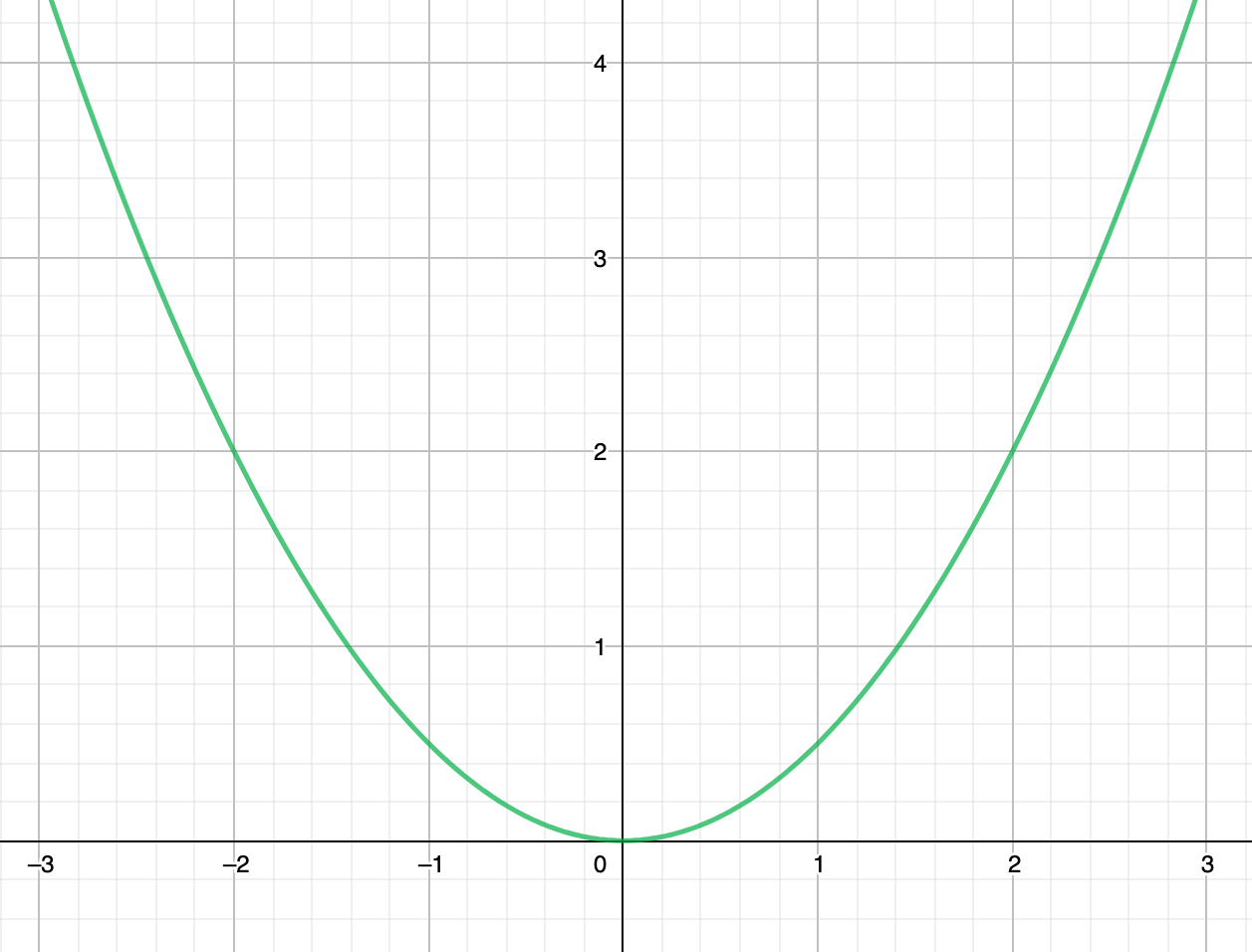
y=12x2y=\frac{1}{2}x^2


Parent Function: y=x2y=x^2


Table of values for parent function:

xy−24−11001124\begin{array}{|c|c|} \hline x&y\\\hline -2&4\\\hline -1&1\\\hline 0&0\\\hline 1&1\\\hline 2&4\\\hline \end{array}

Table of values for transformed function:

xy−22−10.50010.522\begin{array}{|c|c|} \hline x&y\\\hline -2&2\\\hline -1&0.5\\\hline 0&0\\\hline 1&0.5\\\hline 2&2\\\hline \end{array}

Sketch:

Image illustrating Example


Domain: [−∞,∞][-\infin,\infin]

Range: [0,∞)[0,\infin)


Part B

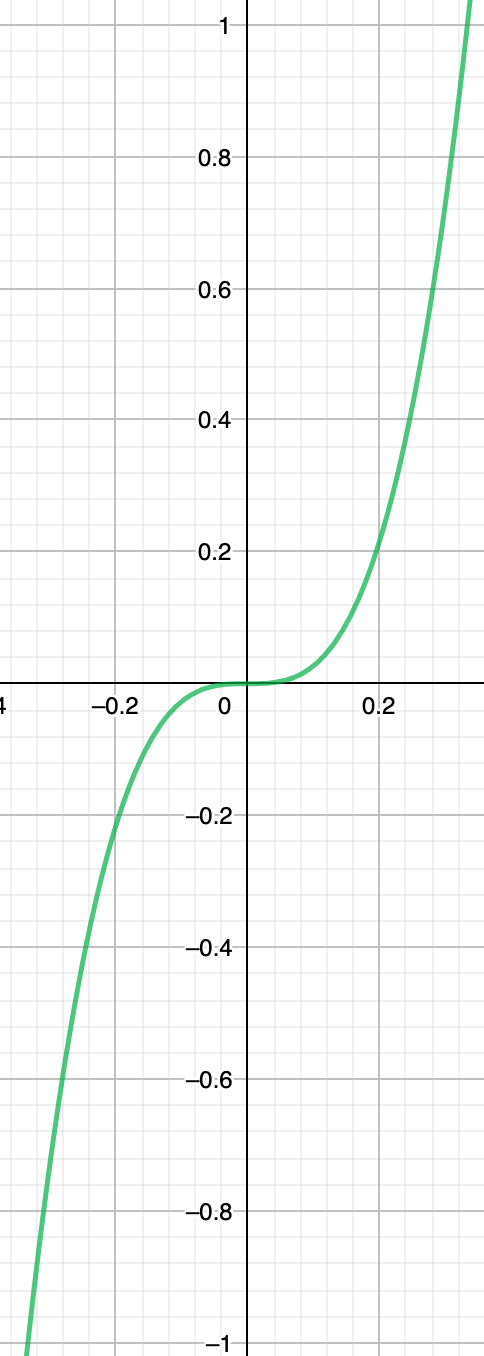
Parent Function: y=x3y=x^3


Table of values for parent function:

xy−2−8−1−1001128\begin{array}{|c|c|} \hline x&y\\\hline -2&-8\\\hline -1&-1\\\hline 0&0\\\hline 1&1\\\hline 2&8\\\hline \end{array}

Table of values for transformed function:

xy−234−13100131234\begin{array}{|c|c|} \hline x&y\\\hline \\-\frac{2}{3}&4\\\\\hline \\-\frac{1}{3}&1\\\\\hline 0&0\\\hline \\\frac{1}{3}&1\\\\\hline \\\frac{2}{3}&4\\\\\hline \end{array}

Sketch:

Image illustrating Example


Domain: [−∞,∞][-\infin,\infin]

Range: [−∞,∞][-\infin,\infin]

Practice: Vertical & Horizontal Expansions & Compressions


The function y=f(x)y=f(x), is shown below.


Illustration for practice question: Vertical & Horizontal Expansions & Compressions


Which graph represents the transformed function y=f(14x)y=f\big(\frac{1}{4}x\big)?

Choose an answer

Create a free account to get started

Unlock full course notes by signing up

  • Video lessons taught by top educators
  • Practice questions with guided solutions
  • Written review notes for reference
  • Expert answers anytime from course tutors

Practice: Vertical & Horizontal Expansions & Compressions

Let y=f(x)y=f(x) be shown below.

Illustration for practice question: Practice: Vertical & Horizontal Expansions & Compressions


Match the transformation with its correct coordinate point.

Match each term
A.

5f(x)5f(x)

B.

13f(x)\frac{1}{3}f(x)

C.

f(12x)f\big(\frac{1}{2}x\big)

D.

f(3x)f(3x)

(3,−5)(3, -5)

(−4,4)(-4, 4)

(4,−23)\Big(4, -\frac{2}{3}\Big)

(13,1)\big(\frac{1}{3},1\big)

Create a free account to get started

Unlock full course notes by signing up

  • Video lessons taught by top educators
  • Practice questions with guided solutions
  • Written review notes for reference
  • Expert answers anytime from course tutors

Practice: Vertical & Horizontal Expansions & Compressions

The point (4,−7) (4, -7)~ is on the graph y=2f(15x)y=2f\big(\frac{1}{5}x\big). What point must be on the graph of y=f(x)?y=f(x)?


Create a free account to get started

Unlock full course notes by signing up

  • Video lessons taught by top educators
  • Practice questions with guided solutions
  • Written review notes for reference
  • Expert answers anytime from course tutors