0:00 / 0:00

Radical Expressions

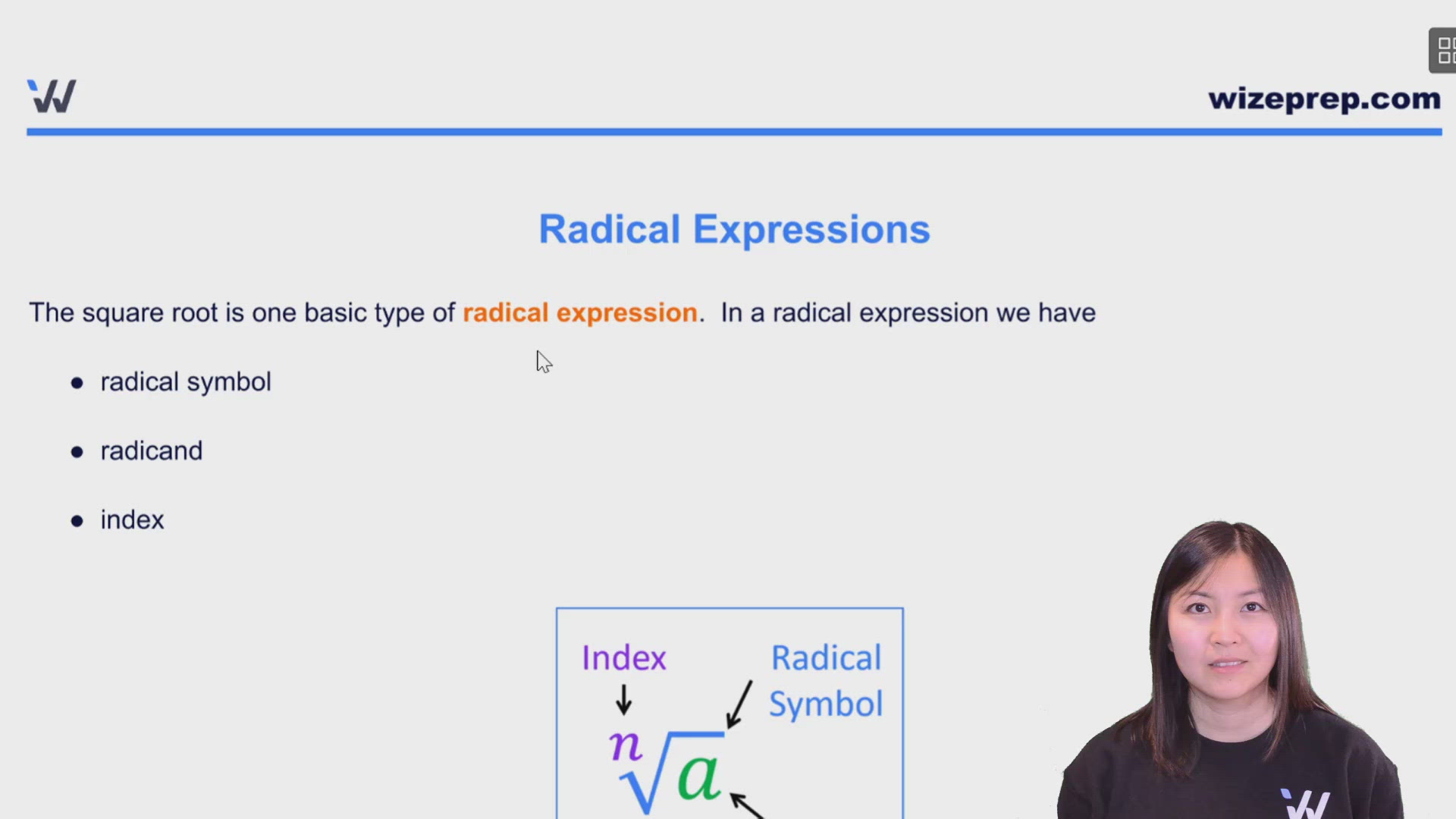
The square root is one basic type of radical expression. In a radical expression we have
  • radical symbol
  • radicand
  • index


Wize Tip
If the index is not written, it is always assumed to be a 2 (square root).

The value of a radical can be found by asking "what number, when raised to the power of the index, will equal the radicand?".


Watch Out!
When the index is even, the radicand must be non-negative!
Ex. 34\sqrt[\scriptsize 4]{-3} is not a real number.

PAGE BREAK

Example 1

1. 49\sqrt{49}

49=77=7\begin{aligned} \sqrt{49} &= \sqrt{7 \cdot 7} \\ &= 7 \end{aligned}

Or, think of it as cancelling the invisible index (2) and the exponent:

49=72=7\begin{aligned} \sqrt{49} &= \sqrt{7^2} \\ &= 7 \end{aligned}


2. 643\sqrt[\scriptsize 3]{64}

643=4443=4\begin{aligned} \sqrt[\scriptsize 3]{64} &= \sqrt[\scriptsize 3]{4 \cdot 4 \cdot 4} \\ &= 4 \end{aligned}

Or, think of it as cancelling the index and the exponent:

643=433=4\begin{aligned} \sqrt[\scriptsize 3]{64} &= \sqrt[\scriptsize 3]{4^3} \\ &= 4 \end{aligned}


3. x4\sqrt{x^4}

x4=(x2)2=x2\begin{aligned} \sqrt{x^4} &= \sqrt{(x^2)^2} \\ &= x^2 \end{aligned}


4. 16\sqrt{-16}

Since the index is even (2) and the radicand is negative, this radical is invalid. It is not a real number.
PAGE BREAK

Adding Like Radicals

Like radicals are radicals with the same index and radicand.
We can add/subtract like radicals by adding/subtracting their coefficients, just like when "collecting like terms".

Example 2

1. Simplify 35+453\sqrt{5}+4\sqrt{5}.

35+45= (3+4)5= 75\begin{aligned} &3\sqrt{5}+4\sqrt{5} \\[0.5em] =\ & (3+4)\sqrt{5} \\[0.5em] =\ & \boxed{7\sqrt5} \end{aligned}

2. Simplify 2+29+92\sqrt{2}+2\sqrt{9}+9\sqrt{2}.

The only like radicals are the 2\sqrt2, so we collect those, and leave the 292\sqrt{9} term alone:

12+29+92= (1+9)2+29= 102+2(3)= 102+6\begin{aligned} & \colorTwo{\colorOne{1}\sqrt{2}}+2\sqrt{9}+\colorOne{9}\colorTwo{\sqrt{2}}\\[0.5em] =\ & (\colorOne{1+9})\colorTwo{\sqrt{2}} + 2\sqrt{9}\\[0.5em] =\ & 10\sqrt{2}+2(3)\\[0.5em] =\ & \boxed{10\sqrt2 + 6} \end{aligned}
0:00 / 0:00

Multiplying Radicals

Multiplying Radicals

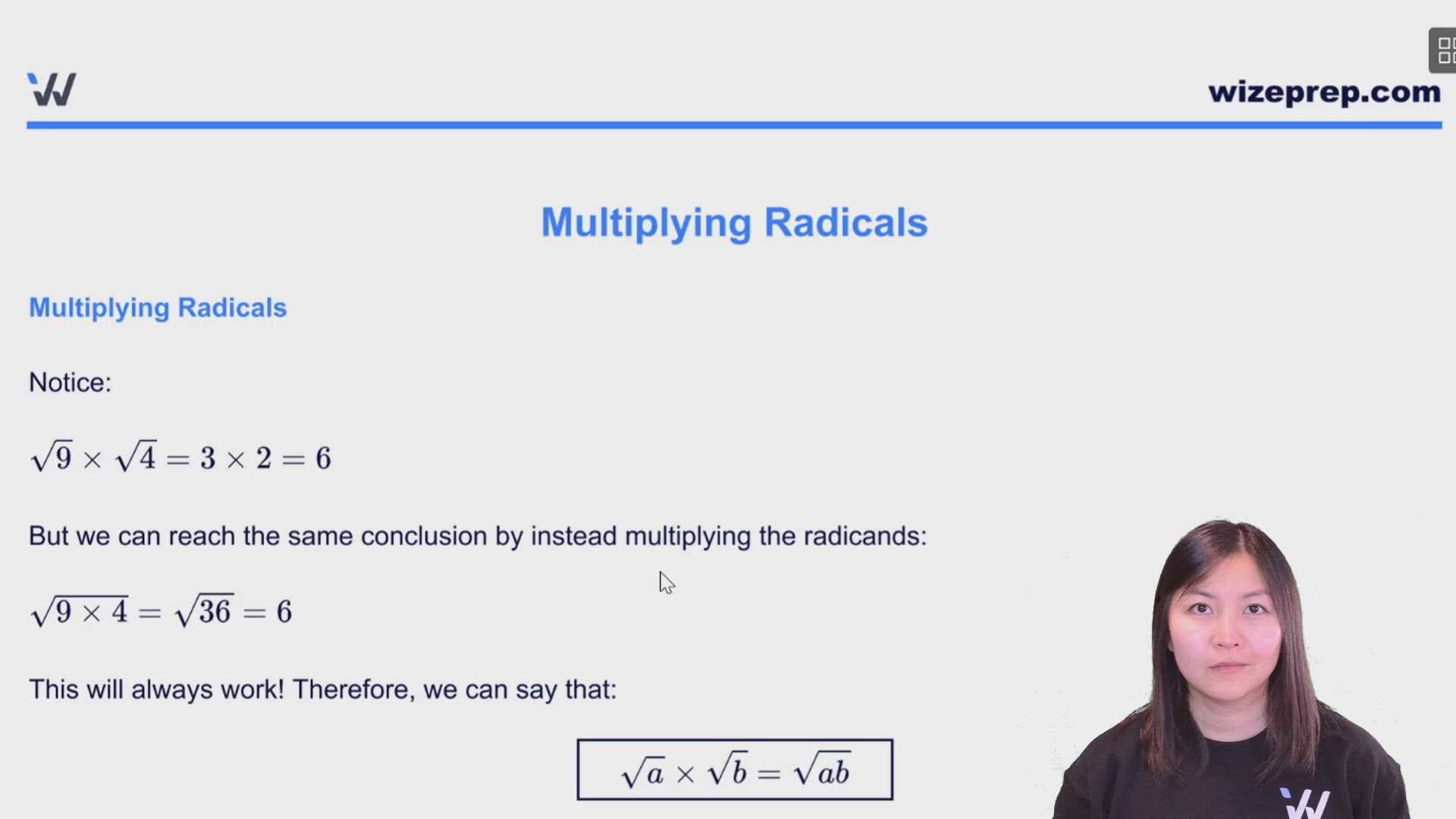
Notice:

9×4=3×2=6\sqrt{9} \times \sqrt{4} = 3\times 2=6

But we can reach the same conclusion by instead multiplying the radicands:

9×4=36=6\sqrt{9 \times4} = \sqrt{36}=6

This will always work! Therefore, we can say that:
a×b=ab\boxed{\quad \sqrt{a}\times\sqrt{b} = \sqrt{ab} \quad}

We can use this to convert between mixed radicals, like 232\sqrt{3}, and entire radicals, like 12\sqrt{12}.

Wize Tip
Entire to mixed: when possible, break up an entire radical by finding a perfect square factor.

Recall that a perfect square is a number that is the result of squaring a number, such as 1,4,9,16,25,1,4,9,16,25,\dots

PAGE BREAK
Examples

1. Express 20\sqrt{20} as a mixed radical.

Find a perfect square factor: 20=4×520=\bm4 \times5

20=4×5=45=25\sqrt{20}=\sqrt{\bm4\times5}=\sqrt{\bm4}\sqrt{5}=\boxed{2\sqrt5}


2. Express 5185\sqrt{18} as a mixed radical in lowest form (factor as much as possible).

Find a perfect square factor of the radicand: 18=9×218=\bm9\times2

518=59×2=592=5(3)2=1525\sqrt{18} = 5\sqrt{\bm9 \times 2} = 5\sqrt{\bm 9}\sqrt{2} = 5(3)\sqrt2 = \boxed{15\sqrt{2}}


3. Express 35-3\sqrt{5} as an entire radical.

Before we can multiply, we must turn the 33 into a radical. Notice that 3=32=93 = \sqrt{3^2} = \sqrt{9}.

35=95=45-3\sqrt{5} = -\sqrt{9}\sqrt{5}=\boxed{-\sqrt{45}}


4. Express the following as a mixed radical in lowest form: 34×753\sqrt4 \times7\sqrt{5}.

Multiplying mixed radicals is as simple as multiplying the coefficients, and then multiplying the radicals:
34×75= (3×7)4×5= 2120= 21×25we saw earlier that 20=25= 425\begin{aligned} & \colorOne3\sqrt{\colorTwo 4} \times \colorOne7\sqrt{\colorTwo 5}\\[0.5em] =\ & (\colorOne{3\times7})\sqrt{\colorTwo{ 4 \times 5}}\\[0.5em] =\ & 21\sqrt{20}\\[0.5em] =\ & 21\times2\sqrt{5} \quad \leftarrow \text{we saw earlier that } \sqrt{20}=2\sqrt{5}\\[0.5em] =\ & 42\sqrt{5} \end{aligned}
0:00 / 0:00

Example: Operations with Radicals

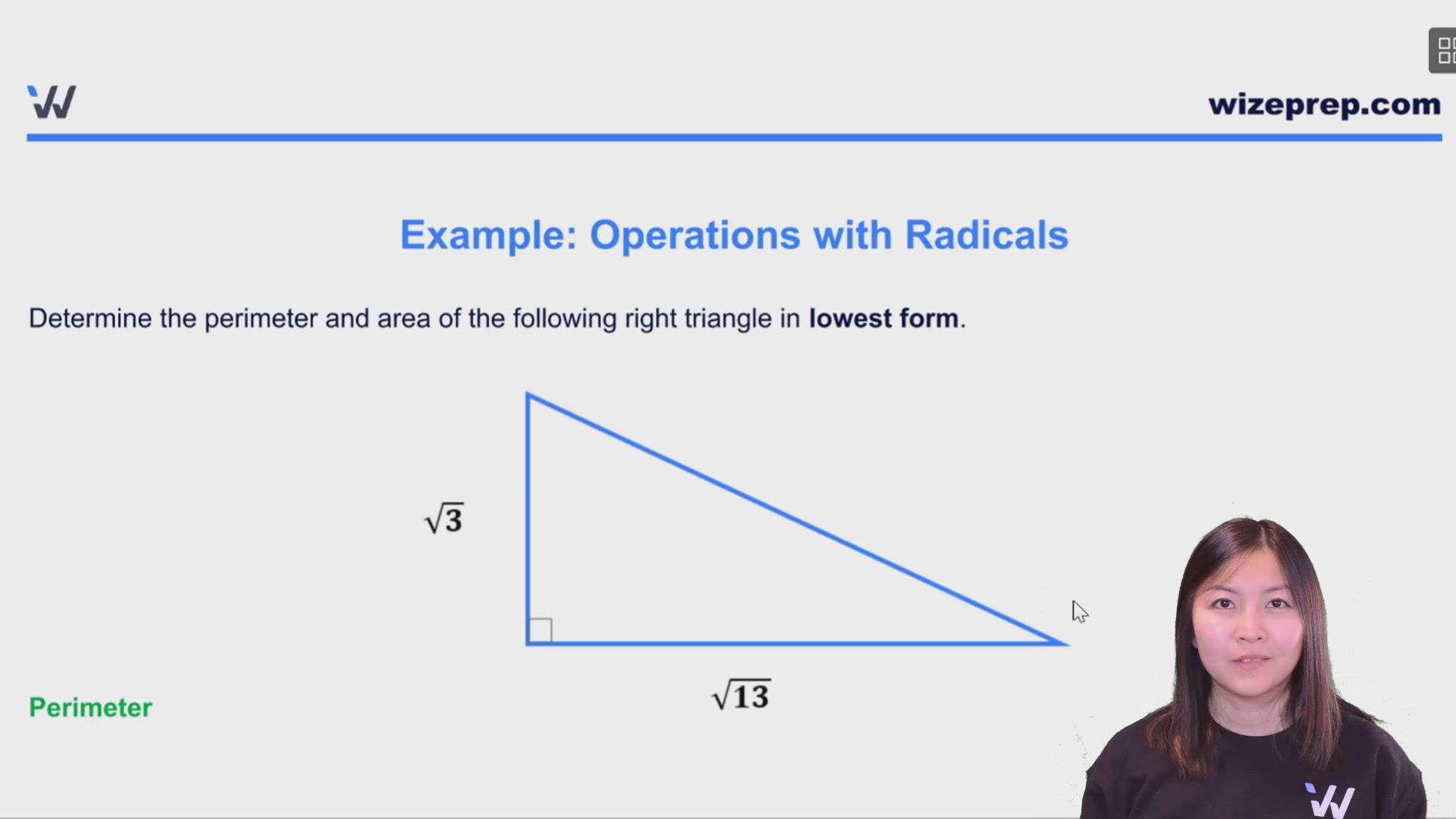
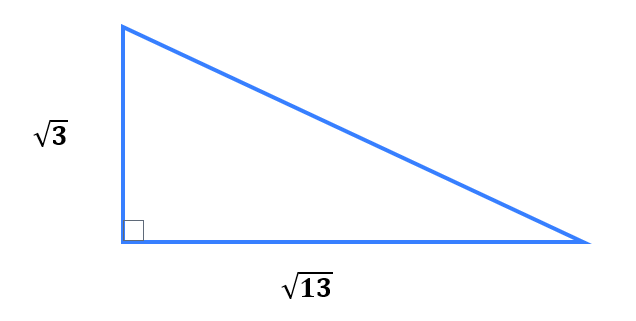
Determine the perimeter and area of the following right triangle in lowest form.


Perimeter

Before we can find the perimeter, we must find the length of the hypotenuse. Use the Pythagorean theorem:

c2=(3)2+(13)2=3+13=16    c=16=4\begin{aligned} c^2 &=(\sqrt{3})^2+(\sqrt{13})^2 = 3+13 = 16 \\\\ \implies c &= \sqrt{16} = 4 \\\\ \end{aligned}
The perimeter is the sum of the side lengths:

P=3+13+4\begin{aligned} P &= \boxed{\sqrt{3}+\sqrt{13}+4}\\[1em] \end{aligned}

Area

A=bh2=1332=13×32=392\begin{aligned} A &= \dfrac{bh}{2} \\[1em] &= \dfrac{\sqrt{13}\sqrt{3}}{2} \\[1em] &= \dfrac{\sqrt{13\times 3}}{2}\\[1em] &=\boxed{ \dfrac{\sqrt{39}}{2}}\\[1em] \end{aligned}

Practice: Operations with Radicals

Which option correctly lists the following radical expressions in ascending order?

53,35,20,26,405\sqrt{3} \quad,\quad 3\sqrt{5} \quad,\quad \sqrt{20} \quad,\quad 2\sqrt{6} \quad,\quad \sqrt{40}

Practice: Operations with Radicals


Simplify:

a) (422)(3+8)(4-2\sqrt{2})(3+\sqrt{8})

b) (32)(3+2)(\sqrt3-\sqrt2)(\sqrt3+\sqrt2)

Practice: Operations with Radicals

Simplify.

a) 38x22x33\sqrt{8x}-2\sqrt{2x^3}

b) 32x5xx3\dfrac{3}{2}\sqrt{x^5}-x\sqrt{x^3}