0:00 / 0:00

Rationalizing the Denominator

The process of making sure a radical is not in the denominator is called rationalizing the denominator.
This is recommended since dividing by an irrational number (e.g. a square root) is very difficult to do by hand.

Monomial in the Denominator


When there is a single term in the denominator (with a square root), rationalize by multiplying top and bottom by the square root expression.

Example 1

Rationalize the denominator: 325\dfrac{3}{2\sqrt{5}}

3×525×5=352(5)=3510\dfrac{3\colorOne{\times\sqrt{5}}}{2\sqrt{5}\colorOne{\times\sqrt{5}}} = \dfrac{3\sqrt5}{2(5)} = \dfrac{3\sqrt5}{10}

PAGE BREAK

Binomial in the Denominator


When there are two terms in the denominator (and at least one has a square root), rationalize by multiplying top and bottom by the conjugate.


Wize Concept
The conjugate of a binomial is the same expression, but the middle sign (+/-) is switched.

This results in a difference of squares! (See Example 2)


Example 2

Rationalize the denominator: 235\dfrac{2}{3-\sqrt{5}}

235×3+53+5= 2(3+5)(35)(3+5)= 2(3+5)(3)2(5)2difference of squares= 2(3+5)95= 2(3+5)4= 3+52\begin{aligned} &\dfrac{2}{3\colorbox{yellow}{$-$}\sqrt{5}} \times \colorOne{\dfrac{3\colorbox{yellow}{$+$}\sqrt{5}}{3\colorbox{yellow}{$+$}\sqrt{5}}} \\[1.5em] =\ & \dfrac{2(3+\sqrt5)}{(3-\sqrt5)(3+\sqrt5)} \\[1.5em] =\ & \dfrac{2(3+\sqrt5)}{(3)^2-(\sqrt{5})^2} \quad \text{difference of squares}\\[1.5em] =\ & \dfrac{2(3+\sqrt5)}{9-5}\\[1.5em] =\ & \dfrac{2(3+\sqrt5)}{4}\\[1.5em] =\ & \dfrac{3+\sqrt5}{2}\\[1.5em] \end{aligned}


0:00 / 0:00

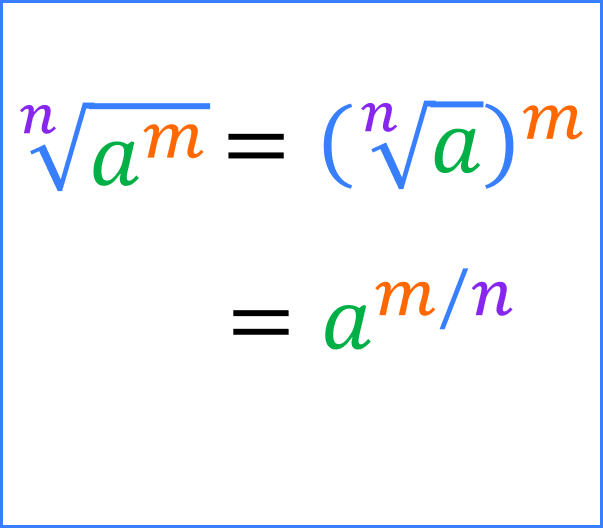
Simplifying Radicals (Advanced)

We can combine radicals in a variety of ways according to their rules


Example 1

1. Write as an entire radical: xy2x2y3\sqrt{xy^2} \cdot\sqrt{x^2y^3}

xy2x2y3=(xy2)(x2y3)=x3y5\begin{aligned} \sqrt{xy^2}\cdot\sqrt{x^2y^3} &= \sqrt{(xy^2)(x^2y^3)} \\ &= \sqrt{x^3y^5} \end{aligned}

2. Simplify: x8y44\sqrt[\scriptsize4]{\dfrac{x^8}{y^4}}

x8y44=x84y44=(x2)44y=x2y\begin{aligned} \sqrt[\scriptsize4]{\dfrac{x^8}{y^4}} &= \dfrac{\sqrt[\scriptsize4]{x^8}}{\sqrt[\scriptsize4]{y^4}} \\[1.5em] &= \dfrac{\sqrt[\scriptsize4]{(x^2)^4}}{y} \\[1em] &= \dfrac{x^2}{y} \end{aligned}

3. Simplify: 256\sqrt{\sqrt{256}}

Method 1Method 2256=16=4256=25622=2562+2=2564=4\begin{array}{cc} \text{Method 1} & \text{Method 2}\\ \begin{aligned} \sqrt{\colorOne{\sqrt{256}}} &= \sqrt{\colorOne{16}} = 4\\[6.5em] \end{aligned} \qquad & \qquad \begin{aligned} \sqrt{\sqrt{256}} &= \sqrt[\scriptsize 2]{\sqrt[\scriptsize 2]{256}} \\[0.5em] &= \sqrt[\scriptsize 2+2]{{256}} \\[0.5em] &= \sqrt[\scriptsize 4]{{256}} \\[0.5em] &= 4 \end{aligned} \end{array}

PAGE BREAK

Simplifying Radicals

When simplifying a radical expression we want to make sure that:
  • The powers in the radicand are smaller than the index
  • The powers in the radicand and the index do not have a common factor more than 1
  • A radical does not appear in any denominators

Example 2

Simplify the following radical expressions.

1. y(x+2)4\sqrt{y(x+2)^4}

y(x+2)4=(x+2)2y\begin{aligned} \sqrt{y(x+2)^4} &= (x+2)^2\sqrt{y} \end{aligned}

2. x(x+1)3\displaystyle\frac{x}{\sqrt{(x+1)^3}}

x(x+1)3×(x+1)3(x+1)3= x(x+1)3(x+1)3= x(x+1)2(x+1)(x+1)3= x(x+1)x+1(x+1)3= xx+1(x+1)2\begin{aligned} &\dfrac{x}{\sqrt{(x+1)^3}} \colorOne{\times \dfrac{\sqrt{(x+1)^3}}{\sqrt{(x+1)^3}}}\\[1.5em] =\ & \dfrac{x\sqrt{(x+1)^3}}{(x+1)^3}\\[1.5em] =\ & \dfrac{x\sqrt{(x+1)^2}\sqrt{(x+1)}}{(x+1)^3}\\[1.5em] =\ & \dfrac{x\cancel{(x+1)}\sqrt{x+1}}{(x+1)^{\cancel3}}\\[1.5em] =\ & \boxed{\dfrac{x\sqrt{x+1}}{(x+1)^2}} \end{aligned}
0:00 / 0:00

Example: Simplifying Radicals (Advanced)


At an assembly factory, there was information on how long it takes to build machinery depending on the number of design changes.
The approximate number of months required to assemble machine A and machine B is given by

A(x)=x+3(x+3)3A(x) = \dfrac{x+3}{\sqrt{(x + 3)^3}}

B(x)=(x+3)5B(x) = \sqrt{(x+3)^5}

where xx is the number of design changes.

Create a new model that represents the total number of months needed to assemble both machines.
Simplify as much as possible, writing the amount as a single fraction.

Start by simplifying each function individually:

A(x)=x+3(x+3)3=x+3(x+3)2(x+3)=x+3(x+3)x+3=1x+3×x+3x+3=x+3x+3B(x)=(x+3)5=(x+3)4(x+3)=(x+3)2x+3\begin{array}{rcl} \begin{aligned} A(x) &= \dfrac{x+3}{\sqrt{(x + 3)^3}} \\[1.5em] &= \dfrac{x+3}{\sqrt{(x + 3)^2}\sqrt{(x + 3)}} \\[1.5em] &= \dfrac{\cancel{x+3}}{\cancel{(x+3)}\sqrt{x + 3}} \\[1.5em] &= \dfrac{1}{\sqrt{x + 3}} \colorOne{\times \dfrac{\sqrt{x+3}}{\sqrt{x+3}}} \\[1.5em] &= \dfrac{\sqrt{x+3}}{x+3} \end{aligned} \qquad & \qquad \begin{aligned} B(x) &= \sqrt{(x+3)^5} \\[1.5em] &= \sqrt{(x+3)^4}\sqrt{(x+3)} \\[1.5em] &= (x+3)^2 \sqrt{x+3} \\[8.5em] \end{aligned} \end{array}

The total number of months is found by adding the two functions together.

C(x)=A(x)+B(x)=x+3x+3+(x+3)2x+3\begin{aligned} C(x) & = A(x) + B(x) \\[1em] &= \dfrac{\sqrt{x+3}}{x+3} + (x+3)^2 \sqrt{x+3} \\ \end{aligned}

Let's find a common denominator:

C(x)=x+3x+3+(x+3)2x+3(x+3x+3)=x+3x+3+(x+3)3x+3x+3=(1+(x+3)3)x+3x+3factored out  x+3\begin{aligned} C(x) &= \dfrac{\sqrt{x+3}}{x+3} + (x+3)^2 \sqrt{x+3} \left( \dfrac{x+3}{x+3} \right) \\[1.5em] &= \dfrac{\sqrt{x+3}}{x+3} + \dfrac{(x+3)^3\sqrt{x+3}}{x+3} \\[1.5em] &=\boxed{ \dfrac{\Big(1 + (x+3)^3\Big)\sqrt{x+3}}{x+3}} \qquad \text{factored out }\ \sqrt{x+3}\\[1.5em] \end{aligned}
This gives us a combined expression to calculate the total time to assemble both machines.

Practice: Operations with Radicals

Simplify the following radical expressions:

a) (2x+1)4\sqrt{(2x + 1)^4}

b) 27p12y63\sqrt[\scriptsize 3]{27p^{12}y^6}

Practice: Operations with Radicals

Simplify.

1. 327y75y+212y3\sqrt{27y} - \sqrt{75y} + 2\sqrt{12y}

2. (2xy+1)(xy3)(2\sqrt{xy} + 1)(\sqrt{xy} - 3)

3. 2p6+7p12\sqrt{\displaystyle\frac{2}{p^6}} + \sqrt{\displaystyle\frac{7}{p^{12}}}

Practice: Operations with Radicals

The expressions below have radicals in the denominator.
What must be multiplied in the numerator and denominator to remove the radical in the denominator?

a) 5y\displaystyle\frac{5}{\sqrt{y}}


b) y+2y3\displaystyle\frac{y+2}{\sqrt{y} -3}


c) 3x3+xy\displaystyle\frac{3x}{3 + \sqrt{x - y}}