Wize High School Grade 12 Pre-Calculus Textbook > Combination of Functions
Sum & Difference of Functions

Sum & Difference
Functions can be combined through addition and subtraction.
Let f(x) and g(x) be two continuous functions defined on the interval (−∞,∞).
- The sum of 2 functions, f(x) and g(x), can be expressed as f(x)+g(x).
- The difference of 2 functions, f(x) and g(x), can be expressed as f(x)−g(x).
PAGE BREAK
Example
Let f(x)=x−2 and g(x)=x+1. Find:
- f(x)+g(x)
- f(x)−g(x)
1.2.f(x)+g(x)f(x)−g(x)====(x−2)+(x+1)2x−1(x−2)−(x+1)−3

Example: Sum & Difference of Functions
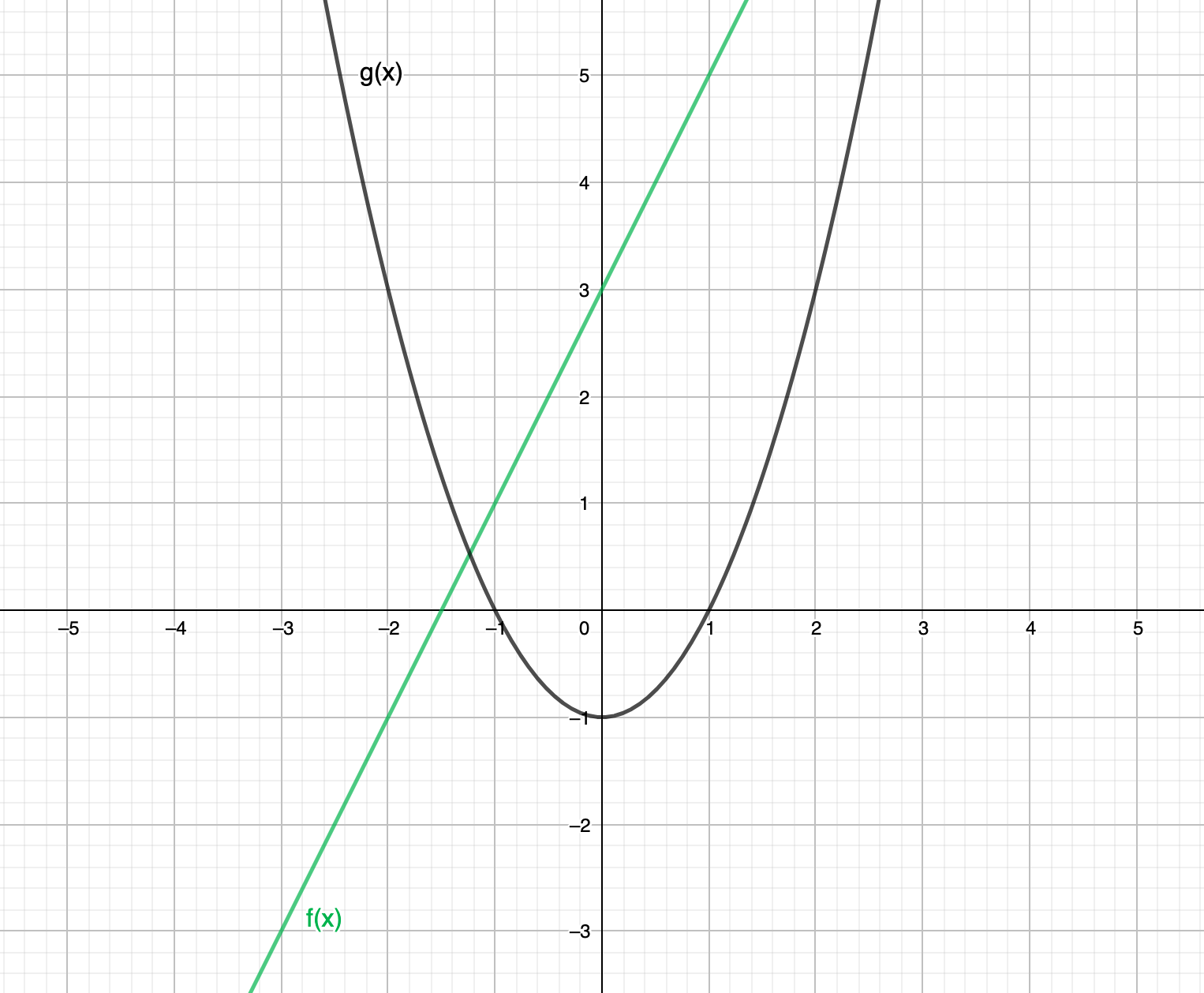
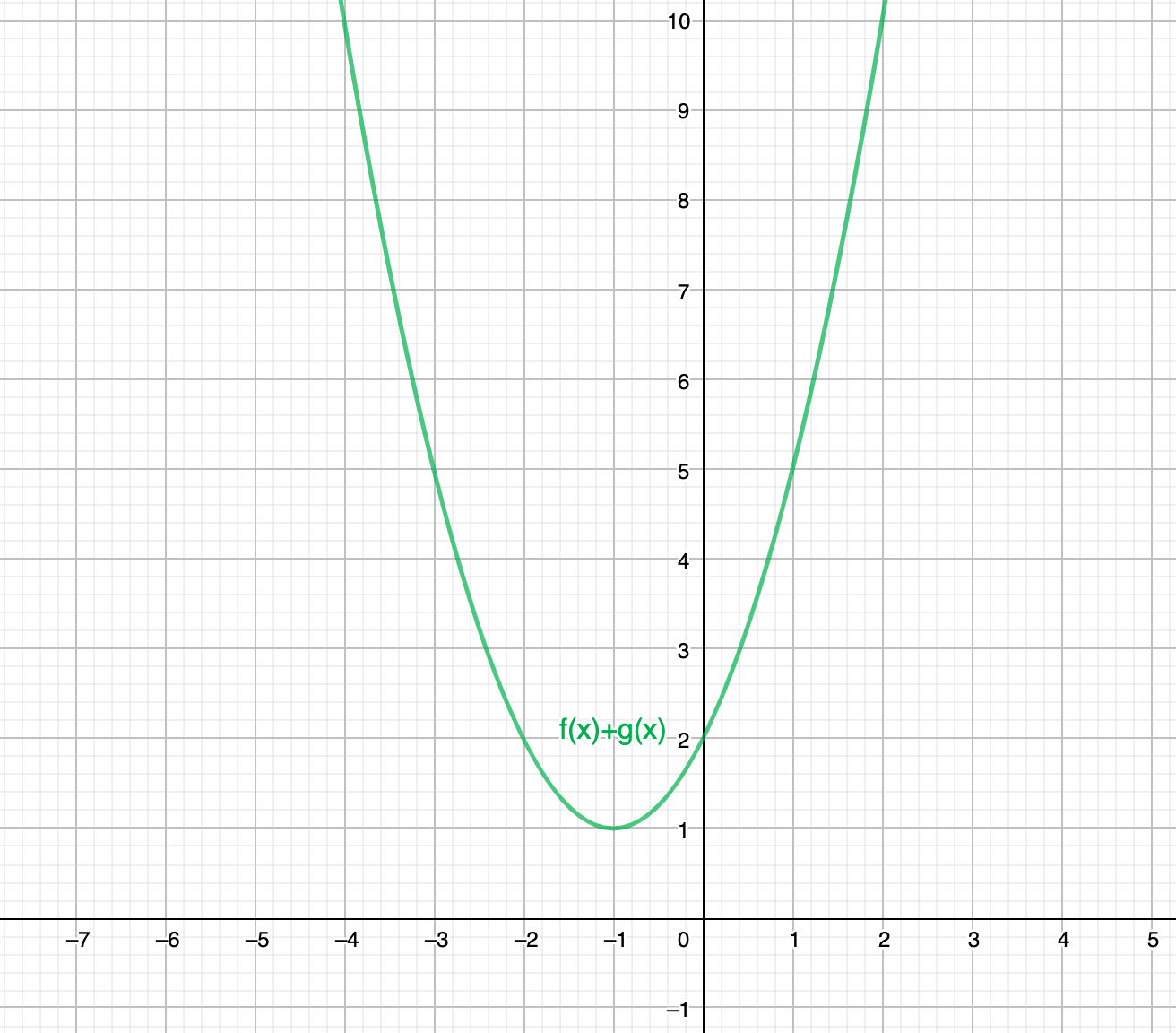
Given f(x)=2x+3 and g(x)=x2−1, determine:
- f(x)+g(x)
- Algebraically
- Graphically
1. f(x)+g(x):
a. f(x)+g(x)====(2x+3)+(x2−1)x2+2x+2(x2+2x+1)+2−1(x+1)2+1
b.

x−2−1012f(x)−11357g(x)30−103f(x)+g(x)212510

The solution is f(x)+g(x)=(x+1)2+1
Practice: Sum & Difference of Functions
If m(x)=3x−41 and n(x)=x+11, determine:
Practice: Sum & Difference of Functions
Maisy went grocery shopping at Fresh-co and used her $5 off coupon. She then went to London Drugs and used her 25% coupon.