Wize High School Grade 12 Pre-Calculus Textbook > Rational Functions
Solving Rational Equations
Popular Courses
Grade 12 Advanced Functions
Ontario High School
Grade 12 Pre-Calculus/Functions
Canada High School
Math 30-1
Alberta High School
Pre-Calculus 12
British Columbia High School
MATH 206
Concordia University
MATH 22
Pennsylvania State University
MAC 1140
University of Florida
MATH 150
Texas A&M University
MATH 41
Pennsylvania State University
MAT 170
Arizona State University - Tempe
MAC 1105
Florida State University
MAT 012
University of California - Davis
MTH 103A
Michigan State University
MTH 116
Michigan State University
MAC 1147
University of Florida
MATH 140
San Diego State University
MATH 2312
University of Houston
MA 15300
Purdue University
MA 15800
Purdue University
MAC 1140C
University of Central Florida
0:00 / 0:00
Solving Rational Equations
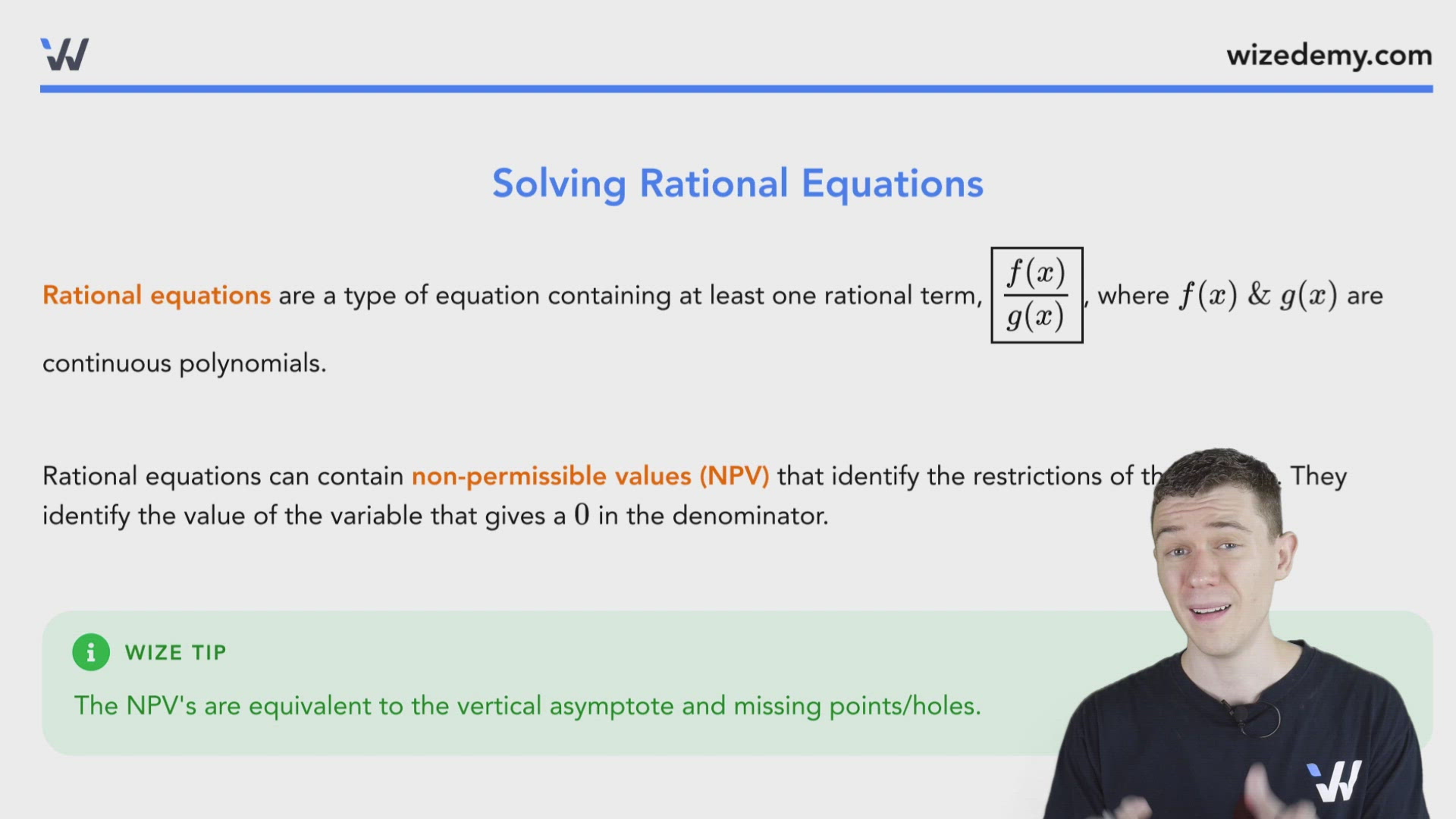
Rational equations are a type of equation containing at least one rational term, , where are continuous polynomials.
Rational equations can contain non-permissible values (NPV) that identify the restrictions of the domain. They identify the value of the variable that gives a in the denominator.
Wize Tip
The NPV's are equivalent to the vertical asymptote and missing points/holes.
Example
Solve , stating any NPV's.
Step 1.
Identify any non-permissible values.
The NPV's are the vertical asymptotes.
Therefore, otherwise there is a total of in the denominator.
Step 2.
Find the lowest common denominator and multiply each term by it.
The lowest common denominator is .
Step 3.
Solve for
Step 4.
Verify.

0:00 / 0:00
Example: Solving Rational Equations
Solve , stating any NPV's.
Step 1.
Identify any non-permissible values.
The NPV's are the vertical asymptotes.
Therefore, otherwise there is a total of in the denominator.
Step 2.
Find the lowest common denominator and multiply each term by it.
The lowest common denominator is .
Step 3.
Solve for
According to the NPV's, .
Therefore, is an extraneous solution.
Step 4.
Verify.
Therefore, is the only solution.
Practice: Solving Rational Equations
True or false:
are solutions to .
Practice: Solving Rational Equations
Given the equation , answer the following questions.
Solve for .
Practice: Solving Rational Equations
Let .
If , then what is