Create a free account to get started

Unlock full course notes by signing up

  • Video lessons taught by top educators
  • Practice questions with guided solutions
  • Written review notes for reference
  • Expert answers anytime from course tutors

Rational Functions

A rational function can be expressed as:

f(x)=axn+bxn−1+...cxm+dxm−1+...\boxed{f(x)=\displaystyle\frac{ax^n+bx^{n-1}+...}{cx^m+dx^{m-1}+...}}

where nn is the largest exponent in the numerator and mm is the largest exponent in the denomiator.


Properties of Rational Functions

  • X-Intercepts can be found by setting f(x)=0f(x)=0 and solving for xx
  • Vertical asymptotes can be found by setting the denominator to 0 and solving for xx
  • Horizontal asymptotes:
  • If n<m‾\underline{n<m}: There is a horizontal asymptote at y=0y=0
  • If n=m‾\underline{n=m}: There is a horizontal asymptote at y=acy=\displaystyle\frac{a}{c}
  • If n>m‾\underline{n>m}: There is no horizontal asymptote. There may be an oblique/diagonal asymptote.
  • If factoring the numerator & denominator of f(x)f(x), any terms that cancel out indicates where a missing point/hole in f(x)f(x)
  • The domain is the set of all real numbers except where there are vertical asymptotes & missing points/holes
  • The range is the set of all real numbers except where there are horizontal asymptotes in most cases


Example 1


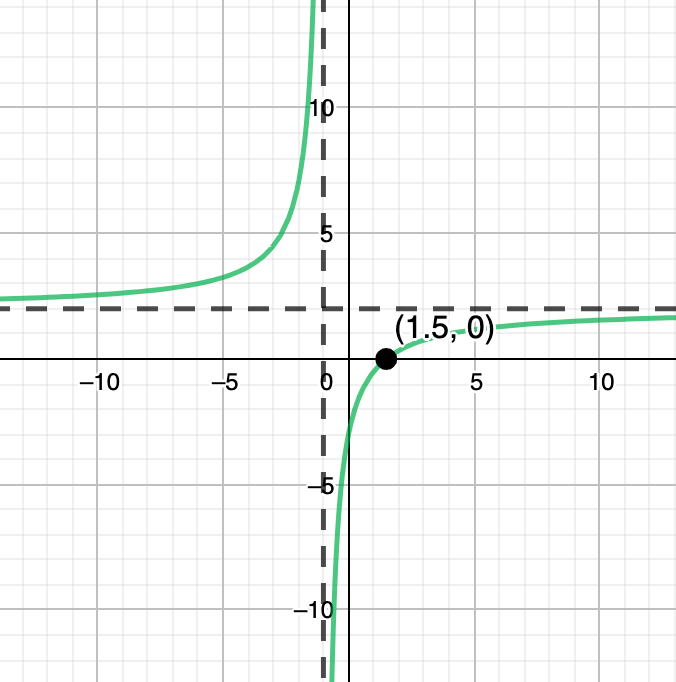
Let's look at f(x)=2x−3x+1f(x)=\displaystyle\frac{2x-3}{x+1}.


Image illustrating Rational Functions


  • xx-Intercept: (32,0)\Bigg(\displaystyle\frac{3}{2},0\Bigg)
  • Vertical Asymptote: x=−1x=-1
  • Horizontal Asymptote: y=2y=2
  • Missing Points/Holes: None
  • Intervals of Increasing: (−∞,−1) ∪ (−1,∞)(-\infin,-1)~\cup~(-1,\infin)
  • Intervals of Decreasing: NA
  • Domain: (−∞,−1) ∪ (−1,∞)(-\infin,-1)~\cup~(-1,\infin)
  • Range: (−∞,2) ∪ (2,∞)(-\infin,2)~\cup~(2,\infin)

Create a free account to get started

Unlock full course notes by signing up

  • Video lessons taught by top educators
  • Practice questions with guided solutions
  • Written review notes for reference
  • Expert answers anytime from course tutors

Example: Rational Functions

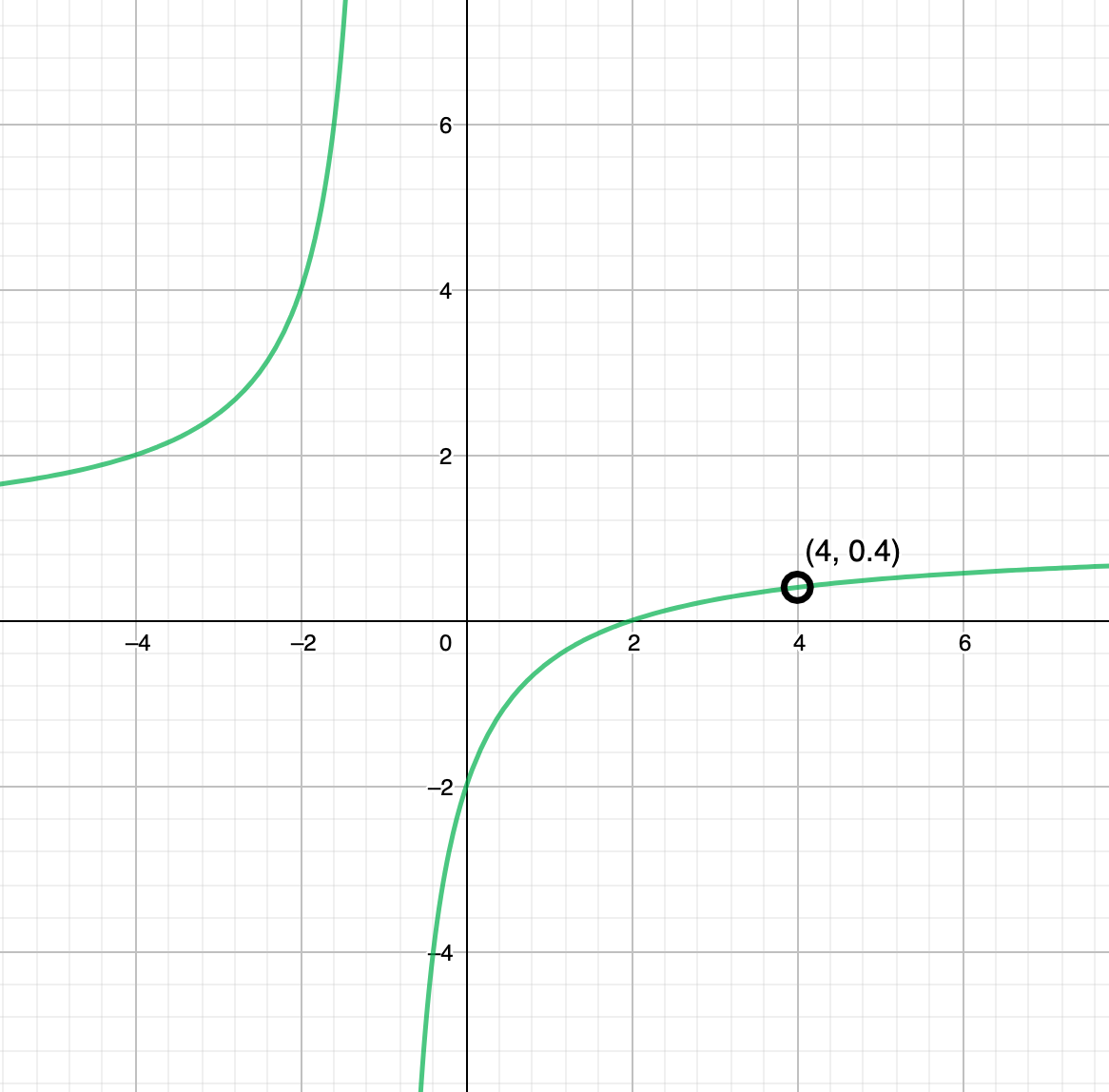
A graph of the function f(x)=x2−6x+8x2−3x−4f(x)=\displaystyle{\frac{x^2-6x+8}{x^2-3x-4}} is sketched below:


Image illustrating Example


Identify the equations for any vertical & horizontal asymptotes, and missing points/holes.


Factor f(x)f(x):


f(x)=x2−6x+8x2−3x−4f(x)=(x−4)(x−2)(x−4)(x+1)f(x)=x−2x+1\begin{array}{rcl} f(x)&=&\displaystyle{\frac{x^2-6x+8}{x^2-3x-4}}\\\\ f(x)&=&\displaystyle{\frac{(x-4)(x-2)}{(x-4)(x+1)}}\\\\ f(x)&=&\displaystyle{\frac{x-2}{x+1}} \end{array}


Vertical Asymptotes:


Let x+1=0x+1=0.


The vertical asymptote is at x=−1.x=-1.


Horizontal Asymptote:


The degree of the numerator is equivalent to the degree in the denominator.


Therefore, y=1y=1.


Missing Points/Holes


Missing points/holes exist whenever terms in the numerator and denominator cancel.


Since the term (x−4)(x-4) was eliminated, there is a missing point/hole at x=4.x=4.

Create a free account to get started

Unlock full course notes by signing up

  • Video lessons taught by top educators
  • Practice questions with guided solutions
  • Written review notes for reference
  • Expert answers anytime from course tutors

Example: Rational Functions

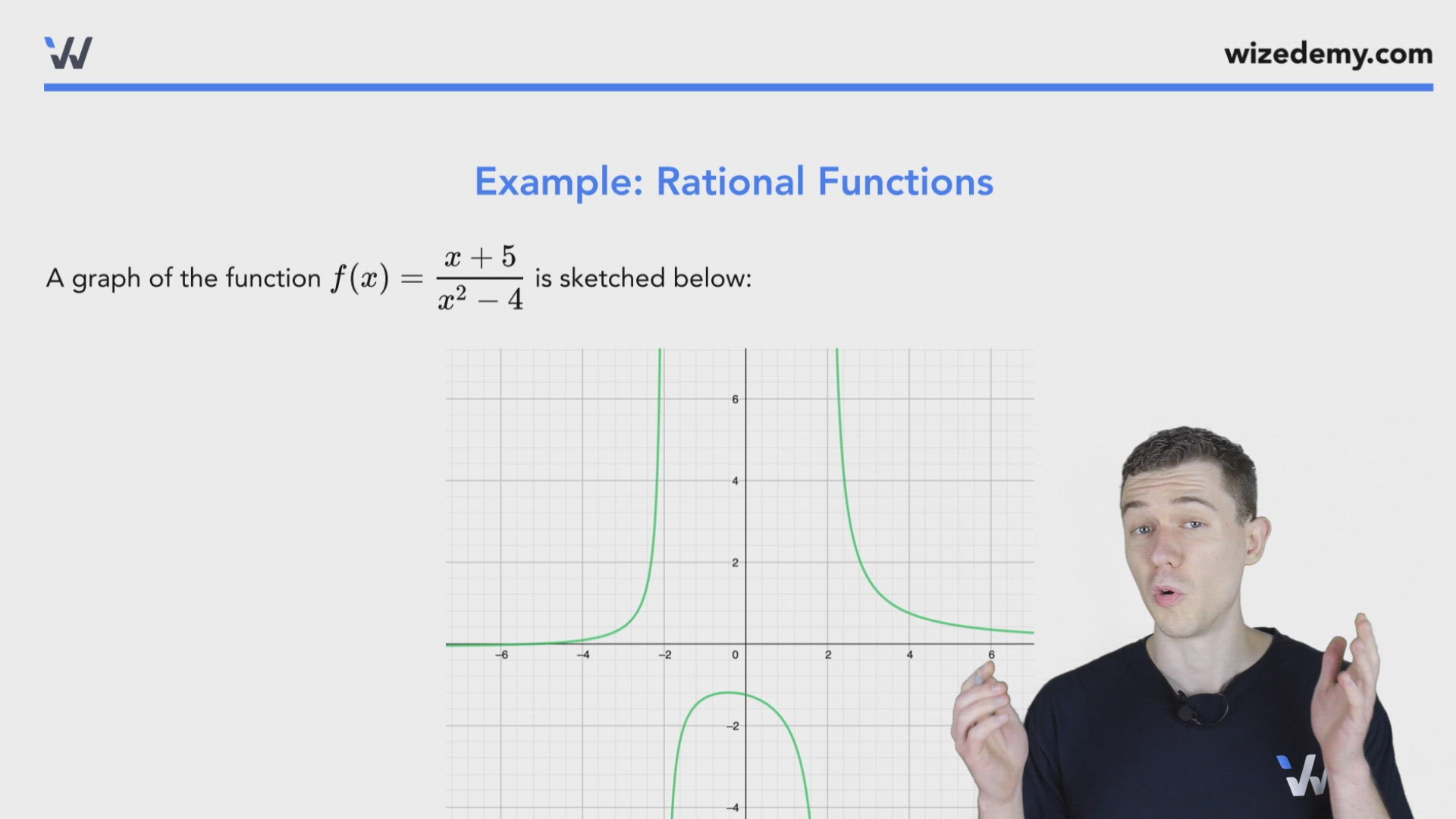
A graph of the function f(x)=x+5x2−4f(x)=\displaystyle{\frac{x+5}{x^2-4}} is sketched below:


Image illustrating Example


Identify the equations for any vertical & horizontal or oblique asymptotes, and missing points/holes.


Factor f(x)f(x):


f(x)=x+5x2−4f(x)=(x+5)(x−2)(x+2)\begin{array}{rcl} f(x)&=&\displaystyle{\frac{x+5}{x^2-4}}\\\\ f(x)&=&\displaystyle{\frac{(x+5)}{(x-2)(x+2)}}\\\\ \end{array}


Vertical Asymptotes:


Let x−2=0x-2=0 and let x+2=0.x+2=0.


The vertical asymptotes are at x=±2.x=\pm2.


Horizontal Asymptote:


The degree of the numerator is less than the degree in the denominator.


Therefore, y=0y=0.


Missing Points/Holes


Missing points/holes exist whenever terms in the numerator and denominator cancel.


Since there are no terms the cancel out, there are no missing points/holes.

Create a free account to get started

Unlock full course notes by signing up

  • Video lessons taught by top educators
  • Practice questions with guided solutions
  • Written review notes for reference
  • Expert answers anytime from course tutors

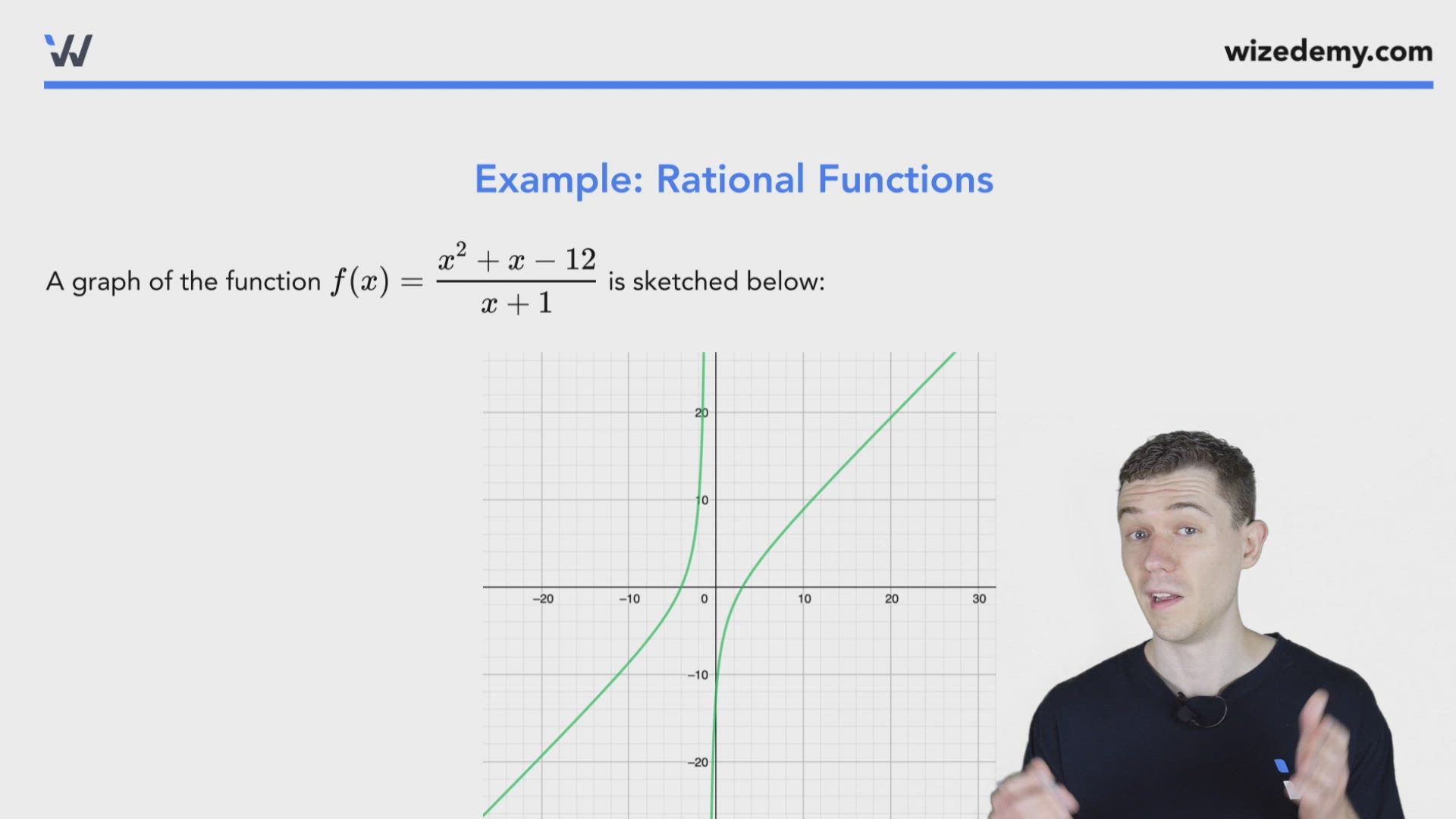
Example: Rational Functions

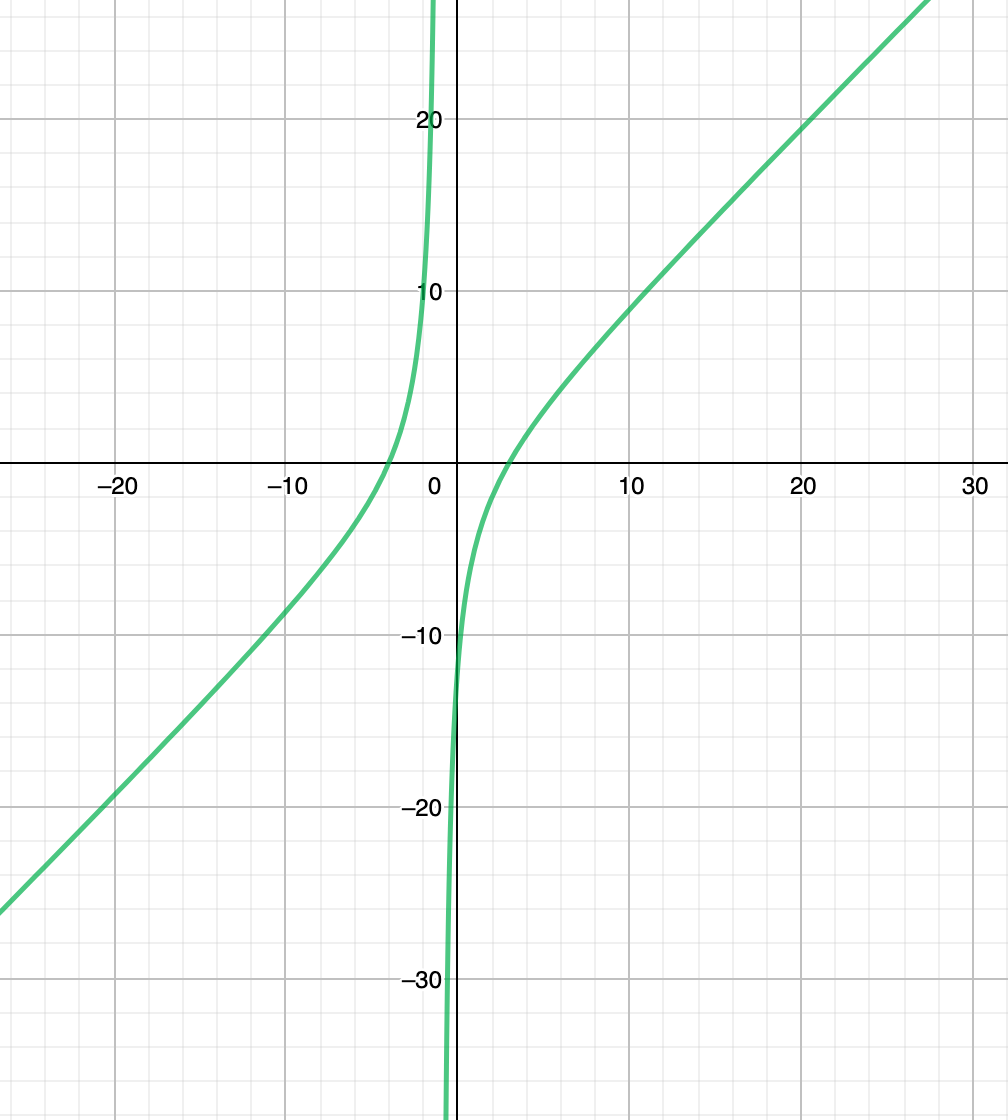
A graph of the function f(x)=x2+x−12x+1f(x)=\displaystyle{\frac{x^2+x-12}{x+1}} is sketched below:


Image illustrating Example


Identify the equations for any vertical & horizontal or oblique asymptotes, and missing points/holes.


Factor f(x)f(x):


f(x)=x2+x−12x+1f(x)=(x−3)(x+4)(x+1)\begin{array}{rcl} f(x)&=&\displaystyle{\frac{x^2+x-12}{x+1}}\\\\ f(x)&=&\displaystyle{\frac{(x-3)(x+4)}{(x+1)}} \end{array}


Vertical Asymptotes:


Let x+1=0x+1=0 .


The vertical asymptote is at x=1x=1.


Horizontal Asymptote:


The degree of the numerator is greater than the degree in the denominator.


Therefore, there is an oblique asymptote which can be found by dividing x2+x−12x+1\displaystyle\frac{x^2+x-12}{x+1}:


11−12−1↓−1010−12\begin{array}{r|ccc} &1&1&-12\\ -1&\downarrow&-1&0\\\hline &1&0&-12 \end{array}


The oblique asymptote does not count the remainder.


So, the oblique asymptote becomes the quotient y=xy=x.


Missing Points/Holes


Missing points/holes exist whenever terms in the numerator and denominator cancel.


Since there are no terms the cancel out, there are no missing points/holes.


Practice: Rational Functions

Match the reciprocal function with the correct sketch of its graph.

Match each term
A.

Illustration for practice question: Rational Functions

B.

Illustration for practice question: Rational Functions

C.

Illustration for practice question: Rational Functions

f(x)=3x2+x−42x2−5x+3f(x)=\displaystyle\frac{3x^2+x-4}{2x^2-5x+3}

f(x)=3x+42x−3f(x)=\displaystyle\frac{3x+4}{2x-3}

f(x)=2x−74x+9f(x)=\displaystyle\frac{2x-7}{4x+9}

Create a free account to get started

Unlock full course notes by signing up

  • Video lessons taught by top educators
  • Practice questions with guided solutions
  • Written review notes for reference
  • Expert answers anytime from course tutors

Identify the vertical asymptotes, the horizontal asymptotes, the x-intercepts, and any missing points of:


f(x)=x2−11x+18x2−3x+2f(x)=\displaystyle\frac{x^2-11x+18}{x^2-3x+2}

Your answers

Create a free account to get started

Unlock full course notes by signing up

  • Video lessons taught by top educators
  • Practice questions with guided solutions
  • Written review notes for reference
  • Expert answers anytime from course tutors

Practice: Rational Functions

Match the equation for the rational function with its appropriate properties.

Match each term
A.


A vertical asymptote at 92\frac{9}{2}

An x-intercept at −53-\frac{5}{3}


B.


A vertical asymptote at 53\frac{5}{3}

An x-intercept at 92\frac{9}{2}


C.


A missing point at x=−2x = -2


D.


A vertical asymptote at x=−2x=-2

A horizontal asymptote at y=0y=0


f(x)=3x+52x−9f(x)=\displaystyle\frac{3x+5}{2x-9}

f(x)=2x−9−3x+5f(x)=\displaystyle\frac{2x-9}{-3x+5}

f(x)=x2−4x+2f(x)=\displaystyle\frac{x^2-4}{x+2}

f(x)=x−2x2−4f(x)=\displaystyle\frac{x-2}{x^2-4}

Create a free account to get started

Unlock full course notes by signing up

  • Video lessons taught by top educators
  • Practice questions with guided solutions
  • Written review notes for reference
  • Expert answers anytime from course tutors