Create a free account to get started

Unlock full course notes by signing up

  • Video lessons taught by top educators
  • Practice questions with guided solutions
  • Written review notes for reference
  • Expert answers anytime from course tutors

Factored Form of a Quadratic Equation

Recall

The standard/ general form of a quadratic equation is y=ax2+bx+cy=ax^2+bx+c.

  • We can solve problems involving quadratic relations by sketching its graph
  • We can sketch its graph by creating a table of values

Graphing with a table of values can be very tedious and inaccurate without the help of technology.


Factored Form

Instead, we turn to a different form-- the factored form of a quadratic equation is y=a(x−r)(x−s)y=a(x-r)(x-s).


*(x−r)(x-r) and (x−s)(x-s) are called the factors of this quadratic equation.


Image illustrating Factored Form of a Quadratic Equation


How do we graph from the factored form?

Direction of the opening

The aa value tells us the ________

  • If aa is positive, the parabola ________
  • If aa is negative, the parabola ________

Zeros and roots

The x-intercepts/ roots/ zeros of a quadratic graph in factored form are ________

  • If the factored form of the quadratic equation is y=a(x−r)(x−s)y=a(x-r)(x-s), where rr and ss are different, then ________
  • If the factored form of the quadratic equation is y=a(x−r)2y=a(x-r)^2, then ________
  • If we cannot find the factored form of the quadratic equation y=ax2+bx+cy=ax^2+bx+c, then ________

Vertex

To find the coordinates of the vertex (h,k)(h,k):

  1. The x-coordinate of the vertex is directly in between the two zeros -- h=r+s2h=\dfrac{r+s}{2}
  2. Substitute this x-coordinate into the quadratic equation to dtermine kk, the y-coordinate of the vertex

Create a free account to get started

Unlock full course notes by signing up

  • Video lessons taught by top educators
  • Practice questions with guided solutions
  • Written review notes for reference
  • Expert answers anytime from course tutors

Example: Factored Form of a Quadratic Equation

Given the factored form y=(x+2)(x−5)y=(x+2)(x-5),


a) determine the direction of opening of the quadratic graph.


The factored form is y=1(x+2)(x−5)y=\bct1\left(x+2\right)\left(x-5\right), so a=1a=1, meaning that the parabola will be opening up\boxed{\text{opening up}}.


b) determine the zeros.


The zeros/ x-intercepts/ roots is when the y value is 0: 0=(x+2)(x−5)0=\left(x+2\right)\left(x-5\right)


Notice that if either of the brackets equal 0, then the y value will be 0:

x+2=0orx−5=0x=−2orx=5\begin{array}{ccc} x+2=0&\text{or}&x-5=0\\ x=-2&\text{or}&x=5 \end{array}

So, the zeros are x=−2x=-2 and x=5x=5, which correspond to the points (−2,0)   and   (5,0)\boxed{(-2, 0)~~~\text{and}~~~(5,0)}.


*Notice that these are the rr and ss values in the factored form y=a(x−r)(x−s)y=a(x-r)(x-s).


c) determine the y-intercept.


y-intercept is where the graph meets the y-axis, meaning when x=0x=0:

y=(0+2)(0−5)=(2)(−5)=−10\begin{aligned} y&=(0+2)(0-5)\\ &=(2)(-5)\\ &=-10 \end{aligned}

So, the y-intercept is y=10y=10, which corresponds to the point (0,−10)\boxed{(0,-10)}.


d) determine the axis of symmetry.


Since the zeros have the same y-values, they are reflections of one another along the axis of symmetry, meaning that the axis of symmetry should be right in the middle between the 2 zeros:

−2+52=32\dfrac{-2+5}{2}=\dfrac{3}{2}

So, the axis of symmetry is x=32\boxed{x=\dfrac{3}{2}}


e) determine the coordinates of the vertex.


The x-coordinate of the vertex is the same as the axis of symmetry: x=32x=\dfrac{3}{2}.


To find the y-coordinate, we substitute x=32x=\dfrac{3}{2} back into the quadratic equation y=(x+2)(x−5)y=(x+2)(x-5):

y=(x+2)(x−5)=(32+2)(32−5)=(72)(−72)=−494      (or 12.25)\begin{aligned} y&=\left(\colorbox{yellow}{$x$}+2\right)\left(\colorbox{yellow}{$x$}-5\right)\\ &=\left(\colorbox{yellow}{$\dfrac{3}{2}$}+2\right)\left(\colorbox{yellow}{$\dfrac{3}{2}$}-5\right)\\ &=\left(\dfrac{7}{2}\right)\left(- \dfrac{7}{2}\right)\\ &=-\dfrac{49}{4}~~~~~~(\text{or }12.25) \end{aligned}


So, the vertex is (32,−494)\boxed{\left(\dfrac{3}{2},-\dfrac{49}{4}\right)}


f) determine the standard form of the quadratic equation.


To go from the factored form to the standard form of a quadratic equation, we need to expand and simplify the equation:

     (x+2)(x−5)=(x)(x)+(x)(−5)+(2)(x)+(2)(−5)=     x2       −5x          +2x       −10=     x2                −3x                 −10\begin{aligned} &~~~~~(\bct{x}\bcth{+2})(x-5)\\ &=\bct{(x)}(x)+\bct{(x)}(-5)+\bcth{(2)}(x)+\bcth{(2)}(-5)\\ &=~~~~~x^2~~~~~~~-5x~~~~~~~~~~+2x~~~~~~~-10\\ &=~~~~~x^2~~~~~~~~~~~~~~~~-3x~~~~~~~~~~~~~~~~~-10 \end{aligned}


So, the standard form is x2−3x−10\boxed{x^2-3x-10}


g) sketch the graph (without using a table of values or technology).
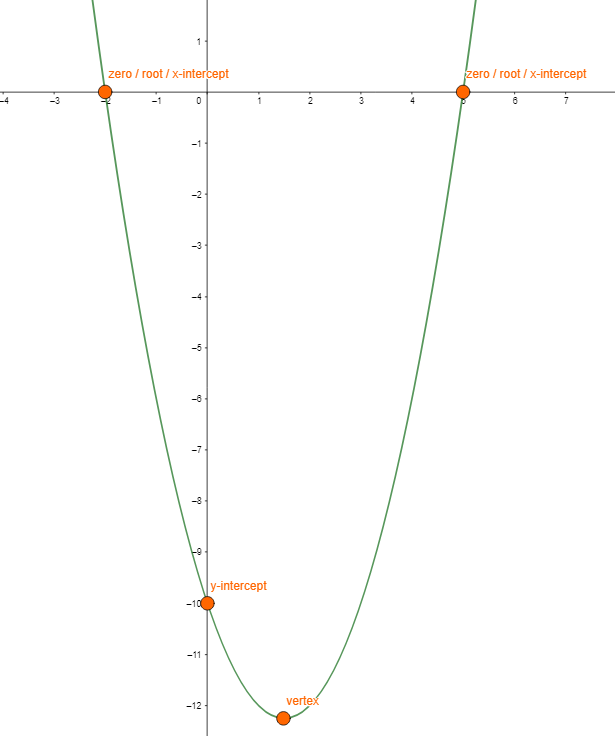

Image illustrating Example


Practice: Factored Form of a Quadratic Equation

Determine the zeros of the following quadratic equations.


Select all of the zeros that apply.

y=−3(x−4)(x+3)y=-3\left(x-4\right)\left(x+3\right)

Choose an answer

Create a free account to get started

Unlock full course notes by signing up

  • Video lessons taught by top educators
  • Practice questions with guided solutions
  • Written review notes for reference
  • Expert answers anytime from course tutors

Practice: Factored Form of a Quadratic Equation

For each of the following quadratic equations,

i) determine the zeros

ii) determine the vertex

iii) determine the y-intercept

iv) graph the quadratic equation.

y=−3x(x+2)y=-3x\left(x+2\right)


Your answers

Create a free account to get started

Unlock full course notes by signing up

  • Video lessons taught by top educators
  • Practice questions with guided solutions
  • Written review notes for reference
  • Expert answers anytime from course tutors

Practice: Factored Form of a Quadratic Equation

You are walking through a forest and you see a bridge in front of you. The height of the bridge above the ground (in meters) can be modelled by the equation h=−0.5(x−1)(x−25)h=-0.5(x-1)(x-25), where xx is the distance (in meters) from you to the start of the bridge.


a) How far away is the start of the bridge from you?


b) What is the horizontal length of this bridge? (Meaning the horizontal distance between the two ends of the bridge)


c) How tall is this bridge (Meaning the vertical height of the bridge)


d) If you walk onto the bridge and then walk forward 10 meters on the bridge, how high off the ground will you be?


Illustration for practice question: Practice: Factored Form of a Quadratic Equation


Your answers

Create a free account to get started

Unlock full course notes by signing up

  • Video lessons taught by top educators
  • Practice questions with guided solutions
  • Written review notes for reference
  • Expert answers anytime from course tutors

Summary - Factored Form of a Quadratic Equation

Given the factored form of a quadratic equation y=a(x−r)(x−s)y=a(x-r)(x-s):


Image illustrating Summary - Factored Form of a Quadratic Equation