Wize High School Grade 11 Math Textbook > Solving Quadratic Equations

Solving Quadratic Equations Using the Quadratic Formula

0:00 / 0:00

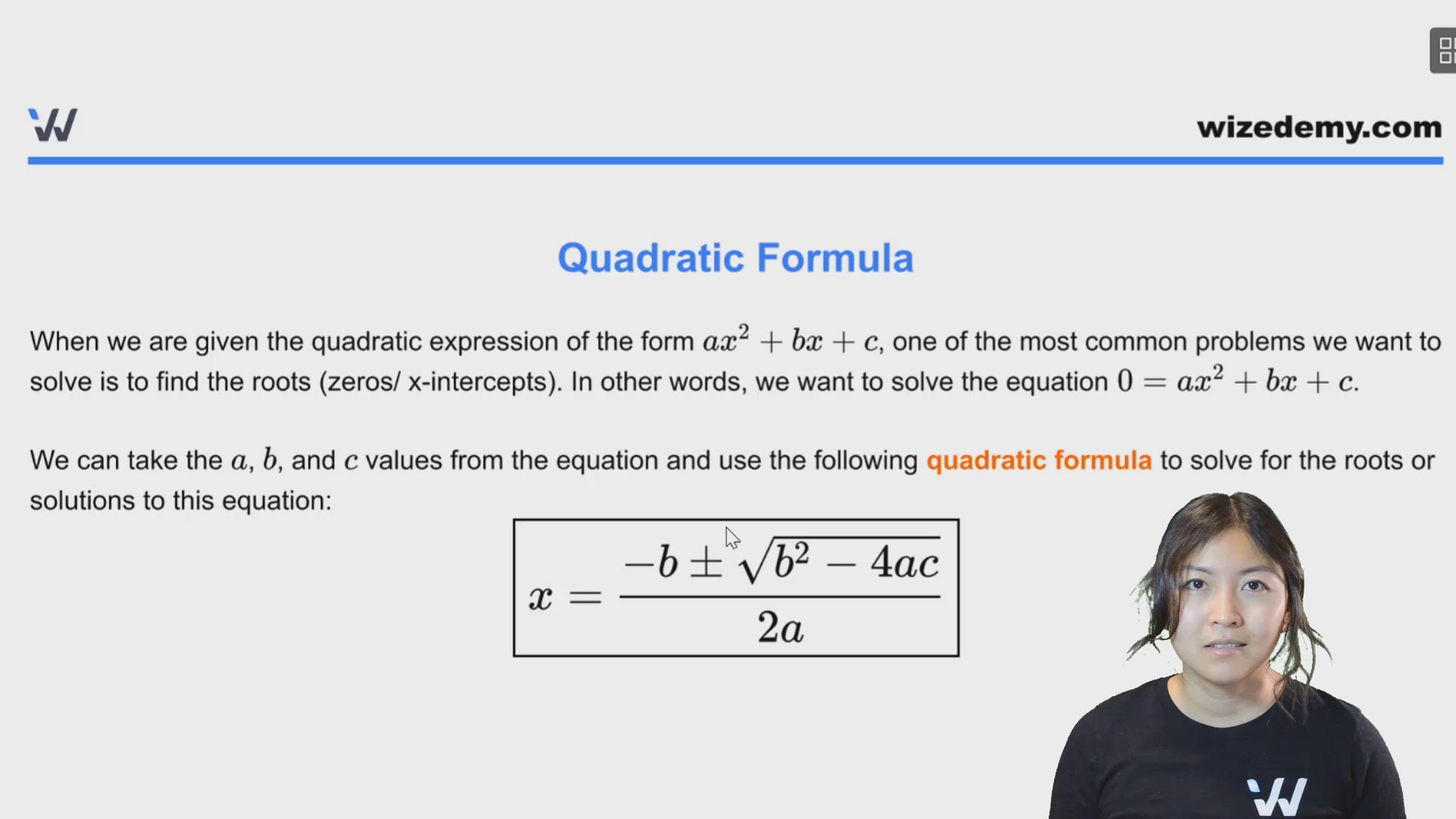
Quadratic Formula

When we are given the quadratic expression of the form ax2+bx+cax^2+bx+c, one of the most common problems we want to solve is to find the roots (zeros/ x-intercepts). In other words, we want to solve the equation 0=ax2+bx+c0=ax^2+bx+c.

We can take the aa, bb, and cc values from the equation and use the following quadratic formula to solve for the roots or solutions to this equation:
x=b±b24ac2a\Large\boxed{x=\dfrac{-b\pm\sqrt{b^2-4ac}}{2a}}

PAGE BREAK

How Did We Come Up With This Formula?

Recall the process for completing the square for 0=ax2+bx+c0=ax^2+bx+c:
  1. Factor aa out of the first 2 terms: 0=a[x2+bax]+c0=\colorbox{yellow}{$a$}\left[x^2+\dfrac{b}{a}x\right]+c
  2. Add and subtract (b2a)2\left(\dfrac{b}{2a}\right)^2: 0=a[x2+bax+(b2a)2(b2a)2]+c0=a\left[x^2+\dfrac{b}{a}x\colorbox{yellow}{$+\left(\dfrac{b}{2a}\right)^2-\left(\dfrac{b}{2a}\right)^2$}\right]+c
  3. Rewrite (factor) the first 3 terms as a perfect square: 0=a[(x+b2a)2(b2a)2]+c0=a\left[\colorbox{yellow}{$\left(x+\dfrac{b}{2a}\right)^2$}-\left(\dfrac{b}{2a}\right)^2\right]+c
  4. Multiply aa into the brackets: 0=a(x+b2a)2a(b2a)2+c0=\colorbox{yellow}{$a$}\left(x+\dfrac{b}{2a}\right)^2-\colorbox{yellow}{$a$}\left(\dfrac{b}{2a}\right)^2+c
  5. Simplify the constant terms: 0=a(x+b2a)2a(b2a)2+c0=a\left(x+\dfrac{b}{2a}\right)^2\colorbox{yellow}{$-a\left(\dfrac{b}{2a}\right)^2+c$}
Now we can solve this equation 0=a(x+b2a)2a(b2a)2+c0=a\left(x+\dfrac{b}{2a}\right)^2-a\left(\dfrac{b}{2a}\right)^2+c!


PAGE BREAK
Move the constant terms to the left side of the equation:
a(b2a)2c=a(x+b2a)2\begin{array}{rcl} a\left(\dfrac{b}{2a}\right)^2-c&=&a\left(x+\dfrac{b}{2a}\right)^2 \end{array}

Divie both sides of the equation by aa:
a(b2a)2aca=a(x+b2a)2a(b2a)2ca=(x+b2a)2\begin{array}{rcl} \dfrac{a\left(\dfrac{b}{2a}\right)^2}{\colorTwo a}-\dfrac{c}{\colorTwo a}&=&\dfrac{a\left(x+\dfrac{b}{2a}\right)^2}{\colorTwo a}\\[1em] \left(\dfrac{b}{2a}\right)^2-\dfrac{c}{a}&=&\left(x+\dfrac{b}{2a}\right)^2\\[1em] \end{array}

Expand and simplify the left side of the equation until we have one fraction on the left:
b24a2ca=(x+b2a)2b24a24ac4a2=(x+b2a)2b24ac4a2=(x+b2a)2\begin{array}{rcl} \dfrac{b^2}{4a^2}-\dfrac{c}{a}&=&\left(x+\dfrac{b}{2a}\right)^2\\[1em] \dfrac{b^2}{4a^2}-\dfrac{4ac}{4a^2}&=&\left(x+\dfrac{b}{2a}\right)^2\\[1em] \dfrac{b^2-4ac}{4a^2}&=&\left(x+\dfrac{b}{2a}\right)^2\\[1em] \end{array}

Take the square root of both sides of the equation:
b24ac4a2=(x+b2a)2\begin{array}{rcl} \sqrt{\dfrac{b^2-4ac}{4a^2}}&=&\sqrt{\left(x+\dfrac{b}{2a}\right)^2}\\[1em] \end{array}

*We end up with both a + and - answer for the square root:
+b24ac4a2=x+b2a+b24ac2a=x+b2aorb24ac4a2=x+b2ab24ac2a=x+b2a\begin{array}{ccc} \begin{array}{rcl} \bct+\dfrac{\sqrt{b^2-4ac}}{\sqrt{4a^2}}&=&x+\dfrac{b}{2a}\\[1em] \bct+\dfrac{\sqrt{b^2-4ac}}{2a}&=&x+\dfrac{b}{2a}\\[1em] \end{array} && \text{or} && \begin{array}{rcl} \bct-\dfrac{\sqrt{b^2-4ac}}{\sqrt{4a^2}}&=&x+\dfrac{b}{2a}\\[1em] \bct-\dfrac{\sqrt{b^2-4ac}}{2a}&=&x+\dfrac{b}{2a}\\[1em] \end{array} \end{array}

Move the constant b2a\dfrac{b}{2a} to the left side:
b2a+b24ac2a=xb + b24ac2a=xorb2ab24ac2a=xb  b24ac2a=x\begin{array}{ccc} \begin{array}{rcl} -\dfrac{b}{2a}\bct+\dfrac{\sqrt{b^2-4ac}}{2a}&=&x\\[1em] \dfrac{-b~\bct+~\sqrt{b^2-4ac}}{2a}&=&x\\[1em] \end{array} && \text{or} && \begin{array}{rcl} -\dfrac{b}{2a}\bct-\dfrac{\sqrt{b^2-4ac}}{2a}&=&x\\[1em] \dfrac{-b~\bct-~\sqrt{b^2-4ac}}{2a}&=&x\\[1em] \end{array} \end{array}

So, we get the formula x=b±b24ac2a\boxed{x=\dfrac{-b\pm\sqrt{b^2-4ac}}{2a}}


Song credit: Pop Goes the Weasel. Licensed under Creative Commons: By Attribution 3.0 License: http://creativecommons.org/licenses/by/3.0/
0:00 / 0:00

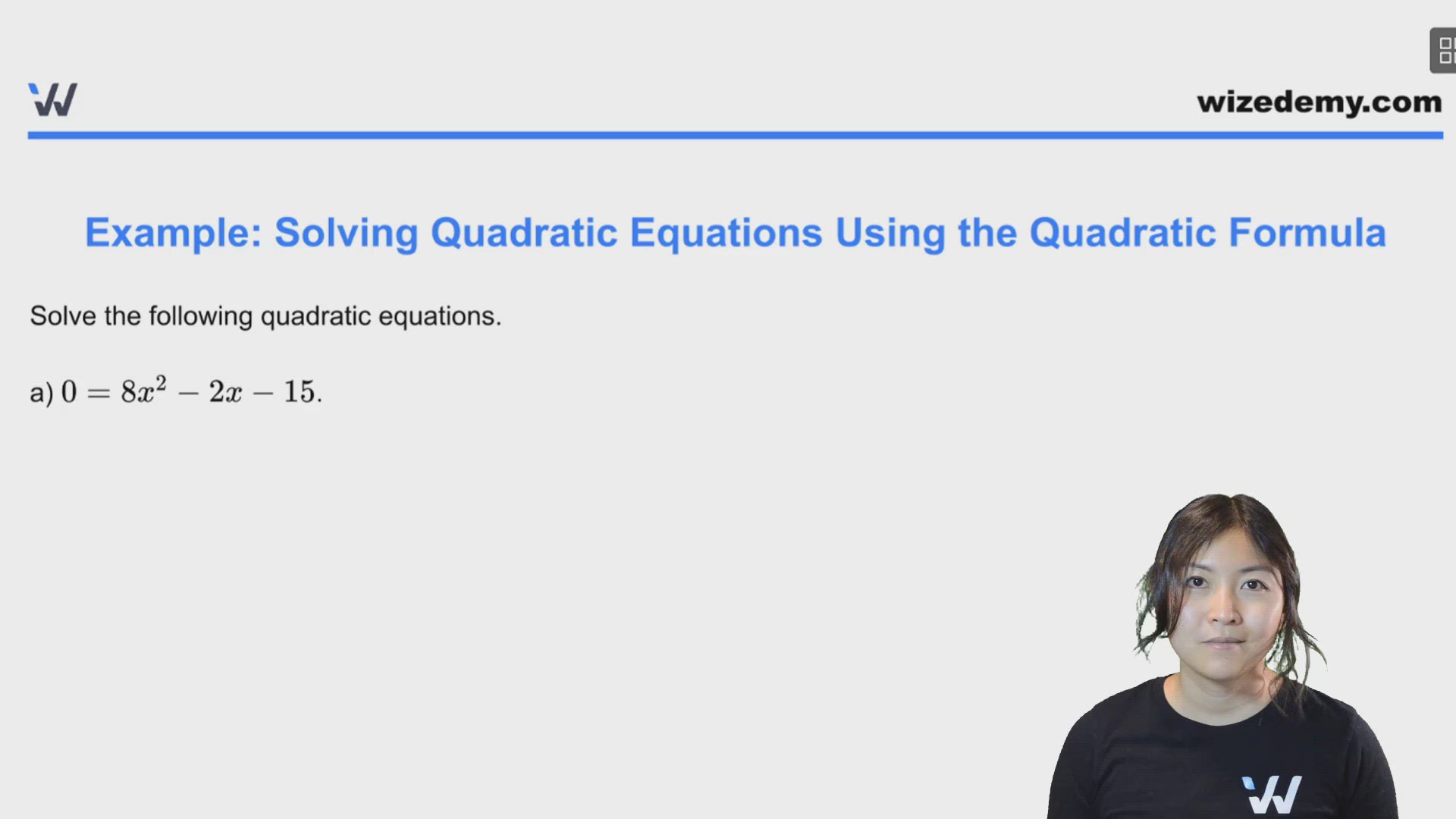
Example: Solving Quadratic Equations Using the Quadratic Formula

Solve the following quadratic equations.

a) 0=8x22x150=8x^2-2x-15.

a=8, b=2, c=15\colorTwo{a=8},~\colorFour{b=-2},~\colorThree{c=-15}

Using the quadratic formula:
x=b±b24ac2a=(2)±(2)24(8)(15)2(8)=2±4+48016=2±48416=2±2216=2+2216  or  42216=2416  or  2016=32  or  54\begin{aligned} x=&\dfrac{-\colorFour{b}\pm\sqrt{\colorFour{b}^2-4\colorTwo{a}\colorThree{c}}}{2\colorTwo{a}}\\[1em] =&\dfrac{-(\colorFour{-2})\pm\sqrt{(\colorFour{-2})^2-4(\colorTwo{8})(\colorThree{-15})}}{2(\colorTwo{8})}\\[1em] =&\dfrac{2\pm\sqrt{4+480}}{16}\\[1em] =&\dfrac{2\pm\sqrt{484}}{16}\\[1em] =&\dfrac{2\pm22}{16}\\[1em] =&\dfrac{2+22}{16}~~\text{or}~~\dfrac{4-22}{16}\\[1em] =&\dfrac{24}{16}~~\text{or}~~\dfrac{-20}{16}\\[1em] =&\boxed{\dfrac{3}{2}~~\text{or}~~-\dfrac{5}{4}} \end{aligned}
Therefore, there are two solutions to this equation x=32x=\dfrac{3}{2} and x=54x=-\dfrac{5}{4}.
PAGE BREAK
b) 3=4x2x+53=4x^2-x+5.

First rearrange so we get 0 on one side: 0=4x2x+20=4x^2-x+2.

a=4, b=1, c=2\colorTwo{a=4},~\colorFour{b=-1},~\colorThree{c=2}

Using the quadratic formula:
x=b±b24ac2a=(1)±(1)24(4)(2)2(4)=1±1328=1±318\begin{aligned} x=&\dfrac{-\colorFour{b}\pm\sqrt{\colorFour{b}^2-4\colorTwo{a}\colorThree{c}}}{2\colorTwo{a}}\\[1em] =&\dfrac{-(\colorFour{-1})\pm\sqrt{(\colorFour{-1})^2-4(\colorTwo{4})(\colorThree{2})}}{2(\colorTwo{4})}\\[1em] =&\dfrac{1\pm\sqrt{1-32}}{8}\\[1em] =&\dfrac{1\pm\sqrt{-31}}{8}\\[1em] \end{aligned}
When we try to find the square root of a negative number with our calculator, we get undefined -- we cannot take the square root of a negative number!

Therefore, there are no solutions to this equation.

Practice: Solving Quadratic Equations Using the Quadratic Formula

Given the equation y=2x210x+12y=2x^2-10x+12,

a) State the a, b, ca,~b,~c values.

b) Write down the quadratic formula.

c) Use the quadratic formula to solve the equation 0=2x210x+120=2x^2-10x+12

Practice: Solving Quadratic Equations Using the Quadratic Formula

Given the equation y=x23x+10y=x^2-3x+10,

a) State the a, b, ca,~b,~c values.

b) Write down the quadratic formula.

c) How many solutions does the equation 10=x23x-10=x^2-3x have?

Practice: Solving Quadratic Equations Using the Quadratic Formula

Given the equation y=6x2+19x36y=6x^2+19x-36,

a) State the a, b, ca,~b,~c values.

b) Write down the quadratic formula.

c) Use the quadratic formula to find the zeros (roots / x-intercepts) of the quadratic equation.

Practice: Solving Quadratic Equations Using the Quadratic Formula.

Solve the equation 0=3x2+5x100=3x^2+5x-10.