Wize High School Grade 10 Math Textbook > Solving Quadratic Equations
Solving Quadratic Equations by Completing the Square
Popular Courses
Grade 10 Math
Canada High School
Algebra I
US High School
DAT
General Course
Grade 10 Principles of Mathematics
Ontario High School
QMS 110
Toronto Metropolitan University
MATH-1980
University of Windsor
MATH 1314
Tarrant County College District
MATH 202
Concordia University
MATH 1148
Ohio State University
MATH 1302
University of Texas at Arlington

0:00 / 0:00
Solving Quadratic Equations by Completing the Square
A quadratic equation can have 1, 2 or 0 solutions.
How to solve by completing the square?
- Complete the square to turn the expression into vertex form
- Solve the equation by using reverse BEDMAS (reverse order of operations)
- Interpret your solutions
*If you need a refresher or extra practice on completing the square, please see the chapter titled "Completing the Square".
Finding the Square Root of
When we take the square root of , we actually get two different answers!
Example 1
To solve , we find the square root of both side, and get . We can check this answer by putting it back into the equation:
However, notice that is also a solution!
We use the symbol to represent a "plus or minus" answer.
So, the solution to is .
Example 2
Solve .
So, could be or .
0:00 / 0:00
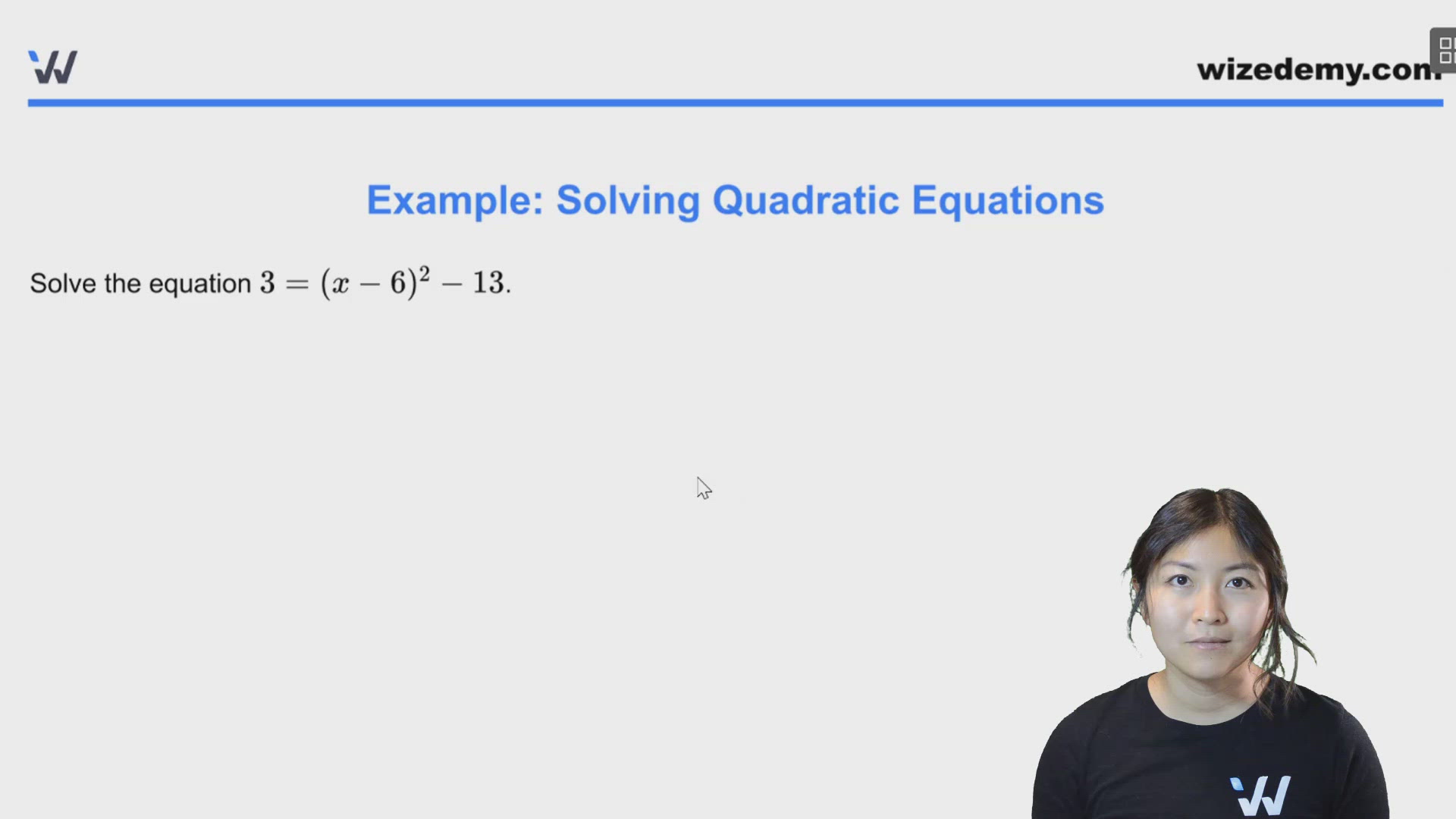
Example: Solving Quadratic Equations
Solve the equation .
So, we get two answers from here:
or
Therefore, the solutions (answers) are or
Let's check our answers:
Practice: Solving Quadratic Equations
Solve the following quadratic equations.
a)
b)
c)
Practice: Solving Quadratic Equations
Solve by first completing the square.
Practice: Solving Quadratic Equations
The height (in feet) of a baseball in the air seconds after it is hit by the bat is given by the equation .
a) What is the maximum height this baseball reaches and when does that occur?
b) When does the ball reach 16 feet?

Practice: Completing the Square
The height of a bungee jumper is given by . Where is the height (in meters) and is the time since the bungee jumper leaves the platform (in seconds). When does the bungee jumper first reach 19 meters?