Solving Polynomial Inequalities Using a Number Line
A polynomial inequality can be solved in similar ways the polynomial equations are solved.
Step 1.
Factor the polynomial.
Step 2.
Identify the x-intercepts and your test points around the x-intercepts to determine where the polynomial exists.
Step 3.
Draw a table & a number line and use the test points around each x-intercept to see if the function is positive or negative.
Step 4.
Express the answer in an appropriate format.
Example
Let's look at the polynomial inequality .
Step 1.
It is already in factored form.
Step 2.
-intercepts:
Test points:
Step 3.
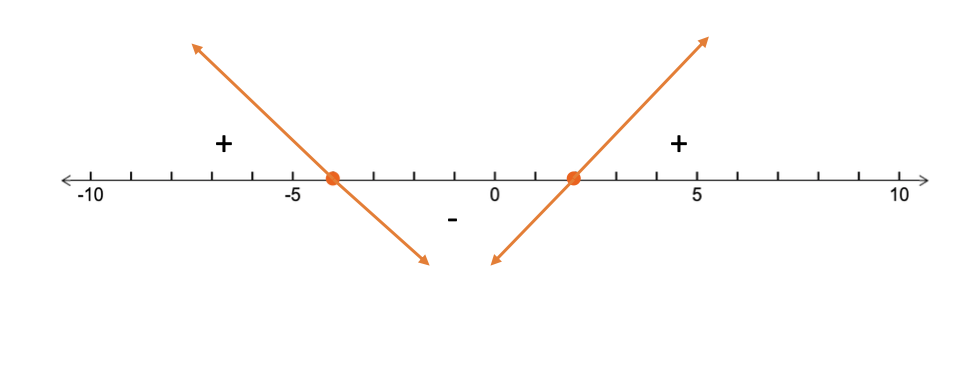
Step 4.
The solution relies on the inequality in the question .
We are looking for the part of the polynomial that lies above 0 (or equals to). Therefore, we want our polynomial to be positive.
The solution is .
Example: Solving Polynomial Inequalities Using a Number Line
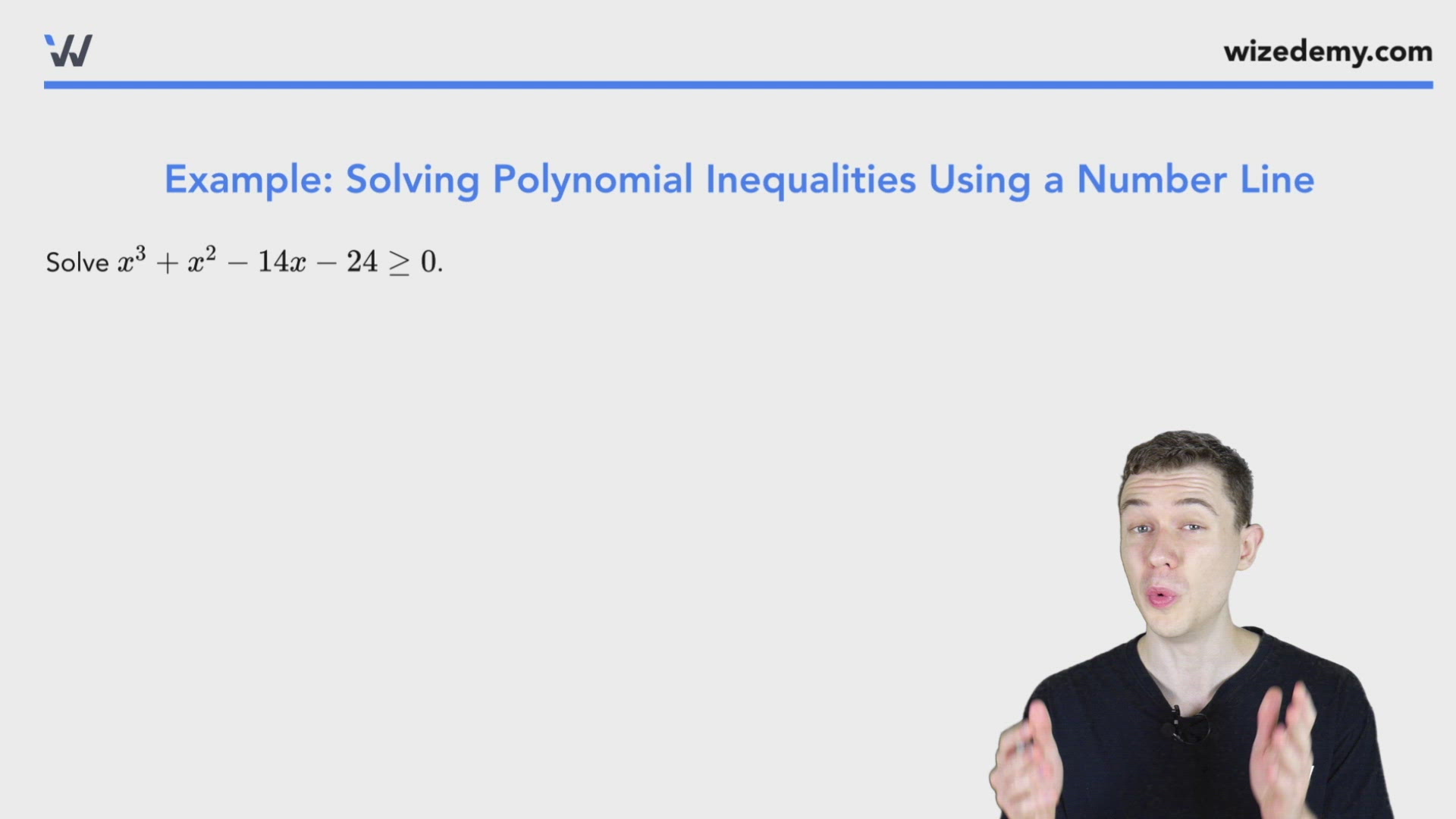
Solve .
Step 1.
Factor using synthetic division.
Let
The quotient becomes .
Our polynomial inequality can be written as .
Step 2.
X-Intercepts:
Test points:
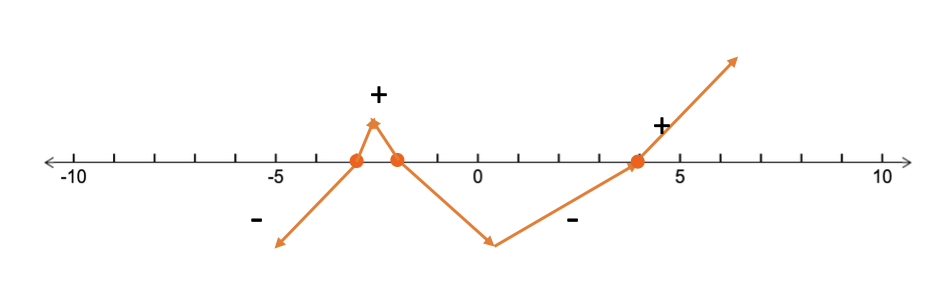
Step 3.
. 
Step 4.
The solution relies on the inequality in the question .
We are looking for the part of the polynomial that lies above 0 (or equals to). Therefore, we want our polynomial to be positive.
The solution is .