Wize High School Grade 11 Math Textbook > Trigonometry
Solving Simple Trig Equations

0:00 / 0:00
Solving Simple Trigonometric Equations
A simple trigonometric equation is in the form:
where is a constant and is a trigonometric function.
Step 1.
Identify what quadrant(s) the angle lies in.
Step 2.
Identify the reference angle.
Step 3.
Solve for the solutions in the appropriate quadrants.
Example
Solve for over the domain .
Step 1.
Identify what quadrant(s) the angle lies in.
Since , then is in quadrants 1 and 4 by the CAST rule.
Step 2.
Identify the reference angle.
, and the side-lengths of 1 and 2 appear in the triangle:

The reference angle is .
Step 3.
Solve for the solutions in the appropriate quadrants.
Quadrant 1 (the principal angle is the same as our reference angle):
Quadrant 4 (almost a full circle -- the reference angle completes the circle):
Therefore, the solutions are
0:00 / 0:00
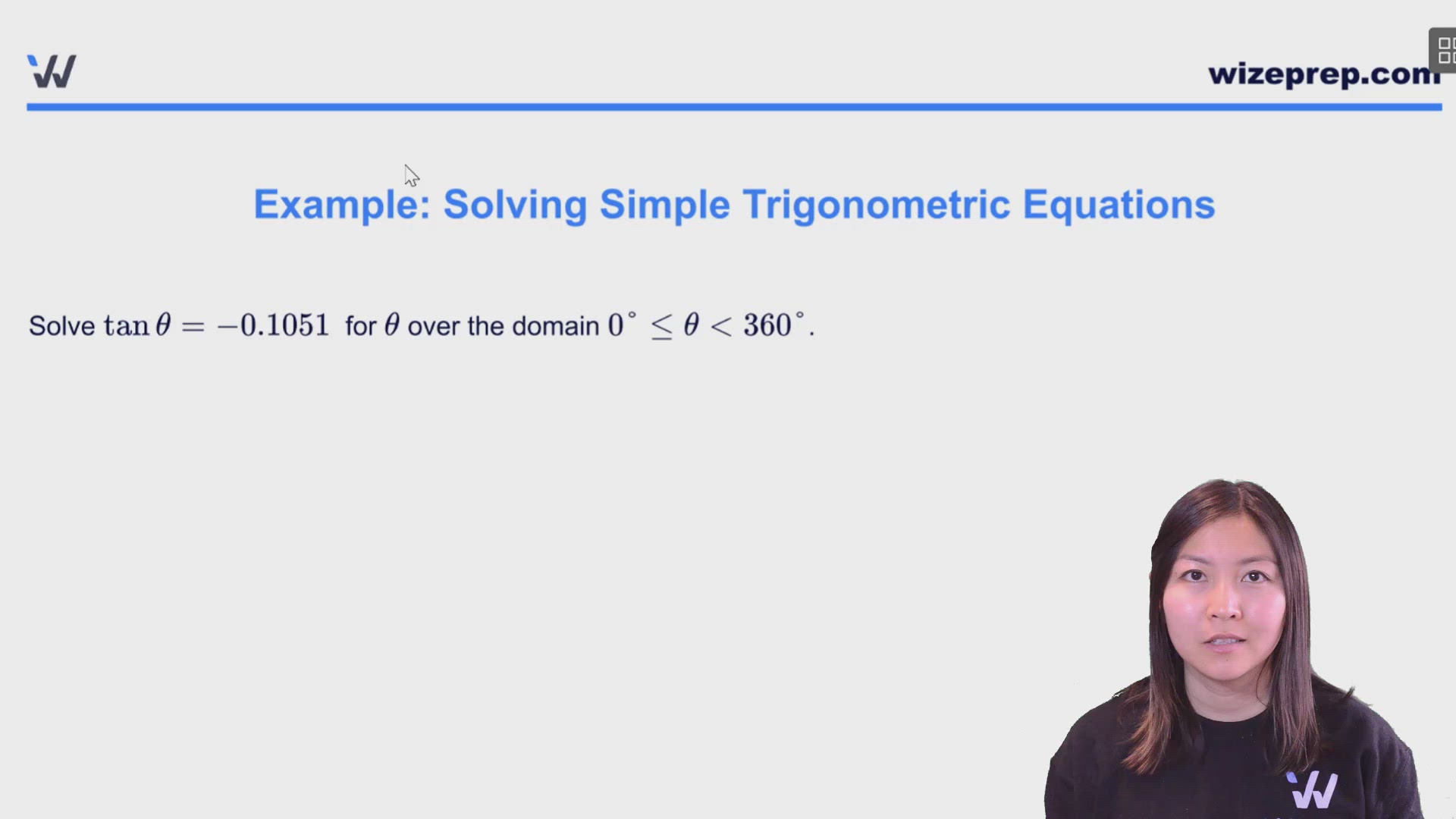
Example: Solving Simple Trigonometric Equations
Solve for over the domain .
Step 1.
Since is negative, is in quadrants 2 and 4 by the CAST rule.
Step 2.
We can't use a special triangle since we don't know anything that relates to .
Instead, solve for the reference angle using the inverse:
So the reference angle must be .
(The negative sign just means it is measured clockwise from the positive x-axis, but it doesn't change how we complete the question).
Step 3.
Quadrant 2 -- almost a semi-circle; the reference angle completes the half-circle:
Quadrant 4 -- almost a full circle; the reference completes the circle:
Practice: Solving Simple Trigonometric Equations
Solve over the domain .
Practice: Solving Simple Trigonometric Equations
Solve for all possible values of between and such that .
0:00 / 0:00
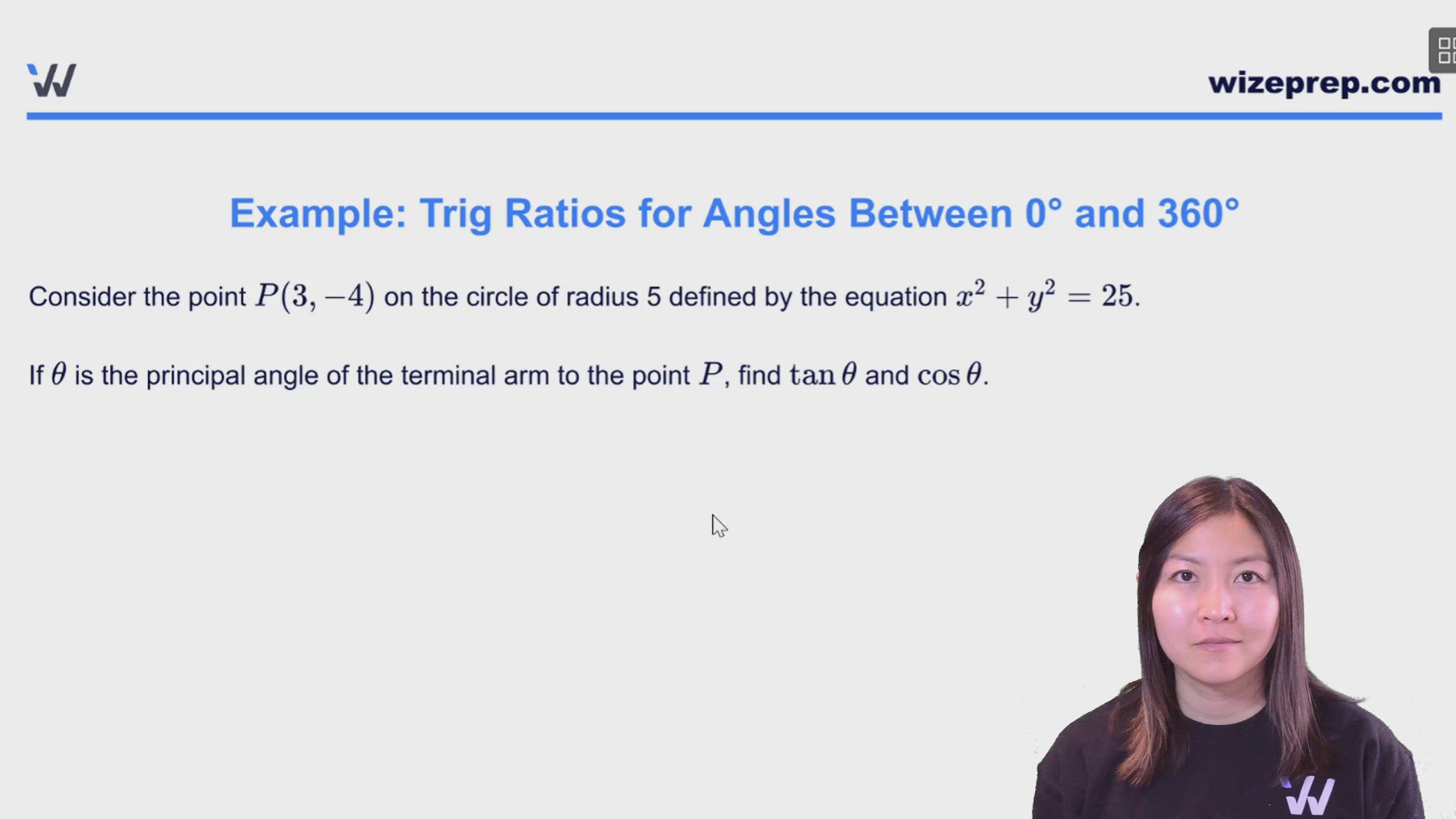
Example: Trig Ratios for Angles Between 0° and 360°
Consider the point on the circle of radius 5 defined by the equation .
If is the principal angle of the terminal arm to the point , find and .
See video solution for "shorter method" for finding and .
Here's the full written solution:
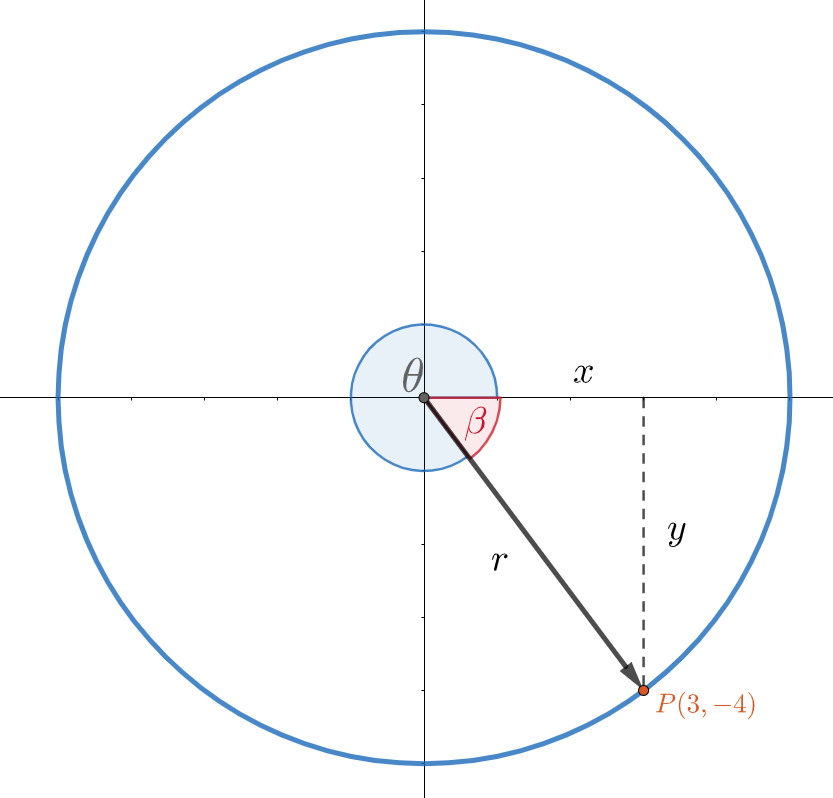
1. We can graph the point and draw the terminal arm.
In the image, .
2. We first find the reference angle using to relate and . [Keep all side-lengths positive at this step]
3. The principal angle is almost a full circle , and the reference angle completes the rest of the circle:
4. By the Pythagorean Theorem:
5. Trig ratios of are the same as trig ratios of , except possibly for the sign (+/-).
By the CAST rule, since we are in quadrant 4 (C), only Cosine is positive.
Therefore, and
Practice: Trig Ratios for Angles Between 0° and 360°
Suppose and for some angle between and .
Determine the other two primary trigonometric ratios. [Make sure your answers are exact values]